
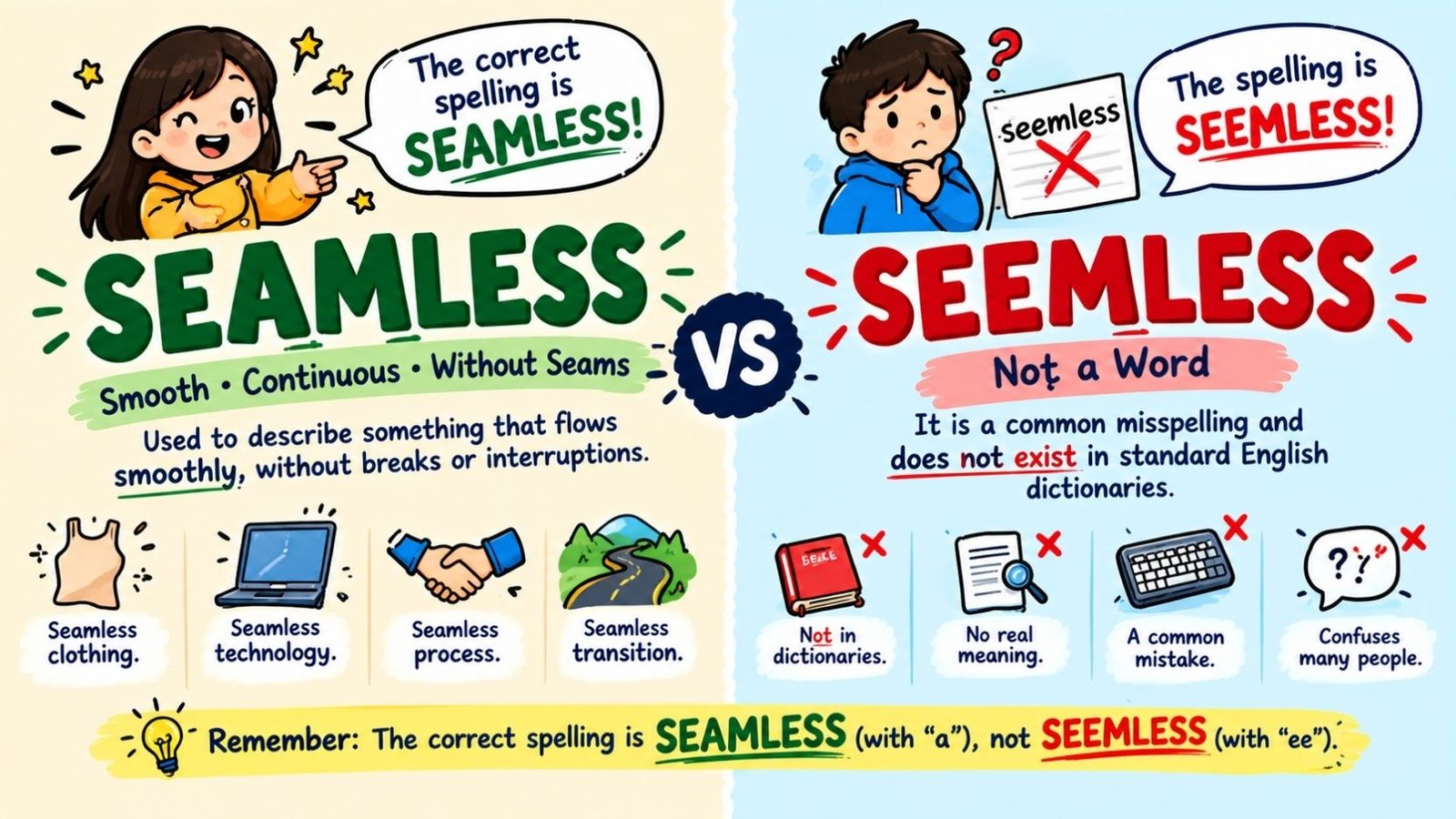
Seamless is the correct spelling. Seemless is a common misspelling that many people type by mistake, often because it sounds close to the word “seem.” If you have ever paused mid-sentence wondering whether to write seemless or seamless, the short answer is simple: always choose seamless.
This word describes something that flows smoothly, without breaks, joins, or interruptions. It started as a literal description of fabric with no visible seams, and today it is used just as often for experiences, transitions, technology, and processes that feel effortless. Understanding why seamless is correct, and why seemless keeps appearing anyway, makes the spelling much easier to remember for good.
Knowing the right form matters for more than just spelling tests. Seamless shows up constantly in business writing, product descriptions, resumes, and everyday conversation. Using the wrong version in an email, an article, or a job application can make writing look careless, even when the meaning is clear.
Once you understand where the confusion comes from, the correct spelling becomes automatic. This guide breaks down the meaning, the grammar, the pronunciation, the origin, and the small but persistent mistake that leads so many people to search for seemless or seamless in the first place.
What Does Seamless Mean?
Seamless means smooth, continuous, and free of any visible joins, gaps, or interruptions. It describes something that works or flows so well that you cannot notice where one part ends and another begins.
The word covers two related ideas, depending on context.
Literal meaning
In its original and most literal sense, seamless describes fabric, clothing, or material made without seams. A seamless garment is stitched or manufactured so that there is no visible line where two pieces of fabric join together.
Read More: Speach Or Speech
Figurative meaning
In everyday and professional use, seamless almost always describes something abstract rather than physical fabric. A seamless transition, a seamless process, or a seamless experience is one that happens smoothly, without friction, delay, or noticeable effort.
| Context | What Seamless Means | Typical Example |
| Clothing or fabric | No visible seam or stitched joint | A seamless pair of leggings |
| Technology | Systems or software that work together without glitches | A seamless login across devices |
| Business or process | A transition or workflow with no disruption | A seamless handover between teams |
| Everyday experience | Something that feels effortless | A seamless morning commute |
Is Seemless A Word?
No, seemless is not a real word. It does not appear in any major dictionary, and it has no accepted meaning of its own. It is simply a misspelling of seamless.
The confusion is understandable. The word “seem” is common, and many people unconsciously connect seamless to the idea of something that “seems” a certain way. In reality, seamless has nothing to do with the verb seem. It comes from the noun “seam,” referring to the line where two pieces of material are joined.
💡 Tip: If you are ever unsure, think of a seam in a piece of clothing. Seamless simply means without that seam.
Seamless or Seemless: Quick Comparison
| Spelling | Correct? | Meaning |
| Seamless | Yes | Smooth, continuous, without interruption or visible joins |
| Seemless | No | Common misspelling with no dictionary meaning |
There is no situation, formal or informal, American or British, where seemless is the accepted spelling. Every dictionary, style guide, and professional editor treats seamless as the only correct form.
Seamless Grammar: Part of Speech and Word Forms
Seamless is an adjective. It describes a noun by telling you that the noun is smooth, continuous, or free of visible joins.
Example sentences as an adjective:
- The team managed a seamless launch of the new app.
- She wore a seamless dress with no visible stitching.
- Their customer service offers a seamless experience from start to finish.
Related word forms
Seamless has a small family of related words, each with a specific grammatical role.
| Word | Part of Speech | Example |
| Seamless | Adjective | The update was seamless. |
| Seamlessly | Adverb | The two systems worked seamlessly together. |
| Seamlessness | Noun | The seamlessness of the design impressed everyone. |
Notice that “seemless” has no correct adverb or noun form either, since it is not a real word to begin with. Only seamless, seamlessly, and seamlessness are grammatically valid.
How To Pronounce Seamless
Seamless is pronounced SEEM less, with the stress on the first syllable.
- Simple pronunciation: SEEM less
- IPA: /ˈsiːm.ləs/
The first part of the word sounds exactly like the word “seem,” which is very likely the reason so many people mistakenly spell it seemless. The pronunciation matches “seem,” but the correct spelling is built from “seam,” not “seem.” This mismatch between sound and spelling is the main root of the confusion.
There is no meaningful difference in pronunciation between American and British English for this word. Both use the same SEEM less sound.
Origin Of Seamless
The word seamless comes directly from the noun “seam,” combined with the suffix “less,” meaning without.
A seam, in its original sense, is the line formed when two pieces of fabric, metal, wood, or other material are joined together, often by stitching, welding, or bonding. The word seam traces back to Old English “seam,” related to the verb “to sew.”
Add the suffix “less,” and seamless literally means without a seam, or without a visible joint.
Over time, the word expanded beyond fabric and construction. As industries like technology, business, and customer service grew, writers began using seamless to describe any process or experience that felt smooth and uninterrupted, even when no physical seam was involved. This figurative use is now the most common way people encounter the word today.
Read More: Cudos Or Kudos
Seamless In Different Contexts
The word adapts naturally to many situations, but the core meaning stays the same: smooth, connected, and free of noticeable breaks.
Seamless In clothing
This is the word’s original home. Seamless underwear, seamless bras, and seamless leggings are designed and manufactured without stitched seams, which reduces visible lines and can improve comfort against the skin. Brands frequently market seamless socks, seamless panties, and seamless bodysuits for this reason.
Seamless In technology
A seamless login means signing into an app or website works instantly, without extra steps or errors. Seamless integration between two pieces of software means they work together smoothly, without the user noticing any friction.
Seamless In business
A seamless transition often describes a smooth change in leadership, ownership, or process, one that does not disrupt daily operations. A seamless handover between employees or teams means information and responsibilities transfer cleanly.
Seamless In everyday conversation
People often say an experience felt seamless when everything simply worked, from a smooth flight connection to an easy customer service call.
Seamless As A brand name
Some readers searching seemless or seamless are actually thinking of specific products or companies that use the word, such as food delivery services, AI research tools, or gutter installation companies. These are proper nouns and brand names, so their exact spelling depends on the company itself, but the general English word remains seamless.
Examples Of Seamless In A Sentence
A few clear examples make the meaning easier to remember than a long list of repetitive ones.
- The company promised a seamless transition after the merger, and employees barely noticed any change in their daily routine.
- Her seamless leggings felt smooth and comfortable, with no visible stitching at all.
- Thanks to the new software update, switching between devices now feels completely seamless.
Common Mistakes With Seemless or Seamless
Even confident writers slip up with this word. Here are the most frequent mistakes, along with the correct version.
❌ Incorrect: The onboarding process was seemless from start to finish.
✅ Correct: The onboarding process was seamless from start to finish.
❌ Incorrect: We aim to provide a seemless customer experience.
✅ Correct: We aim to provide a seamless customer experience.
❌ Incorrect: These socks are advertised as seemless and comfortable.
✅ Correct: These socks are advertised as seamless and comfortable.
Why does the correct form work? Seamless is built from “seam” plus “less.” There is no root word “seem” hiding inside it, even though the pronunciation makes that connection feel natural. Once you remember the word comes from fabric seams, the correct spelling becomes much easier to recall.
⚠️ Common mistake: Autocorrect on some devices will not always catch “seemless” as an error, since it can resemble a plausible English word. Always double-check manually, especially in professional writing like resumes, emails, and reports.
Seamless Synonyms And Related Words
Several words share meaning with seamless, though each carries a slightly different shade of usage.
| Word | Meaning | Difference From Seamless |
| Smooth | Free from difficulty or roughness | Broader term, not limited to transitions or joins |
| Effortless | Requiring little or no effort | Focuses on ease rather than continuity |
| Continuous | Uninterrupted in time or space | Emphasizes duration more than smooth connection |
| Uninterrupted | Not stopped or broken | Focuses on the absence of interruption specifically |
| Fluid | Flowing smoothly and easily | Often used for movement or style, not just process |
Seamless is unique because it specifically implies that separate parts or steps blend so well that no divide is noticeable. Smooth and effortless are close in meaning but do not carry that same idea of hidden joints or invisible transitions.
Antonyms of seamless include choppy, disjointed, broken, and interrupted. These words describe experiences or processes with noticeable gaps or rough transitions, the opposite of what seamless describes.
Seemless or Seamless: Which Should You Use In Formal Writing?
Always use seamless in formal writing, including resumes, business reports, academic papers, and professional emails. Since seemless is not a recognized word, using it in formal contexts can suggest carelessness or a lack of proofreading, even if the intended meaning is obvious to the reader.
In informal writing, such as texting or casual social media posts, misspelling the word will not cause serious harm, but it also offers no benefit. Since seamless is not harder to type or remember once you understand its origin, there is no real reason to use seemless anywhere.
Read More: Losing Or Loosing
Frequently Asked Questions
Is it seemless or seamless?
It is seamless. Seemless is a common misspelling with no accepted dictionary meaning.
What does seamless mean?
Seamless means smooth, continuous, and free of visible joins or interruptions. It can describe fabric without stitched seams or a process that flows without noticeable breaks.
Why do people spell it seemless?
The word is pronounced SEEM less, which sounds like the common word “seem.” This pronunciation leads many people to assume the spelling starts with “seem,” even though the correct root is “seam.”
Is seamless a noun or an adjective?
Seamless is an adjective. It describes a noun, such as an experience, a garment, or a transition, as smooth and continuous.
What is the adverb form of seamless?
The adverb form is seamlessly, used to describe how an action happens, as in “the two teams worked seamlessly together.”
What are good synonyms for seamless?
Common synonyms include smooth, effortless, continuous, uninterrupted, and fluid, depending on the context.
Does seamless have a different meaning in clothing?
In clothing, seamless refers specifically to garments made without visible stitched seams, often for added comfort and a smoother appearance under other clothes.
Is seamless used the same way in British and American English?
Yes. Both British and American English use the same spelling, meaning, and pronunciation for seamless. There is no regional variation for this word.
Can seemless ever be correct in any context?
No. Seemless is never correct in standard English, regardless of formality, region, or context. It should always be corrected to seamless.
Final Thoughts
Seamless is the only correct spelling, and it describes something that flows smoothly without visible breaks, joins, or interruptions, whether that means a piece of clothing sewn without seams or a business process that runs without friction. Seemless, despite how often it appears in searches and casual writing, is simply a misspelling shaped by the way the word sounds rather than how it is actually built.
Remembering that seamless comes from “seam” plus “less” makes the correct spelling much easier to hold onto for good. The next time you are deciding between seemless or seamless, picture a piece of fabric with no seam at all, and the right word will come naturally.

Zunaira Qasim is the author and creator of Gramvixo, dedicated to making English grammar easier for learners and everyday writers. With 4 years of experience researching grammar, confusing words, word choices, and common language mistakes, they create clear and practical content that helps readers understand English and use it with confidence.
One Comment