
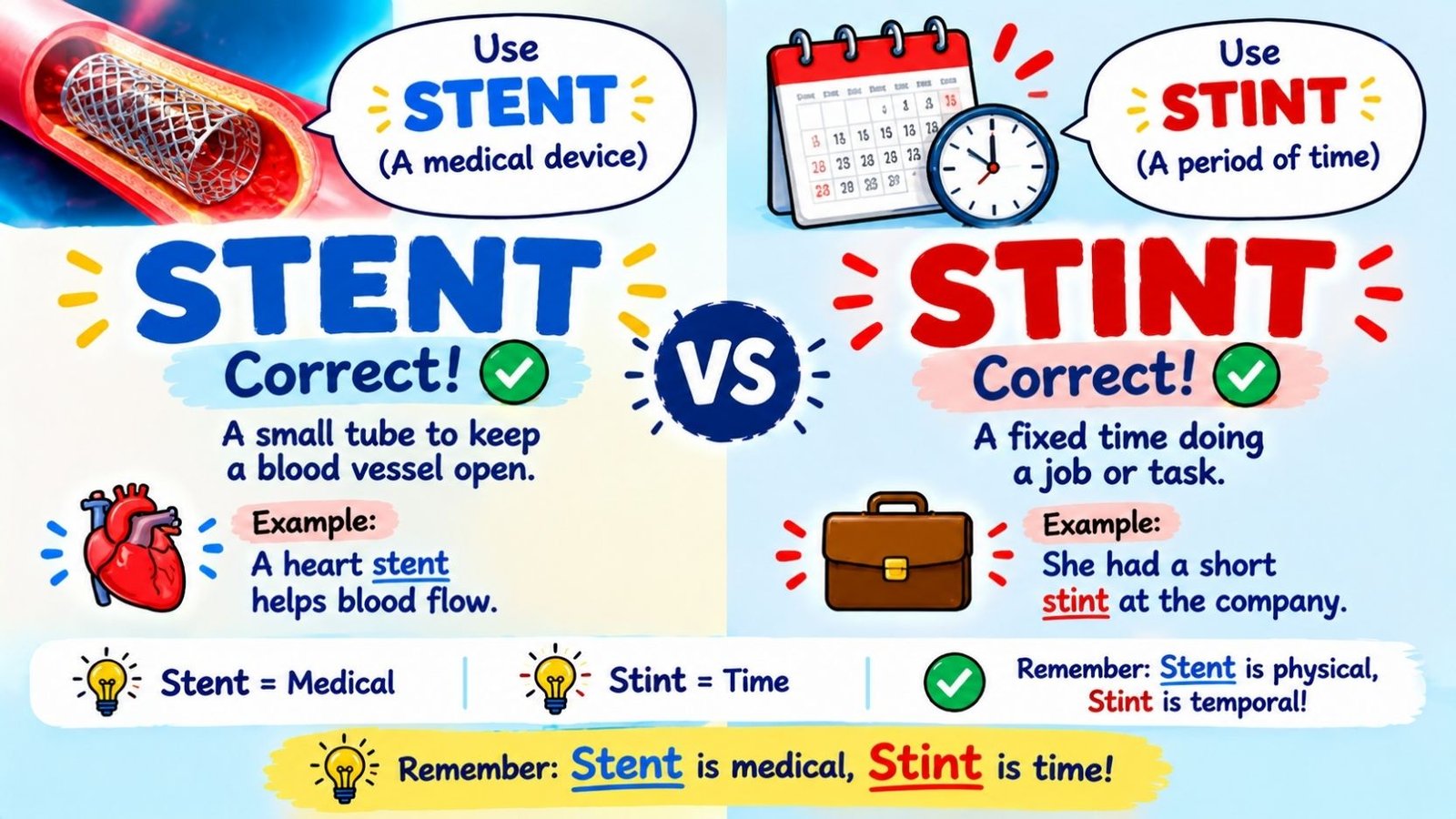
Many readers search for “stent” vs “stint” because the two words sound alike but mean completely different things. A stent is a small medical device placed inside the body to keep a blood vessel or duct open. A stint is a fixed period of time spent doing a specific job, task, or activity. Understanding this difference matters most when you are reading medical information or talking about someone’s work history.
Confusing these two words is a very common mistake, especially in casual writing or when typing quickly. The mix-up usually happens because stent and stint differ by only one letter and share a similar sound. Doctors, patients, sports writers, and job seekers all use these words often, sometimes without realizing the difference. This guide breaks down the meaning, grammar, pronunciation, and correct usage of both words clearly.
Stent Vs Stint: The Simple Definition
Here is the direct answer before anything else.
| Word | Simple Meaning | Word Type |
| Stent | A small medical tube or mesh device inserted into a blood vessel or duct to keep it open | Noun |
| Stint | A set period of time spent doing a task, job, or activity | Noun and verb |
A stent is something a doctor places inside your body. A stint is something you do or complete, usually related to time or work. Once you remember that a stent is physical and a stint is temporal, the confusion mostly disappears.
Read More: Layed Vs Laid
What Is A Stent?
A stent is a small tube, often made of metal mesh or a flexible material, placed inside a blood vessel, artery, or duct in the body. Its job is simple: hold the passage open so blood, urine, or other fluids can flow properly. Doctors typically insert a stent during a minimally invasive procedure rather than open surgery.
Stents are most commonly discussed in two medical contexts: the heart and the kidneys.
Heart Stent
A heart stent, sometimes called a cardiac stent, is placed inside a coronary artery. This is usually done after the artery has narrowed due to plaque buildup, a condition known as atherosclerosis. The stent props the artery open so blood can reach the heart muscle normally again.
The procedure is often paired with angioplasty, a technique that uses a small balloon to widen the artery before the stent is placed. This is why people frequently search for angioplasty vs stent, since the two procedures usually happen together rather than separately. Angioplasty widens the artery, and the stent keeps it open long term.
Kidney Stent
A kidney stent, more precisely called a ureteral stent, is placed in the ureter. The ureter is the thin tube that carries urine from the kidney to the bladder. Doctors use a ureteral stent when the ureter is blocked, often by a kidney stone, swelling, or scar tissue.
People who search how to sleep with a kidney stent are usually looking for comfort tips during recovery. Common recommendations include sleeping on the side opposite the stent, using a pillow for support, and staying well hydrated. Always follow guidance from your own doctor, since recovery details vary by individual case.
💡 Tip: If you notice fever, chills, or severe pain after stent placement, these can be signs of a ureteral stent infection, and you should contact your doctor promptly.
What Is A Stint?
A stint is a defined period of time spent doing a particular activity, job, or role. It usually implies a temporary or limited duration, not a permanent commitment. The word can function as a noun or, less commonly, as a verb.
Here are a few natural examples.
- She completed a two-year stint at the marketing firm before starting her own business.
- He had a brief coaching stint with the team last season.
- The humorist who describes his stint in the army often uses humor to soften difficult memories.
You will often see stint paired with a specific role or timeframe, such as a coaching stint, a work stint, or a military stint. News articles frequently use this word when summarizing someone’s career history. For example, a piece about DeAndre Hopkins’s Patriots coaching stint would describe a limited period spent in that specific coaching role.
Stint As A Verb
Stint can also work as a verb, though this usage is less common today. As a verb, it means to limit or be sparing with something.
Example: She did not stint on the ingredients when baking the cake, meaning she used them generously rather than sparingly.
This verb form appears mostly in formal or older writing, so most readers will encounter stint as a noun far more often.
Stent Vs Stint: Side by Side Comparison
| Feature | Stent | Stint |
| Category | Medical device | Period of time or activity |
| Part of speech | Noun | Noun, sometimes verb |
| Common context | Heart, kidney, arteries | Jobs, sports, military service |
| Physical or abstract | Physical object | Abstract concept of time |
| Example sentence | The cardiologist inserted a stent to open the artery | He finished his stint as team captain last year |
This table captures the core distinction. A stent is something a doctor places inside your body during a procedure. A stint is something a person completes over a stretch of time, often related to a job or role.
Grammar Breakdown
Both words are common nouns, meaning they refer to general things rather than specific names.
Stent
- Singular: stent
- Plural: stents
- Usage: “He needed a stent,” or “Doctors placed two stents.”
Stint
- Singular: stint
- Plural: stints
- Usage: “She had a short stint,” or “He completed several stints over the years.”
Neither word requires capitalization unless it begins a sentence or appears in a title. Both words follow standard English pluralization rules, simply adding an s.
Read More: Favourites Or Favorites
How To Pronounce Stent And Stint
Pronunciation is another reason these words get mixed up, since they differ by a single vowel sound.
- Stent is pronounced STENT, rhyming with “went” or “bent.”
- Stint is pronounced STINT, rhyming with “hint” or “mint.”
The vowel sound is the only real difference. Stent uses a short “e” sound, like in “bed.” Stint uses a short “i” sound, like in “sit.”
Saying both words aloud a few times often helps readers remember the difference permanently.
Word Origin
Understanding where each word comes from can make the difference easier to remember.
Stent comes from the name of Charles Thomas Stent, a nineteenth-century English dentist. He developed a compound originally used for dental molds, and later medical researchers adapted the term for the tubular devices used in modern medicine. The word has been used in its current medical sense since the mid-twentieth century.
Stint comes from Old English, originally meaning to make short or to limit. Over time, this meaning shifted toward describing a fixed, limited period of time or duty. This origin explains why stint still carries a sense of something temporary or bounded, rather than permanent.
Common Mistakes To Avoid
Mixing up stent and stint is easy to do, especially while typing quickly or speaking casually.
❌ Incorrect: He had a heart stint last year.
✅ Correct: He had a heart stent last year.
❌ Incorrect: She completed a two year stent at the company.
✅ Correct: She completed a two year stint at the company.
❌ Incorrect: The doctor recommended a stint for his narrowed artery.
✅ Correct: The doctor recommended a stent for his narrowed artery.
A simple memory trick: stent starts with the same letters as “steel tube,” reminding you it is a physical device. Stint rhymes with “print,” and a printed schedule reminds you it relates to a fixed period of time.
Is It Stunt, Stint Or Stent?
Some readers also search stunt vs stint, adding a third word into the confusion.
- Stunt refers to a dangerous or skillful physical act, often in movies or sports.
- Stint refers to a period of time doing an activity.
- Stent refers to a medical device.
These three words share similar sounds but completely different meanings, so context is the best way to identify which one applies in a sentence.
Stent Vs Shunt: A Related Comparison
Another word people sometimes confuse with stent is shunt, since both are medical devices.
A stent holds a vessel or duct open from the inside, usually shaped like a small mesh tube. A shunt is a tube that creates a new pathway, redirecting fluid from one area of the body to another, such as in cases of hydrocephalus. While both are medical implants, they serve different structural purposes.
Synonyms And Related Words
| Word | Meaning | Difference From Stent or Stint |
| Shunt | A tube redirecting fluid | Creates a new path rather than holding one open |
| Graft | A section of tissue or material used to repair a vessel | Often replaces tissue rather than propping it open |
| Tenure | A period of holding a position | Similar to stint but often implies permanence or formal status |
| Term | A fixed period of time in a role | Very close to stint, though often used in political or academic contexts |
These related words help clarify subtle differences in meaning, especially for readers researching medical or professional terminology.
How Long Does A Stent Stay In?
Many readers also ask how long a stent should stay in the body.
- Coronary stents used for heart arteries are typically permanent, remaining in place for life once inserted.
- Ureteral stents used for kidney issues are usually temporary, often removed within a few weeks to a few months depending on the reason for placement.
Recovery time and stent duration always depend on the specific medical situation, so patients should follow their doctor’s individual guidance rather than general timelines.
Little Stint: A Different Kind of Meaning
Interestingly, “little stint” is also the name of a small wading bird found in parts of Europe, Asia, and Africa. In this context, stint is not describing a period of time at all, but functions as part of the bird’s common name. This is a good reminder that word meanings can shift entirely depending on subject matter and context.
Read More: Thier Or Their
Frequently Asked Questions
What is the difference between a stint and a stent?
A stent is a medical device placed inside the body to keep a vessel open, while a stint is a period of time spent doing a job or activity.
Is stent a noun or a verb?
Stent is a noun. It is not commonly used as a verb.
Is stint a noun or a verb?
Stint most commonly functions as a noun, though it can occasionally be used as a verb meaning to limit or be sparing.
How do you pronounce stent and stint?
Stent rhymes with “went,” using a short “e” sound. Stint rhymes with “hint,” using a short “i” sound.
What is a heart stent?
A heart stent, or cardiac stent, is a small device placed inside a coronary artery to keep it open after it has narrowed due to plaque buildup.
What is a kidney stent used for?
A kidney stent, called a ureteral stent, keeps the ureter open so urine can flow from the kidney to the bladder, often after a blockage from a kidney stone.
How long can a stent stay in the body?
Heart stents are usually permanent, while kidney stents are often temporary and removed after a few weeks or months.
What are signs of a ureteral stent infection?
Common signs include fever, chills, pain during urination, and increased discomfort near the kidney or bladder area.
Is it correct to say stint or stent when talking about a job?
Stint is correct for describing a period of time in a job, such as “a two year stint.” Stent would be incorrect in this context.
What does angioplasty vs stent mean?
Angioplasty is a procedure that widens a narrowed artery using a small balloon, while a stent is the device placed afterward to keep the artery open long term.
Final Thoughts
Stent and stint may look and sound almost identical, but their meanings sit in completely different worlds. A stent is a physical medical device, most often associated with the heart or kidneys, designed to keep a passage open. A stint, on the other hand, describes a limited stretch of time spent in a job, role, or activity, with no medical connection at all.
Remembering the vowel sound is the easiest trick: stent has an “e” like in “medical,” while stint has an “i” like in “time limit.” Whether you are researching a health procedure or writing about someone’s career history, choosing the correct word ensures your meaning comes through clearly and accurately.

Zunaira Qasim is the author and creator of Gramvixo, dedicated to making English grammar easier for learners and everyday writers. With 4 years of experience researching grammar, confusing words, word choices, and common language mistakes, they create clear and practical content that helps readers understand English and use it with confidence.


One Comment