
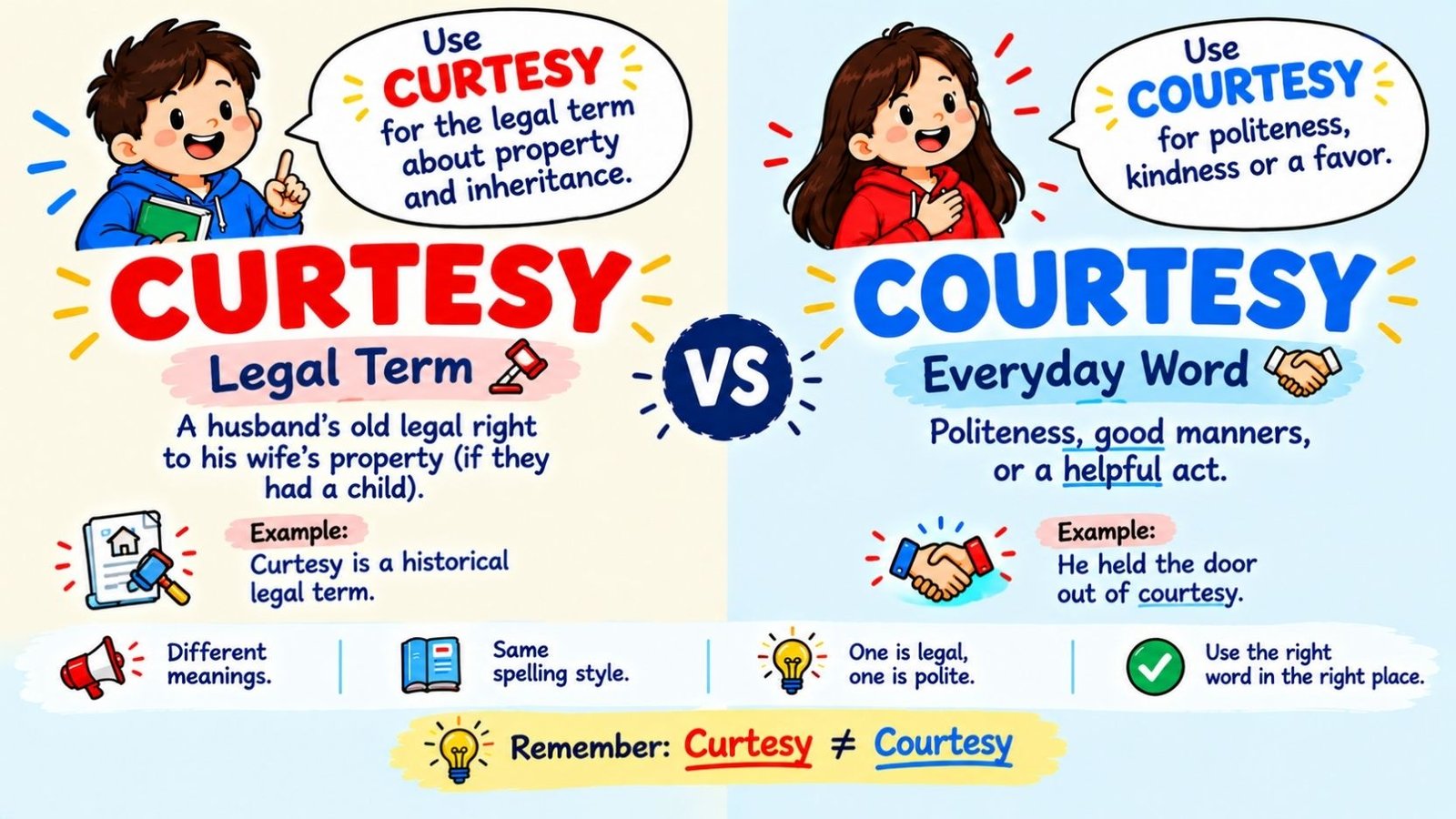
Curtesy and courtesy sound almost identical, but they mean completely different things. Courtesy is the everyday word for politeness or kindness. Curtesy is a specific legal term tied to old property and inheritance law.
Most people typing “curtesy” actually mean “courtesy.” That single letter swap changes the meaning entirely. This guide breaks down both words clearly, so you always use the right one in the right place.
What Does Courtesy Mean?
Courtesy is the word you already know and use often. It refers to polite behavior, respect, or a small favor extended out of kindness rather than obligation.
Simple definition: Courtesy means politeness, good manners, or a considerate act toward another person.
Courtesy shows up constantly in everyday language:
- “He held the door out of courtesy.”
- “Please show some courtesy to your coworkers.”
- “The hotel offered a courtesy shuttle to the airport.”
It also appears in set phrases where it means “provided free” or “as a favor,” such as a courtesy call, courtesy car, or courtesy copy.
Read More: Finaly Or Finally
What Does Curtesy Mean?
Curtesy is a narrow legal term. It has nothing to do with manners or politeness, despite looking like a simple misspelling of courtesy.
Simple definition: Curtesy refers to a husband’s historical right, under common law, to a life estate in his deceased wife’s real property, provided the couple had a child capable of inheriting it.
According to Merriam-Webster, curtesy is a husband’s interest upon the death of his wife in the real property of an estate that she either solely owned or inherited, provided they bore a child capable of inheriting the estate. Cornell Law School’s legal dictionary describes it more plainly: curtesy is an outdated term that refers to the portion of an estate a husband is entitled to upon the passing of their spouse.
This right applied automatically in earlier centuries. If a wife owned land and the couple had a child, the husband gained a life interest in that land once she died, even if she left no will naming him.
Curtesy Vs Courtesy: Quick Comparison
| Word | Part Of Speech | Meaning | Common Use |
| Courtesy | Noun | Politeness, respect, a free favor | Everyday speech, business, etiquette |
| Curtesy | Noun | A husband’s historic legal right to his late wife’s property | Legal and historical writing only |
Courtesy is a word you will use regularly. Curtesy is a word most people will only ever encounter in a law textbook, a will, or an old court case.
Dower And Curtesy
Curtesy did not exist alone. It had a counterpart for wives called dower. Dower refers to the rights of a wife if her spouse dies, and dower normally gives the wife a life estate to one third of her husband’s estate no matter what.
The two rights worked as mirror images of each other under common law:
- Curtesy: A husband’s life estate in his wife’s property, only if a child was born.
- Dower: A wife’s life estate in a portion of her husband’s property, regardless of children.
Both concepts have mostly disappeared from modern law. Both dower and curtesy are now replaced with equal treatment for every gender regarding what an individual is entitled to upon the passing of their spouse.
Curtesy In Real Estate Law
In real estate and probate contexts, curtesy sometimes still appears when discussing historical property rights or older statutes that have not been fully repealed. Some states kept versions of curtesy on the books long after it stopped being common practice.
Legal writing distinguishes between two stages of this right:
- Curtesy initiate: The interest a husband holds while his wife is still alive, once a qualifying child has been born.
- Curtesy consummate: The full life estate the husband receives after his wife’s death.
Today, most states have replaced curtesy and dower with statutes that give surviving spouses an “elective share” of the estate, regardless of gender or whether they had children together.
Common Curtesy: A Frequent Mix Up
Many people search for “common curtesy” when they actually mean “common courtesy.” This is one of the most frequent spelling mix ups tied to these two words.
⚠️ Common mistake:
❌ Incorrect: “Is it too much to ask for common curtesy?”
✅ Correct: “Is it too much to ask for common courtesy?”
Common courtesy means basic politeness that people expect from one another, such as saying please and thank you, or being punctual. There is no legal or standard phrase called “common curtesy.”
Curtesy Lunges Or Curtsy Lunges?
Fitness content adds another layer of confusion. The exercise where you cross one leg behind the other in a lunge is not called a “curtesy lunge.” It is called a curtsy lunge, spelled without the extra “e.”
The name comes from the traditional curtsy, the gesture of bending one knee while stepping one leg behind the other, historically used as a polite greeting. The exercise mimics that same leg motion.
⚠️ Common mistake:
❌ Incorrect: Curtesy lunge, curtesy lunges
✅ Correct: Curtsy lunge, curtsy lunges
Neither “curtesy” nor “courtesy” is the correct word here. The exercise term borrows from “curtsy,” a completely separate word describing the bowing gesture itself.
Courtesy In Business And Service Contexts
Courtesy appears constantly in customer service and hospitality language, almost always meaning “free” or “provided as a kind gesture.” Common examples include:
| Term | Meaning |
| Courtesy car | A vehicle a dealership or shop lends you free of charge |
| Courtesy call | A call made as a polite gesture, not for urgent business |
| Courtesy clerk | A grocery store employee who bags groceries and assists customers |
| Courtesy flush | Flushing a toilet partway through use, out of consideration for others |
| Courtesy copy | A copy of a document sent to someone for their awareness, often abbreviated “cc” |
You will also see “courtesy” used as part of business names, such as dealership names like Courtesy Ford, Courtesy Toyota, or Courtesy Nissan. In that context, it signals friendly, customer first service rather than any specific legal meaning.
Senatorial Courtesy
One more specialized use worth knowing is senatorial courtesy, a political tradition in the United States Senate. Under this practice, the Senate generally defers to a home state senator’s objection to a presidential nominee for a federal position in that senator’s state, particularly judicial appointments. It is a custom rather than a formal rule, but it has shaped confirmation politics for a long time.
“Courtesy Of” In Song And Speech
The phrase “courtesy of” means “provided by” or “thanks to.” It shows up in everyday speech, such as “dinner tonight is courtesy of my brother,” and in cultural references like Toby Keith’s song title, which uses the phrase to credit a source rather than to describe manners.
Pronunciation
Both words are pronounced similarly, which adds to the confusion in spoken English.
- Courtesy: KUR tuh see
- Curtesy: KUR tuh see
Since they sound nearly identical when spoken, the difference only becomes clear in writing. This is one reason the two words get confused so often online.
Origin Of The Words
Courtesy comes from Old French “corteisie,” related to “cort,” meaning court, referring to the refined manners expected in a royal court. Curtesy actually shares that same root, tracing back to Middle English “corteisie,” the same source word as courtesy.
Over time, the legal sense of curtesy split off and narrowed into its specific meaning tied to a husband’s property rights, while courtesy kept the broader, everyday meaning of politeness. This shared origin explains why the spellings and pronunciations stayed so close, even though the meanings drifted far apart.
Read More: Triple Vs Tripple
Similar And Related Words
| Word | Meaning | How It Differs |
| Courtesy | Politeness or a free favor | The everyday word people almost always mean |
| Curtesy | A husband’s historic property right at common law | A narrow legal term, not about manners |
| Curtsy | A bowing gesture, bending one knee | An action or greeting, not a noun for politeness |
| Dower | A widow’s historic property right | The wife’s equivalent of curtesy |
Frequently Asked Questions
What does curtesy mean?
Curtesy is a common law term for a husband’s right to a life estate in his deceased wife’s property, granted only if the couple had a child who could inherit it.
What does courtesy mean?
Courtesy means politeness, respect, or a favor given freely, such as holding a door or offering a free service.
Is curtesy a real word?
Yes. Curtesy is a real, dictionary recognized legal term, though it is rarely used outside law and history.
Is “common curtesy” correct?
No. The correct phrase is “common courtesy,” meaning basic politeness. “Common curtesy” is a frequent misspelling.
How do you spell courtesy?
Courtesy is spelled C, O, U, R, T, E, S, Y.
What is the difference between curtesy and dower?
Curtesy was a husband’s life estate in his wife’s property after her death, granted only with a surviving child. Dower was a wife’s life estate in a portion of her husband’s property, granted regardless of children.
Is curtesy still legally used today?
Rarely. Most states have replaced curtesy and dower with modern elective share statutes that apply equally regardless of gender.
What is a curtsy lunge?
A curtsy lunge is a lower body exercise where one leg crosses behind the other, resembling a curtsy. It is spelled “curtsy,” not “curtesy.”
What does “courtesy of” mean?
“Courtesy of” means “provided by” or “thanks to,” used to credit whoever supplied something.
What is senatorial courtesy?
Senatorial courtesy is a U.S. Senate tradition of deferring to a home state senator’s objection to a nominee for a federal position in that state.
Conclusion
Courtesy is the word almost everyone needs, covering politeness, good manners, and free favors extended out of kindness. Curtesy is a much narrower legal term describing a husband’s historic right to a life estate in his late wife’s property, a right that has largely disappeared from modern law.
If you are writing about manners, service, or everyday kindness, courtesy is almost always correct. Save curtesy for legal or historical writing about property and inheritance rights, and remember that the exercise move is spelled curtsy, not curtesy.

Zunaira Qasim is the author and creator of Gramvixo, dedicated to making English grammar easier for learners and everyday writers. With 4 years of experience researching grammar, confusing words, word choices, and common language mistakes, they create clear and practical content that helps readers understand English and use it with confidence.
2 Comments