
If you have ever paused mid-sentence wondering whether to type “cacoon” or “cocoon,” you are far from alone. The two words look almost identical, sound almost identical, and show up everywhere from science class to furniture shopping. Cocoon is the correct spelling for the silky casing insects spin during metamorphosis, and it is also the word behind the 1985 film, the mattress line, and the everyday phrase about feeling safe and wrapped up.
Cacoon is not simply a typo, though. It is a real trademark used by a hammock and hanging-chair brand, and it also names a tropical vine with large seed pods. Knowing the difference matters because using the wrong spelling in a science paper, a product review, or a blog post can quietly undercut your credibility. This article walks through the meaning, grammar, pronunciation, origin, and every common context where this word pair confuses.
Cacoon Or Cocoon: Which One Is Correct?
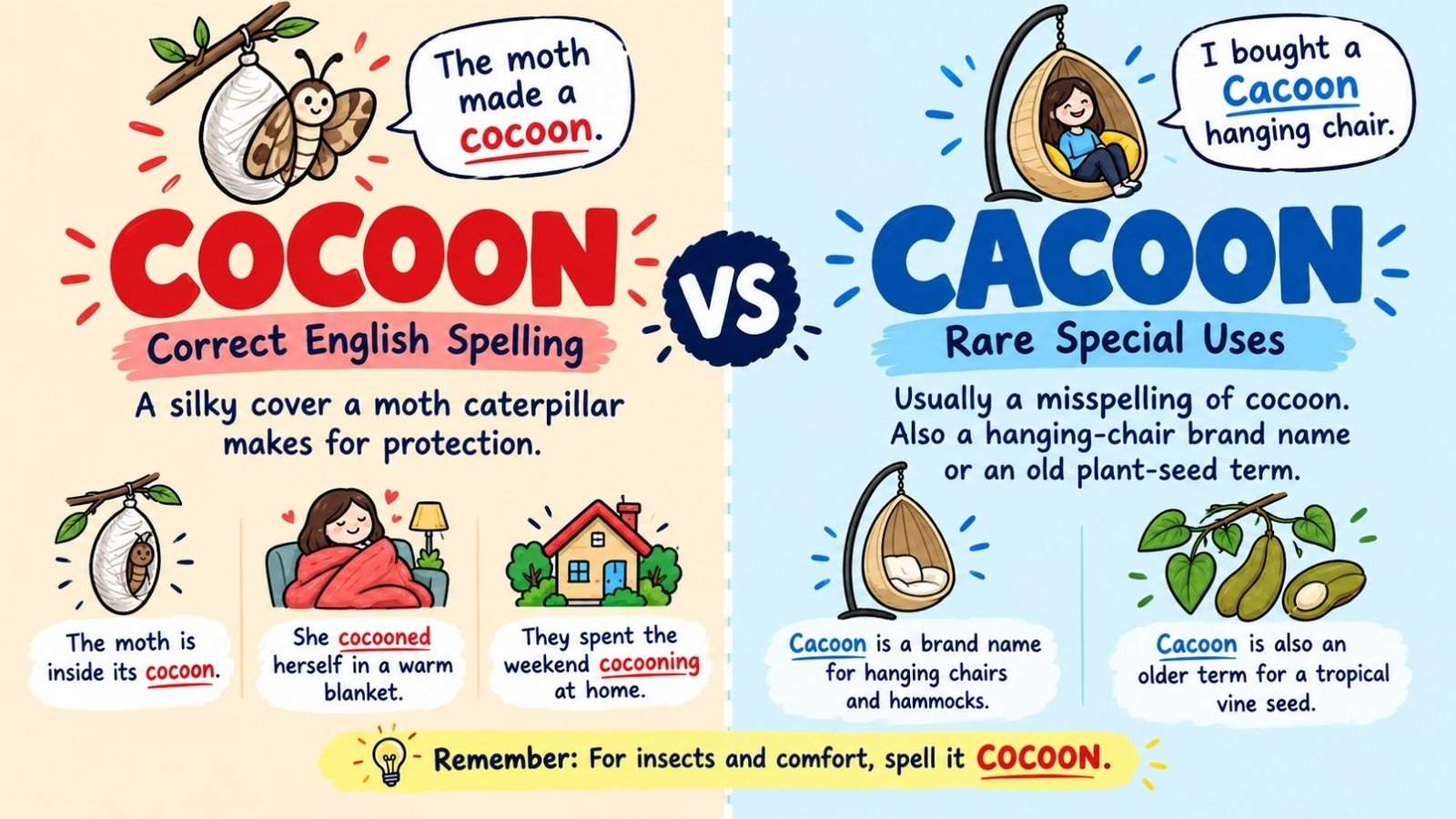
Cocoon is the correct English word in nearly every situation. It refers to the protective silk case that a caterpillar or other insect larva builds around itself before it changes into an adult form. Dictionaries, biology textbooks, and style guides all agree on this spelling, with two o’s in the first syllable and two more in the second.
Cacoon is not standard English. Most of the time, it is simply a misspelling that happens because the two words sound so much alike when spoken quickly. However, cacoon does have two legitimate, narrow uses worth knowing:
- It is the registered name of a brand of hanging chairs, swings, and pod-shaped hammocks made by the company Vivere.
- It is an older botanical term for the large, flat, bean-like seeds of a tropical vine called Fevillea cordifolia.
So if someone asks, “Is cacoon a real word?” the honest answer is: rarely, and only in those two specific contexts. For anything related to insects, protection, comfort, or the well-known movie, cocoon is the spelling you want.
Read More: Courtesy Vs Curtesy
Quick Answer Table
| Word | Correct Use | Common Mistake |
| Cocoon | Insect silk casing, metaphor for safety or isolation, movie title, mattress brand | Rarely misspelled once you know the pattern |
| Cacoon | Vivere brand of hanging swing chairs; a tropical vine seed in older botany texts | Frequently used by mistake instead of cocoon |
What Does Cocoon Mean?
The word cocoon has a few related meanings, and separating them makes the word much easier to use with confidence.
Meaning 1: The silk casing insects spin. A cocoon is a protective covering, usually made of silk, that a caterpillar or other larva spins around its body before it transforms into an adult insect. Moths are the insects most associated with true cocoons.
Meaning 2: A verb describing wrapping something protectively. To cocoon something means to wrap it up snugly, as if inside a protective shell. You might read that a blanket cocoons a sleeping baby.
Meaning 3: A metaphor for emotional or physical safety. People often say they are cocooning when they stay home, avoid stress, and create a sense of comfort and distance from the outside world. This meaning became especially common during periods of social withdrawal, but it existed in everyday English long before that.
Meaning 4: A product or brand name. Several companies, including Sealy’s Cocoon mattress line, use the word to suggest softness, comfort, and enclosure.
Each of these meanings shares the same core idea: something wrapped, protected, or enclosed.
Cocoon Butterfly: A Common Mix-Up
Search interest around “cacoon or cocoon butterfly” points to a widespread misunderstanding worth clearing up directly. Butterflies do not actually spin cocoons. Only moths do that. A butterfly forms a hard, smooth shell called a chrysalis instead of a silk cocoon.
This distinction trips up a lot of people because both structures serve the same purpose, protecting the insect while it changes from larva to adult. But the materials and the insects involved are different.
Chrysalis Vs Cocoon: What Is the Real Difference?
This is one of the most searched comparisons connected to this topic, so it deserves a clear breakdown.
| Feature | Chrysalis | Cocoon |
| Made by | Butterflies | Moths |
| Material | The caterpillar’s own hardened outer skin | Silk thread spun by the caterpillar |
| Texture | Smooth, shell-like, often shiny | Soft, fuzzy, or papery |
| Location | Often hangs exposed on a twig or leaf | Often hidden in leaf litter, bark, or soil |
A chrysalis is not a covering the insect builds. It is the caterpillar’s final larval skin, which hardens into a protective shell. A cocoon, by contrast, is something the insect actively spins from silk produced by glands near its mouth.
💡 Tip: If you see a smooth, hanging shell with no visible threads, you are likely looking at a chrysalis. If you see a fuzzy or woven-looking case, you are likely looking at a moth cocoon.
Difference Between Chrysalis, Cocoon, and Pupa
A third word often enters this conversation: pupa. Understanding how it relates to the other two clears up a lot of confusion.
- Pupa is the general biological stage of insect development between larva and adult. It applies to all insects that go through complete metamorphosis, not just butterflies and moths.
- Chrysalis is the specific term for the pupal stage of a butterfly, referring to the hardened casing itself.
- Cocoon is the silk structure that surrounds the pupa of a moth, but it is not the pupa itself. The pupa is the insect inside; the cocoon is the wrapping around it.
So a moth caterpillar spins a cocoon, and inside that cocoon, it becomes a pupa. A butterfly caterpillar sheds its skin to reveal a chrysalis, which is both the pupal stage and its outer shell at the same time.
Moth Cocoon: How It Actually Works
A moth cocoon forms in a fairly predictable sequence:
- Egg stage. A female moth lays eggs, usually on a leaf that will later serve as food.
- Larva stage. The caterpillar hatches and spends most of its time eating and growing.
- Spinning stage. When it is ready to change, the caterpillar produces silk from special glands and wraps itself in layer after layer, forming the cocoon.
- Pupa stage. Inside the finished cocoon, the caterpillar’s body restructures itself into an adult moth.
- Emergence. The adult moth breaks out of the cocoon, usually using a combination of body movement and, in some species, a fluid that softens the silk.
Some moth species reinforce their cocoons with leaves, bark, or soil particles for extra protection. This is part of why cocoons often look rougher or more irregular than a butterfly’s smooth chrysalis.
Caterpillar Cocoon Or Caterpillar Chrysalis?
Whether a caterpillar makes a cocoon or a chrysalis depends entirely on what kind of insect it will become.
- If the caterpillar will become a moth, it typically spins a cocoon.
- If the caterpillar will become a butterfly, it forms a chrysalis instead, without spinning any silk casing.
There are some exceptions and unusual cases across the huge variety of moth and butterfly species worldwide, but this rule holds for the vast majority of common backyard insects in the United States.
Cocoon Grammar: Part of Speech and Word Forms
Cocoon can function as either a noun or a verb in English, which sometimes causes uncertainty about how to use it correctly in a sentence.
As a noun, cocoon refers to the silk casing itself or to a protective, enclosed state.
- The moth crawled out of its cocoon at dawn.
- She wrapped herself in blankets like she was building a cocoon.
As a verb, to cocoon means to wrap something snugly or to withdraw into comfort and safety.
- He liked to cocoon himself in a warm sweater during winter.
- They spent the weekend cocooning at home instead of going out.
Word Forms Table
| Form | Word | Example |
| Singular noun | Cocoon | The cocoon hung from a branch. |
| Plural noun | Cocoons | Several cocoons dotted the tree bark. |
| Base verb | Cocoon | I want to cocoon this weekend. |
| Present participle | Cocooning | She is cocooning under a heavy quilt. |
| Past tense | Cocooned | He cocooned himself in his favorite blanket. |
Cocoon is a regular noun and a regular verb, so it follows standard English pluralization and conjugation rules, without any irregular spellings to memorize.
Read More: Butterfly Chrysalis Vs Moth Cocoon Differences
How to Pronounce Cocoon?
Cocoon is pronounced kuh-KOON, with the stress falling on the second syllable. The first syllable is unstressed and often sounds like a quick “kuh” rather than a clear “co,” which is part of why some people mishear it and write “cacoon” instead.
In IPA, the pronunciation is written as /kəˈkuːn/. Both American and British English pronounce the word the same way, with no regional variation worth noting.
Origin of the Word Cocoon
Cocoon entered English from the French word “cocon,” which itself came from the older French word “coque,” meaning shell. That root traces further back to the Latin word “coccum,” referring to a shell or berry. English speakers began using cocoon in the seventeenth century, originally to describe the silk casings spun by silkworms, since silk production was already a well-established trade connecting Europe and Asia at that time.
Over the following centuries, the word expanded from its narrow scientific meaning into broader, more figurative use, describing anything wrapped protectively, including emotional states of comfort or withdrawal. This kind of shift, from a specific technical term to a common metaphor, happens often in English.
Cacoon Definition: The Two Real Meanings
Since cacoon is not simply an error in every case, it deserves its own explanation.
Cacoon as a plant term. In older botanical writing, cacoon refers to the large, hard, flattened seeds produced by Fevillea cordifolia, a climbing vine native to tropical parts of Central and South America. These seeds, sometimes called cacoon beans, have traditionally been used in folk medicine and decorative crafts in some regions. This use of the word is uncommon in everyday American English today.
Cacoon as a product brand name. Vivere, a Canadian outdoor furniture company, sells a line of hanging pod chairs and swings under the trademarked name Cacoon. These are cozy, enclosed hammock-style seats designed to be hung from a tree, ceiling beam, or stand, and they are sold through major retailers.
Because this brand has become fairly popular, especially for kids’ hanging chairs and swings, many shoppers now search “cacoon” expecting product results rather than a spelling lesson. If you are shopping for one of these hanging seats, cacoon is the correct spelling to search for the actual product. If you are talking about insects, comfort, or the movie, cocoon remains correct.
Cacoon Swing And Cacoon Bed: What Shoppers Are Really Looking For
Several of the most common searches around this word are product-related rather than grammar related. Here is a quick breakdown of what people usually mean:
- Cacoon swing typically refers to the Vivere Cacoon Saucer Swing or similar hanging pod swings.
- Cacoon bed usually describes a hanging hammock-style bed shaped like a cocoon, sometimes from Vivere and sometimes from other brands using similar “cocoon bed” language.
- Cacoon Mexico most often refers to shoppers or retailers searching for these hanging chairs available through Mexican retailers or shipping regions.
- Blue Cacoon and Cacoon Cat usually describe specific color options or pet-related hanging pods sold under this product line, rather than any grammar issue.
If your search intent is about buying a hanging chair, cacoon with an “a” is genuinely the right spelling to use. If your intent is understanding meaning, grammar, or biology, stick with cocoon.
Cacoon Or Cocoon Movie: Clearing Up the Confusion
The correct title of the 1985 film is Cocoon, spelled with the standard double “o” pattern. Directed by Ron Howard, the movie tells the story of a group of retirees who discover a swimming pool containing rejuvenating alien cocoons and experience a sudden burst of youthful energy.
The film stars Don Ameche, Wilford Brimley, Hume Cronyn, Brian Dennehy, Jack Gilford, Maureen Stapleton, Jessica Tandy, Gwen Verdon, Herta Ware, and Tahnee Welch. It was released in theaters on June 21, 1985, and both Ameche and the film’s visual effects team won Academy Awards for their work on the picture. A sequel, Cocoon: The Return, followed in 1988, bringing back most of the original cast.
Wilford Brimley, who played Ben Luckett, was only 49 years old during filming and had to be aged up with makeup, since he was significantly younger than most of the other actors playing elderly characters. This has made “Wilford Brimley Cocoon” a frequent search on its own, usually from people trying to confirm his role or his age during production.
There is no film titled “Cacoon.” Anyone searching that spelling is almost always looking for the 1985 movie or its sequel, both spelled with the standard “cocoon.”
Cocoon Coat: A Fashion Term
A cocoon coat is a style of outerwear with a rounded, oversized silhouette that narrows at the hem, creating a shape that loosely resembles an insect cocoon.
This style has appeared repeatedly in fashion over the decades and remains a recognizable term among designers and shoppers. There is no equivalent “cacoon coat” in fashion; the spelling here always follows the standard word.
Cocoon Vanilla JS: A Note For Developers
Outside of biology and fashion, “cocoon” also shows up in technology contexts. Cocoon.js, sometimes referenced casually as “cocoon vanilla js,” was a development framework historically used to package HTML5 and JavaScript applications for mobile platforms.
If you are researching this in a coding context, you are looking for the standard “cocoon” spelling as well, since it is simply borrowing the same word to suggest wrapping code into a mobile app shell.
Common Mistakes With Cacoon and Cocoon
❌ Incorrect: The caterpillar spun a cacoon around itself.
✅ Correct: The caterpillar spun a cocoon around itself.
❌ Incorrect: I just want to cacoon on the couch this weekend.
✅ Correct: I just want to cocoon on the couch this weekend.
❌ Incorrect: We watched the cacoon movie with Wilford Brimley.
✅ Correct: We watched the cocoon movie with Wilford Brimley.
✅ Correct product use: I bought a Cacoon hanging chair for the backyard.
The pattern to remember is simple: unless you are naming the Vivere hanging chair brand or the older botanical seed term, cocoon is always the spelling you want.
Similar Words and Related Terms
| Word | Meaning | How It Differs From Cocoon |
| Chrysalis | The hardened pupal shell of a butterfly | Formed from the caterpillar’s own skin, not spun silk |
| Pupa | The general insect stage between larva and adult | A broader biological term covering many insect types |
| Cacoon | A brand of hanging chairs, or a tropical vine seed | A distinct word with its own separate meanings |
| Nest | A structure built by animals to house eggs or young | Used for birds and some insects, not for metamorphosis casings |
Understanding these related words helps you choose the most accurate term depending on what you are actually describing.
Cocoon In Everyday, Non-Scientific Use
Outside biology, cocoon is one of those words that comfortably crossed over into everyday emotional language. People describe cocooning when they:
- Stay in comfortable clothes and skip social plans to recharge
- Wrap themselves in blankets during cold weather
- Create a calm, controlled home environment away from daily stress
- Emotionally withdraw for a period of healing or reflection
This figurative sense is completely standard English and appears often in casual conversation, journalism, and lifestyle writing.
Read More: Chrysalis Vs Cocoon
Frequently Asked Questions
Is it spelled cacoon or cocoon?
Cocoon is the correct spelling for the insect casing, the movie, the mattress brand, and the everyday comfort metaphor. Cacoon is correct only when referring to the Vivere hanging chair brand or the older botanical seed term.
What does cocoon mean?
A cocoon is the silk casing a moth caterpillar spins around itself before becoming an adult moth. The word also describes wrapping something protectively or withdrawing into comfort and safety.
Is cocoon a noun or a verb?
Cocoon can be both. As a noun, it names the silk casing itself. As a verb, it means to wrap something snugly or to stay in a comfortable, protected state.
Do butterflies make cocoons?
No. Butterflies form a hardened shell called a chrysalis, made from their own outer skin. Only moths spin true silk cocoons.
What is the difference between chrysalis and cocoon?
A chrysalis is the hardened pupal shell of a butterfly, formed from the caterpillar’s skin. A cocoon is a silk structure spun by a moth caterpillar to protect it during the pupal stage.
What is the difference between cocoon and pupa?
Pupa is the general term for the insect stage between larva and adult. Cocoon refers specifically to the silk covering that surrounds a moth’s pupa, not the pupa itself.
Is cacoon a real word?
Yes, but only in two narrow contexts: as the trademarked name of a hanging chair and hammock brand, and as an older term for the seeds of a tropical vine. It is not a valid alternative spelling of cocoon.
Who starred in the movie Cocoon?
The 1985 film Cocoon starred Don Ameche, Wilford Brimley, Hume Cronyn, Brian Dennehy, Jack Gilford, Maureen Stapleton, Jessica Tandy, Gwen Verdon, Herta Ware, and Tahnee Welch, directed by Ron Howard.
How do you pronounce cocoon?
Cocoon is pronounced kuh-KOON, with stress on the second syllable, in both American and British English.
Where does the word cocoon come from?
Cocoon comes from the French word “cocon,” rooted in the older French “coque,” meaning shell, which traces back to the Latin word for shell or berry.
Conclusion
Cocoon is the correct spelling in almost every situation, whether you are writing about insects, describing a cozy feeling, referencing the 1985 film, or shopping for a mattress. Cacoon only becomes correct in two specific and fairly narrow cases: the Vivere brand of hanging chairs and swings, and an older botanical term for a tropical vine’s seeds. Outside those two exceptions, cacoon is simply a common misspelling caused by how similar the two words sound when spoken.
The next time you catch yourself hesitating between cacoon or cocoon, think about what you are actually describing. If it involves a caterpillar, a metaphor for safety, a movie, or a mattress, reach for cocoon with confidence. If you are specifically shopping for a Vivere hanging chair or reading older plant science texts, cacoon is the word you want. Getting this small distinction right shows real attention to detail, and it makes your writing clearer for every reader who comes across it.

Zunaira Qasim is the author and creator of Gramvixo, dedicated to making English grammar easier for learners and everyday writers. With 4 years of experience researching grammar, confusing words, word choices, and common language mistakes, they create clear and practical content that helps readers understand English and use it with confidence.
One Comment