
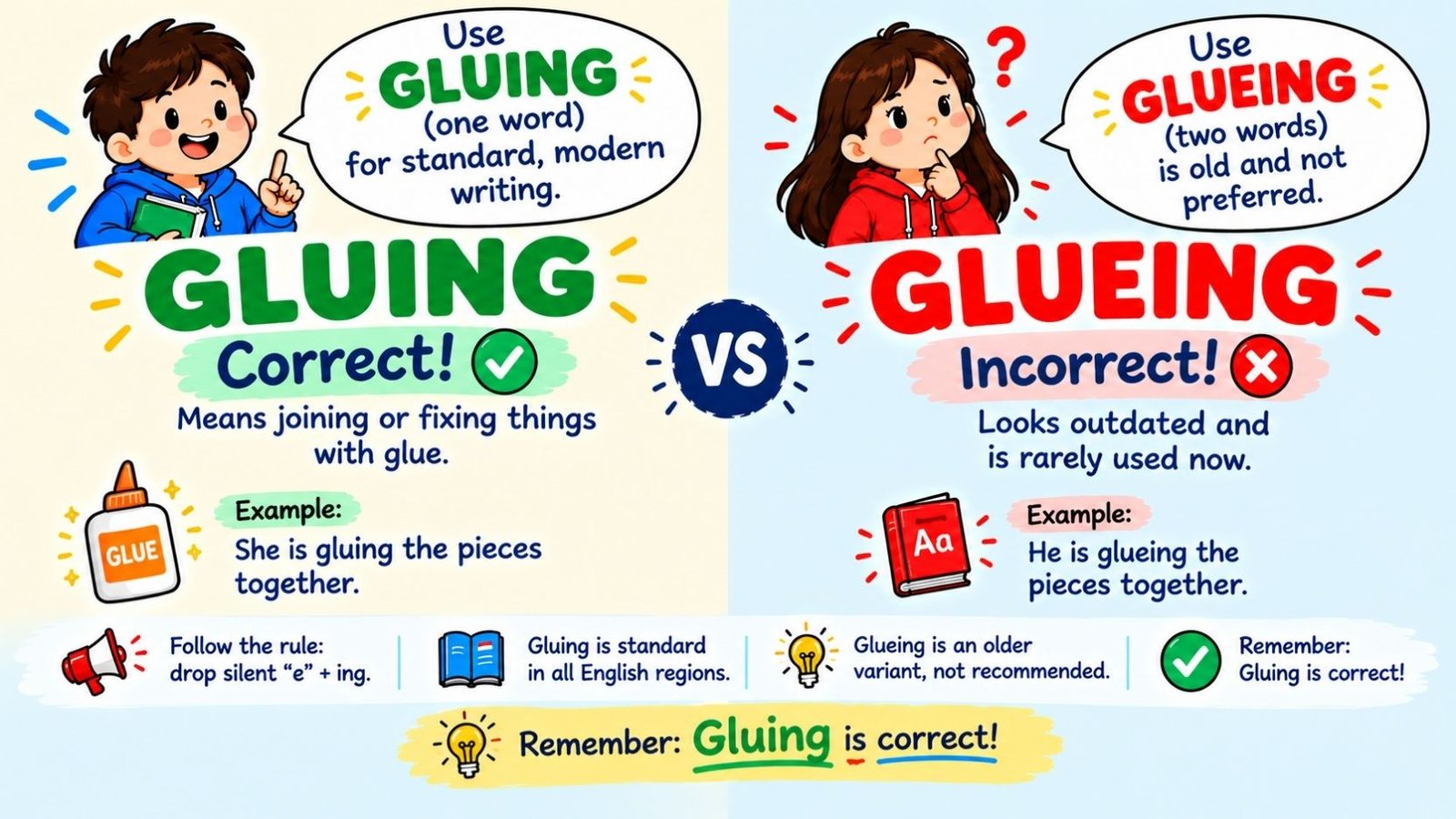
Gluing is the correct and standard spelling. It follows the normal English rule of dropping a silent “e” before adding “ing.” Glueing is a much older variant that keeps the “e.” Most dictionaries today list gluing as the only accepted modern form. If you are unsure which one to use, gluing is always the safer choice.
This small spelling question causes more confusion than it should, mostly because “glue” ends in a silent “e.” English usually drops that silent “e” before adding “ing,” but a few exceptions exist, like “dyeing” or “singeing,” where dropping the “e” would create confusion with another word. Glue does not have that problem, which is exactly why gluing became the standard form over time.
What Does Gluing Mean?
Gluing is the present participle and gerund form of the verb “to glue.” It describes the action of joining, fixing, or bonding two or more things together using an adhesive substance.
You will see it used in ordinary, everyday sentences such as:
- She is gluing the broken handle back onto the mug.
- He spent the afternoon gluing wooden panels for a bookshelf.
- The teacher showed the students a video about cutting and gluing paper shapes.
The meaning stays the same whether the word is spelled gluing or glueing. This is purely a spelling question, not a meaning difference.
Read More: Nighttime Or Night Time
Gluing Or Glueing: Quick Answer Table
| Spelling | Status | Common Region |
| Gluing | Standard, correct, preferred | American English and British English |
| Glueing | Rare, older variant | Occasionally seen in older British texts |
Why Gluing Is the Correct Spelling
English has a well-known spelling rule for verbs that end in a silent “e.” When you add “ing” to these verbs, you normally remove the final “e” first.
Here is how that rule plays out with familiar words.
| Base Verb | Add Ing | Result |
| Make | Ing | Making |
| Write | Ing | Writing |
| Glue | Ing | Gluing |
Glue follows this same pattern. The silent “e” at the end simply drops away, and “ing” attaches directly to the remaining letters. That gives you gluing.
This rule exists because English spelling tries to avoid unnecessary letters once the pronunciation is already clear. Saying “gluing” out loud sounds exactly the same with or without that extra “e,” so keeping it serves no real purpose.
Why Glueing Sometimes Shows Up Anyway
If gluing follows the standard rule so cleanly, why does glueing keep appearing in some writing? There are a few honest reasons for this.
First, a small group of English verbs do keep the silent “e” before “ing” to avoid confusion with another word. Dye becomes dyeing, not “dying,” because “dying” already means something else entirely. Writers sometimes assume glue follows this same exception, even though it does not create any similar conflict.
Second, older printed texts occasionally used glueing, especially in British publications from earlier decades. Spelling standards were less consistent before modern dictionaries and style guides became widely available, so some inconsistent forms simply lingered in older documents.
Third, glueing simply looks familiar to readers who are used to seeing words like cueing or shoeing, where the extra vowel remains. That visual pattern can make glueing feel more natural, even though it is not the standard modern spelling.
Gluing Or Glueing In American English
In American English, gluing is used almost exclusively. Glueing is rare enough that most American readers would immediately flag it as a typo rather than recognize it as an alternate spelling.
Major American dictionaries and style guides consistently list gluing as the correct present participle of glue, with no meaningful mention of glueing as an accepted American form.
Gluing Or Glueing In British English
British English generally agrees with American English here, which is somewhat unusual for spelling questions. Words like colour and color, or traveller and traveler, show real regional splits. Gluing does not.
Modern British dictionaries also treat gluing as the standard, correct form. Glueing does still appear occasionally in older or informal British writing, but it is best understood as a dated or nonstandard variant rather than an accepted regional alternative.
Gluing Or Glueing In Australia And Canada
Australian and Canadian English generally follow British spelling conventions for many words, yet gluing remains standard across both. Glueing is not treated as a recognized regional form in either country. If you are writing for an Australian or Canadian audience, gluing is still the spelling to use.
Read More: Courtesy Vs Curtesy
Common Mistakes With Gluing Or Glueing
Understanding the rule helps, but a few common mix ups still trip writers up.
⚠️ Common mistake: Assuming glue works like dye or singe.
❌ Incorrect: Glueing the pieces together took longer than expected.
✅ Correct: Gluing the pieces together took longer than expected.
⚠️ Common mistake: Copying the pattern from words like shoeing or cueing.
❌ Incorrect: She was glueing labels onto every jar.
✅ Correct: She was gluing labels onto every jar.
⚠️ Common mistake: Trusting spellcheck inconsistently across different tools.
Some older or less reliable spellcheck tools do not flag glueing as an error, which can make writers assume it is acceptable. Most modern spellcheckers and style guides will correctly flag it, so it is worth double-checking manually if you are unsure.
Gluing In A Sentence: More Examples
A few clear examples make the correct usage easier to remember.
- The children were gluing colorful shapes onto their poster boards.
- He is gluing the loose tile back into place before it cracks further.
- Careful gluing is essential when working with delicate materials like glass.
- The instructions recommend gluing the edges first, then clamping them together.
- She kept gluing small pieces of the model airplane late into the night.
Notice that gluing works the same way in every sentence, whether it functions as part of a continuous verb form or as a gerund acting like a noun.
Gluing as a Gerund vs a Continuous Verb
Gluing can work in two slightly different grammatical roles, and recognizing the difference can help with sentence structure.
As part of a continuous verb, gluing follows a form of “to be.”
Example: She is gluing the frame back together.
As a gerund, gluing acts like a noun and can be the subject or object of a sentence.
Example: Gluing small parts requires a lot of patience.
In both cases, the spelling stays exactly the same. Only the grammatical role changes depending on how the sentence is built.
Gluing In Different Contexts
The word gluing shows up across many everyday situations, and the meaning shifts slightly depending on context, even though the spelling never changes.
- Crafts and hobbies: Gluing paper, fabric, or small decorative pieces together during craft projects, scrapbooking, or classroom activities.
- Construction and woodworking: Gluing wood panels, joints, or edges together, often alongside clamping or other reinforcement methods for a stronger bond.
- Repairs and household use: Gluing broken items back together, such as ceramics, handles, or small plastic parts around the home.
- Manufacturing and industrial use: Gluing components together using specialized adhesives, sometimes with dedicated gluing machines designed for precision and speed.
Each context uses the same word and the same spelling, which is part of why getting the spelling right matters across so many different types of writing.
Word Glue: Origin
The word glue has a long history that traces back through Old French and further into Latin roots. Early forms of the word referred broadly to a sticky substance used for binding or fastening materials together.
Over centuries, English absorbed the term and gradually standardized its spelling, following the same broader pattern that shaped much of modern English spelling. As dictionaries became more established and widely used, spelling variations like glueing became less common, eventually settling into the gluing form used consistently today.
Similar Words That Follow the Same Rule
Seeing how other silent “e” verbs behave can reinforce why gluing is correct.
| Base Verb | Correct Ing Form | Notes |
| Use | Using | Drops silent e |
| Argue | Arguing | Drops silent e |
| Continue | Continuing | Drops silent e |
| Glue | Gluing | Drops silent e |
Compare this with the small exception group.
| Base Verb | Correct Ing Form | Reason for Exception |
| Dye | Dyeing | Avoids confusion with dying |
| Singe | Singeing | Avoids confusion with singing |
Glue simply does not belong to that exception group, since there is no competing word it could be confused with. That absence of conflict is exactly why the standard rule applies cleanly here.
Gluing Or Glueing: Which Should You Use?
If you are writing anything intended for a general audience, whether that is a school assignment, a professional document, a website, or everyday communication, gluing is the spelling to use. It matches what nearly every major dictionary lists, it reads as correct to the widest possible audience, and it avoids the small but real risk of looking like a typo.
Glueing is not necessarily “wrong” in every historical sense, since older texts have used it, but modern English has clearly settled on gluing as the standard form across both American and British usage.
Read More: Cacoon Or Cocoon
Frequently Asked Questions
Is it gluing or glueing?
Gluing is the correct spelling in modern English. Glueing is an older, uncommon variant that most dictionaries no longer list as standard.
What does gluing mean?
Gluing means joining or fastening things together using an adhesive substance. It is the present participle and gerund form of the verb glue.
Is gluing correct in both American and British English?
Yes. Gluing is the standard spelling in American English, British English, Australian English, and Canadian English alike.
Why is the silent e dropped in gluing?
English typically drops a silent e before adding ing, since the pronunciation stays clear without it. Glue does not have any competing word it could be confused with, so the silent e simply drops away.
Is glueing ever considered correct?
Glueing appears occasionally in older or informal writing, but it is not treated as a standard modern spelling by major dictionaries or style guides.
What part of speech is gluing?
Gluing can function as a present participle, forming part of a continuous verb, or as a gerund, acting like a noun in a sentence.
How do you spell the ing form of glue?
The correct ing form of glue is gluing, spelled without the extra e.
Does gluing follow the same rule as words like making or writing?
Yes. Gluing follows the standard rule of dropping a silent e before adding ing, just like make becomes making and write becomes writing.
Is glueing a spelling mistake?
In most modern contexts, yes. Style guides and dictionaries generally treat it as an outdated or nonstandard form rather than an accepted alternative.
Which spelling should I use in professional writing?
Gluing is the safer and more widely accepted choice for professional, academic, and everyday writing.
Conclusion
Gluing is the correct, standard spelling of the present participle of glue, and it is recognized this way across American English, British English, Australian English, and Canadian English. It follows the ordinary rule of dropping a silent e before adding ing, the same rule that shapes words like making, writing, and using. Glueing is an older variant that occasionally appears in historical or informal writing, but it does not reflect current standard usage.
Whenever you find yourself unsure about gluing or glueing, remembering the simple rule behind silent e verbs will point you in the right direction. Choosing gluing keeps your writing accurate, consistent, and aligned with how nearly every major dictionary defines the word today.

Zunaira Qasim is the author and creator of Gramvixo, dedicated to making English grammar easier for learners and everyday writers. With 4 years of experience researching grammar, confusing words, word choices, and common language mistakes, they create clear and practical content that helps readers understand English and use it with confidence.
3 Comments