
If you sell something for a living, or you are writing about someone who does, you have probably paused and asked yourself: is it vender or vendor? The confusion is common because both words look and sound almost identical, and both are connected to the idea of selling.
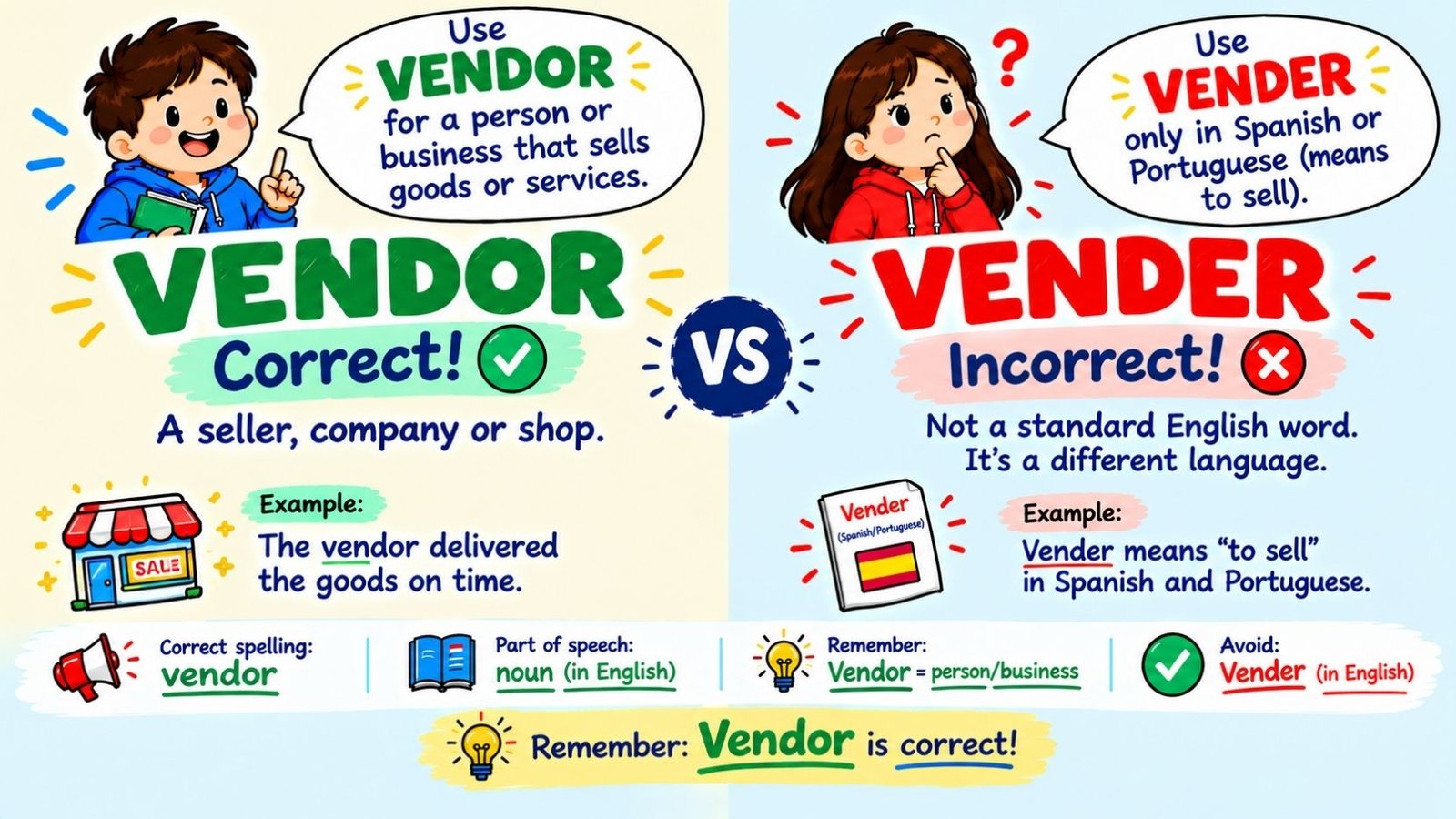
The short answer is simple. Vendor is the correct English word for a person or business that sells goods or services. Vender is an old, rarely used variant spelling of the same word, and it is also the standard Spanish and Portuguese verb meaning to sell.
This article breaks down the meaning, grammar, spelling, pronunciation, and real usage of both words. You will also see clear examples, common mistakes, and answers to the most frequent questions people search for on this topic.
Vendor: The Correct Spelling In English
In modern English, vendor is the accepted and standard spelling. You will find it in every major English dictionary, in business contracts, in legal documents, and in everyday conversation.
A vendor is a person, company, or entity that sells something. This could be a small business owner at a farmers market, a large corporation supplying software to another company, or a street seller offering food or goods.
Simple definition: A vendor is a seller.
Here is the word broken down clearly:
| Detail | Information |
| Correct spelling | Vendor |
| Part of speech | Noun |
| Meaning | A person or business that sells goods or services |
| Plural form | Vendors |
| Common field | Business, retail, contracts, supply chains |
Read More: Disgard Or Discard
Is Vender A Real Word?
Vender is not considered an error in the strictest sense, but it is not the modern standard. Some older dictionaries and historical English texts do list vender as a valid alternate spelling of vendor. However, this spelling has fallen out of common use in contemporary English.
If you write vender in a business email, a legal document, or professional content today, most readers will assume it is a typo. For that reason, style guides and editors consistently recommend vendor as the correct choice in current English writing.
⚠️ Common mistake: Using vender when writing in English about a business seller. Always use vendor instead.
Vender Or Vendor: Which Is Correct?
For English writing, the answer is clear and direct.
- ✅ Correct: The vendor delivered the office supplies on time.
- ❌ Incorrect: The vender delivered the office supplies on time.
There is one important exception. If you are writing or speaking in Spanish or Portuguese, vender is completely correct, but it means something different. It is not a noun. It is a verb meaning to sell.
Vender or Vendor Meaning: Two Different Languages, Two Different Words
This is where a lot of the confusion actually comes from. People searching for vender or vendor meaning are often mixing two separate languages without realizing it.
In English: Vendor (noun) means a seller of goods or services.
In Spanish and Portuguese: Vender (verb) means to sell.
These two words are not different spellings of the same idea. They belong to different languages and different grammatical categories. One is a person or business. The other is an action.
| Word | Language | Part of Speech | Meaning |
| Vendor | English | Noun | A seller of goods or services |
| Vender | Spanish and Portuguese | Verb | To sell |
Vender Conjugation And Vender Preterite
Since vender is a real and commonly used verb in Spanish and Portuguese, it follows regular verb conjugation patterns in those languages.
In Spanish, vender is a regular ‑er verb. A few examples of its conjugation:
- Yo vendo (I sell)
- Tú vendes (You sell)
- Él vende (He sells)
- Nosotros vendemos (We sell)
In the preterite, or simple past tense, vender changes to describe a completed action:
- Yo vendí (I sold)
- Tú vendiste (You sold)
- Él vendió (He sold)
- Nosotros vendimos (We sold)
This confirms that vender is a legitimate word, but only inside Spanish or Portuguese sentences. It should not be used as an English noun.
How To Spell Vendor Correctly
Many people search for how to spell vender or vendor simply because the two words look so close together. Here is a simple way to remember the correct English spelling.
💡 Tip: Vendor ends in O R, just like actor, editor, and doctor. All of these words describe a person who does something, and they follow the same spelling pattern.
If you remember that vendor belongs to this same family of English nouns, the correct spelling becomes much easier to recall.
Read More: In Person Vs In-Person
Pronunciation
Vendor is pronounced VEN‑dor, with the stress on the first syllable. In American English, it sounds like “VEN‑der,” even though it is spelled with an O. This is actually part of why the vender spelling mistake happens so often. The word sounds like it ends in “er,” but it is written with “or.”
In British English, the pronunciation is very similar, with a slightly softer R sound depending on the regional accent.
Vendor In A Sentence
Seeing the word used naturally can make the meaning easier to remember.
- The company hired a new vendor to supply raw materials.
- She runs a small vendor stall at the weekend market.
- Every vendor at the trade show had a different product to showcase.
- The city requires vendors to have a permit before selling on public streets.
Vendor or Vendor: Regional Usage
Vendor or Vendor UK: In the United Kingdom, vendor is used exactly as it is in the United States, especially in legal and real estate contexts. In UK property transactions, the vendor is the person selling the house or property, while the buyer is referred to as the purchaser.
Vendor or Vendor Canada: Canadian English closely follows both British and American conventions. Vendor is the standard and expected spelling in Canadian business, legal, and everyday writing.
There is no country where vender is the accepted standard spelling in English. It remains a variant form found mostly in older texts.
Common Business Uses Of The Word Vendor
The word vendor shows up constantly in professional and business settings. A few common examples include:
- Vendor Management: The process businesses use to select, monitor, and maintain relationships with their suppliers.
- Vendor Portal: An online platform where suppliers can submit invoices, track orders, or communicate with a company.
- Vendor Central: A term commonly associated with platforms where manufacturers sell products directly to large retailers.
- Software Vendor: A company that creates and sells software products to businesses or individuals.
These examples show that vendor is deeply established across industries, from retail to technology to real estate.
Common Mistakes To Avoid
⚠️ Mixing up vendor and vender is the most frequent mistake, especially among people who speak both English and Spanish or Portuguese.
- ❌ Incorrect: We need a reliable vender for next month’s event.
- ✅ Correct: We need a reliable vendor for next month’s event.
Another common mistake is assuming vender is simply a shortened or casual version of vendor. It is not. They are two unrelated words from two different languages, and mixing them in formal English writing can look like a spelling error to native readers.
Synonyms And Related Words
Vendor has several related words in English, though each carries a slightly different shade of meaning.
| Word | Meaning | Typical Use |
| Seller | A general term for anyone selling something | Everyday and informal use |
| Supplier | A business that provides goods, often in bulk | Business and manufacturing contexts |
| Merchant | Someone who trades or sells goods, often historically | Retail and trade contexts |
| Retailer | A business that sells directly to consumers | Consumer-facing sales |
Vendor is often used interchangeably with supplier in business writing, though supplier tends to emphasize an ongoing supply relationship, while vendor can refer to any seller, even a one time transaction.
Read More: Simular Vs Similar
Frequently Asked Questions
Is it spelled vender or vendor?
In English, the correct spelling is vendor. Vender is an outdated variant that is rarely used today.
What does vendor mean?
A vendor is a person or business that sells goods or services.
Is vendor a noun or a verb?
Vendor is a noun. It describes a person or entity, not an action.
What does vender mean in Spanish?
In Spanish, vender is a verb meaning to sell.
Is vender a word in English?
Vender does appear in some older dictionaries as an alternate spelling of vendor, but it is not used in modern standard English.
How do you pronounce vendor?
Vendor is pronounced VEN‑dor, with the stress on the first syllable.
What is the difference between a vendor and a supplier?
A vendor is any seller of goods or services, while a supplier usually refers to a business that provides goods on an ongoing basis, often for manufacturing or resale.
Is vendor used the same way in the UK and the US?
Yes. Vendor is used the same way in both British and American English, including in legal, business, and everyday contexts.
What is a vendor in real estate?
In real estate, especially in UK usage, the vendor is the person selling the property.
Why do people confuse vender and vendor?
The confusion often comes from the similar spelling and pronunciation, along with the fact that vender is a real word in Spanish and Portuguese, just with a completely different meaning and grammatical function.
Final Thoughts
Vendor is the word you want whenever you are talking about a seller in English, whether that is a business, a market stall, or a supplier in a contract. Vender is not a modern English spelling. It only appears as a legitimate word when you are speaking or writing in Spanish or Portuguese, where it functions as a verb meaning to sell.
The easiest way to keep these two straight is to remember that vendor is a person or business, spelled like actor or doctor, while vender is an action that belongs to a different language entirely. Once you separate the two by language and by meaning, the confusion between vender and vendor disappears for good.

Zunaira Qasim is the author and creator of Gramvixo, dedicated to making English grammar easier for learners and everyday writers. With 4 years of experience researching grammar, confusing words, word choices, and common language mistakes, they create clear and practical content that helps readers understand English and use it with confidence.
One Comment