
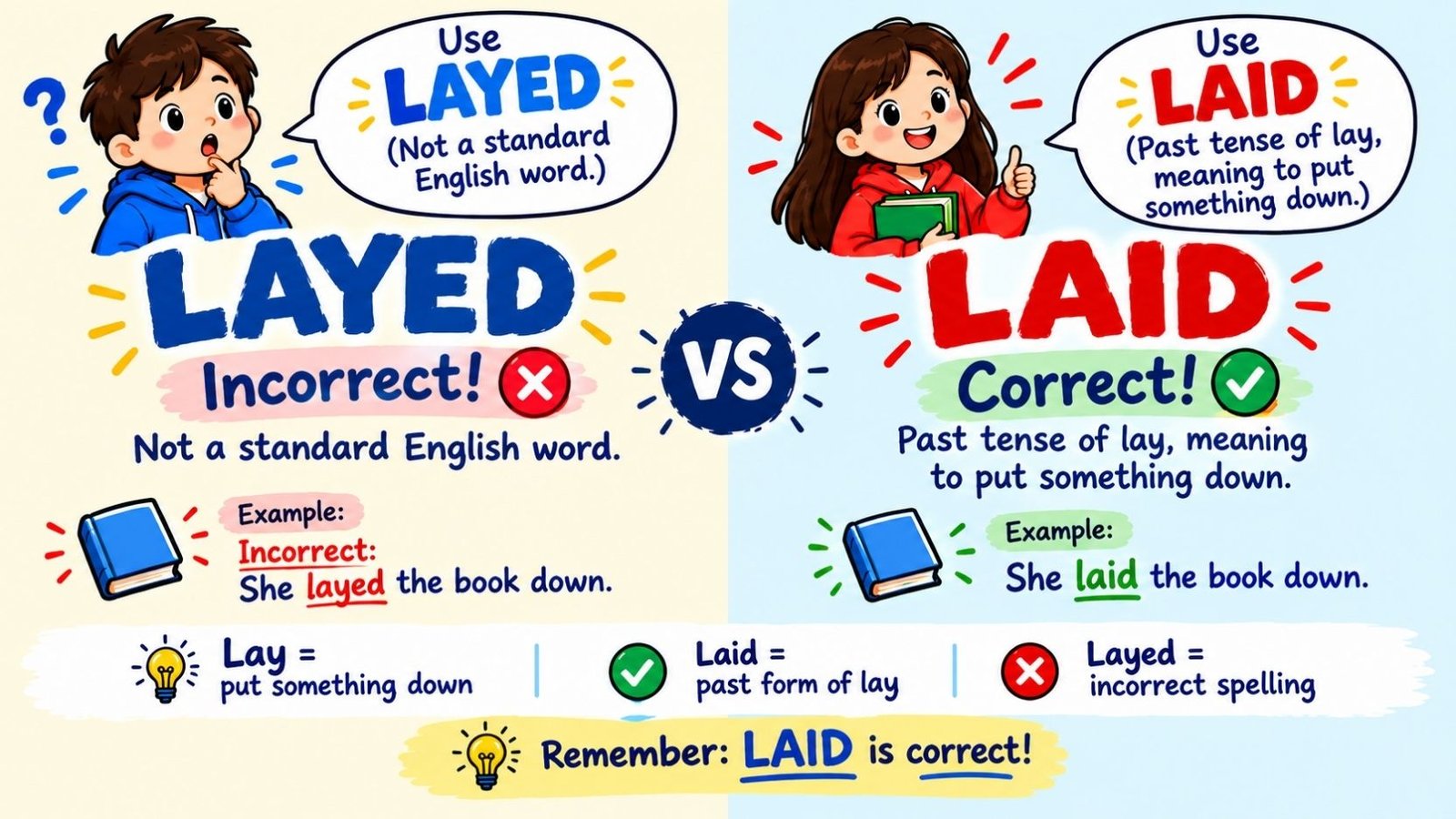
Laid is the correct word. Layed is not a real word in standard English. If you are trying to write the past tense of lay, the correct spelling is always laid, no matter the sentence.
This mistake is one of the most common spelling confusions in English. It happens because laid sounds like it should follow a regular pattern, the way walked or talked do. But lay is an irregular verb, so it breaks that pattern. Once you understand why laid is correct, you will stop second-guessing yourself.
The confusion gets worse because English has two similar verbs, lay and lie, that overlap in tricky ways. Lay means to put something down. Lie means to recline or rest. Their past tense forms cross over each other, which is exactly where most people get stuck.
This article breaks down the meaning, grammar, and correct usage of laid, explains why layed is not standard English, and shows you exactly how to use laid correctly in every situation, including phrases like laid off, laid down, laid out, and laid in bed.
Layed vs Laid: The Simple Answer
Here is the direct answer before anything else.
- Laid is a real word. It is the correct past tense and past participle of the verb lay.
- Layed is not a standard English word. It is a spelling mistake, not an alternate form.
If you are ever unsure which one to use, choose laid. There is no situation in standard, edited English where layed is correct.
| Word | Status | Correct Use |
| Laid | Correct | Past tense and past participle of lay |
| Layed | Incorrect | Common misspelling, not a recognized word |
Read More: Thier Or Their
Why Layed Feels Like It Should Be a Word
Most English verbs form their past tense by adding ed. Walk becomes walked. Talk becomes talked. Play becomes played. This pattern is so common that your brain naturally tries to apply it to every verb, including lay.
That instinct produces layed. It looks logical. It even sounds correct when you say it out loud. But lay does not follow the regular ed pattern. It is an irregular verb, and irregular verbs form their past tense in unpredictable ways.
Because of this, dictionaries, style guides, and grammar authorities do not list layed as a valid spelling. It shows up often in casual writing, texting, and social media, but it is treated as an error in schools, publishing, and professional writing.
What Does Laid Mean?
Laid is the past tense and past participle of the verb lay. To understand laid, you first need to understand lay.
Lay means to put something down or place something somewhere. It is a transitive verb, which means it always needs an object. You lay something.
Examples of the base verb:
- She lays the book on the table every morning.
- Please lay your keys on the counter.
When you talk about this action happening in the past, lay becomes laid.
- She laid the book on the table yesterday.
- He laid his keys on the counter before leaving.
Laid also works as a past participle, which means it pairs with helping verbs like has, have, or had.
- She has laid the book down already.
- They had laid the foundation before winter.
Lay vs Lie: The Real Source Of The Confusion
Most people who struggle with layed vs laid are actually struggling with a bigger issue: the overlap between lay and lie.
These are two separate verbs with different meanings.
| Verb | Meaning | Needs an Object? |
| Lay | To put something down | Yes |
| Lie | To recline or rest | No |
Lay always takes an object. You lay something down. Lie never takes an object. You lie down yourself.
The confusion happens because the past tense of lie is lay. This means the word lay does double duty. It is the present tense of one verb and the past tense of a completely different verb.
Here is the full picture.
| Verb | Present | Past | Past Participle |
| Lay (to place something) | lay | laid | laid |
| Lie (to recline) | lie | lay | lain |
This table explains a lot. When someone says I lay down for a nap yesterday, they are actually using the past tense of lie correctly, even though it looks similar to the present tense of lay. It is a coincidence of English grammar, not a mistake.
Layed vs Laid Down
Laid down is the correct phrase when talking about placing something down in the past.
- Correct: He laid down his pen and walked away.
- Incorrect: He layed down his pen and walked away.
If the sentence describes a person reclining, the correct past tense word is lay, not laid.
- Correct: I lay down for an hour after lunch.
- Incorrect: I laid down for an hour after lunch. When referring to yourself resting, technically calls for lay, though laid down is extremely common in everyday speech.
💡 Tip: If you can replace the phrase with placed, laid is correct. If you can replace it with rested or reclined, lay is the grammatically precise choice, even though laid down is widely used in casual English.
Layed vs Laid Out
Laid out means arranged, planned, or displayed in an organized way. This phrase always uses laid, never layed.
- Correct: The team laid out the schedule for next month.
- Incorrect: The team layed out the schedule for next month.
Laid out also appears in physical contexts.
- She laid out her clothes for the morning.
- The garden was laid out in neat rows.
Read More: Mei Fun Vs Chow Fun
Layed vs Laid Off
Laid off is the correct phrase for describing job loss due to company decisions, not employee performance. This is one of the most searched versions of this confusion, likely because it appears constantly in news and workplace conversations.
- Correct: The company laid off two hundred workers last quarter.
- Incorrect: The company layed off two hundred workers last quarter.
Laid off meaning: Being laid off means your employer ended your job, usually due to budget cuts, restructuring, or reduced business needs. It is different from being fired, which usually relates to performance or conduct.
| Term | Meaning |
| Laid off | Job ended due to company needs, not personal performance |
| Fired | Job ended due to performance or conduct issues |
Both refer to job loss, but the reason behind each is different. Laid off generally does not carry the same negative implication as fired.
Layed vs Laid in Bed
This phrase usually describes resting, which technically calls for a form of lie, not lay.
- Grammatically precise: I lay in bed all morning.
- Common but less precise: I laid in bed all morning.
- Incorrect: I layed in bed all morning.
In relaxed, everyday speech, many people say laid in bed instead of lay in bed. Careful writing and formal English still favor lay in bed when describing yourself resting, since no object is being placed anywhere.
Layed vs Laid Vs Lied
This one adds a third verb into the mix: lie, meaning to say something untrue.
| Verb | Meaning | Past Tense |
| Lay | To place something | laid |
| Lie (recline) | To rest | lay |
| Lie (untruth) | To say something false | lied |
- She lied about her age. (told an untruth)
- She lay in bed all day. (rested)
- She laid the blanket on the bed. (placed something)
These three words look similar but come from different meanings entirely. Lied is the easiest of the three, since it never causes spelling confusion the way laid does.
Is Layed A Word?
No. Layed is not recognized as a standard English word by major dictionaries or grammar authorities. It is considered a spelling error, not an accepted variant.
You may see layed used online, in casual messages, or in user-generated content, but it does not appear in edited publications, academic writing, or professional communication. If you are writing anything formal, including emails, resumes, essays, or articles, always use laid.
Common Mistakes With Layed and Laid
❌ Incorrect: She layed the papers on the desk.
✅ Correct: She laid the papers on the desk.
❌ Incorrect: He was layed off last Friday.
✅ Correct: He was laid off last Friday.
❌ Incorrect: I layed down for a nap.
✅ Correct: I lay down for a nap, or in casual speech, I laid down for a nap.
❌ Incorrect: The hens have layed eggs all week.
✅ Correct: The hens have laid eggs all week.
⚠️ Common mistake: Adding ed to lay out of habit. Remember that lay is irregular, so it never becomes layed in any tense.
How to Remember Laid Is Correct
A simple trick helps most people lock this in permanently.
- If you are placing an object somewhere, use laid.
- If you can rewrite the sentence using placed instead, laid is correct.
- Layed is never correct, in any sentence, in any context.
Example check: “She laid the baby in the crib.” Can you say “She placed the baby in the crib?” Yes. So laid is correct.
Examples Of Laid Used Correctly
- The construction crew laid the bricks in a straight line.
- He laid his jacket over the chair before sitting down.
- The company laid off part of its staff after the merger.
- She has laid out three outfits for the trip.
- The hen laid five eggs this morning.
Laid Pronunciation
Laid is pronounced the same as the day of the week word lay plus a d sound, or written phonetically as layd. It rhymes with made, paid, and played. There is only one accepted pronunciation, and it does not change based on meaning.
Laid Origin
Laid comes from the Old English verb lecgan, which meant to place or put down. Over centuries, this evolved into the modern verb lay, with laid developing as its irregular past tense form. Because the verb has ancient roots, it kept its irregular pattern instead of shifting to a regular ed ending, unlike many newer verbs in English.
This history explains why laid resists the regular pattern that produces words like layed. Irregular verbs often come from older forms of English that predate the standardized ed rule.
Similar Words And Related Confusions
| Word Pair | Difference |
| Lay vs Lie | Lay needs an object, lie does not |
| Laid vs Lain | Laid is from lay, lain is the past participle of lie |
| Laid vs Lied | Laid means placed, lied means told an untruth |
| Laid back vs Layed back | Laid back is correct; it means relaxed or easygoing |
Laid Back Meaning
Laid back describes a relaxed, easygoing personality or atmosphere. It always uses laid, never layed.
- Correct: He has a laid back attitude about deadlines.
- Incorrect: He has a layed back attitude about deadlines.
Laid Up Meaning
Laid up means unable to work or move around normally, usually due to illness or injury. This phrase also always uses laid.
- Correct: She has been laid up with the flu all week.
- Incorrect: She has been layed up with the flu all week.
Read More: Favourites Or Favorites
Frequently Asked Questions
Is layed a real word?
No. Layed is not a standard English word. It is a common misspelling of laid and does not appear in major dictionaries.
What is the correct past tense of lay?
The correct past tense of lay is laid. This applies to both simple past tense and past participle uses.
What does laid off mean?
Laid off means an employer ended someone’s job due to business reasons, such as budget cuts or restructuring, rather than the employee’s performance.
Is it laid down or layed down?
It is laid down. Layed down is never correct in standard English.
Is it I lay down or I laid down?
Grammatically, I lay down is correct for describing yourself resting in the past, since this uses the verb lie. In everyday speech, many people say I laid down instead, though it technically borrows from the verb lay.
Is it laid out or layed out?
It is laid out. This phrase means arranged or displayed, and it always uses laid.
Why do people confuse lay and lie?
People confuse lay and lie because lay is both the present tense of one verb, meaning to place something, and the past tense of a different verb, meaning to recline. This overlap causes frequent mix ups.
Is laid the past tense or past participle?
Laid works as both. It is the simple past tense of lay, and it is also the past participle used with helping verbs like has, have, or had.
Do hens lay or lie eggs?
Hens lay eggs, and the past tense is laid. A hen laid an egg is correct. Lie is never used for this meaning.
Is laid off the same as fired?
No. Laid off usually refers to job loss due to company decisions like downsizing, while fired usually refers to job loss due to performance or conduct issues.
Final Takeaway
Laid is always the correct spelling for the past tense and past participle of the verb lay, whether you are talking about laying down an object, being laid off from a job, or laying out your plans for the day. Layed is not an accepted English word, no matter how natural it may look after a quick text or a fast sentence.
The easiest way to stay confident with this word is to remember that lay is irregular, so it never takes a simple ed ending. If you are placing, positioning, or setting something down, laid is the word you want, and once this rule feels familiar, you will never second-guess layed vs laid again.

Zunaira Qasim is the author and creator of Gramvixo, dedicated to making English grammar easier for learners and everyday writers. With 4 years of experience researching grammar, confusing words, word choices, and common language mistakes, they create clear and practical content that helps readers understand English and use it with confidence.

One Comment