
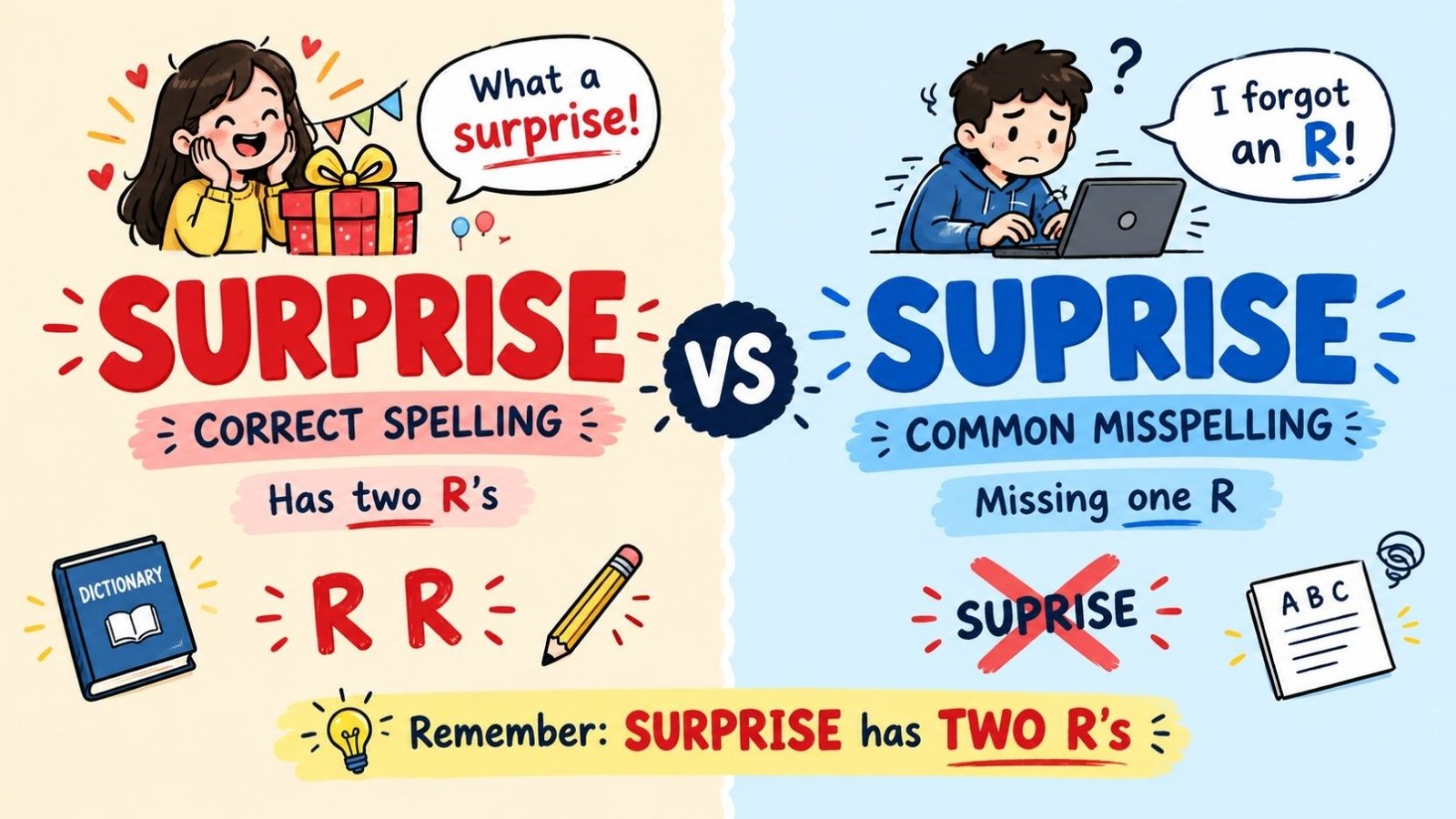
The correct spelling is surprise, not suprise. Suprise is a common misspelling that drops the first r, but it is not a recognized word in any English dictionary. If you have ever paused mid sentence wondering whether to write surprise or suprise, you are not alone. This mix-up happens because the word is easy to say quickly but slightly trickier to spell.
Surprise is a word most people use every week, whether they are planning a birthday party, reacting to unexpected news, or describing a plot twist in a movie. Getting the spelling right matters for schoolwork, professional writing, and everyday messages. This guide breaks down the meaning, grammar, pronunciation, and origin of surprise, and explains exactly why suprise never became the standard form.
Surprise or Suprise: The Quick Answer
Surprise is always the correct spelling in American English, British English, and every other standard variety of English. Suprise is simply a typo or a misheard version of the word, and it does not appear in Merriam Webster, the Oxford English Dictionary, Cambridge Dictionary, or any other established reference.
The confusion usually comes from pronunciation. When people say surprise quickly, the first r can sound soft or almost silent, especially in casual speech. That makes suprise look like a reasonable way to write the word, even though it is not.
| Spelling | Status | Found in Dictionaries |
| Surprise | Correct | Yes |
| Suprise | Incorrect | No |
If you remember one thing from this article, remember this: surprise has two r sounds built into its spelling, even if your mouth skips one of them when you talk fast.
What Does Surprise Mean?
Surprise has a few related meanings, and all of them connect to the idea of something unexpected.
Meaning 1: A Feeling of Mild Astonishment
Surprise can describe the emotion you feel when something happens that you did not expect. This is the most common everyday use of the word.
Example: Her sudden visit filled him with surprise.
Meaning 2: An Unexpected Event or Gift
Surprise can also refer to the thing itself, not just the feeling. A surprise party, a surprise gift, or a surprise announcement are all examples of this noun usage.
Example: The team had a surprise waiting for her at the office.
Meaning 3: To Cause Astonishment (Verb Form)
As a verb, to surprise someone means to catch them off guard or to do something they did not anticipate.
Example: The results surprised the entire research team.
These three meanings work together, but keeping them separate helps you understand how the word functions in a sentence, since the same spelling covers a noun, an adjective-related form, and a verb.
Surprise Grammar: Part of Speech and Sentence Structure
Surprise is flexible in English grammar. It can function as a noun, a verb, or the root of an adjective, depending on how it is used in a sentence.
Surprise As A Noun
When surprise is a noun, it names a feeling or an event.
Example: The news came as a complete surprise.
The plural form is surprises.
Example: Life is full of small surprises.
Surprise As A Verb
When surprise is a verb, it describes an action, usually one person or event affecting another.
Present tense: I surprise, you surprise, he or she surprises
Past tense: surprised
Past participle: surprised
Present participle: surprising
Example sentences:
She surprises her coworkers every year with homemade gifts.
He surprised his parents by graduating early.
They are surprising the whole neighborhood with a fireworks display.
Surprised As An Adjective
The past participle surprised often works as an adjective describing a person’s emotional state.
Example: I was surprised by how quickly the meeting ended.
Surprising As An Adjective
The present participle surprising describes something that causes the feeling of surprise.
Example: It was a surprising turn of events.
A quick way to remember the difference: use surprised for how a person feels, and surprising for what caused that feeling. Saying I am surprising means something very different from I am surprised, so this distinction matters in formal writing.
| Form | Type | Example |
| Surprise | Noun or base verb | It was a nice surprise. |
| Surprised | Adjective or past tense verb | I was surprised. |
| Surprising | Adjective or present participle | That was surprising news. |
| Surprisingly | Adverb | Surprisingly, she agreed right away. |
How To Pronounce Surprise?
Surprise is pronounced sur PRYZE, with the stress on the second syllable. In the International Phonetic Alphabet, it is written as /sərˈpraɪz/.
Here is a simple breakdown:
- The first syllable, sur, sounds like the word sir.
- The second syllable, prise, rhymes with the word eyes.
- The stress falls on prise, not on sur.
In fast, casual speech, especially in American English, the first r can sound very light. This is likely the reason so many people search for surprise or suprise in the first place. The sound is there, but it is easy to miss when the word is spoken quickly.
British and American pronunciations are very similar for this word, with only minor differences in vowel tone rather than in the actual sounds used.
Why Suprise Is Not a Real Word?
Suprise is not listed in any major dictionary, including Merriam Webster, Oxford, Cambridge, Collins, or Dictionary.com. It has no accepted definition, no grammatical entry, and no historical usage as a standalone word in standard English.
The reason suprise shows up so often in searches and casual writing comes down to two factors.
First, pronunciation. As mentioned above, the first r in surprise can be soft in natural speech, which makes it easy to drop when typing quickly.
Second, keyboard habits. When typing fast, it is common to skip a letter, especially when a word has two similar sounding syllables close together, like sur and prise.
Some readers also wonder if suprise might be an older or regional spelling. It is not. There is no historical record of suprise being an accepted variant in any documented stage of the English language.
Common Mistakes: Surprise vs Suprise
Here are the most frequent mistakes people make with this word, along with the correct form.
❌ Incorrect: That was a big suprise for everyone.
✅ Correct: That was a big surprise for everyone.
❌ Incorrect: I was suprised by the outcome.
✅ Correct: I was surprised by the outcome.
❌ Incorrect: She has a suprising talent for painting.
✅ Correct: She has a surprising talent for painting.
❌ Incorrect: He suprised his sister on her birthday.
✅ Correct: He surprised his sister on her birthday.
A simple memory trick: think of the phrase sur plus prise. Sur means over or above in French, and prise relates to grasping or taking. Remembering that the word is built from two parts, both starting with distinct sounds, can help you keep both r’s in place.
Origin And Etymology Of Surprise
Surprise comes from Old French, where it originally meant to be taken unaware or to be seized. The French word surprise is the feminine past participle of the verb surprendre, which combines sur, meaning over or beyond, with prendre, meaning to take or seize.
The word entered Middle English in the 14th century, initially carrying a stronger sense of being caught or overtaken, often in a military or physical context, such as an army being surprised by an ambush. Over time, the meaning softened and broadened to include the emotional reaction people feel today, whether from good news, bad news, or an unexpected event.
This history explains the spelling. Because surprise was borrowed directly from French rather than built from English word parts, its spelling follows French conventions rather than a phonetic English pattern. That is part of why the first r can feel unexpected to spell, even though it has always been part of the word.
Surprise In Different Contexts
Everyday Conversation
In daily conversation, surprise usually refers to a pleasant or neutral unexpected moment.
Example: What a surprise to see you here.
Formal Or Written English
In formal writing, surprise often appears in more structured sentences, describing reactions to events, data, or decisions.
Example: The board expressed surprise at the sudden change in leadership.
Business And News Writing
In business and news contexts, surprise frequently describes unexpected results, announcements, or shifts.
Example: The company posted a surprise profit despite a difficult quarter.
Emotional Or Personal Writing
In personal writing, surprise can carry more emotional weight, especially when paired with other feelings like joy, shock, or confusion.
Example: A mix of surprise and relief washed over her when she heard the news.
Synonyms And Related Words
Several words relate closely to surprise, though each carries a slightly different shade of meaning.
| Word | Meaning | Difference from Surprise |
| Astonish | To surprise greatly | Stronger, suggests amazement |
| Shock | To surprise in a jarring way | Often implies a negative or intense reaction |
| Amaze | To fill with wonder | Focuses more on awe than unexpectedness |
| Startle | To surprise suddenly | Often physical, involves a quick reaction |
| Stun | To surprise to the point of disbelief | Suggests the person is temporarily unable to react |
Surprise is the more neutral, general term. Astonish and amaze lean positive or wonder filled. Shock and stun often carry a heavier or more negative tone. Startle usually involves a sudden, brief physical reaction, like jumping at a loud noise.
Antonyms Of Surprise
Words with roughly the opposite meaning include:
- Expect
- Anticipate
- Predict
- Foresee
These words describe situations where an outcome was known in advance, the direct opposite of being caught off guard.
Examples of Surprise Used Correctly
Here are a few natural example sentences that show surprise working as different parts of speech.
- As a noun: The surprise on his face was impossible to hide.
- As a verb: Nothing seems to surprise her anymore.
- As an adjective (surprised): I was pleasantly surprised by the restaurant.
- As an adjective (surprising): It is surprising how quickly the year has gone by.
- As an adverb (surprisingly): Surprisingly, the test was easier than expected.
Surprise Or Suprise In British English
Surprise is spelled the same way in both British and American English. There is no regional variant that uses suprise instead. This is one of the few English words where spelling stays fully consistent across major English speaking countries, unlike words such as colour and color, which do change between British and American forms.
So whether you are writing for a UK audience, a US audience, or any other English speaking region, surprise is always the correct and only accepted spelling.
Frequently Asked Questions
Is it surprise or suprise?
It is always surprise. Suprise is a common misspelling and does not appear in any standard dictionary.
Why do people spell it suprise?
Because the first r in surprise is often soft or barely audible in fast speech, which makes it easy to accidentally drop when writing.
Is surprise a noun or a verb?
Surprise can be both. As a noun, it refers to a feeling or unexpected event. As a verb, it means to cause that feeling in someone else.
How do you pronounce surprise correctly?
It is pronounced sur PRYZE, with stress on the second syllable, written phonetically as /sərˈpraɪz/.
What is the past tense of surprise?
The past tense is surprised, as in she surprised her friends with the news.
What is the difference between surprised and surprising?
Surprised describes how a person feels. Surprising describes what caused that feeling. For example, the news was surprising, and I was surprised by it.
Is suprise ever correct in British English?
No. Suprise is not a recognized spelling in British English, American English, or any other standard form of English.
What is a synonym for surprise?
Common synonyms include astonish, amaze, startle, and shock, though each has a slightly different intensity or tone.
Where does the word surprise come from?
It comes from Old French, from the verb surprendre, meaning to overtake or seize, and entered English in the 14th century.
Is it surprise or suprise when spelling for a party?
It is surprise, as in surprise party. Suprise party is a misspelling, even though it appears often in casual writing and social media captions.
Conclusion
Surprise is the only correct spelling, whether you are describing a feeling, an event, or the action of catching someone off guard. Suprise is a misspelling that likely comes from how softly the first r is pronounced in everyday speech, but it has no place in formal or standard written English. Understanding the word’s grammar, from its noun and verb forms to its adjective forms like surprised and surprising, makes it much easier to use correctly in any sentence.
The next time you type this word, remember that it comes from the French surprendre, meaning to seize or overtake, and that its spelling has stayed consistent across centuries and across English speaking countries. Whether you are planning a surprise party, writing a business update, or just texting a friend about unexpected news, spelling it surprise, with both r’s in place, is always the safe and correct choice.

Zunaira Qasim is the author and creator of Gramvixo, dedicated to making English grammar easier for learners and everyday writers. With 4 years of experience researching grammar, confusing words, word choices, and common language mistakes, they create clear and practical content that helps readers understand English and use it with confidence.
2 Comments