
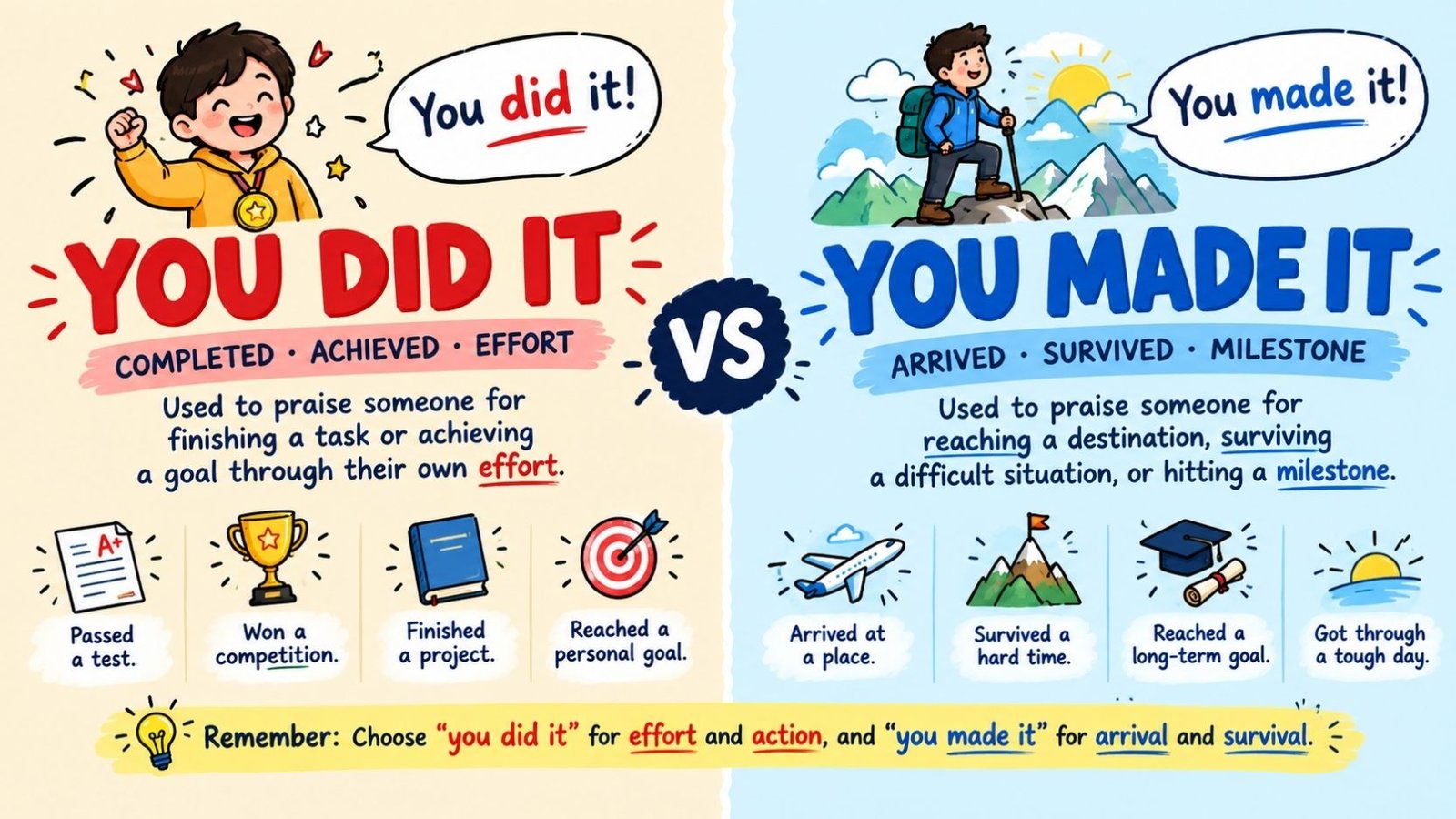
“You did it” means someone completed a task, achieved a goal, or accomplished something through their own effort. “You made it” means someone arrived somewhere, survived a difficult situation, or reached a milestone, often after struggle or uncertainty. Both phrases celebrate success, but they point to different kinds of success.
The difference matters because using the wrong phrase can send the wrong message. Telling a marathon runner “you made it” after they cross the finish line sounds natural, but telling them “you did it” right after they finally land a new job also works. Once you understand the small shift in meaning between these two phrases, you will know exactly which one fits your situation.
What Does “You Did It” Mean?
“You did it” is a short phrase used to congratulate someone for completing a specific action or achieving a specific result. It focuses on effort and accomplishment. The listener is being praised for something they actively caused to happen.
This phrase works well when someone:
- Finishes a project they were working on
- Passes an exam or a difficult test
- Wins a competition or a game
- Solves a problem after trying multiple times
- Reaches a personal goal, like finishing a book or learning a skill
Example: After months of practice, Sarah finally landed the backflip. Her coach shouted, “You did it!”
Here, the phrase points directly to the action Sarah performed. She trained, she tried, and she succeeded. “You did it” gives credit for the doing.
Read More: Surprise Or Suprise
What Does “You Made It” Mean?
“You made it” usually means someone arrived at a destination, survived something difficult, or reached a stage after a period of struggle or doubt. It often carries a sense of relief, not just achievement.
This phrase is common when someone:
- Arrives at an event, party, or meeting, sometimes after a long trip
- Survives a hard situation, like an illness or a dangerous circumstance
- Reaches a long-term milestone, like graduation or a promotion, after years of work
- Gets through a difficult day or a stressful stretch of time
Example: After a delayed flight and a missed connection, James walked into the wedding just as the ceremony started. His friend smiled and said, “You made it.”
In this case, “you made it” reflects relief that James arrived at all, not praise for a specific skill. The emphasis is on reaching a point, not on completing a task through effort alone.
You Did It vs You Made It: Quick Comparison
| Phrase | Core Meaning | Common Context | Emotional Tone |
| You did it | You completed or achieved something through effort | Finishing tasks, winning, solving problems | Pride, celebration |
| You made it | You arrived, survived, or reached a milestone | Arriving somewhere, surviving hardship, reaching a long-term goal | Relief, warmth, celebration |
This table shows the main pattern, but real usage is more flexible. Many situations allow either phrase, depending on what you want to emphasize.
The Core Difference: Effort Vs Arrival
The clearest way to separate these two phrases is to ask what you are actually praising.
💡 Tip: If you are praising the action itself, use “you did it.” If you are praising the fact that someone reached a point despite obstacles, use “you made it.”
Think about graduation day. Both phrases are common here, but they highlight different things.
- “You did it” praises the years of studying, writing papers, and passing classes. It focuses on what the graduate accomplished.
- “You made it” praises the fact that the graduate got through a long and sometimes exhausting journey and finally reached the end.
Neither phrase is wrong for graduation. Native speakers use both, and the choice often depends on personal style rather than a strict rule.
Grammar Of “You Did It”
“You did it” is a simple past tense sentence.
- You — subject pronoun, second person
- Did — past tense of the verb “do”
- It — object pronoun, referring to a task, goal, or action already mentioned or understood from context
The base verb is “do,” and “did” is its simple past form. This structure follows the standard subject, verb, object pattern found in everyday English sentences.
Verb forms of “do”:
| Tense | Form | Example |
| Present | do | You do it every day. |
| Past | did | You did it yesterday. |
| Present perfect | have done | You have done it before. |
| Future | will do | You will do it soon. |
“You did it” specifically uses the simple past because the action is already finished at the moment of speaking. That is why the phrase works so well right after someone completes something.
Read More: Hypothesis Or Hypotheses
Grammar of “You Made It”
“You made it” is also a simple past tense sentence, built the same way.
- You — subject pronoun
- Made — past tense of the verb “make”
- It — object pronoun, referring to a place, a deadline, or a difficult situation
“Made” is the irregular past tense of “make.” Unlike regular verbs that add “-ed,” “make” changes its spelling entirely in the past tense.
Verb forms of “make”:
| Tense | Form | Example |
| Present | make | You make it every time. |
| Past | made | You made it last night. |
| Present perfect | have made | You have made it through worse. |
| Future | will make | You will make it eventually. |
Because “made” is irregular, some learners of English mistakenly write “maked.” The correct past tense form is always “made.”
⚠️ Common Mistake
❌ Incorrect: You maked it to the finish line.
✅ Correct: You made it to the finish line.
“Make” never takes a regular “-ed” ending in the past tense. “Made” is the only correct past form.
Is “You Made It” an Idiom?
Yes, in many contexts, “you made it” functions as an idiom. When someone says “you made it,” they are rarely talking about physically manufacturing something. Instead, the phrase has taken on a figurative meaning tied to arrival, survival, or success.
This idiomatic use is why “you made it” can describe so many different situations, from arriving at a party to surviving a hard year. The literal meaning of “make” (to create or produce) has shifted into a broader sense of reaching or achieving.
“You did it,” on the other hand, stays closer to its literal meaning. The phrase almost always refers to a specific action the person actually performed.
You Made It: Common Contexts and Variations
The phrase “you made it” appears in many everyday situations, and small changes in wording adjust the meaning slightly.
You Made It Safely / You Made It Home Safe
“Glad you made it home safely” is a common way to express relief that someone arrived without an accident or problem. This phrase is often used after a trip, especially at night or in bad weather.
Both “safely” and “safe” appear in casual speech. “Safely” is the grammatically standard adverb form, since it describes how someone traveled. “Safe” is technically an adjective, but it is widely accepted in informal spoken English, as in “glad you made it home safe.” In formal writing, “safely” is the more accurate choice.
You Made It Weird
“You made it weird” means someone’s words or actions turned a normal or comfortable moment into an awkward one. This phrase is used casually, often as a lighthearted accusation among friends.
Example: “It was a nice conversation until you brought up my ex. You made it weird.”
This use of “made” follows the “make + adjective” pattern, meaning “caused something to become.” It works the same way as phrases like “you made it difficult” or “you made it clear.”
You Made It Feel Like Home
“You made it feel like home” is a warm, emotional phrase used to thank someone for creating comfort or belonging in a place. It often appears in messages to hosts, roommates, or partners.
Example: “Thank you for the warm welcome. You made it feel like home.”
You Made It to Friday
“You made it to Friday” is a common motivational phrase used at the end of a long work week. It treats the entire week as a challenge that someone has now survived or completed.
Look at You, You Made It Out
“Look at you, you made it out” usually refers to someone escaping a difficult situation, environment, or period of life. This phrasing carries a stronger sense of struggle than a simple arrival, often implying that leaving was genuinely hard.
You Did It: Common Contexts and Variations
“You did it” also shows up in several familiar situations, almost always tied to a completed action.
Congratulations, You Did It
This is one of the most common congratulatory phrases in English. It appears on graduation cards, achievement posts, and celebration messages. It works for almost any accomplishment, from finishing school to completing a personal goal.
You Did It Meme and You Did It Gif
“You did it” is widely used in internet culture as a meme and reaction gif, often shown with a celebratory image or character. These are typically used online to congratulate someone in a lighthearted or humorous way, matching the same core meaning as the spoken phrase.
Just Because You Did It Doesn’t Mean You’re Guilty
This longer sentence uses “did it” in a different sense, referring to committing an action, often in a legal or accusatory context. Here, “did it” simply means “performed the act in question,” separate from the celebratory meaning discussed earlier in this article. Context always determines whether “did it” is a compliment or an accusation.
Synonyms And Related Phrases
Both phrases have alternatives that native speakers use depending on tone and situation.
| Phrase | Similar Meaning | Difference |
| You did it | You pulled it off | “Pulled it off” often suggests the task was difficult or uncertain |
| You did it | Way to go | “Way to go” is more casual and enthusiastic |
| You made it | You got here | “Got here” is more neutral, without the sense of relief |
| You made it | You pulled through | “Pulled through” emphasizes survival or recovery specifically |
| You made it | You reached it | “Reached it” is more literal and less emotional |
These alternatives are not perfect substitutes. Each one shifts the tone slightly, so the best choice depends on how formal or emotional the moment feels.
When Either Phrase Works
Some situations genuinely allow both phrases without changing the meaning much. Graduation, as mentioned earlier, is a strong example. So is finishing a long-term project after a difficult stretch of time.
Example: After a two-year renovation, the couple finally moved into their finished home.
- “You did it” praises their work and planning.
- “You made it” praises their persistence through a long, tiring process.
In cases like this, either phrase is correct. The choice simply depends on whether you want to highlight the effort behind the achievement or the relief of finally reaching the end of it.
Common Mistakes With These Phrases
⚠️ Mistake 1: Using “you made it” for a skill-based achievement with no arrival or survival element
❌ Less natural: You made it on the final exam.
✅ More natural: You did it on the final exam.
An exam is a task completed through effort, not a place reached or a hardship survived, so “you did it” fits more naturally.
⚠️ Mistake 2: Confusing the past tense of “make”
❌ Incorrect: You have maked great progress.
✅ Correct: You have made great progress.
⚠️ Mistake 3: Dropping “it” when the object is unclear
❌ Unclear: You did!
✅ Clear: You did it! (referring to a specific, understood achievement)
Without a clear reference point, “you did!” can sound incomplete or confusing to a reader who does not already know the context.
Related Grammar Question: Is “You Did Good” Grammatically Correct?
“You did good” is common in casual speech, but it is not considered grammatically correct in formal English. “Good” is an adjective, while the verb “did” needs an adverb to describe how the action was performed. The grammatically correct version is “you did well,” since “well” is the adverb form.
That said, “you did good” is widely understood and commonly used in informal conversation, especially in spoken English. It is worth knowing the difference, even if you choose the informal version in casual settings.
Related Grammar Question: Is “Just You and Me” Grammatically Correct?
Yes, “just you and me” is grammatically correct. Many people mistakenly say “just you and I” because it sounds more formal, but that is incorrect in this context. “You and me” functions as the object of the sentence, and object pronouns like “me” are correct in that position, not subject pronouns like “I.”
Example: “It’s just you and me tonight,” is correct, not “It’s just you and I tonight.”
Read More: Chrysalis Vs Cocoon
Pronunciation
Both phrases are pronounced using natural, everyday stress patterns in American English.
- “You did it” is pronounced with stress on “did”: you DID it.
- “You made it” is pronounced with stress on “made”: you MADE it.
In fast, casual speech, “it” often softens, and the phrases can sound like “you did-it” and “you made-it,” spoken quickly as one rhythmic unit. This is normal in spoken English and does not change the meaning.
Frequently Asked Questions
What does “you did it” mean?
“You did it” means someone completed a task, achieved a goal, or accomplished something through their own effort.
What does “you made it” mean?
“You made it” means someone arrived somewhere, survived a difficult situation, or reached a milestone, often after struggle or a long process.
Is “you made it” a noun or a verb phrase?
“You made it” is a verb phrase. “Made” is the past tense of the verb “make,” and the full phrase functions as a short sentence, not a noun.
How do you use “you did it” in a sentence?
Use “you did it” right after someone completes a specific action or achievement, such as “You studied for months, and you did it, you passed.”
How do you use “you made it” in a sentence?
Use “you made it” when someone arrives or reaches a point after difficulty, such as “The roads were terrible, but you made it to the party on time.”
Is it “you made it safe” or “you made it safely”?
“You made it safely” is grammatically correct because “safely” is an adverb describing how someone traveled. “You made it safe” is common in casual speech but is not the formally correct version.
Can “you did it” and “you made it” mean the same thing?
In some situations, such as graduation or finishing a long project, both phrases can apply. “You did it” focuses on the effort involved, while “you made it” focuses on reaching the end of a difficult journey.
What is the past tense of “make”?
The past tense of “make” is “made,” which is an irregular verb form, not “maked.”
Is “you did it” appropriate for graduation?
Yes, “you did it” is a common and appropriate phrase for graduation, since it praises the years of work that led to the achievement.
Is “you made it” appropriate for graduation?
Yes, “you made it” also works well for graduation, especially when emphasizing how long or difficult the journey was.
Conclusion
“You did it” and “you made it” both celebrate success, but they highlight different parts of the story. “You did it” praises the action someone took and the effort behind a specific result, while “you made it” praises arrival, survival, or reaching a milestone after a challenging path. Understanding this distinction helps you choose the phrase that actually matches what you want to say, rather than picking whichever one comes to mind first.
In many everyday situations, from graduations to long journeys, either phrase can work. What matters most is thinking about whether you are congratulating someone for what they did, or for how far they came to get there. Once you notice that difference, choosing between “you did it” and “you made it” becomes much easier.

Zunaira Qasim is the author and creator of Gramvixo, dedicated to making English grammar easier for learners and everyday writers. With 4 years of experience researching grammar, confusing words, word choices, and common language mistakes, they create clear and practical content that helps readers understand English and use it with confidence.
2 Comments