
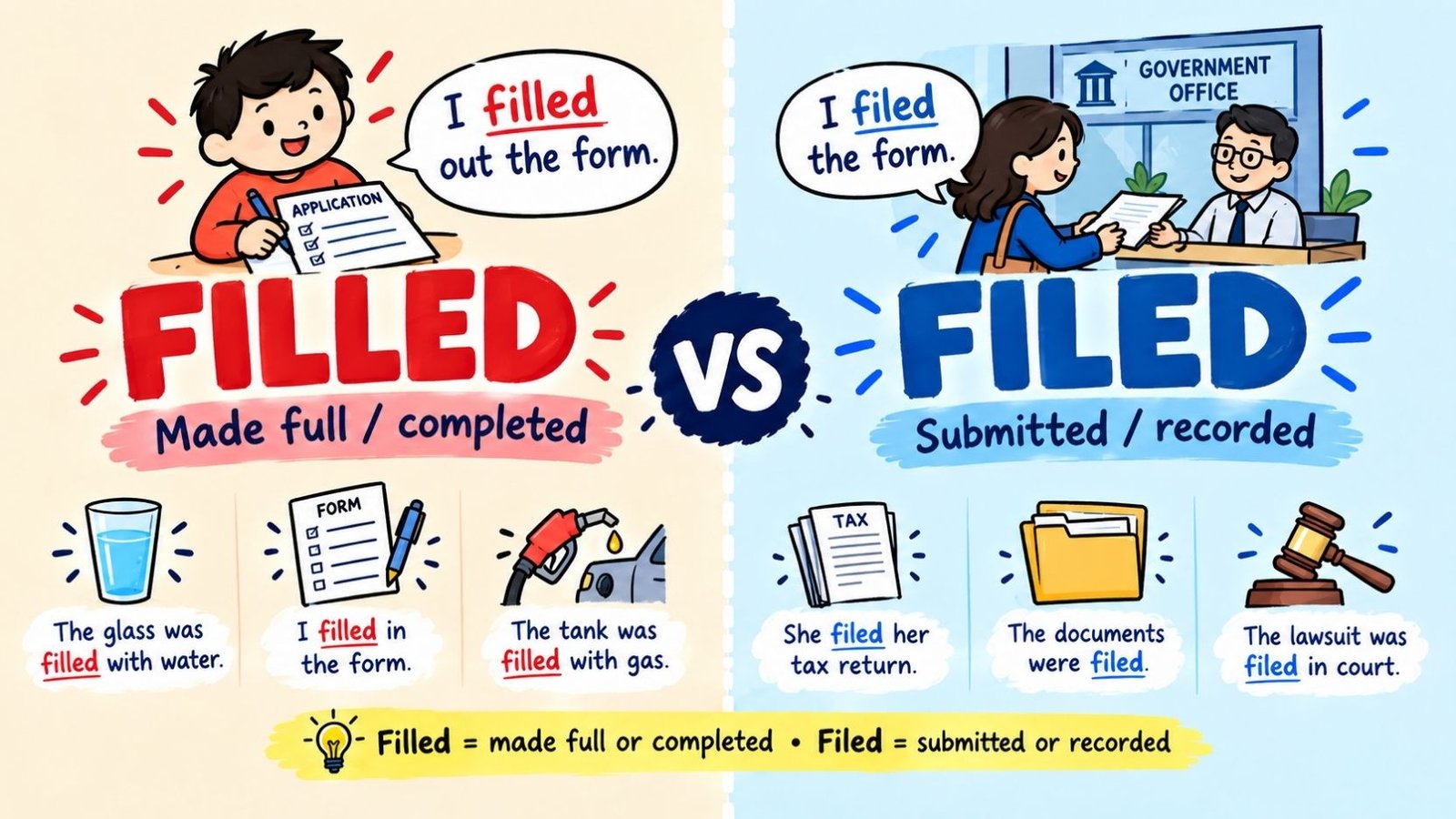
Filled or filed is a common mix up because the two words look similar but mean very different things. Filled means something was made full, like a form completed with information or a jar packed with liquid. Filed means something was submitted, recorded, or placed into an official system, like paperwork sent to a court or a tax return sent to the government.
This confusion happens because filled and filed sound alike and both often describe what people do with forms and documents. Understanding the difference matters for everyday writing, tax season, legal paperwork, and even casual conversation. Once you see the pattern, you will never mix them up again.
Filled Or Filed: The Quick Answer
Here is the short version before we go deeper.
Filled is the past tense of fill. It means to make something full or to complete something by adding information.
Filed is the past tense of file. It means to submit, organize, or place a document into a system, often an official one.
| Word | Base Verb | Core Meaning | Typical Use |
| Filled | Fill | Made full, completed with content | A jar filled with water, a form filled with details |
| Filed | File | Submitted or recorded officially | Taxes filed, a lawsuit filed, papers filed |
If you are asking whether to write “I filled out my tax return” or “I filed my tax return,” both can be correct, but they mean slightly different things. Filling out a form means writing the information into it. Filing the form means sending it to the right office once it is done.
See More: Inexcusable Vs Unexcusable
What Does Filled Mean?
Filled is the past tense and past participle of the verb fill. It describes the action of making something full or complete.
Meaning 1: Made Full With a Substance
This is the most common everyday meaning. Something that was empty now has content inside it.
- The glass was filled with juice.
- The tank was filled with gas.
- Her eyes filled with tears.
Meaning 2: Completed With Written Information
When people talk about paperwork, filled usually refers to writing details into blank spaces on a form.
- She filled in her name and address.
- He filled out the application before the deadline.
Meaning 3: Occupied a Role or Position
Filled can also describe a job, seat, or vacancy that has been taken.
- The position was filled last week.
- All the seats in the theater were filled.
What Does Filed Mean?
Filed is the past tense and past participle of the verb file. It usually means one of two related things: organizing documents, or officially submitting them.
Meaning 1: Submitted to an Official System
This is the meaning people search for most, especially around taxes, lawsuits, and government paperwork.
- She filed her tax return before the deadline.
- The company filed for bankruptcy.
- He filed a police report after the incident.
Meaning 2: Organized or Stored Documents
File also describes the simple act of putting papers into folders or a system for later reference.
- The clerk filed the documents alphabetically.
- I filed the receipts in a folder.
Meaning 3: Smoothed With a Tool (Unrelated Sense)
There is also a completely different meaning tied to the noun “file” as a tool.
- She filed her nails before the event.
- He filed the rough edge of the metal.
This meaning has nothing to do with paperwork. It comes from a separate word history, which we will cover in the origin section.
Filled Or Filed: Side By Side Comparison
Seeing both words in similar sentences makes the difference clearer.
| Situation | Correct Word | Example Sentence |
| Writing information into blank spaces | Filled | I filled in the application form. |
| Submitting the form to an office | Filed | I filed the application with the county office. |
| A cup with coffee inside it | Filled | The cup was filled with coffee. |
| A legal case sent to court | Filed | The lawsuit was filed in federal court. |
| A job vacancy that is taken | Filled | The manager position was filled yesterday. |
| Tax paperwork sent to the IRS | Filed | Millions of Americans filed their taxes in April. |
Filled Or Filed: Which Is Correct For Tax Forms?
This is one of the most searched versions of this question, so it deserves its own explanation.
When you write information into your tax form, you filled it out.
When you send that completed form to the IRS or state tax agency, you filed it.
So the natural sentence progression looks like this:
I filled out my tax return, then I filed it before the deadline.
Both actions usually happen together during tax season, which is exactly why people confuse the two words. Filling is the writing step. Filing is the submission step.
Filed Taxes: Common Real Questions
People frequently search about tax filing deadlines and requirements. Tax filing dates can shift slightly year to year based on IRS announcements, so always confirm the exact date directly with the IRS or a tax professional for the current tax year rather than relying on a general date.
For married couples, the phrase “married filing jointly” describes a filing status, not a grammar rule. It refers to the tax bracket structure used when spouses submit one combined tax return instead of separate ones.
See More: Speach Or Speech
Filled Or Filed Form: What Is the Difference?
“Filled form” and “filed form” describe two different stages of the same document.
A filled form is one where the blank fields now contain information. Nothing has been submitted yet.
A filed form is one that has already been submitted, recorded, or officially received by the relevant office or organization.
💡 Tip: If the form is sitting on your desk with information written in it, it is filled. Once it has been sent, submitted, or stamped as received, it becomes filed.
Example Progression
- You receive a blank form.
- You filled in your personal details.
- You reviewed everything for accuracy.
- You filed the completed form with the appropriate office.
Duly Filled Or Filed: What This Phrase Means
You may come across the phrase “duly filled” in formal or legal writing, especially on official applications. Duly filled means the form was correctly and properly completed according to the required instructions. It focuses on the accuracy and completeness of the information written into the form, not on whether it was submitted.
A separate but related phrase, “duly filed,” means the document was properly and officially submitted according to the required process. Some formal documents use both terms together, such as “duly filled and filed,” to confirm that a form was correctly completed and then correctly submitted.
Common Mistakes With Filled And Filed
Even confident writers slip up here, usually because the words sound close and often appear in the same sentence.
❌ Incorrect: I filed out the form before mailing it.
✅ Correct: I filled out the form before mailing it.
❌ Incorrect: She filled a complaint against her landlord.
✅ Correct: She filed a complaint against her landlord.
❌ Incorrect: The tank was filed with water.
✅ Correct: The tank was filled with water.
❌ Incorrect: He filled his taxes on time this year.
✅ Correct: He filed his taxes on time this year.
A simple way to check yourself: if you are talking about something becoming full or being written into, use filled. If you are talking about paperwork being submitted or stored in a system, use filed.
Pronunciation Of Filled And Filed
The pronunciation difference is small but important, since it affects how people hear and remember these words in speech.
Filled is pronounced with a short “i” sound, similar to the word “fill” with a “d” added at the end. It rhymes with “billed” and “skilled.”
Filed is pronounced with a long “i” sound, similar to the word “file” with a “d” added at the end. It rhymes with “smiled” and “piled.”
⚠️ Common mistake: Some non native English speakers pronounce both words the same way, which increases the chance of writing the wrong one. Practicing the vowel sound difference out loud, short “i” for filled versus long “i” for filed, can help fix both the spoken and written mix up.
Grammar Breakdown: Fill Versus File
Understanding the base verbs makes the past tense forms easier to remember.
| Base Verb | Present Tense | Past Tense | Past Participle | Present Participle |
| Fill | fill / fills | filled | filled | filling |
| File | file / files | filed | filed | filing |
Both verbs are regular verbs, meaning they simply add “ed” to form the past tense. Fill becomes filled. File becomes filed, with the silent “e” dropped before adding “ed.”
This regular pattern is actually helpful. Once you know the base verb you mean, fill or file, the correct past tense follows automatically.
Origin Of Fill And File
Fill comes from Old English “fyllan,” related to the word “full.” Its core meaning, making something complete or full, has stayed consistent for centuries.
File has a more layered history. The paperwork sense of file comes from the French word “filer,” meaning to string documents together, originally referring to papers literally threaded on a string or wire for storage. Over time, this evolved into the modern meaning of organizing or submitting documents.
The tool sense of file, as in filing your nails, comes from a separate Old English word, “feol,” referring to a metal tool used for smoothing surfaces. Although both meanings share the spelling “file,” they developed from different word roots and are not directly connected in meaning.
Filled Or Filed In Different Contexts
Legal Context
In legal writing, filed almost always refers to submitting documents to a court or government office.
- The attorney filed the motion before the hearing.
- Charges were filed against the suspect.
Business Context
Businesses often use filed for regulatory or official submissions, and filled for completing internal forms or fulfilling orders.
- The company filed its annual report with regulators.
- The warehouse team filled the customer order.
Everyday Conversation
In casual speech, filled usually appears far more often than filed, since it describes ordinary actions like eating, drinking, or completing simple forms.
- I filled up the car with gas.
- She filled the basket with fruit.
Synonyms For Filled
Understanding related words can help clarify meaning further.
| Word | Meaning | Example Use |
| Packed | Filled tightly with something | The suitcase was packed with clothes. |
| Loaded | Filled with a heavy or large amount | The truck was loaded with boxes. |
| Completed | Finished writing required information | She completed the form. |
| Stuffed | Filled to the point of being full | The pillow was stuffed with feathers. |
Synonyms for Filed
| Word | Meaning | Example Use |
| Submitted | Sent officially for review or processing | He submitted the report on time. |
| Recorded | Officially noted or entered into a system | The transaction was recorded. |
| Registered | Formally entered into an official system | The business was registered with the state. |
| Lodged | Formally submitted, often used in legal contexts | The complaint was lodged with the agency. |
Filled Versus Other Confusing Word Pairs
Filled and filed are not the only pair that trips people up. If you found this comparison helpful, you may also want to understand the difference between similar sounding word pairs like “compliment and complement,” or “affect and effect,” which follow a similar pattern of small spelling differences leading to very different meanings.
Gold Filled And Oil Filled: A Different Kind Of Filled
The word filled also appears in product names, and these uses can confuse readers searching for jewelry or appliances rather than grammar help.
Gold Filled Jewelry
Gold filled jewelry is not the same as gold plated jewelry, and the difference matters if you are shopping for quality.
Gold filled jewelry has a thick layer of real gold that is mechanically bonded to a base metal using heat and pressure. This layer is significantly thicker than plating, so gold filled pieces tend to last much longer and resist fading.
Gold plated jewelry has a much thinner layer of gold applied through an electroplating process. It generally wears off faster than gold filled jewelry, especially with daily use.
| Feature | Gold Filled | Gold Plated |
| Gold layer thickness | Thicker, bonded layer | Very thin, electroplated layer |
| Durability | Longer lasting | Wears off faster |
| Price | Generally higher | Generally lower |
| Best for | Long term everyday wear | Occasional wear or lower budget |
Oil Filled Heaters
An oil filled heater, sometimes called an oil filled radiator, is a type of space heater that contains a reservoir of thermal oil inside its metal fins. The oil itself is never burned or consumed. Instead, an electric element heats the oil, and the oil retains and radiates that heat slowly into the room. This design makes oil filled heaters known for steady, lasting warmth even after they are switched off.
These product related uses of filled are unrelated to the grammar comparison with filed. They simply share the same base word because something, in this case gold or oil, has been used to fill or coat the object.
Filed Nails: Another Everyday Use
“Filed nails” refers to nails that have been shaped or smoothed using a nail file, a small hand tool with an abrasive surface. This meaning connects to the tool sense of file mentioned earlier in the origin section, not the paperwork sense.
- She filed her nails into a rounded shape.
- Regularly filed nails are less likely to catch on clothing or break.
Quick Reference: When to Use Filled
Use filled when you mean:
- Something became full of a substance
- Someone wrote information into blank spaces on a form
- A position, seat, or vacancy was taken
- A product contains a filling material, like gold filled jewelry or oil filled heaters
Quick Reference: When to Use Filed
Use filed when you mean:
- A document was submitted to an official office or system
- Paperwork was organized or stored for reference
- A legal action, like a lawsuit or complaint, was formally submitted
- Nails or a rough surface were smoothed with a file tool
See More: Seemless Or Seamless
Frequently Asked Questions
What does filled or filed mean?
Filled means something was made full or completed with written information. Filed means something was submitted, recorded, or organized, often in an official system like a court or tax office.
Is it filled or filed for a form?
Both can apply, but they describe different steps. You filled out the form when you wrote information into it. You filed the form when you submitted it to the required office.
Is filled or filed the correct spelling for taxes?
Filed is correct when talking about submitting your tax return. Filled is correct if you are describing the act of writing your details into the tax form itself.
How do you pronounce filled and filed?
Filled uses a short “i” sound and rhymes with “billed.” Filed uses a long “i” sound and rhymes with “smiled.”
Is filled a noun or a verb?
Filled is a verb. It is the past tense and past participle form of the verb fill.
Is filed a noun or a verb?
Filed is primarily used as a verb, the past tense and past participle of file. File can also function as a noun, referring to a folder or a stored document.
What is the difference between gold filled and gold plated?
Gold filled jewelry has a thicker, mechanically bonded layer of gold, making it more durable. Gold plated jewelry has a thin, electroplated layer that tends to wear off faster.
What does duly filled mean?
Duly filled means a form was correctly and completely filled out according to the required instructions, before it is submitted.
Can filed mean something other than paperwork?
Yes. Filed can also describe smoothing an object, like filed nails, using a small tool called a file. This meaning is unrelated to submitting documents.
Why do people confuse filled and filed?
The two words look and sound similar, and both often appear when discussing forms and paperwork, which makes it easy to use the wrong one without noticing.
Final Thoughts
Filled and filed both come from simple, regular verbs, but they point in different directions. Filled is about making something full or writing information into a space. Filed is about submitting or organizing something, often within an official process like taxes, legal paperwork, or business records. Once you separate these two ideas, choosing the right word becomes automatic.
Whether you are completing a tax return, sending a legal document, or just describing a jar of water, remembering the small difference between these two past tense verbs will keep your writing accurate and clear. A quick mental check, full versus submitted, is often all it takes to pick the correct word every time.

Zunaira Qasim is the author and creator of Gramvixo, dedicated to making English grammar easier for learners and everyday writers. With 4 years of experience researching grammar, confusing words, word choices, and common language mistakes, they create clear and practical content that helps readers understand English and use it with confidence.

2 Comments