
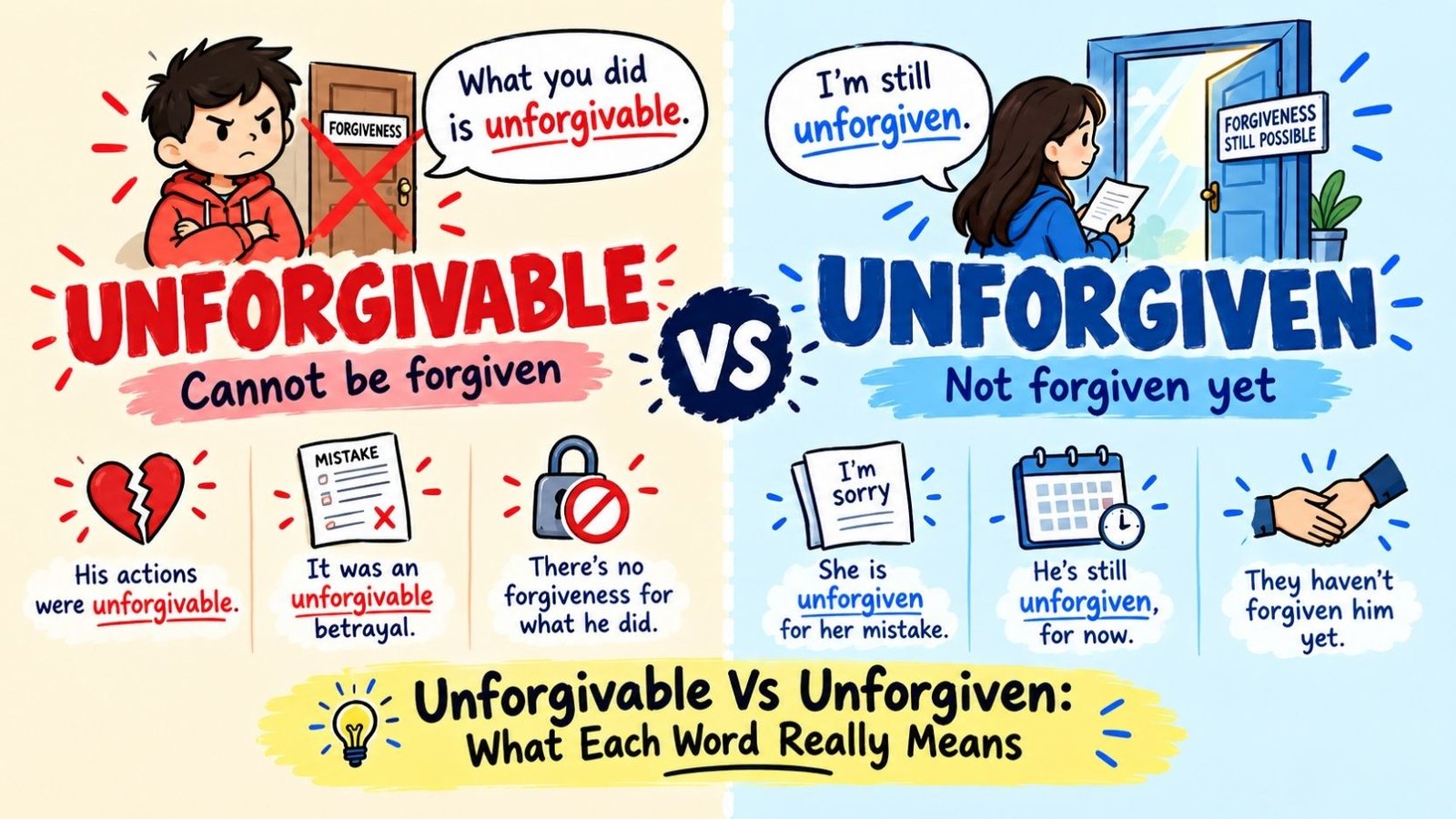
Unforgivable and unforgiven look almost identical, but they do different jobs in a sentence. Unforgivable describes something so bad that it cannot be pardoned. Unforgiven describes someone or something that has not yet received forgiveness, even if forgiveness is still possible. The difference sits entirely in one idea: permanence.
That small difference matters more than most readers expect. It shapes how you talk about mistakes, sins, grudges, and even pop culture, since both words show up everywhere from religious teaching to Netflix titles, Metallica lyrics, and a cologne bottle. Once you understand the grammar behind each word, the rest becomes easy to sort out.
Unforgivable Meaning
Unforgivable is an adjective. It describes an act, comment, or behavior that is too severe, cruel, or damaging to ever be excused. When someone calls a betrayal unforgivable, they mean forgiveness is not on the table, now or later.
The word carries a sense of finality. It is not simply “hard to forgive.” It suggests the door is closed for good. People use it in emotional situations, such as a broken friendship, a cruel remark, or a serious betrayal of trust.
- Part of speech: adjective
- Core meaning: incapable of being forgiven
- Tone: strong, final, emotionally loaded
- Common use: describing actions, words, or behavior
Example sentences:
- Lying to your best friend about something that serious felt unforgivable to her.
- The coach called the referee’s decision unforgivable.
- Some fans still think the plot twist was unforgivable.
See More: Chrysalis Vs Cocoon
Unforgiven Meaning
Unforgiven is also an adjective, but it works differently. It describes a person, action, or debt that has not been forgiven yet. Unlike unforgivable, it does not claim that forgiveness is impossible. It simply states that forgiveness has not happened.
This is the key grammatical distinction. Unforgivable is about capability. Unforgiven is about status. Something can be unforgiven today and forgiven tomorrow. Something unforgivable, by definition, stays that way.
- Part of speech: adjective
- Core meaning: not yet forgiven
- Tone: neutral to serious, but not necessarily final
- Common use: describing a current state, often in formal, religious, or narrative writing
Example sentences:
- He went to his grave with old grievances unforgiven.
- Her harsh words remained unforgiven for years, though the two eventually reconciled.
- The debt sat unforgiven on the family ledger.
Unforgivable Vs Unforgiven: Quick Comparison
The table below lays out the core difference in one glance.
| Word | Meaning | Implies Permanence? | Typical Use |
| Unforgivable | Cannot ever be forgiven | Yes | Describing a severe act or behavior |
| Unforgiven | Has not been forgiven yet | No | Describing a current, possibly temporary, state |
💡 Tip: If you can imagine forgiveness happening later, use unforgiven. If forgiveness feels permanently off the table, use unforgivable.
Grammar Breakdown
Both words are adjectives built from the verb forgive, but they use different word-formation patterns, and that pattern is exactly why their meanings diverge.
Unforgivable combines:
- The prefix un- (not)
- The verb forgive
- The suffix -able (capable of)
This structure means “not capable of being forgiven.” The -able suffix is what creates the sense of possibility, or in this case, impossibility.
Unforgiven combines:
- The prefix un- (not)
- The past participle forgiven
This structure means “not forgiven,” describing a completed or ongoing state rather than a capability. Forgiven itself is the past participle of forgive, so unforgiven functions almost like a passive description, similar to unwashed or unopened.
Why the Suffix Changes the Meaning
The -able ending in English regularly signals possibility or capacity, as in readable, breakable, or comparable. The -en ending in forgiven, by contrast, marks a completed action, similar to broken, spoken, or written. That grammatical pattern explains why unforgivable sounds absolute while unforgiven sounds like a status that could shift.
How To Pronounce Unforgivable And Unforgiven
Both words follow standard American English stress patterns.
- Unforgivable: uhn-fer-GIV-uh-bul (stress on the third syllable, “GIV”)
- Unforgiven: uhn-fer-GIV-en (stress also on “GIV”)
The core syllable “give” carries the emphasis in both words, since it holds the root meaning. Speakers rarely mispronounce these words, but the stress placement is worth noting for anyone learning English, since misplaced stress can make the word harder to recognize in conversation.
Origin Of Unforgivable And Unforgiven
Both words trace back to the Old English verb forgiefan, which meant to give up, to grant, or to pardon. Over time this evolved into the modern verb forgive, meaning to pardon an offense or stop feeling angry about a wrong.
The prefix un- has been used in English for centuries to reverse or negate a meaning, and it was attached to forgive and forgiven separately as the language developed. Unforgivable, with its -able suffix, reflects a pattern common in English where the ability or incapacity to do something is expressed by adding -able to a verb, as seen in words like unbearable or unbelievable. Unforgiven follows the older, simpler pattern of negating a past participle, the same pattern found in words like unloved or unspoken.
See More: Hypothesis Or Hypotheses
Unforgivable In Different Contexts
The word unforgivable shows up in several distinct settings beyond everyday conversation. Understanding these contexts helps explain why so many people search for the term.
The Unforgivable Sin in Religious Context
One of the most common searches connected to this word involves the unforgivable sin described in the Bible. In Christian teaching, this sin is usually identified as blasphemy against the Holy Spirit.
According to Mark 3:28 and Matthew 12:22 through 32, Jesus said that people can be forgiven for their sins and even for slander, but blasphemy against the Holy Spirit will never be forgiven. This is generally treated as a single, specific exception rather than a broad category of sins.
Bible scholars explain the reasoning behind this teaching in a fairly consistent way. Forgiveness depends on repentance, and repentance depends on conviction, which comes from the Holy Spirit. When someone rejects the Holy Spirit’s work, they cut off the very source that would normally lead them toward repentance.
Theologians also stress that this sin is not a single slip of the tongue. Blasphemy against the Holy Spirit is not simply saying something negative about the Spirit. It describes an ongoing, deliberate rejection of the Spirit’s work of exposing sin and pointing people toward faith.
This distinction matters for a commonly asked question: is suicide an unforgivable sin? Most mainstream Christian teaching does not classify suicide as the unforgivable sin described in the Gospels, since that sin is specifically tied to a persistent, willful rejection of the Holy Spirit rather than any single tragic act. Because interpretations vary across denominations, readers with personal or theological concerns are generally encouraged to speak with a pastor, priest, or religious counselor for guidance specific to their tradition.
⚠️ Note: Bible scholars widely agree that a person who worries they may have committed the unforgivable sin has almost certainly not committed it, since that concern itself reflects a conscience still responsive to conviction.
Unforgivable Curses in Fiction
Outside religious contexts, “unforgivable” also appears in popular fiction. In the Harry Potter book and film series, the “Unforgivable Curses” are three dark spells so dangerous that using any of them carries a severe magical penalty. The name reflects the same core meaning discussed earlier: these actions are considered beyond excuse within the story’s moral framework, regardless of intent or circumstance.
The Unforgivable, the 2021 Film
Unforgivable also functions as a title. The Unforgivable is a 2021 psychological drama released on Netflix. It stars Sandra Bullock as a woman released from prison after serving twenty years for killing a sheriff who came to evict her, and the story follows her attempt to reconnect with her estranged younger sister. The film was directed by Nora Fingscheidt and based on the 2009 British miniseries “Unforgiven,” written by Sally Wainwright.
The cast of The Unforgivable includes several well-known names. Alongside Sandra Bullock, the film stars Vincent D’Onofrio, Jon Bernthal, Richard Thomas, Linda Emond, Aisling Franciosi, Rob Morgan, and Viola Davis. It received a limited theatrical release in the United States on November 24, 2021, before streaming on Netflix starting December 10, 2021.
Sean John Unforgivable Cologne
Unforgivable is also a fragrance brand name. Unforgivable by Sean John is an aromatic fougere fragrance for men that launched in 2006, created by perfumers David Apel, Pierre Negrin, Aurélien Guichard, and Caroline Sabas. The scent won the FiFi Award for Fragrance of the Year in the Men’s Luxe category in 2007. The fragrance was released by Sean Combs under his Sean John label and remains one of the more recognizable celebrity colognes on the market.
Unforgiven In Different Contexts
The word unforgiven has its own set of well-known cultural references, mostly tied to film and music titles rather than everyday speech.
Unforgiven, the 1992 Clint Eastwood Film
Unforgiven is widely known as the title of a 1992 American western. The film was produced and directed by Clint Eastwood from a screenplay by David Webb Peoples, and it stars Eastwood as William Munny, an aging outlaw who takes on one final job years after leaving his violent past behind. The film also stars Gene Hackman, Morgan Freeman, and Richard Harris.
Fans frequently ask where Unforgiven was filmed. The 1992 movie was filmed on location in Alberta, Canada. Some additional scenes were also shot in Sonora, California. The set built for the film’s fictional town of Big Whiskey has been preserved on a large Alberta property known as The Ranch at Fisher Creek.
The film remains one of Eastwood’s most acclaimed works. Unforgiven won four Academy Awards, including Best Director for Eastwood, and is considered a revisionist western that challenges the genre’s usual glorification of violence.
The Unforgiven, the 1960 Film
A separate, older film uses the title The Unforgiven. Released in 1960, this western was directed by John Huston and starred Burt Lancaster and Audrey Hepburn, with a supporting cast that included Audie Murphy, Charles Bickford, Lillian Gish, and John Saxon. The story was based on a 1957 novel by Alan Le May and was filmed in Durango, Mexico.
The plot centers on a frontier family whose community turns against them after rumors spread that their adopted daughter, played by Hepburn, may actually be Native American by birth. The film is often cited for addressing racial prejudice in the Old West, though critics have noted its portrayal is imperfect by modern standards.
Metallica’s “The Unforgiven”
Unforgiven is also closely tied to music, largely because of Metallica’s well-known song of the same name. “The Unforgiven” was released as the second single from Metallica’s self-titled 1991 album, often called The Black Album, and was released on October 28, 1991. The song explores the struggle of an individual against forces that try to control or subjugate him, a theme the band later revisited in two sequel songs, “The Unforgiven II” and “The Unforgiven III.”
Out of respect for copyright, this article will not reproduce the song’s lyrics. Readers who want the exact wording can find it through a licensed lyrics platform or official Metallica release.
Unforgiven and Le Sserafim
More recently, “Unforgiven” has appeared as a song and album title from the K-pop group Le Sserafim. As with the Metallica track, the word signals the same core meaning: something, or someone, still waiting on forgiveness that has not arrived.
Similar Words And Related Terms
Several words sit close to unforgivable and unforgiven in meaning, but each carries its own shade of difference.
| Word | Meaning | Difference From Unforgivable / Unforgiven |
| Inexcusable | Cannot be justified or excused | Focuses on justification rather than forgiveness specifically |
| Unpardonable | Cannot be pardoned | Nearly identical to unforgivable, often used in legal or formal writing |
| Forgiven | Has received forgiveness | The direct opposite of unforgiven |
| Irredeemable | Cannot be saved, redeemed, or improved | Broader in scope, often used for character or moral standing, not just single acts |
| Unforgettable | Impossible to forget | Unrelated in meaning despite the similar spelling |
⚠️ Common Mistake: Unforgivable and unforgettable are often confused because they look alike. Unforgivable means “cannot be forgiven.” Unforgettable means “cannot be forgotten.” They describe completely different ideas.
Common Mistakes With Unforgivable And Unforgiven
Because these words look so similar, writers sometimes swap them by accident. Here are the most frequent mix-ups.
❌ Incorrect: His mistake was completely unforgiven, and no one would ever accept his apology.
✅ Correct: His mistake was completely unforgivable, and no one would ever accept his apology.
Here, the sentence describes a permanent judgment, so unforgivable is the right word.
❌ Incorrect: Years passed, and the insult remained unforgivable between them, though they eventually made peace.
✅ Correct: Years passed, and the insult remained unforgiven between them, though they eventually made peace.
Since the sentence describes a situation that later changes, unforgiven fits better because it does not claim permanence.
💡 Tip: Ask yourself whether the sentence allows for future forgiveness. If yes, use unforgiven. If the sentence closes the door completely, use unforgivable.
Unforgivable Vs Unforgivable: A Note On Duplicate Searches
Some readers search variations like “unforgivable vs unforgivable” by mistake, usually while trying to compare unforgivable with unforgiven or with unpardonable. If you were looking for a comparison between unforgivable and a similar-sounding word, the two most useful comparisons are unforgivable versus unforgiven, covered above, and unforgivable versus unpardonable, which are close enough in meaning that they are often used interchangeably in formal writing.
See More: Null Hypothesis Vs Alternzative Hypothesis
Frequently Asked Questions
What does unforgivable mean?
Unforgivable means something is so serious that it cannot be forgiven, ever. It describes a permanent judgment about an action or behavior.
What does unforgiven mean?
Unforgiven means something has not yet been forgiven. It describes a current state, not a permanent one, so forgiveness could still happen later.
Is unforgivable a noun or an adjective?
Unforgivable is an adjective. It describes a noun, such as an act, comment, or decision.
How do you use unforgivable in a sentence?
Use it to describe something too severe to excuse, as in: “Betraying a close friend’s trust felt unforgivable to her.”
What is the unforgivable sin in the Bible?
The unforgivable sin, mentioned in Mark 3:22 through 30 and Matthew 12:22 through 32, refers to blasphemy against the Holy Spirit, described as the one sin Jesus said would never be forgiven.
Is suicide considered an unforgivable sin?
Most mainstream Christian teaching does not classify suicide as the specific unforgivable sin described in the Gospels, since that sin refers to a deliberate, ongoing rejection of the Holy Spirit rather than a single act. Views vary by denomination, so those with personal concerns are encouraged to speak with a religious leader.
What is the difference between unforgivable and unpardonable?
The two words are extremely close in meaning. Unpardonable tends to appear in more formal or legal writing, while unforgivable is more common in everyday speech.
Where was the movie Unforgiven filmed?
The 1992 Clint Eastwood film Unforgiven was filmed on location in Alberta, Canada, with some additional scenes shot in Sonora, California.
Who starred in The Unforgivable on Netflix?
The Unforgivable stars Sandra Bullock, Vincent D’Onofrio, Jon Bernthal, Richard Thomas, Linda Emond, Aisling Franciosi, Rob Morgan, and Viola Davis.
What album is Metallica’s “The Unforgiven” from?
“The Unforgiven” appears on Metallica’s self-titled 1991 album, commonly known as The Black Album.
Final Thoughts
Unforgivable and unforgiven share a root, a prefix, and a lot of surface similarity, but they answer two different questions. Unforgivable asks whether something can ever be forgiven, and the answer built into the word is no. Unforgiven simply reports that forgiveness has not happened yet, leaving the door open. Once that distinction clicks, choosing the right word becomes second nature.
Beyond grammar, both words carry real cultural weight, from a disputed sin in Christian theology to iconic film titles, a Metallica ballad, and even a bottle of cologne. Whether you are writing about a personal grudge, a Bible passage, or a classic western, picking the right word, unforgivable for something final, unforgiven for something still open, will make your meaning clear every time.

Zunaira Qasim is the author and creator of Gramvixo, dedicated to making English grammar easier for learners and everyday writers. With 4 years of experience researching grammar, confusing words, word choices, and common language mistakes, they create clear and practical content that helps readers understand English and use it with confidence.

One Comment