
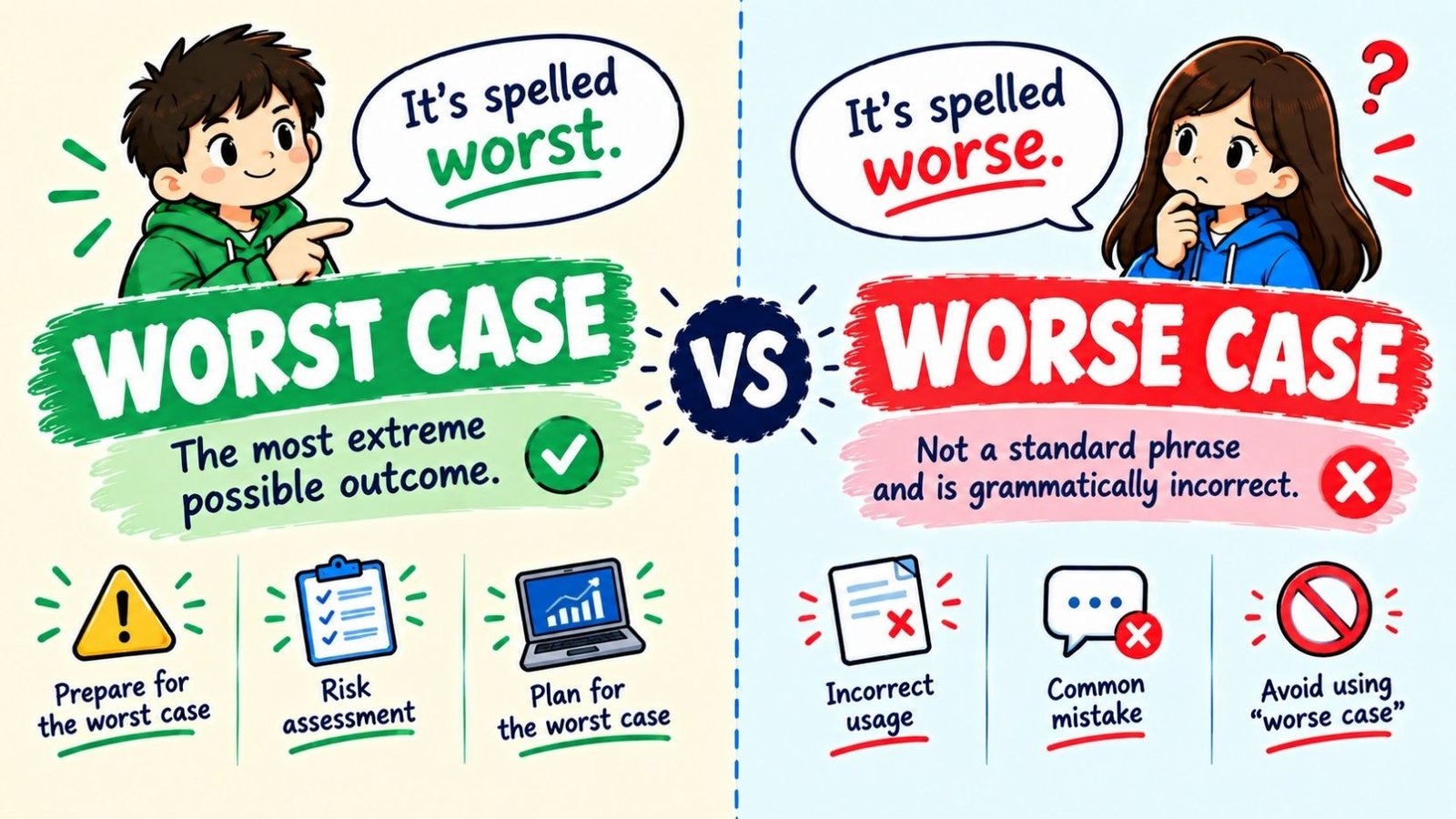
The correct phrase is worst case, not worse case. Worst is the superlative form of bad, and it means the most extreme or least favorable possibility out of every option available. Worse is the comparative form, and it only makes sense when you are comparing exactly two things.
So when someone says “prepare for the worst case scenario,” they mean the single most negative outcome that could happen, out of all possible outcomes. This distinction matters more than people expect, because the two words look similar but do different grammatical jobs. Getting it right makes your writing sound more polished, especially in business, planning, and technical contexts where this phrase shows up constantly.
Worst Case: The Simple Definition
Worst case refers to the most unfavorable possible outcome in a given situation. It is used to describe the scenario where everything that could go wrong actually does go wrong.
You will see it most often in phrases like:
- Worst case scenario
- In the worst case
- Worst case, we lose the client
- Plan for the worst case
In every one of these examples, worst is doing the job of a superlative adjective. It is comparing one possibility against every other possibility and picking out the single most negative one.
See More: Thumb In Or Thumb Out
Why “Worse Case” Is Grammatically Wrong
Worse is the comparative form of bad or badly. Comparatives are used when you are measuring one thing against exactly one other thing, not against a whole group.
For example:
- This outcome is worse than the last one. (comparing two things)
- Things went from bad to worse. (comparing two states)
The phrase worse case would only make grammatical sense if you were directly comparing two specific cases to each other, and even then, native speakers rarely phrase it that way.
When people say “worse case scenario,” they almost always mean the same thing intended by worst case scenario, the most extreme negative outcome. That meaning calls for a superlative, not a comparative, which is why worse case is considered incorrect in this expression.
Worse Vs Worst: The Core Grammar Rule
| Form | Type | When to Use | Example |
| Bad | Base adjective | Describing something negative on its own | The weather is bad today. |
| Worse | Comparative | Comparing two things | My cold is worse than yesterday. |
| Worst | Superlative | Comparing three or more things, or picking the most extreme option | This is the worst traffic I have ever seen. |
A simple way to remember it: worse always needs a “than” comparison sitting nearby, either stated or clearly implied. Worst never needs that comparison, because it already means the most extreme option among many.
Since a case scenario is really shorthand for “out of every possible case, this is the most extreme one,” the superlative worst fits, while the comparative worse does not.
Worst Case Scenario: What The Full Phrase Means
Worst case scenario is a fixed expression used to describe the most damaging or difficult outcome that could realistically happen in a situation. It is common in:
- Business planning and risk assessment
- Project management
- Emergency preparedness
- Everyday conversation about problems or decisions
- Computer science, where it describes the maximum time or resources an algorithm could require
In everyday use, someone might say, “Worst case, the flight gets delayed and we miss the connection.” This means: if things go as badly as they possibly could, that is what will happen. The phrase sets a boundary. It tells the listener the absolute limit of how bad things might get, which is often reassuring, because it puts a ceiling on the uncertainty.
See More: Authentication Vs Authorization
Correct And Incorrect Examples
Seeing the two forms side by side makes the rule easier to apply in your own writing.
Incorrect: In the worse case, the server crashes during launch.
Correct: In the worst case, the server crashes during launch.
Incorrect: Let’s plan for the worse case scenario before we sign the contract. Correct: Let’s plan for the worst case scenario before we sign the contract.
Incorrect: What’s the worse case if this experiment fails?
Correct: What’s the worst case if this experiment fails?
Correct use of worse (different meaning): This year’s turnout was worse than last year’s.
That last example shows the only situation where worse belongs in this territory, when you are directly comparing two specific outcomes to each other rather than describing the single most extreme possibility.
How To Use It In A Sentence
Worst case can function in a few different ways depending on the sentence:
- As a noun phrase: “The worst case is that we lose the account entirely.”
- As an introductory phrase: “Worst case, we reschedule for next week.”
- Within a larger phrase: “They ran a worst case scenario analysis before approving the budget.”
Notice that “worst case” often appears without articles like “the” when it opens a sentence informally, almost functioning like an adverb of possibility. This informal usage is extremely common in spoken English and casual writing, and it is accepted in most everyday and business contexts.
Where The Confusion Comes From
The mix-up between worse and worst is understandable. Both words come from the same root, bad, and they differ by only one letter in their most common forms when spoken quickly. In fast speech, “worst case” and “worse case” can sound almost identical, especially when the final t blends into the following consonant sound. This is a purely phonetic issue rather than a grammar one, but it is likely the biggest reason the error spreads through spoken and then written English.
Autocorrect tools and casual typing habits can also reinforce the mistake once it takes hold, since neither word is technically misspelled on its own. The error only appears once you look at the two words together in context.
Origin Of The Phrase
Worst case as an expression became especially common in the twentieth century within engineering, computer science, and military planning, where analysts needed a precise term for the most extreme negative outcome a system or plan could produce.
In computer science specifically, worst case complexity describes the maximum amount of time or memory an algorithm could ever require, regardless of the input. From there, the phrase spread into general business and everyday language as a shorthand for “the most extreme bad outcome we should prepare for.”
The words themselves, worse and worst, trace back to Old English wyrsa and wyrsta, both irregular comparative and superlative forms tied to the adjective bad. English has a small group of these irregular adjectives, including good, better, best, and bad, worse, worst, where the comparative and superlative forms do not simply add “er” or “est” to the base word.
Similar And Related Words
| Word or Phrase | Meaning | Difference From Worst Case |
| Best case | The most favorable possible outcome | Opposite meaning, same grammatical structure |
| Worse | Comparative form of bad | Only compares two specific things |
| At worst | Similar meaning to worst case | Slightly more casual, often used mid sentence |
| Worst case scenario | Full form of the phrase | Identical meaning, more formal or written tone |
At worst functions almost identically to worst case in everyday speech. “At worst, we lose a day” carries the same meaning as “Worst case, we lose a day.” Both are grammatically correct because both use the superlative form.
Common Mistakes To Avoid
- ❌ Incorrect: “Worse case, nobody shows up.”
- ✅ Correct: “Worst case, nobody shows up.”
- ❌ Incorrect: “We need a worse case analysis before the launch.”
- ✅ Correct: “We need a worst case analysis before the launch.”
- ❌ Incorrect: “The worse case would be losing the entire budget.”
- ✅ Correct: “The worst case would be losing the entire budget.”
A quick test you can use: if you can mentally replace the word with “most extreme,” worst is correct. If you can only make sense of it by adding “than something,” worse is correct.
American English Vs British English
This is not a regional spelling difference. Both American and British English follow the same grammar rule here, and worst case is the standard, correct form in both varieties.
You will not find a dialect where worse case scenario is considered the accepted form. Any appearance of worse case in published writing is a grammatical slip rather than a regional variant, similar to mixing up “less” and “fewer.”
See More: Born In Or Born On
Frequently Asked Questions
Is it worse case or worst case?
It is worst case. Worst is the superlative form of bad, used to describe the single most extreme negative outcome, which is exactly what this phrase is describing.
Is it worse case scenario or worst case scenario?
The correct phrase is worst case scenario. Worse case scenario is a common error caused by the similar sound of the two words in speech.
Why do people say worse case instead of worst case?
Mostly because worse and worst sound very similar in fast, casual speech, and the final “t” sound in worst can be hard to hear clearly before the word case.
Is worse case ever correct in any sentence?
Only if you are directly comparing two specific cases to each other, such as “This case is worse than that one.” Even then, most speakers would phrase it differently rather than using “worse case” as a set phrase.
What is the difference between worse and worst?
Worse is a comparative adjective used to compare two things. Worst is a superlative adjective used to identify the most extreme option among three or more things, or the most extreme possibility overall.
What does worst case mean in business?
In business and risk planning, worst case describes the most damaging realistic outcome of a decision, project, or event, used to set expectations and prepare contingency plans.
What does worst case mean in computer science?
It refers to the maximum time or resources an algorithm could ever require to complete, no matter what input it receives, which helps engineers understand performance limits.
Can you say “at worst” instead of “worst case”?
Yes. “At worst” carries the same meaning and is grammatically correct, often used in the middle of a sentence rather than at the start.
Is “worst case scenario” one word or two?
It is written as three separate words: worst case scenario. It is not hyphenated in standard usage.
Does British English use a different form?
No. British English follows the same rule as American English, and worst case is correct in both.
Final Thoughts
Worst case is the grammatically correct form, and worse case is a common but incorrect variation caused by how similar the two words sound when spoken. Worst is a superlative, built to describe the single most extreme outcome out of every possibility, which is exactly the job this phrase is doing in everyday speech and writing.
Once you remember that worse always needs a direct comparison between two things, while worst stands on its own as the most extreme option, the choice becomes easy. The next time you are planning for something uncertain, you can confidently write or say worst case scenario, knowing it is both the natural and the correct way to express it.

Zunaira Qasim is the author and creator of Gramvixo, dedicated to making English grammar easier for learners and everyday writers. With 4 years of experience researching grammar, confusing words, word choices, and common language mistakes, they create clear and practical content that helps readers understand English and use it with confidence.
2 Comments