
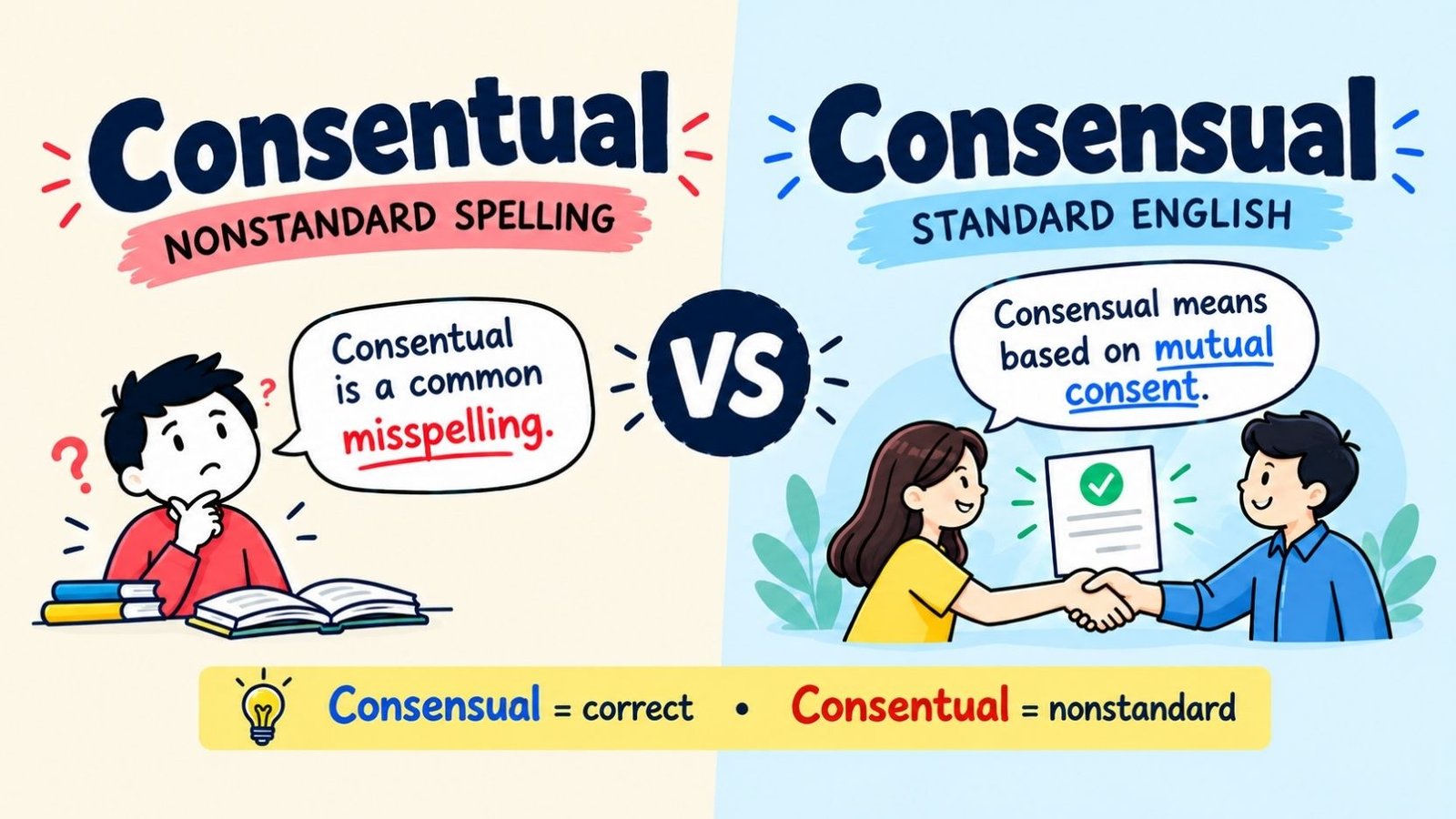
If you searched for consentual vs consensual, you are probably trying to figure out which word is actually correct. The short answer is simple. Consensual is the correct and standard English word. Consentual is a rare variant spelling that almost no dictionary treats as the main form.
This confusion happens because both words sound almost the same, and both connect to the idea of consent. But only one of them is the word you should use in writing, in conversation, and in formal or legal contexts. Understanding the small difference between them will help you avoid a common spelling mistake.
Below, you will find a clear breakdown of the meaning, grammar, pronunciation, origin, and correct usage of both words, along with real examples and answers to the most common questions people ask about this topic.
Consensual Meaning
Consensual is an adjective. It describes something that is done, agreed to, or entered into with the full and willing agreement of everyone involved.
If an action, arrangement, or relationship is consensual, every person involved has agreed to it freely. No one was forced, tricked, or pressured.
Here is the simplest way to think about it:
- Consensual means “based on mutual consent.”
- It always involves two or more people.
- It signals that agreement, not force or pressure, is present.
See More: Worse Case Or Worst Case
Example sentences:
- The two neighbors reached a consensual agreement about the shared fence.
- Their relationship was entirely consensual from the start.
- The contract was ended through a consensual decision by both companies.
Consensual can apply to everyday agreements, business arrangements, relationships, and legal matters. In modern usage, it appears especially often in discussions about relationships and personal boundaries, where the presence or absence of consent matters a great deal.
Is Consentual A Real Word?
Consentual is not a standard word in mainstream English. Major dictionaries such as Merriam-Webster and Dictionary.com list consensual as the correct term. Consentual shows up occasionally as a nonstandard or historical variant spelling, but it is not the word you should use in normal writing.
If you are trying to describe something based on mutual agreement, the correct word is always consensual, not consentual.
Think of consentual as a common misspelling that happens because people mentally connect the word to “consent.” That connection makes sense, since consensual is indeed related to consent. But the correct spelling still follows the consensus pattern, not the consent pattern.
Consentual Vs Consensual: Quick Comparison
| Word | Standard English? | Correct Usage |
| Consensual | Yes | Use this word in all writing and speech |
| Consentual | No, nonstandard | Avoid using this spelling |
There is no meaningful difference in meaning between the two, because consentual is simply a misspelling of consensual. They are not two different words with two different definitions. Only one of them belongs in correct English.
Why Do People Confuse Consentual And Consensual?
The confusion almost always comes from the word “consent.” Since consensual describes agreement, and consent also means agreement, it feels natural to assume the adjective should be spelled “consentual,” built directly from “consent” plus “ual.”
But that is not how the word actually formed. Consensual comes from a different root, which is explained in the origin section below. Once you understand where the word actually comes from, the correct spelling becomes much easier to remember.
Grammar And Part Of Speech
Consensual is an adjective. It describes a noun, and it cannot stand alone as a full sentence idea.
Common grammatical patterns:
- Consensual + noun: a consensual agreement, a consensual relationship, a consensual decision
- Subject + is/was + consensual: The deal was consensual. The encounter was consensual.
Consensual does not have a verb form. The related verb is “consent,” as in “Both parties consented to the terms.” The noun form is “consent” or “consensus,” depending on the context, which is explained further below.
How To Pronounce Consensual
Consensual is pronounced kuhn-SEN-shoo-uhl.
Breaking it into syllables:
- con
- SEN
- shoo
- uhl
The main stress falls on the second syllable, “SEN.” American and British pronunciations are very similar, with only minor differences in vowel sound and rhythm.
Origin Of The Word Consensual
Consensual comes from Latin, not directly from the English word “consent.”
Word history in simple steps:
- It traces back to the Latin verb consentire, meaning “to feel together” or “to agree.”
- From this verb came the Latin noun consensus, meaning “agreement” or “accord.”
- English then formed the adjective consensual using consensus as its base, adding the suffix “ual.”
This explains why the correct spelling uses “sensual” at its core, not “sentual.” The word grew out of “consensus,” not directly out of “consent,” even though both words share the same deeper Latin root.
Consensual has been used in English since at least the 1600s, originally in formal and legal writing, and later expanded into everyday language.
See More: Blankie Or Blanky
Consensual In Different Contexts
The word consensual shows up in several different areas of life. The core meaning stays the same, but the context shapes how people apply it.
Legal Context
In law, consensual often describes agreements, contracts, or transactions where all parties freely agreed to the terms, without coercion.
- Example: A consensual settlement avoided the need for a trial.
Relationships
In personal relationships, consensual usually describes an arrangement, encounter, or relationship that both people willingly agreed to.
- Example: They described their relationship as fully consensual and based on open communication.
Business and Everyday Agreements
Consensual can describe ordinary decisions made together, without any legal or romantic context at all.
- Example: The roommates made a consensual choice about how to split the bills.
Consensual Non Consent Meaning
This phrase often confuses people because it looks contradictory at first glance. Consensual nonconsent describes a specific type of role play, most often used in certain personal or intimate contexts, where participants agree in advance to act out a scenario that appears to lack consent, even though full consent was actually given beforehand.
Important points about this phrase:
- Consent is agreed upon in advance, often through discussion or a safe word.
- The scenario simulates the appearance of non consent.
- Everyone involved understands and agrees to the setup ahead of time.
Because the agreement happens before the scenario begins, the situation remains consensual, even though it may look nonconsensual from the outside. The phrase highlights that real, ongoing consent is what defines whether something is truly consensual, not how the scenario appears on the surface.
You may also see this idea written as consensual non consent, consensual nonconsent, or consensual non-consent. All of these refer to the same concept, just written with different spacing or punctuation.
Non Consensual Meaning
Non consensual is the direct opposite of consensual. It describes something done without the agreement of everyone involved.
If an action is non consensual, at least one person did not agree to it, or agreement was never properly given.
Example sentences:
- The contract was declared invalid because it was non consensual.
- Non consensual actions of this kind are treated seriously under the law.
Non consensual is an important legal and ethical term, especially in contexts involving personal boundaries, medical treatment, and law.
Consensual Non Monogamy
Consensual non monogamy refers to relationship structures where all partners agree, openly and honestly, to have more than one romantic or intimate relationship at the same time.
The key word here is still consensual. Everyone involved understands and agrees to the arrangement. This distinguishes it from situations involving deception or broken agreements, since consensual non monogamy is built entirely on shared understanding between all partners.
Common Mistakes With Consentual and Consensual
Many spelling mistakes happen because people write words the way they sound, rather than the way they are actually built.
Incorrect: The agreement was fully consentual.
Correct: The agreement was fully consensual.
Incorrect: They had a consentual relationship.
Correct: They had a consensual relationship.
Why the correct spelling works:
Consensual is built from “consensus,” not “consent.” Since consensus already contains an “s” instead of a “t” in that position, the correct adjective keeps that same “s” spelling.
A simple memory trick: if you can imagine the word “consensus” hiding inside “consensual,” you will remember the correct spelling. Both words share the same core.
Similar And Related Words
| Word | Meaning | How It Differs From Consensual |
| Consent | Permission or agreement, usually as a noun or verb | Consent is the base concept; consensual is the adjective describing something built on that agreement |
| Consensus | General agreement among a group | Consensus refers to shared opinion or agreement itself, while consensual describes something done with that agreement |
| Mutual | Shared or felt by both sides | Mutual is broader and does not always involve formal agreement, while consensual specifically implies agreement was given |
These words are closely related in meaning, but each one plays a slightly different grammatical role. Consent is often a noun or verb. Consensus is a noun describing shared agreement. Consensual is the adjective form that describes something based on that agreement.
See More: Moment Vs Momment
Frequently Asked Questions
Is it consentual or consensual?
The correct word is consensual. Consentual is a nonstandard spelling and should be avoided in formal and everyday writing.
What does consensual mean in simple terms?
Consensual means something was agreed to by everyone involved, without force or pressure.
Is consensual a noun or an adjective?
Consensual is an adjective. It describes a noun, such as an agreement, relationship, or decision.
How do you pronounce consensual?
It is pronounced kuhn-SEN-shoo-uhl, with the stress on the second syllable.
What is the difference between consent and consensual?
Consent is usually a noun or verb describing the act of agreeing. Consensual is the adjective that describes something built on that agreement.
What does consensual non consent mean?
It describes a scenario where participants agree in advance to act out a situation that appears to lack consent, even though real consent was given beforehand.
What does non consensual mean?
Non consensual describes something done without full agreement from everyone involved.
What is consensual non monogamy?
It refers to relationships where all partners openly agree to have more than one intimate relationship at the same time.
Where does the word consensual come from?
It comes from the Latin word consensus, meaning agreement, which itself comes from the verb consentire, meaning to feel together or agree.
Can consensual describe a business agreement?
Yes. Consensual can describe any agreement, personal or professional, where everyone involved agreed willingly.
Final Thoughts
Consensual is the correct English word for describing something based on mutual agreement, while consentual is a nonstandard spelling that should be avoided. The confusion between the two comes from their closeness to the word “consent,” but consensual actually grows out of “consensus,” which explains its correct spelling.
Whether you are writing about relationships, contracts, or everyday decisions, using consensual correctly shows attention to detail and helps your writing stay clear and accurate. The next time you are unsure which spelling to use, remember that consensual is always the safe and correct choice.

Zunaira Qasim is the author and creator of Gramvixo, dedicated to making English grammar easier for learners and everyday writers. With 4 years of experience researching grammar, confusing words, word choices, and common language mistakes, they create clear and practical content that helps readers understand English and use it with confidence.
One Comment