
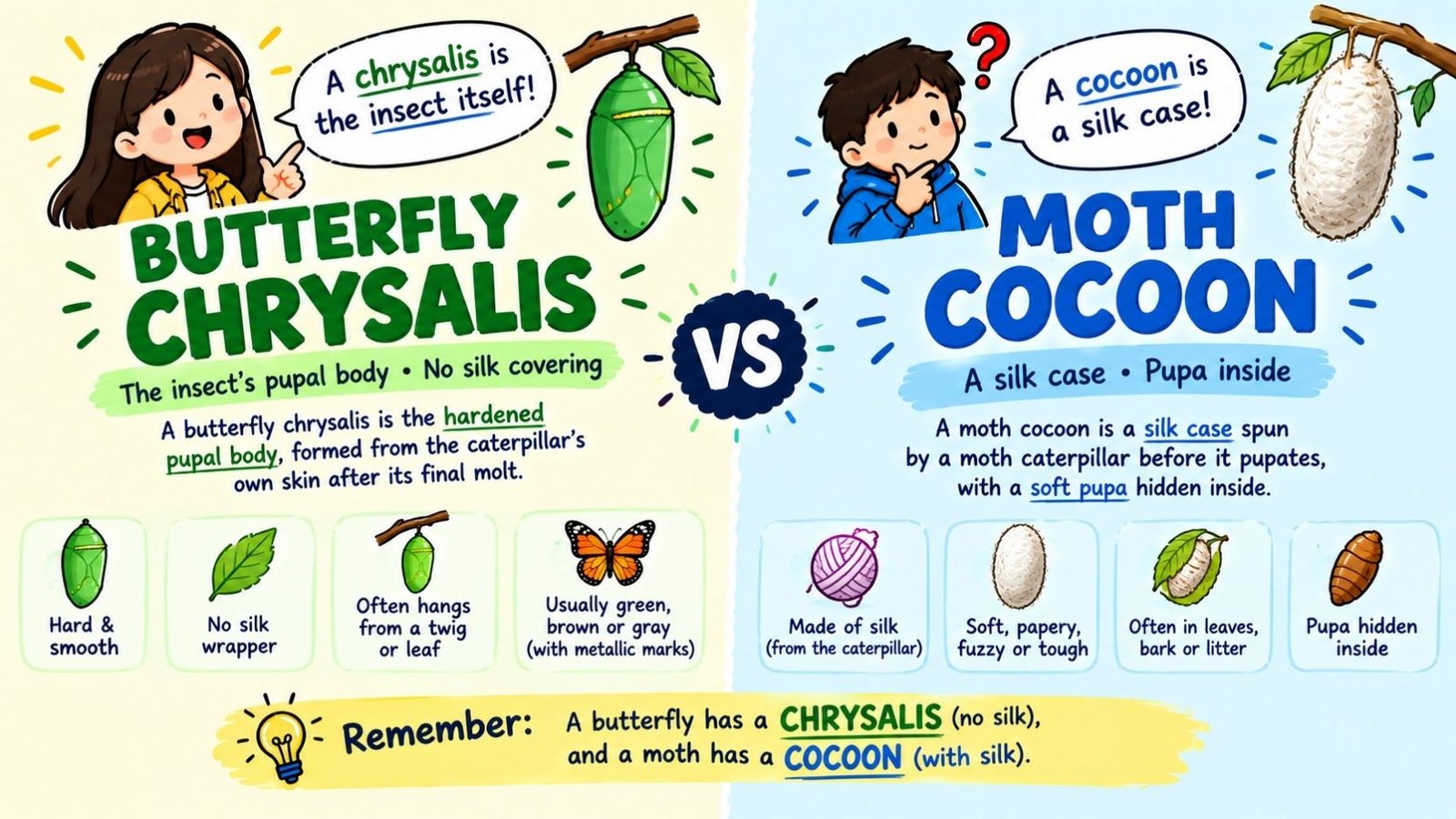
The main butterfly chrysalis vs moth cocoon differences come down to one thing: a chrysalis is the insect itself, while a cocoon is only a covering. A chrysalis is the hardened pupal body of a butterfly, formed from the caterpillar’s own skin after its final molt. A moth cocoon is a silk case that a moth caterpillar spins around itself before it pupates, with a soft pupa hidden inside. So a chrysalis has no silk wrapper, and a cocoon is not a living body at all.
That distinction matters because almost everyone says “butterfly cocoon,” and the phrase is technically wrong. Once you know that silk is the giveaway, you can identify most things you find on a stem, a fence, a windowsill, or in leaf litter. You will also read nature guides, school worksheets, and museum labels with far more confidence. The rest of this guide explains the difference in plain English, shows you how to tell them apart in real life, and clears up the exceptions that most articles skip.
💡 Quick Answer
- Chrysalis: the pupa of a butterfly. Naked, hard, smooth, no silk covering.
- Cocoon: a silk case spun by a moth caterpillar. The pupa sits inside it.
- Pupa: the scientific word for the whole resting stage. A chrysalis is one type of pupa.
- Simple rule: silk on the outside usually means moth. Bare and hard usually means butterfly.
Butterfly Chrysalis Vs Moth Cocoon: Quick Comparison Table
| Feature | Butterfly chrysalis | Moth cocoon |
|---|---|---|
| What it actually is | The pupa’s own body and outer shell | A silk shelter built around the pupa |
| Made from | The insect’s hardened cuticle | Silk from the caterpillar’s salivary glands |
| Silk used | Only a small silk pad or thin girdle for attachment | Large amounts, often mixed with leaves, hair, or debris |
| Texture | Hard, smooth, sometimes leathery | Papery, fuzzy, silky, or tough and rubbery |
| Typical colors | Green, jade, brown, gray, often with metallic gold or silver marks | White, cream, tan, gray, brown |
| Usual position | Hanging from a twig, leaf, or wall, or upright against a surface | Wrapped in a leaf, tucked in bark, buried in litter, or spun in a corner |
| Can you see body parts | Yes, wing cases, eyes, antennae and legs are visible as molded shapes | No, the pupa is hidden until you open the case |
| Who makes it | Almost all butterflies | Many moths, but not all |
| Typical duration | Often 1 to 3 weeks in warm weather | Weeks in summer, or many months if the species overwinters |
| Common wrong name | “Butterfly cocoon” | “Moth chrysalis” |
Read More: Atleast Or At Least
What Is a Butterfly Chrysalis?
A butterfly chrysalis is the third stage in a butterfly’s life cycle, after the egg and the caterpillar. It is not a shelter the caterpillar builds. It is the caterpillar’s next body, revealed when the larval skin splits and falls away for the last time.
The new pupal cuticle forms underneath the old caterpillar skin before the molt. When that skin comes off, the soft pupa hardens within hours into the familiar smooth shell. From that moment, the insect cannot walk, feed, or run away. Most chrysalises can only twitch the abdomen as a defense.
Because the chrysalis is exposed, camouflage does most of the protective work. Many species look like a dry leaf, a green bud, a bird dropping, or a splinter of bark. Others use shine and pattern instead. The gold flecks on a monarch chrysalis are structural color produced by the cuticle, not added decoration.
How a chrysalis attaches
Butterflies use silk sparingly, and only as hardware.
- Hanging chrysalis: the caterpillar spins a small silk button, grips it with hooks on a rear structure called the cremaster, and hangs head downward. Monarchs, queens, painted ladies, and mourning cloaks do this.
- Upright chrysalis: the caterpillar adds a thin silk girdle around its middle and sits angled against a stem or wall. Swallowtails, whites, and sulphurs do this.
That is the full extent of the silk in most cases. A short pad and a thread. Nothing that would ever be mistaken for a cocoon.
🦋 Butterfly chrysalis close up: what you can see
Look at a chrysalis in good light and the future adult is already mapped on the surface:
- Two wing cases, one on each side, often with faint vein lines
- A ridge marking the developing proboscis
- Smooth grooves where the antennae will lie
- Segment lines on the abdomen, which is the only part that can move
- Small pale dots along the sides, which are spiracles for breathing
What Is a Moth Cocoon?
A moth cocoon is a protective case made of silk. The caterpillar builds it first, then molts into a pupa inside the finished shelter. So there are two separate objects: the cocoon, which is a construction, and the pupa, which is the living insect.
Silk comes from modified salivary glands in the caterpillar’s head. The caterpillar spins with a swinging motion of the head, laying thread in loops and layers. Many species do not use silk alone. They weave in whatever is close by.
Common additions include:
- Leaves, which are pulled around the case and stitched shut
- The caterpillar’s own bristles, which makes the cocoon irritating to handle
- Bark flakes, soil grains, wood shavings, or plant fibers
- Frass, which is caterpillar droppings
- Fabric fibers, in the case of clothes moths indoors
A cocoon is generally built where the insect will be hardest to find. That is a real identification clue. Chrysalises tend to be out in the open on plants and structures. Cocoons tend to be inside something: a rolled leaf, a crack, a pile of litter, the seam of a stored sweater.
Why moths invest in silk
Many moth pupae stay in place for a long time. Giant silk moths in the northern United States often spend the whole winter as pupae, sometimes eight or nine months. A tough, waterproof, insulated case is worth the effort over that span. Butterflies that overwinter usually do it as eggs, caterpillars, or adults instead, which reduces the pressure to build a winter shelter at the pupal stage.
Chrysalis Vs Cocoon Vs Pupa: The Word Most People Skip
This is where most confusion starts, and it is easy to fix.
| Term | What it names | Applies to |
|---|---|---|
| Pupa | The entire resting, transforming stage | All insects with complete metamorphosis, including butterflies, moths, beetles, flies, bees, ants |
| Chrysalis | A butterfly pupa, and the shell that encloses it | Butterflies |
| Cocoon | A silk case built around a pupa | Many moths, plus some other insects and animals |
Three practical takeaways:
- Every chrysalis is a pupa. Not every pupa is a chrysalis.
- A cocoon is never a pupa. It contains one.
- Moth pupae exist whether or not a cocoon exists. Some moths skip the silk entirely.
One honest note on usage. Major dictionaries define chrysalis first as a butterfly pupa, then allow a broader sense of “an insect pupa” generally. So you will occasionally see a moth pupa called a chrysalis in older or looser writing. In biology, teaching, and nature guides, keep chrysalis for butterflies. It is clearer and it is what readers expect.
The Main Butterfly Chrysalis Vs Moth Cocoon Differences Explained
1. One is a body, the other is a building
This is the difference that makes all the others make sense. A chrysalis is anatomy. A cocoon is architecture. If you cut open a chrysalis, you damage the insect. If you cut open a cocoon, you find a separate pupa sitting loose or lightly held inside.
2. The order of events is reversed
- Butterfly: the caterpillar attaches, hangs in a J shape or sits in a girdle, then molts into the chrysalis. Attachment first, then transformation.
- Moth: the caterpillar spins the cocoon, seals itself in, then molts into the pupa. Construction first, then transformation.
3. Material and feel
A chrysalis feels hard and smooth, a little like a seed pod or a dried bean. Tap it gently and it is firm. A cocoon feels papery, fuzzy, silky, or springy. Cecropia cocoons feel almost like tough canvas. Luna moth cocoons feel like thin crumpled paper.
4. Where you find them
| Where you found it | More likely to be |
|---|---|
| Hanging under a leaf, twig, gutter, or windowsill | Chrysalis |
| Upright against a stem or fence, held by a thread | Chrysalis |
| Rolled inside a leaf, still attached to a branch | Moth cocoon |
| Loose in leaf litter or under a log | Moth cocoon, or a soil pupa |
| A few inches under loose soil, with no silk | Moth pupa with no cocoon |
| In a closet seam, pantry corner, or ceiling edge indoors | Moth cocoon of a pest species |
5. Visible detail
On a chrysalis, the outline of the adult is molded into the surface. On a cocoon, you see silk and nothing else. That single observation settles most cases in a second.
6. How long the stage lasts
Warm season butterflies are often quick. Monarchs commonly take about eight to fourteen days. Painted ladies often take seven to ten days. Many moths run on a completely different clock, especially the large silk moths, which can sit in the cocoon from late summer until the following spring.
7. Getting out
A butterfly simply splits the chrysalis along seams near the head and wing cases, then climbs out and hangs to expand its wings. A moth in a tough cocoon has a harder job. Some silk moths release an enzyme, called cocoonase, that softens the silk so the adult can push through. Cecropia moths build the cocoon with a weaker valve at one end that opens outward. Others cut or shove their way out using spines on the pupal case or stiff bristles on the thorax.
Do Butterflies Have Cocoons or Chrysalises? The Real Answer
Butterflies form chrysalises. That is the rule, and it holds for the overwhelming majority of species. But two exceptions are worth knowing, because they are the reason careful writers say “almost all” instead of “all.”
- Skippers (family Hesperiidae). These small, fast, often orange and brown butterflies are true butterflies. Their caterpillars live in leaf shelters stitched with silk, and many spin a loose, flimsy silk case around the pupa. It is fair to call it a cocoon, though it is thin and nothing like a silk moth’s.
- Apollo and parnassian butterflies (subfamily Parnassiinae). Several of these mountain butterflies pupate in a loose silk cocoon in litter or under stones rather than in an exposed hanging chrysalis.
So the accurate sentence is this: butterflies form chrysalises, and a small number of butterfly groups add a loose silk cocoon around the pupa. If a reader tells you their skipper made a cocoon, they are not wrong.
Do Moths Make Cocoons or Chrysalises? The Exception Most Articles Miss
Moths make pupae. Many of them build cocoons, but a very large number do not.
Moths that usually skip the cocoon include:
- Hawk moths and sphinx moths (Sphingidae), including the tomato hornworm and tobacco hornworm. The caterpillar burrows into soil and pupates in a bare earthen chamber. The pupa is hard, brown, and often has a curved handle shape holding the developing proboscis.
- Many cutworms and other owlet moths (Noctuidae). They pupate in the soil in a thin lined cell, with little or no true cocoon.
- Underground and root feeding species in several families, which simply form a chamber in the substrate.
This is why gardeners regularly dig up a smooth brown object that looks like a chrysalis but is actually a moth pupa. In that situation, the silk test fails and you have to use other clues, which the next section covers.
⚠️ Common mistake: assuming “no silk means butterfly.” No silk plus underground plus a long curved snout case almost always means a hawk moth.
How to Tell If a Cocoon Is a Moth or Butterfly: A Field Checklist
Work through these in order. Most cases resolve by step three.
- Is there a silk case around it? Yes, and it is substantial: moth cocoon. No, and the object is hard and shaped like an insect: butterfly chrysalis, or a moth pupa with no cocoon.
- Is it hanging from a single point, head down? That posture is very strongly butterfly.
- Is it held upright by a thread around the middle? That is a swallowtail or white butterfly pattern.
- Was it in soil or deep litter? Favor moth.
- Can you see wing cases, antennal grooves, and a proboscis ridge? You are looking at a pupa, not a cocoon. Now judge butterfly or moth by the shape below.
- Is there a long curved or looped tube along the front? That is a hawk moth proboscis case. Moth.
- Is the case fuzzy, hairy, or itchy to touch? Moth, and likely a tussock or tiger moth. Wash your hands.
- Is it indoors in fabric or stored food? Moth, and a pest species.
Shape clues on the bare pupa
| Clue | Points toward |
|---|---|
| Angular, ridged, with a pointed or keeled shape | Butterfly |
| Metallic gold or silver spots and lines | Butterfly, especially milkweed butterflies |
| Smooth, plain, torpedo shaped, uniform brown | Moth |
| Antennae cases wide and feathery in outline | Moth |
| Antennae cases thin and clubbed at the tip | Butterfly |
| Visible cremaster hooks at the tail end | Butterfly, for hanging types |
Butterfly Chrysalis Stages Day by Day
Timelines depend heavily on temperature, so treat these as typical warm weather ranges rather than fixed schedules. Cool weather stretches every stage.
Monarch butterfly chrysalis stages
| Phase | Roughly when | What you see |
|---|---|---|
| Hanging J | Day 0, about 12 to 24 hours | Caterpillar hangs head down from a silk button, body relaxed into a J |
| Pupation | Day 1, a few minutes | Skin splits behind the head, soft green pupa emerges and shortens |
| Hardening | Day 1 | Jade green shell firms up, gold dot line becomes crisp |
| Quiet middle | Days 2 to 8 | Little visible change, shell stays green and glossy |
| Darkening | Day 8 to 11 | Shell turns dusky, then clear, orange and black wing pattern shows through |
| Eclosion | Day 9 to 14 | Case splits, adult emerges, hangs for two to four hours to expand and dry wings |
The monarch’s gold spots are one of the best known features of any insect pupa. They are produced by the structure of the cuticle itself.
Painted lady butterfly chrysalis stages
Painted lady chrysalises are mottled brown and gray with small gold flecks, and they hang pendant. In classroom kits they often eclose in about seven to ten days at room temperature. The chrysalis darkens noticeably in the final day or two, and a small amount of reddish fluid, called meconium, is released after emergence. That fluid is normal waste, not blood or injury.
Other commonly searched species
- Queen butterfly chrysalis: very similar to a monarch’s, pale green to pinkish with gold marks, hanging pendant.
- Mourning cloak butterfly chrysalis: grayish brown, spiny, hanging pendant, usually about two weeks. Note that mourning cloaks overwinter as adults, not as pupae, which is why you see them flying on early spring days.
- Black swallowtail chrysalis: upright with a girdle, green or brown to match the surroundings, and it may either emerge within a few weeks or overwinter until spring.
📝 Handling tip: if a chrysalis falls, it can often be reattached. Tie a thread around the silk pad or use a tiny dot of glue on the pad only, then hang it with room below for the wings. Never glue the body or the wing cases.
Read More: Forteen Or Fourteen
Moth Cocoon Identification: Common United States Species
This works as a practical moth cocoon identification chart for the species people search for most.
| Species | Cocoon description | Where you find it | Timing |
|---|---|---|---|
| Luna moth | Thin, papery, brown silk, usually wrapped in a leaf | Falls to the ground with the leaf, sits in litter | Overwinters in the north, multiple generations in the south |
| Cecropia moth | Very large, tough, gray or brown, baggy outer layer with a dense inner case | Attached lengthwise along a twig or fence, often high | Overwinters |
| Polyphemus moth | Dense, oval, brown, often wrapped in a leaf | Sometimes hangs on the branch, often drops to the ground | Overwinters in the north |
| Promethea moth | Leaf rolled into a tube, hanging from a twig by a silk reinforced stalk | Hangs on the tree through winter, very visible after leaf fall | Overwinters |
| Domestic silk moth | Dense white or yellow oval cocoon, farmed commercially | On rearing trays, not in the wild in the United States | Days to weeks |
| Tussock moths | Cocoon studded with the caterpillar’s own bristles, gray and untidy | Bark crevices, fences, eaves, undersides of branches | Varies by species |
| Isabella tiger moth, the woolly bear | Loose, fuzzy cocoon made from silk plus the caterpillar’s own hairs | Under boards, bark, and litter | Spins in spring after overwintering as a caterpillar |
| Bagworm moths | A portable bag of silk covered in needles, leaf bits, or twigs | Hanging from evergreens and shrubs, looks like a small cone | Pupates inside the bag it carried all season |
| Webbing clothes moth | Small silk cocoon incorporating fabric fibers, plus loose webbing and tubes | Closets, wool items, carpet edges, under furniture | Indoors, year round |
| Case bearing clothes moth | A portable case the larva carries, colored by the fabric it ate | Same indoor locations | Indoors, year round |
| Indian meal moth, the pantry moth | Small, loose, off white silk cocoon | Pantry corners, shelf edges, ceiling and wall junctions | Indoors, year round |
⚠️ Safety note: do not handle tussock moth cocoons or woolly bear cocoons with bare hands. The bristles woven into the silk can irritate skin and eyes.
Brown cocoons in leaf litter
A plain brown cocoon in leaf litter is one of the hardest things to identify, because dozens of moth families produce something similar. Three helpful signals:
- A leaf clearly stitched around the case suggests a giant silk moth.
- A very thin papery wall that crackles suggests a luna or a related species.
- No silk at all, just a hard brown object, suggests a soil pupating moth such as a hawk moth or a cutworm.
If precise identification matters, photograph it in place and ask a regional extension service or a local entomology group. Rearing it in a ventilated container with a stick and slight humidity is the surest answer, since the adult tells you everything.
Cocoons Found Indoors: Clothes Moths And Pantry Moths
Indoor cocoons are almost never butterflies. Butterflies do not breed in closets or cereal boxes. If you find small silk cases inside your home, you are looking at a stored product or fabric pest, and the cocoon is a sign that a generation has finished feeding.
Signs of webbing clothes moths:
- Irregular grazed patches on wool, cashmere, felt, or silk
- Loose silk tubes and grains of frass on the fabric
- Small cocoons pressed into seams, cuffs, and folds
Signs of pantry moths:
- Webbing and clumping inside flour, grain, dried fruit, pet food, or birdseed
- Small caterpillars crawling well away from the food source
- Cocoons in corners, along shelf lips, and where the wall meets the ceiling
Practical response for both: find and discard the infested source, vacuum cracks and seams thoroughly, wash or freeze salvageable items, and store dry goods in sealed hard containers. Removing the food supply does more than removing the cocoons.
Inside the Pupa: What Actually Happens
Both a chrysalis and a cocooned pupa are doing the same job. The stage looks still, but it is the busiest part of the life cycle.
- Many larval tissues are broken down in a process called histolysis.
- Clusters of cells set aside earlier, called imaginal discs, grow into wings, legs, antennae, and reproductive organs.
- The gut is rebuilt for a liquid diet of nectar, or in some silk moths, for no feeding at all.
- Breathing continues the whole time through spiracles, which is why sealing a pupa in an airtight container kills it.
One popular claim deserves a careful answer. Does the insect remember anything from being a caterpillar? There is real published research on this. In a study on tobacco hornworms, researchers trained caterpillars to avoid a specific odor, and the avoidance persisted in the adult moths, which indicates that some neural connections survive metamorphosis. That is evidence for retained learning in one species. It is not evidence that the caterpillar’s whole experience carries over, and it should not be stretched into “butterflies remember being caterpillars.”
How to Pronounce Chrysalis, Cocoon And Pupa
| Word | Simple pronunciation | IPA, American English | Stress |
|---|---|---|---|
| chrysalis | KRIS uh lis | /ˈkrɪsəlɪs/ | First syllable |
| chrysalides | kri SAL uh deez | /krɪˈsælɪdiːz/ | Second syllable |
| cocoon | kuh KOON | /kəˈkuːn/ | Second syllable |
| pupa | PYOO puh | /ˈpjuːpə/ | First syllable |
| pupae | PYOO pee | /ˈpjuːpiː/ | First syllable |
| metamorphosis | met uh MOR fuh sis | /ˌmɛtəˈmɔːrfəsɪs/ | Third syllable |
Two points people get wrong:
- The ch in chrysalis is a hard k sound. It is never “chriss” with a ch as in chair.
- Cocoon is stressed on the second syllable. “COKE oon” sounds off to native speakers.
Grammar And Word Forms
Chrysalis
- Part of speech: noun, countable.
- Plural: chrysalises is standard in everyday and general science writing. Chrysalides is the older technical plural and still appears in entomology.
- Verb form: there is no verb “to chrysalis.” Use pupate. The caterpillar pupated last night.
- Correct: The monarch chrysalis turned clear overnight.
- Also correct: Three chrysalises hung under the railing.
Cocoon
- Part of speech: noun and verb.
- Plural: cocoons.
- As a verb: to cocoon means to wrap or enclose something protectively, and in everyday use, to stay comfortably at home. She cocooned the seedlings in fleece. We cocooned all weekend.
- Related forms: cocooned, cocooning.
Pupa
- Part of speech: noun, countable.
- Plural: pupae, or pupas in general writing.
- Verb: pupate. Noun for the act: pupation.
- Adjective: pupal. The pupal stage lasted ten days.
Word choice table
| Instead of | Write | Why |
|---|---|---|
| Butterfly cocoon | Butterfly chrysalis | Butterflies do not normally spin a cocoon |
| Moth chrysalis | Moth pupa, or moth cocoon if you mean the case | Chrysalis is reserved for butterflies |
| The cocoon hatched | The moth emerged from the cocoon | Hatching applies to eggs, not pupae |
| The chrysalis hatched | The butterfly eclosed, or emerged | Eclosion is the correct term for emergence from a pupa |
| Inside the chrysalis, the caterpillar sleeps | Inside the chrysalis, the tissues are reorganized | It is not sleep, and the chrysalis is not a container |
Origin Of The Words Chrysalis And Cocoon
Chrysalis came into English from Latin chrysallis, which came from Greek khrusallis, built on khrusos, meaning gold. The name records an observation, not a theory. Some butterfly pupae, including those of milkweed butterflies like the monarch and the queen, carry bright metallic gold marks. Early naturalists named the stage after that gilded look.
Cocoon arrived through French cocon, from a Provencal word meaning eggshell or shell, traced back to Latin coccum, which referred to a berry or a plant gall. The thread runs from a small round shell shaped object to the silk case of a moth. English borrowed the word in the eighteenth century, in the era when silk production made moth cocoons commercially important.
Pupa is Latin for doll or puppet. Carl Linnaeus applied it to the stage because a bound, motionless pupa resembles a swaddled figure. That image is a useful memory aid: a pupa looks like a doll, and a cocoon looks like a blanket wrapped around one.
Figurative Meanings of Chrysalis and Cocoon
Both words do steady work outside biology, and the metaphors differ in a way worth noticing.
Chrysalis implies a transitional phase that leads to a transformed result.
- The startup spent two years in a chrysalis, and came out as something entirely different.
- She emerged from that chrysalis with a clear sense of what she wanted.
Cocoon implies protection, comfort, and insulation from the outside world, sometimes with a mild criticism of withdrawal.
- The car’s interior is a cocoon of quiet.
- He had cocooned himself in routines that kept anything new from reaching him.
The social sense of cocooning, meaning staying home rather than going out, was popularized by trend forecaster Faith Popcorn in the late 1980s and is now standard in marketing and lifestyle writing.
Notice the difference: a chrysalis points forward to change, while a cocoon points inward to shelter. Choosing the right one makes writing sharper.
Common Mistakes About Chrysalises and Cocoons
❌ Incorrect: The caterpillar built a cocoon and turned into a butterfly.
✅ Correct: The caterpillar molted into a chrysalis and turned into a butterfly. Butterflies do not build the shell. It is their own body.
❌ Incorrect: All moths spin cocoons.
✅ Correct: Many moths spin cocoons, and many pupate in soil without one. Hawk moths and large numbers of owlet moths pupate underground.
❌ Incorrect: A chrysalis is a hard cocoon.
✅ Correct: A chrysalis is a pupa. A cocoon is a separate silk case. Hardness is not the defining trait. Origin is.
❌ Incorrect: The chrysalis hatched this morning.
✅ Correct: The butterfly emerged from the chrysalis this morning. Eggs hatch. Adults emerge, or eclose.
❌ Incorrect: Butterflies never use silk.
✅ Correct: Butterflies use a little silk to attach, and skippers spin a loose cocoon. The amount and purpose of the silk is the real distinction.
❌ Incorrect: I sealed the pupa in a jar to keep it safe.
✅ Correct: Keep pupae in a ventilated container with light humidity. Pupae breathe, and sealed containers cause suffocation or mold.
Quick Field Notes You Can Use Today
- Silk on the outside, substantial and obvious: moth cocoon.
- Bare, hard, insect shaped, hanging or girdled on a plant: butterfly chrysalis.
- Bare, hard, plain brown, dug from soil: moth pupa.
- Fuzzy or bristly case: moth, and do not touch it.
- Indoors in fabric or food: moth, and a pest problem.
- Long looped tube molded along the front of the pupa: hawk moth.
- Gold or silver metallic dots: butterfly, very likely a milkweed butterfly.
Read More: Recieved Or Received
Where to Check Reliable Information
If you want to verify anything here or go deeper, these are the kinds of sources worth trusting:
- Smithsonian Institution educational resources on the butterfly and moth life cycle
- University entomology extension programs, including the University of Florida Featured Creatures database and state extension services
- Peer reviewed entomology literature for specific claims about development and behavior
- Merriam Webster and the Oxford English Dictionary for definitions, plurals, and etymology
- Conservation organizations such as the Xerces Society for identification and regional context
When sources differ, the difference is usually about usage rather than biology. Dictionaries allow a loose sense of chrysalis for any insect pupa, while entomology keeps it for butterflies. Both descriptions are accurate about their own domain.
Frequently Asked Questions
What is the main difference between a butterfly chrysalis and a moth cocoon?
A chrysalis is the butterfly pupa itself, formed from the insect’s own hardened skin. A moth cocoon is a silk case spun by the caterpillar, with a separate pupa inside it.
Do butterflies have cocoons or chrysalises?
Butterflies form chrysalises. A small number of groups, mainly skippers and parnassians, add a loose silk cocoon around the pupa.
Do moths make cocoons or chrysalises?
Moths make pupae. Many species enclose the pupa in a silk cocoon, but hawk moths and many owlet moths pupate in soil with no cocoon at all.
Is a chrysalis the same as a pupa?
A chrysalis is a type of pupa. Pupa is the general term for the stage in all insects with complete metamorphosis, so beetles and flies have pupae too, but not chrysalises.
How can I tell if a cocoon is a moth or a butterfly?
Check for silk. A real silk case means moth. If the object is bare and you can see wing cases and antennal grooves, it is a pupa, and a hanging or girdled position on a plant points to a butterfly.
Why is a chrysalis called a chrysalis?
The word traces back to the Greek word for gold, because several butterfly pupae, including the monarch’s, have bright metallic gold markings.
How long does a butterfly stay in the chrysalis?
Commonly one to three weeks in warm weather. Monarchs often take eight to fourteen days and painted ladies seven to ten. Some species overwinter in the chrysalis for months.
How long does a moth stay in the cocoon?
Weeks for many summer species, and six to nine months for giant silk moths such as cecropia, polyphemus, and luna in northern regions.
Is it safe to touch a chrysalis or a cocoon?
Handle a chrysalis only by its silk pad or the twig it hangs from, and never squeeze it. Avoid touching fuzzy cocoons, since tussock and tiger moth cases contain irritating bristles.
How do you pronounce chrysalis?
KRIS uh lis, with a hard k sound and stress on the first syllable. The plural is chrysalises, or chrysalides in technical writing.
Can I say butterfly cocoon?
People will understand you, but it is technically incorrect. Butterfly chrysalis is the accurate term.
What is inside a cocoon?
A pupa, and sometimes shed larval skin and the caterpillar’s bristles. The pupa is a separate object from the silk wall around it.
Conclusion
The butterfly chrysalis vs moth cocoon differences are simple once you separate the insect from its shelter. A chrysalis is the butterfly’s own pupal body, hard and bare, usually hanging from a silk pad or held upright by a thin girdle, with the shape of the future adult already molded into its surface. A moth cocoon is a silk construction built before pupation, often reinforced with leaves, bristles, or debris, with a soft pupa resting inside. Pupa is the umbrella term that covers both, which is why “butterfly cocoon” and “moth chrysalis” both sound wrong to anyone who works with these insects.
Keep the honest exceptions in mind, because they are where most confident explanations go wrong. Skippers are butterflies that spin a loose cocoon, and hawk moths are moths that skip silk and pupate in bare soil. So the useful test is not the label on the species but the evidence in front of you: substantial silk means cocoon, a bare insect shaped shell means pupa, and a hanging or girdled position on a plant with metallic markings means you have almost certainly found a butterfly chrysalis. Once you can read those three clues, you can identify nearly anything you come across on a stem, in leaf litter, or tucked into the corner of a shed.

Zunaira Qasim is the author and creator of Gramvixo, dedicated to making English grammar easier for learners and everyday writers. With 4 years of experience researching grammar, confusing words, word choices, and common language mistakes, they create clear and practical content that helps readers understand English and use it with confidence.
2 Comments