
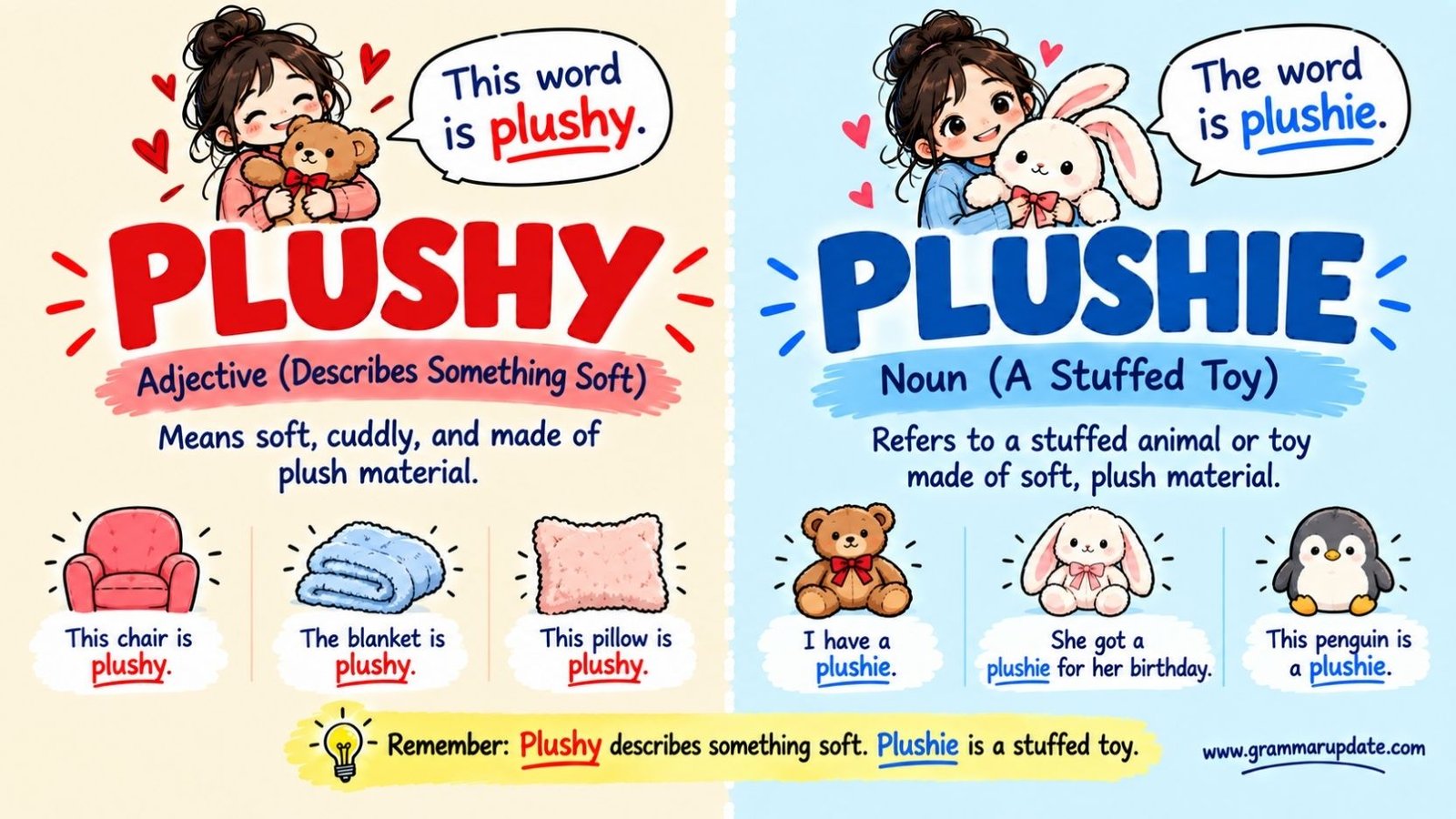
If you have typed “plushy” and then second guessed yourself and typed “plushie” instead, you are not alone. Plushie is the standard spelling for a soft stuffed toy, and it works as a noun. Plushy is mainly an adjective that describes something soft, thick, or covered in plush fabric, like a plushy blanket or a plushy carpet.
The confusion is understandable because both words come from the same root word, plush, and they sound almost identical when spoken aloud. Getting the spelling right matters more than it might seem, especially if you sell toys online, write product descriptions, or just want your message to read clearly. This guide walks through the meaning, grammar, pronunciation, and origin of both words so you never have to guess again.
Plushy Or Plushie: The Quick Answer
Here is the short version before we go deeper.
- Plushie is a noun. It means a soft stuffed toy, such as a teddy bear, a cartoon character toy, or an animal shaped cushion.
- Plushy is an adjective. It describes something with a soft, fluffy, or luxurious texture, similar to velvet or fleece.
- Both spellings are real English words with dictionary entries, but they are not interchangeable in careful writing.
So if someone asks, is it spelled plushy or plushie, the answer depends on what you mean. Talking about the toy on your shelf? Use plushie. Describing how soft your new hoodie feels? Use plushy.
What Does Plushie Mean?
A plushie is a stuffed toy made from soft fabric and filled with cotton, polyester fiberfill, or foam. Merriam Webster defines plushie as a toy covered in plush fabric and filled with soft material, also called plush.
Plushies come in almost every shape imaginable. A cat plushie, a shark plushie, a bunny plushie, and a Hello Kitty plushie are all examples of the same basic idea: a cuddly, fabric covered toy meant to be held, collected, or displayed.
The word plushie is informal but widely accepted. It shows up in toy store listings, fan communities, social media captions, and casual conversation. You will see it used for anything from a Snoopy plushie found in a gift shop to a large seal plushie sold as a collectible.
Common examples of plushie used as a noun:
- My niece asked for a Stitch plushie for her birthday.
- The store had a whole wall of Sonic plushies.
- He collects plushies shaped like sea animals, including an axolotl plushie and a capybara plushie.
What Does Plushy Mean?
Plushy is an adjective. Merriam Webster defines it as having the texture of or being covered with plush, meaning notably soft or luxurious.
You use plushy to describe fabric, furniture, carpet, or clothing that feels rich, thick, and comfortable to the touch. It does not usually refer to a toy directly, though a toy can be described as plushy if you are talking about its texture rather than naming it as an object.
Common examples of plushy used as an adjective:
- The hotel room had plushy towels and a plushy robe.
- Her new couch is covered in a plushy velvet fabric.
- The carpet felt plushy under my bare feet.
Notice the difference. In each example, plushy is describing a quality, not naming a specific item you can hold up and show someone.
See More: Inexcusable Vs Unexcusable
Plushie vs Plushy: Key Differences
| Feature | Plushie | Plushy |
| Part of speech | Noun | Adjective |
| Basic meaning | A soft stuffed toy | Having a soft, luxurious texture |
| Typical use | Naming a toy or collectible | Describing fabric, furniture, or texture |
| Example sentence | I bought a shark plushie at the aquarium gift shop. | The blanket feels wonderfully plushy. |
| Common in | Toy listings, fan communities, gift descriptions | Interior design, fashion, product reviews |
Is It Plushy Or Plushie? How To Choose The Right Word
A simple test can help you pick the correct word every time. Ask yourself whether you are naming a thing or describing a quality.
- If you can point at it and say “that is a,” you likely need plushie. Example: That is a monkey plushie.
- If you are describing how something feels, you likely need plushy. Example: This towel is so plushy.
Another quick trick is to try swapping in the word “toy.” If the sentence still makes sense with “toy” in place of the word, plushie is almost always correct. “I bought a spiderman plushie” becomes “I bought a spiderman toy,” which works. “The couch is plushy” does not become “the couch is toy,” which confirms plushy is the right choice there.
Quick reference:
✅ Correct: She gave her daughter a cow plushie for Christmas.
❌ Incorrect: She gave her daughter a cow plushy for Christmas.
✅ Correct: The blanket is plushy and warm.
❌ Incorrect: The blanket is plushie and warm.
See More: Null Hypothesis Vs Alternzative Hypothesis
Grammar: Part Of Speech And Word Forms
Plushie functions as a countable noun. It has a regular plural form.
- Singular: one plushie
- Plural: several plushies
Because plushie ends in “ie,” the plural is formed simply by adding an “s,” similar to words like “cookie” becoming “cookies.” There is no need to change the spelling further.
Plushy functions as an adjective. Like most adjectives, it can take comparative and superlative forms in informal writing, although these forms are used less often in edited text.
- Base form: plushy
- Comparative: plushier
- Superlative: plushiest
Example: This carpet is plushier than the one in my old apartment.
How To Pronounce Plushie And Plushy
Both words are pronounced the same way in everyday speech.
- Simple pronunciation: PLUH shee
- IPA: /ˈplʌʃi/
The stress falls on the first syllable in both words. Since plushie and plushy sound identical when spoken, pronunciation alone will not tell you which spelling to use in writing. You have to rely on meaning and part of speech instead, using the guidance above.
Origin Of The Word
Both plushie and plushy come from the base word “plush.” Plush originally referred to a woven fabric with a soft, raised pile, similar to velvet but usually with a longer and looser nap. The word plush entered English from the French word “peluche,” which itself traces back to Latin roots related to hair or fur.
Plush fabric became closely associated with stuffed toys because manufacturers used it to cover teddy bears and other soft toys starting in the early twentieth century. Over time, English speakers began referring to these toys directly using shortened, informal forms of the word.
Plushie emerged as a playful noun form, following a common English pattern of adding “ie” to create an affectionate or informal version of a word, similar to how “movie” or “cookie” developed. Plushy stayed closer to its adjective roots, continuing to describe texture and softness rather than naming an object.
This shared origin explains why the two words look and sound so similar today, even though they now serve different grammatical roles.
Plushie In Everyday Use
The word plushie has grown well beyond toy stores. It now appears across gaming culture, anime fandoms, internet memes, and gift shops. A few examples of how widely the word is used:
- Character plushies: Fans buy plushies based on favorite characters, such as a Hello Kitty plushie, a Cinnamoroll plushie, a Sonic plushie, or a Spiderman plushie.
- Animal plushies: Realistic and cartoon style animal plushies remain popular gifts, including a deer plushie, a monkey plushie, and a seal plushie.
- Meme culture plushies: Internet trends sometimes turn into physical products, which is part of why searches for things like a 67 plushie or a Vox plushie have appeared online alongside more traditional characters.
- Brand plushies: Companies sometimes commission custom plushies as promotional items or collectibles, which is why some business owners specifically search for how to get a quality plushy toy made for their brand.
Because the word covers so much ground, from a simple childhood teddy bear to a modern collectible sold in limited runs, plushie has become one of the more flexible informal nouns in everyday English.
Common Mistakes
Even careful writers mix up plushie and plushy sometimes. Here are the mistakes to watch for.
Mistake 1: Using plushy as a noun
❌ Incorrect: I bought a new plushy at the mall.
✅ Correct: I bought a new plushie at the mall.
Plushy on its own does not typically function as a noun in standard usage. If you are naming the toy itself, plushie is the word you want.
Mistake 2: Using plushie as an adjective
❌ Incorrect: The sofa fabric feels really plushie.
✅ Correct: The sofa fabric feels really plushy.
Since plushie is a noun, it does not usually describe texture on its own the way plushy does.
Mistake 3: Assuming only one spelling exists
Some writers assume plushy is simply a misspelling of plushie, or the other way around. In reality, both spellings are legitimate dictionary words with distinct jobs. The mistake is not in the spelling itself, but in using the wrong one for the sentence.
Similar And Related Words
| Word | Meaning | How It Differs |
| Plush | A soft fabric with a raised pile, or an adjective meaning luxurious | The original root word behind both plushie and plushy |
| Stuffed animal | A toy filled with soft stuffing, usually shaped like an animal | A more formal, older term with the same general meaning as plushie |
| Plush toy | A general term for any soft, fabric covered toy | Functions the same as plushie but sounds slightly more formal |
| Cuddly | Soft and pleasant to hug or hold | Describes a feeling or quality, similar to plushy, but broader in use |
Plush toy and stuffed animal are often used interchangeably with plushie, especially in product listings and retail settings. Plushie tends to sound more casual and is common in fan communities, while plush toy is more likely to appear in formal product names.
Plushy Or Plushie: A Note On Online Usage
Because both words look so similar, you will often see plushy used loosely online as a stand in for plushie, especially in casual comments, forum posts, and social media captions. This kind of blending is common with informal internet vocabulary, and it does not mean the spelling has officially changed.
If you are writing casually with friends, either spelling will likely be understood. If you are writing a product listing, an article, or anything meant to look polished and professional, sticking to the grammar based distinction above will keep your writing accurate.
This distinction holds true across American English contexts, and it is the pattern followed by major dictionaries and edited publications.
See More: Filled Or Filed
Frequently Asked Questions
Is it spelled plushy or plushie?
Both spellings exist, but they mean different things. Plushie is the noun that names a soft stuffed toy. Plushy is the adjective that describes something with a soft, luxurious texture.
What is a plushie exactly?
A plushie is a toy made from soft fabric, filled with stuffing such as cotton or polyester fiberfill. Teddy bears, animal shaped toys, and character toys are all common types of plushies.
Is plushy a real word?
Yes. Plushy is a real, dictionary recognized adjective meaning soft, thick, or covered with plush material.
Can plushy ever mean a toy?
In very casual writing, some people use plushy loosely to mean a toy, but this is not the standard or dictionary supported usage. Plushie is the correct noun for the toy.
What is the plural of plushie?
The plural of plushie is plushies, formed simply by adding an “s.”
Do plushie and plushy sound the same?
Yes. Both words are pronounced the same way, roughly as “PLUH shee.” The spelling, not the sound, is what tells them apart in writing.
Where does the word plushie come from?
Plushie comes from the word plush, a soft fabric traditionally used to cover stuffed toys. Over time, plush became shortened into the informal noun plushie to describe the toys themselves.
What is the difference between a plush toy and a plushie?
There is no real difference in meaning. Plush toy is a slightly more formal term, while plushie is the casual, everyday word for the same kind of soft stuffed toy.
Is plushie only used for toys, or can it describe other soft objects?
Plushie almost always refers to toys specifically. If you are describing a soft object that is not a toy, such as a blanket or a piece of furniture, plushy is the better word choice.
Conclusion
The difference between plushy and plushie comes down to grammar, not personal preference. Plushie is the noun you reach for when you are talking about an actual stuffed toy, whether it is a Hello Kitty plushie on a shelf or a shark plushie won at a fair. Plushy is the adjective you use when describing texture, like a plushy blanket or a plushy pair of slippers.
Once you remember that one word names an object and the other describes a feeling, the confusion disappears. The next time you are unsure whether to write plushy or plushie, just ask what you are trying to say: are you naming a toy, or describing how something feels? That one question will always point you to the right word.

Zunaira Qasim is the author and creator of Gramvixo, dedicated to making English grammar easier for learners and everyday writers. With 4 years of experience researching grammar, confusing words, word choices, and common language mistakes, they create clear and practical content that helps readers understand English and use it with confidence.
One Comment