
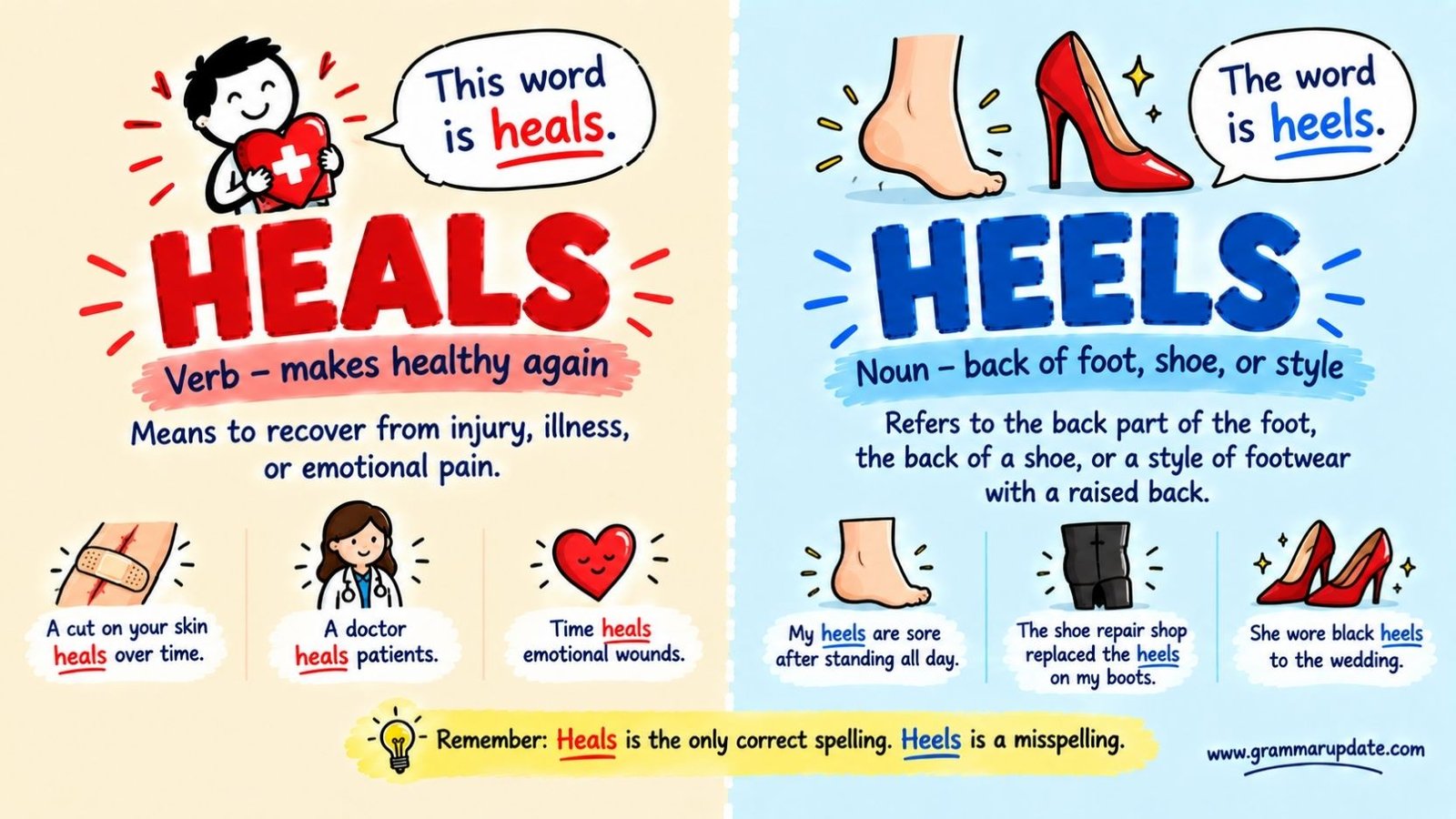
If you have ever paused mid sentence wondering whether to write heals or heels, you are not alone. These two words sound exactly the same when spoken out loud, but they mean completely different things in writing. Heals comes from the verb heal, which means to make or become healthy again. Heels refers to the back part of the foot, the bottom of a shoe, or a style of footwear with a raised back.
Getting this mixed up is one of the most common spelling mistakes in English because heals and heels are homophones. They share identical pronunciation but different spelling, different meaning, and different grammatical roles. This guide breaks down exactly when to use each word, why the confusion happens, and how to remember the difference for good.
What Does Heals Mean?
Heals is the present tense, third person singular form of the verb heal. It describes the action of recovering from injury, illness, or emotional pain, or the action of helping something recover.
- A cut on your skin heals over time.
- A doctor heals patients.
- Time heals emotional wounds, according to the popular saying.
Heals always relates to healing, recovery, or repair. It is never used to describe a shoe or the back of a foot. If the sentence involves getting better, recovering, or fixing something physical or emotional, heals is the correct spelling.
See More: Atleast Or At Least
Heals in a Sentence
- She heals quickly after minor injuries.
- The medicine heals the infection within a week.
- He believes that laughter heals the soul.
In every example above, heals functions as a verb. It shows an action tied to recovery, whether physical, emotional, or spiritual.
What Does Heels Mean?
Heels is a noun, and it has three related but distinct meanings.
Meaning 1: The back part of the human foot The heel is the rounded area at the back of the foot, below the ankle. When people say their heels hurt after a long walk, they mean this part of the body.
Meaning 2: The back part of a shoe Heels also refers to the raised portion under the back of a shoe. This is the part that lifts the wearer’s foot off the ground.
Meaning 3: A style of footwear This is probably the most common everyday use. Heels, in this sense, refers to shoes designed with an elevated back, often worn for formal occasions, work, or fashion. High heels, kitten heels, and platform heels all fall under this category.
Heels in a Sentence
- She wore black heels to the wedding.
- My heels are sore after standing all day.
- The shoe repair shop replaced the heels on my boots.
Heals Or Heels: Quick Comparison Table
| Word | Part of Speech | Meaning | Example |
| Heals | Verb | Recovers or makes healthy again | Her wound heals slowly. |
| Heels | Noun | Back of the foot, back of a shoe, or a shoe style | She bought new heels for the party. |
If you remember only one thing, remember this: heals is something the body or a situation does, while heels is something you wear or a part of your foot.
Why Do People Confuse Heals And Heels?
The confusion is completely understandable. Heal and heel are pronounced identically in American and British English, both sounding like “heel.” Since English spelling does not always match pronunciation, writers rely on context and memory rather than sound alone.
This is a classic example of a homophone pair, similar to other commonly confused words like:
- Their, there, and they’re
- Your and you’re
- Its and it’s
Homophones exist because English borrowed spelling patterns from multiple language sources over centuries, so words that sound alike often developed different spellings based on their origin and grammatical function.
Heals Or Heels For Shoes: Which Is Correct?
When talking about footwear, the correct word is always heels, never heals. This applies to any shoe style with a raised back, including:
- High heels
- Kitten heels
- Platform heels
- Red bottom heels
- Wedge heels
Writing “heals shoes” or “high heals” is a spelling mistake. Even though it sounds correct when spoken, the written form must be heels because the word refers to a physical object, not an act of recovery.
💡 Tip: If you can replace the word with “shoes” or “the back of the foot” and the sentence still makes sense, use heels.
Is It “Head Over Heels” Or “Head Over Heals”?
The correct expression is head over heels, not head over heals. This idiom means to be completely and often suddenly in love, or to be overwhelmed by strong emotion.
- She fell head over heels for him after their first date.
- He was head over heels with excitement about the new job.
The phrase originally described a literal tumble, where a person’s head ends up below their heels, like in a somersault. Over time, it evolved into a figurative expression for being overwhelmed, especially by love. Since heels here refers to the physical part of the foot involved in that tumbling image, heals would be grammatically and historically incorrect.
Is It “Time Heals All Wounds” Or “Time Heels All Wounds”?
The correct saying is time heals all wounds. This proverb means that emotional pain lessens as time passes. Since heals is the verb form describing recovery, it fits this context perfectly. Heels, a noun, would not make sense here.
This phrase is popular in tattoos, quotes, and everyday conversation, so getting the spelling right matters, especially for anything permanent, like a tattoo design.
See More: Butterfly Chrysalis Vs Moth Cocoon Differences
Religious And Inspirational Uses Of Heals
The word heals appears often in religious and spiritual contexts, especially in translations of religious texts describing acts of healing.
- Jesus heals the blind man.
- Jesus heals the paralytic.
- He heals the brokenhearted.
- God heals the broken hearted.
In these examples, heals describes an act of restoring health or wholeness. Since these sentences describe healing, not footwear, heels would be incorrect in every case.
Common Mistakes With Heals And Heels
Understanding the difference in theory is one thing. Avoiding the mistake in real writing is another. Here are the most frequent errors people make.
❌ Incorrect: She wore high heals to the party.
✅ Correct: She wore high heels to the party.
❌ Incorrect: The medicine heels the infection.
✅ Correct: The medicine heals the infection.
❌ Incorrect: He fell head over heals in love.
✅ Correct: He fell head over heels in love.
❌ Incorrect: Time heels all wounds.
✅ Correct: Time heals all wounds.
The pattern is simple. If the sentence describes an action related to recovery, use heals. If it describes footwear or a body part, use heels.
Pronunciation Of Heals And Heels
Both heals and heels are pronounced the same way in standard American and British English: “heelz,” with a long E sound, similar to the word “wheels.”
Since pronunciation offers no clue about spelling, the only reliable way to choose correctly is by identifying the meaning and grammatical role of the word in your sentence.
Origin Of Heal And Heel
Heal comes from the Old English word “hælan,” meaning to cure or make whole. It shares roots with the word “whole,” reflecting its original meaning of restoring completeness or health.
Heel comes from the Old English word “hēla,” referring to the back part of the foot. Over time, the meaning expanded to include the corresponding part of a shoe, and later, an entire category of footwear design.
Although both words trace back to Old English, they developed from entirely separate root words. Their identical modern pronunciation is a coincidence of language evolution, not a shared origin.
Grammar Breakdown: Verb Vs Noun
Understanding the grammar behind these two words makes the correct choice much easier.
| Feature | Heals | Heels |
| Part of speech | Verb | Noun |
| Function | Describes an action | Names a thing |
| Tense | Present tense, third person singular | Not tense based, it is a noun |
| Plural form | Not applicable to verbs this way | Yes, heels is already plural of heel |
A simple grammar check: if you can put “he,” “she,” or “it” directly before the word and it forms a complete verb phrase, such as “it heals,” the word is heals. If the word can follow “a pair of” or “my,” such as “a pair of heels,” the word is heels.
Types Of Heels On Shoes
Since heels as footwear is such a common search topic, it helps to understand the different types.
- Stiletto heels: Thin, tall heels often associated with formal or dressy shoes.
- Kitten heels: Short, slim heels, generally under two inches, offering a more comfortable alternative to stilettos.
- Platform heels: Shoes with a thick sole under the entire foot, in addition to a raised heel, which reduces the incline.
- Wedge heels: A solid, wedge shaped sole that runs from the back of the shoe to the front, without a distinct heel post.
- Block heels: Wide, sturdy heels that offer more stability than thin stiletto styles.
None of these terms are ever spelled with an “a.” They are always heels, since they describe a physical object.
Heal Or Heel For Dogs
In dog training, the command is heel, not heal. When a trainer says “heel,” they are instructing the dog to walk closely beside them, typically at the handler’s leg. This command relates to the position of the dog relative to the handler’s heel, not to any act of healing.
- Correct: Teach your dog to heel during walks.
- Incorrect: Teach your dog to heal during walks.
This is a helpful example because it shows that even outside of footwear, heel and heels relate to position, body parts, or objects, never to recovery or health.
See More: Plushy Or Plushie
Similar And Related Words
| Word | Meaning | Difference From Heals or Heels |
| Heal | Base verb form, to cure or recover | Heals is simply the third person present tense of heal |
| Heel | Singular noun, one heel | Heels is the plural form, or refers to the general category |
| Healing | Present participle or noun form | Refers to the ongoing process, such as “the healing process” |
| Healed | Past tense of heal | Refers to something that has already recovered |
Frequently Asked Questions
What does heals or heels mean?
Heals is a verb meaning to recover or restore health. Heels is a noun referring to the back of the foot, the back of a shoe, or a style of footwear.
Is it heals or heels for shoes?
It is always heels when referring to footwear. Heals refers only to healing or recovery, never to shoes.
How do you pronounce heals and heels?
Both words are pronounced the same way, as “heelz,” with a long E sound.
Is heals or heels used in “time heals all wounds”?
Heals is correct in this phrase, since it describes the act of healing over time.
Is it “head over heels” or “head over heals”?
The correct phrase is head over heels, describing a state of being deeply in love or emotionally overwhelmed.
What part of speech is heals?
Heals is a verb, specifically the present tense, third person singular form of heal.
What part of speech is heels?
Heels is a noun, referring to a body part, a part of a shoe, or a category of footwear.
Can heels ever be a verb?
No, heels functions only as a noun. The verb form related to heel, used in dog training, is heel, not heels, though “heeling” is used as the present participle in that context.
Why are heal and heel pronounced the same?
They are homophones, meaning they sound identical despite having different spellings, origins, and meanings.
Is there a British versus American difference in spelling?
No, both heal and heel, along with their forms heals and heels, are spelled the same way in British and American English. Pronunciation is also consistent across both varieties.
Final Thoughts
The difference between heals and heels comes down to one simple distinction: action versus object. Heals describes something recovering, curing, or getting better, whether that is a wound, an illness, or emotional pain. Heels refers to a physical thing, whether that is the back of your foot, the base of a shoe, or the fashionable footwear you wear to a formal event.
Once you connect heals to healing and heels to feet or footwear, the confusion tends to disappear. The next time you are writing about a painful blister, a pair of stylish shoes, or a wound that is getting better, you will know exactly which spelling to reach for.

Zunaira Qasim is the author and creator of Gramvixo, dedicated to making English grammar easier for learners and everyday writers. With 4 years of experience researching grammar, confusing words, word choices, and common language mistakes, they create clear and practical content that helps readers understand English and use it with confidence.
One Comment