
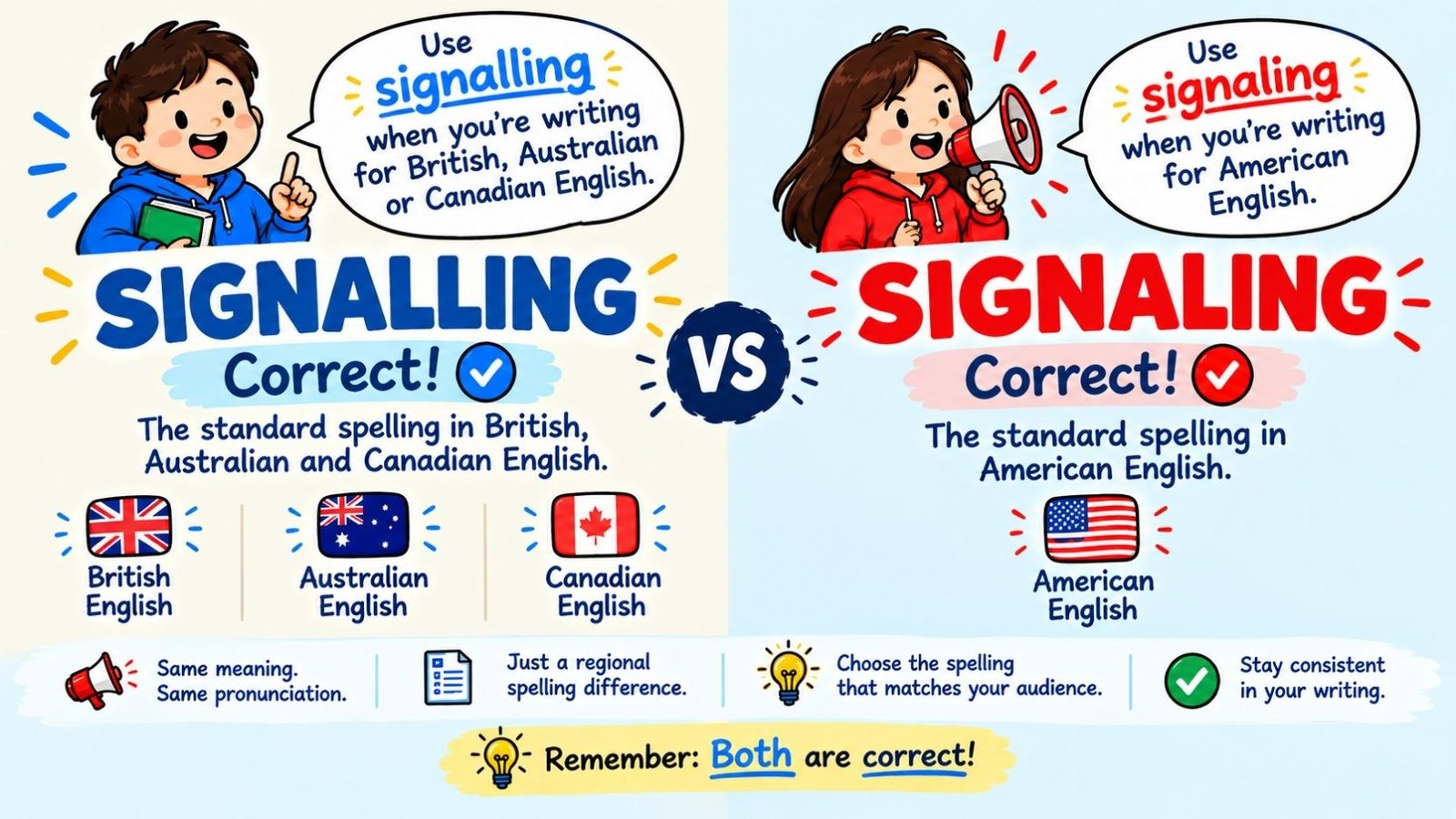
Both signalling and signaling are qzcorrect. The difference comes down to regional spelling, not grammar. Signalling, with two Ls, is the standard spelling in British English, Australian English, and Canadian English. Signaling, with one L, is the standard spelling in American English.
Neither version is wrong on its own. What matters is which audience you are writing for and staying consistent once you choose one. This small spelling difference shows up often because the word signal is used constantly in technology, biology, economics, transport, and everyday conversation, so people run into both spellings and start to wonder which one is the “correct” form.
The Simple Answer
If you are writing for a British, Australian, Canadian, or general international audience, use signalling. If you are writing for an American audience, use signaling. Both spellings mean exactly the same thing and are pronounced the same way.
| Spelling | Region | Example |
| Signalling | British, Australian, Canadian English | The train signalling system was upgraded. |
| Signaling | American English | The train signaling system was upgraded. |
See More: Disfunction Or Dysfunction
Why Two Spellings Exist
This is not a random inconsistency. It comes from a general pattern in English spelling that separates British English from American English.
The Doubling Rule
In British English, when a word ends in a single vowel followed by a single consonant, and you add a suffix like ing or ed, the final consonant is usually doubled if the stress does not fall on the last syllable. The word signal ends in a single L after a vowel, so British spelling doubles it before adding ing, giving signalling.
American English, following the influence of Noah Webster’s early spelling reforms, generally does not double the final consonant in these cases when the stress falls earlier in the word. This gives the shorter form, signaling.
You can see the same pattern in related word pairs:
| British Form | American Form |
| Travelling | Traveling |
| Cancelled | Canceled |
| Modelling | Modeling |
| Fuelled | Fueled |
Signalling and signaling follow this same rule exactly. There is nothing unusual about this word specifically. It is simply one more example of a well established British versus American spelling pattern.
Signalling Or Signaling In Different English Speaking Countries
Spelling habits are not always split neatly between just Britain and America. Here is how the word is generally used around the world.
- United Kingdom: Signalling is the standard and expected spelling in UK English, including in news writing, education, and official documents.
- United States: Signaling is the standard and expected spelling across American publishing, education, and business writing.
- Canada: Canadian English usually leans toward the British spelling, so signalling is more common, although American influence means signaling does appear, especially in casual or American influenced writing.
- Australia: Australian English closely follows British spelling conventions, so signalling is the standard and preferred form.
- India and other Commonwealth countries: Most Commonwealth countries that were historically influenced by British English, including India, tend to follow British spelling, so signalling is the more common and expected form.
If you are writing for a specific country, matching that country’s convention will always look more natural to local readers than defaulting to one global spelling.
Signalling Or Signaling: Grammar And Word Form
Both signalling and signaling are the present participle and gerund form of the verb signal. Understanding the grammar helps explain why the spelling changes but the meaning never does.
- Base verb: Signal, meaning to send a message, sign, or indication, often without using words.
- Present participle or gerund: Signalling or signaling, used after helping verbs, in continuous tenses, or as a noun form.
- Past tense: Signalled in British English, signaled in American English.
- Third person singular: Signals, spelled the same in both varieties.
Examples In A Sentence
- She was signalling to the driver that the road was clear. (British)
- She was signaling to the driver that the road was clear. (American)
- The company is signalling a shift toward renewable energy. (British)
- The company is signaling a shift toward renewable energy. (American)
Notice that only the ing form changes. The base word signal, and the third person form signals, stay identical no matter which English variety you are using.
Common Mistakes With Signalling Or Signaling
Because both spellings look almost identical, small errors are easy to make, especially when switching between British and American style guides.
❌ Incorrect: He was signalling and signaling in the same paragraph.
✅ Correct: He was signalling throughout the report. (Stay with one spelling consistently.)
❌ Incorrect: Signaling with two Ls in American English.
✅ Correct: Signaling with one L is standard American English. Signalling with two Ls is standard British English.
❌ Incorrect: Assuming one spelling is more “correct” or more formal than the other.
✅ Correct: Both spellings are equally correct. The right choice depends on your audience, not on formality.
The most common real mistake is not choosing the wrong spelling, but mixing both spellings within the same document. Consistency matters more than which variant you pick.
See More: Collocate Vs Colocate
Signalling Or Signaling In Specific Fields
The word signal is used heavily across science, technology, transport, and finance, and each field tends to follow the general regional spelling rule rather than having its own separate convention.
Cell Signalling Or Cell Signaling
In biology, cell signalling, or cell signaling in American writing, refers to how cells communicate with each other and respond to their environment through chemical and molecular messages.
This includes processes like paracrine signaling, where a cell sends signals to nearby cells, autocrine signaling, where a cell responds to its own signals, endocrine signaling, which relies on hormones travelling through the bloodstream; juxtacrine signaling, which requires direct cell contact; and synaptic signaling between neurons.
Well known cell signalling pathways studied in biology include the Wnt signaling pathway, Notch signaling, insulin signaling, and stress signaling, along with the signaling involved in apoptosis, or programmed cell death.
Academic journals vary depending on whether they follow British or American style guidelines, so students and researchers may see either spelling depending on the publication.
Rail Signalling
In the transport and engineering industry, rail signalling, more commonly using the British spelling even in some American technical writing due to historical British influence on railway engineering terms, refers to the systems of lights, signs, and controls that manage train movement safely.
Rail signalling jobs, panel sound signalling devices, and light and sound signalling devices are all part of this broader field, which includes both visual and audio methods, such as semaphore flag signalling, used to communicate instructions along a rail or naval system.
Signalling Theory In Economics And Finance
Signalling theory, or signaling theory in American writing, is a concept used in economics and finance to explain how one party credibly communicates information to another when there is an imbalance of knowledge between them.
For example, a company may use signalling through actions like paying dividends or investing in visible quality improvements to indicate financial strength to investors, since simply stating strength through words is not always convincing on its own.
WebRTC Signalling
In technology, WebRTC signalling, or signaling, refers to the process that allows two devices to exchange information needed to establish a direct connection, such as network details and session data, before real time communication like video or voice calls can begin.
A signalling server, or signaling server, coordinates this exchange, and a signalling firewall may be involved in managing or restricting that traffic for security purposes.
Virtue Signalling
Virtue signalling, or virtue signaling, is a more informal and often critical term. It describes the act of publicly expressing an opinion or taking an action mainly to demonstrate good character or moral values to others, rather than out of genuine concern or a meaningful commitment to the cause being expressed.
The phrase is frequently used in social and political discussions, often as a criticism suggesting that the expression is more about appearance than sincere belief.
Signalling Or Signaling: Table Of Related Forms
| Word Form | British English | American English |
| Base verb | Signal | Signal |
| Present participle or gerund | Signalling | Signaling |
| Past tense | Signalled | Signaled |
| Noun, general | Signal | Signal |
| Adjective form | Signalling device | Signaling device |
Pronunciation
Signalling and signaling are pronounced exactly the same way, regardless of spelling. The word is pronounced with stress on the first syllable: SIG nal ing. The doubled L in British spelling does not create an extra sound. It is purely a written spelling difference, not a spoken one.
Synonyms And Related Words
Depending on context, several words can express a similar idea to signalling or signaling, though none are perfect substitutes in every situation.
| Word | Meaning | Difference From Signalling |
| Indicating | Showing or pointing something out | Broader and less associated with deliberate communication |
| Gesturing | Using hand or body movement to communicate | Specifically physical, while signalling can be visual, verbal, or systemic |
| Communicating | Sharing information generally | Much broader in meaning, not limited to signs or indicators |
| Alerting | Warning someone of something | Focuses on warning, while signalling can be neutral information |
These words can sometimes replace signalling or signaling in casual writing, but none carry the exact same technical or contextual precision, especially in fields like biology, transport, or economics.
See More: Realising Or Realizing
Frequently Asked Questions
Is it signalling or signaling?
Both are correct. Signalling is standard in British, Australian, and Canadian English. Signaling is standard in American English.
Is signalling or signaling used in the UK?
Signalling, with two Ls, is the standard and expected spelling throughout the United Kingdom.
Is signalling or signaling used in Australia?
ignalling is standard in Australian English, following the same pattern as British English.
Is signalling or signaling used in Canada?
Canadian English generally favors signalling, though American influence means signaling is also seen, particularly in informal or American style writing.
What is the American spelling, signalling or signaling?
Signaling, with one L, is the correct American English spelling.
Is cell signalling or cell signaling correct in biology?
Both are used, and the choice depends on whether the publication follows British or American spelling conventions. The scientific meaning is identical either way.
What is virtue signalling or virtue signaling?
It refers to publicly expressing opinions or values mainly to appear morally good to others, rather than out of genuine conviction. Both spellings refer to the same concept.
Is one spelling more formal or more correct than the other?
No. Neither spelling is more correct or more formal. The right choice depends entirely on regional convention and audience, not on formality.
Final Thoughts
Signalling and signaling are two correct spellings of the same word, separated only by regional convention rather than meaning or grammar. British, Australian, and Canadian English generally use the double L form, signalling, while American English uses the single L form, signaling. The underlying word, its pronunciation, and its meaning remain exactly the same across both versions.
The most practical approach is to choose the spelling that matches your intended audience and stay consistent with it throughout your writing. Whether you are describing cell signalling in biology, rail signalling systems, signalling theory in economics, or virtue signalling in everyday conversation, the spelling you choose should reflect the regional English convention your readers expect, not a personal preference or a rule about correctness.

Zunaira Qasim is the author and creator of Gramvixo, dedicated to making English grammar easier for learners and everyday writers. With 4 years of experience researching grammar, confusing words, word choices, and common language mistakes, they create clear and practical content that helps readers understand English and use it with confidence.

3 Comments