
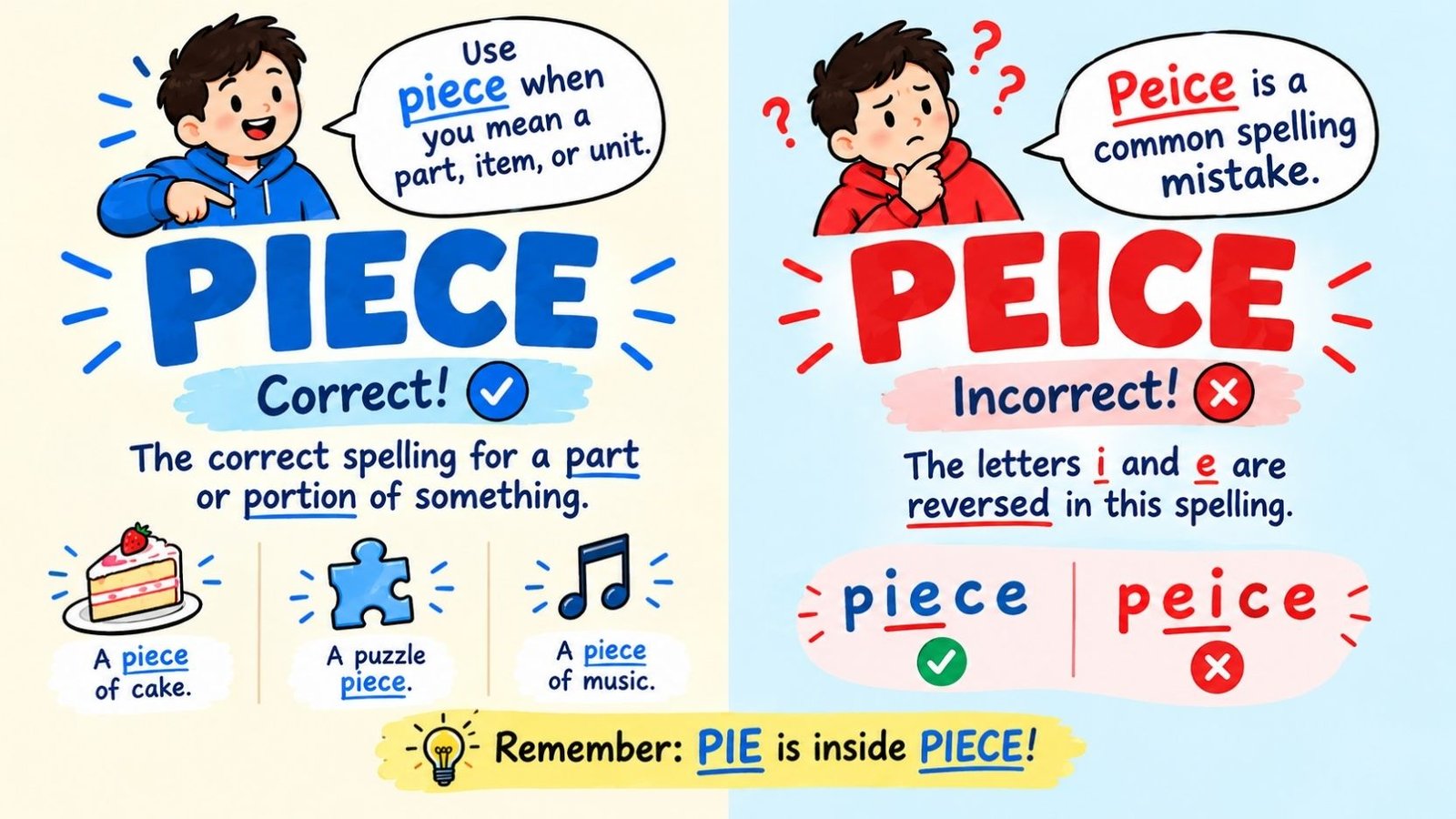
The correct spelling is piece, not peice. Piece follows the standard English pattern where “i” comes before “e,” except after “c.” Peice is a common misspelling that happens because people mix up the order of these two letters. If you have ever paused mid sentence wondering which version looks right, you are not alone, since this is one of the most frequently misspelled words in English.
Understanding why piece is correct helps you avoid the mistake permanently. The confusion usually comes from a half remembered spelling rule or from typing too quickly. Once you see the pattern clearly, along with a few memory tricks, you will stop second guessing yourself. This guide covers the meaning, grammar, pronunciation, origin, and common uses of the word piece, along with practical tips for remembering the correct spelling for good.
Piece Or Peice: What Is The Correct Spelling?
Piece is the only correct spelling. Peice does not appear in any standard English dictionary and is considered a spelling error rather than an alternate form.
This mistake is so common that it has its own explanation in most grammar guides. English learners and native speakers alike often mix up ie and ei combinations, especially in words that sound similar when spoken aloud.
Here is a simple way to check yourself:
| Spelling | Status | Notes |
| Piece | Correct | Standard spelling used in all English dictionaries |
| Peice | Incorrect | Common typo caused by reversing the i and e |
If you remember nothing else from this article, remember this: piece is always correct, and peice is always wrong.
See More: Perfer Vs Prefer
Why Do People Confuse Piece and Peice?
Most of the confusion comes from an old spelling rule taught in schools: “i before e, except after c.” This rule technically applies to words where the ie or ei combination makes a long e sound, like in believe or receive.
Piece follows the main part of that rule directly, since it has an i before an e and there is no c involved. The mix up happens because people sometimes apply the “except after c” part incorrectly, or they simply type the letters in the wrong order out of habit.
A few common reasons for the mistake include:
- Typing quickly without checking the letter order
- Confusing piece with words like receive or ceiling, which do follow the “after c” exception
- Relying on how the word sounds rather than how it looks
- Autocorrect not catching the error in every situation
Knowing the reason behind the mistake makes it easier to correct.
What Does Piece Mean?
The word piece has several related meanings, all connected to the idea of a single part or unit of something larger.
- Meaning 1: A part of a whole. A piece is a portion or section separated from a larger object. For example, a piece of cake is one slice taken from the full cake.
- Meaning 2: A single item in a set or group. Piece can describe one item among several similar items, such as a piece of furniture or a chess piece.
- Meaning 3: A single work of writing, music, or art. A piece can also refer to a complete creative work, such as a piece of music, a news piece, or a piece of writing.
- Meaning 4: An example or instance of something. Piece is sometimes used to describe a single instance of information or advice, as in a piece of news or a piece of advice.
These meanings all share the same core idea: piece refers to one identifiable unit, whether it is a physical fragment, a single item, or a complete creative work.
Piece: Part Of Speech And Grammar
Piece is primarily a noun, though it can also function as a verb in certain contexts.
As a noun: Piece refers to a part, item, or unit, as shown above. Example: She placed the last piece of the puzzle.
As a verb: Piece is used in phrases like piece together, meaning to assemble something from separate parts. Example: Investigators pieced together the events of that night.
| Form | Example | Function |
| Piece (noun) | A piece of bread | Names a part or item |
| Piece (verb) | Piece together the story | Describes an action |
| Pieces (plural noun) | Several pieces of evidence | More than one piece |
| Pieced (past tense verb) | She pieced the quilt together | Completed action |
| Piecing (present participle) | He is piecing it together | Ongoing action |
The plural form is pieces, formed by simply adding an s, since piece does not follow any irregular plural pattern.
How To Pronounce Piece
Piece is pronounced as “peess,” rhyming with words like lease and fleece.
In IPA notation, it is written as /piːs/. The vowel sound is a long e, and the word has only one syllable, which makes it straightforward to say once you know the correct spelling.
A helpful trick: if you can say the word correctly out loud, you are less likely to misspell it, since the correct spelling closely follows how it sounds when broken into its letter sounds, p, ie, and s.
Origin Of The Word Piece
Piece comes from the Old French word “piece,” which itself developed from Vulgar Latin. The word has been used in English since the medieval period, originally referring to a portion or fragment of something.
Over centuries, the meaning expanded from simply describing physical fragments to covering creative works, sets of items, and abstract units like a piece of advice. The spelling has remained fairly stable throughout its history in English, which is part of why peice never became an accepted alternate form.
See More: Signalling Or Signaling
Piece In Different Contexts
The word piece appears in many everyday situations. Here are some of the most common contexts where it shows up.
Piece In Food And Everyday Language
People commonly use piece when talking about food or everyday objects.
- A piece of cake (a slice, or an expression meaning something is easy)
- A piece of bread
- A piece of fruit
Piece In Art And Music
In creative fields, piece refers to a complete work.
- A piece of music
- An art piece
- A theatrical piece
Piece In Games
In games like chess, a piece refers to one of the individual playing tokens.
- Chess piece
- Puzzle piece
- Game piece
Piece In Business And Writing
Piece is also common in professional and journalistic contexts.
- A news piece
- An opinion piece
- A piece of advice
- A piece of information
Piece In Clothing
Piece can describe an individual clothing item or a set.
- A two piece set
- A statement piece
Each of these contexts uses the same core meaning, a single identifiable part or unit, adapted to fit the situation.
Common Mistakes: Piece Vs Peice
The most common mistake with this word is straightforward: writing peice instead of piece.
❌ Incorrect: I need one more peice of the puzzle.
✅ Correct: I need one more piece of the puzzle.
❌ Incorrect: That was a beautiful peice of music.
✅ Correct: That was a beautiful piece of music.
💡 Tip: Remember the phrase “a piece of pie” and picture the word pie sitting inside piece. This can help you recall that the i comes before the e.
⚠️ Common mistake: Confusing piece with words that genuinely follow the “e before i after c” exception, such as receive, ceiling, or perceive. Piece does not contain a c, so this exception does not apply to it.
Piece Vs Peace
Another frequent mix-up involves piece and peace, two words that sound completely different but are sometimes confused in writing because they look similar.
| Word | Meaning | Example |
| Piece | A part or portion of something | She ate a piece of toast |
| Peace | A state of calm or absence of conflict | They finally found peace |
These two words are unrelated in meaning and are not interchangeable, even though their spelling looks alike at a glance.
Synonyms And Related Words
Depending on context, piece has several synonyms. The right synonym depends on what kind of piece is being described.
| Word | Meaning | Difference from Piece |
| Portion | A part of a whole | Often used for food or shares, slightly more formal |
| Segment | A distinct part of something divided | More technical, common in structured or data contexts |
| Fragment | A small broken part | Suggests the piece is incomplete or damaged |
| Section | A defined part of a larger structure | Common in writing, documents, and buildings |
| Chunk | A large, thick piece | More casual, often used informally |
Choosing the right synonym depends on tone and context. Portion and segment sound more formal, while chunk feels casual and conversational.
See More: Disfunction Or Dysfunction
Frequently Asked Questions
Is it spelled piece or peice?
It is spelled piece. Peice is an incorrect spelling and does not appear in standard dictionaries.
Why do people spell it peice?
People often reverse the letters by mistake, sometimes confusing piece with words that follow the “e before i after c” rule, even though piece does not contain a c.
What does piece mean?
Piece means a part or portion of something, a single item in a group, or a complete creative work such as a piece of music or writing.
Is piece a noun or a verb?
Piece is mainly used as a noun, but it can also function as a verb, as in the phrase piece together.
How do you pronounce piece?
Piece is pronounced “peess,” with a long e sound, similar to lease or fleece.
What is the plural of piece?
The plural of piece is pieces, formed by simply adding an s.
Is piece of cake one word or two?
Piece of cake is written as three separate words. It functions as a phrase, either literally describing a slice of cake or figuratively meaning something is easy.
What is the difference between piece and peace?
Piece refers to a part or portion of something, while peace refers to a state of calm or absence of conflict. They are unrelated in meaning despite looking similar.
Is peice ever correct in any dialect of English?
No. Peice is not accepted in American English, British English, or any other standard English dialect. It is considered a spelling error everywhere.
Conclusion
The correct spelling is always piece, never peice. Piece follows the standard “i before e” pattern, and since the word contains no c, the common exception to that rule does not apply here. The confusion between piece and peice usually comes from typing quickly or mixing up spelling rules learned in school, but once you understand the pattern, the correct spelling becomes easy to remember.
Whether you are describing a piece of cake, a piece of music, or a piece of advice, the spelling stays consistent across every context. A simple memory trick, like picturing the word pie inside piece, can help the correct spelling stick permanently, so you never have to second guess it again.

Zunaira Qasim is the author and creator of Gramvixo, dedicated to making English grammar easier for learners and everyday writers. With 4 years of experience researching grammar, confusing words, word choices, and common language mistakes, they create clear and practical content that helps readers understand English and use it with confidence.
One Comment