
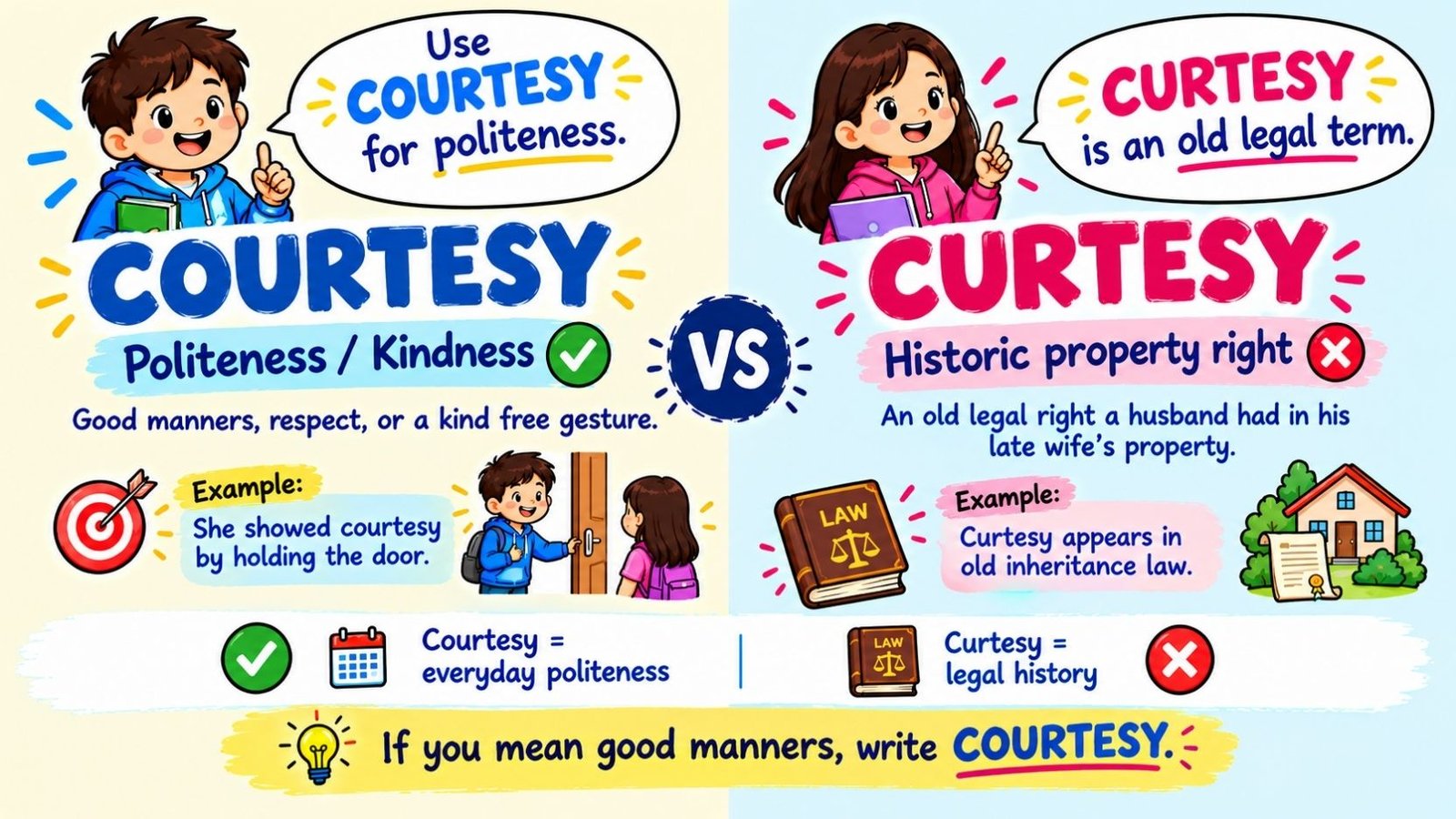
Courtesy and curtesy look almost identical, but they mean very different things. Courtesy is the common word for polite, respectful behavior toward others. Curtesy is a rare legal term tied to old property and inheritance law. Mixing them up in writing can confuse readers or even change the meaning of a legal sentence.
This difference matters because these two words are easy to swap by accident. Courtesy appears constantly in everyday speech, business writing, and casual conversation. Curtesy seldom appears outside legal documents, law textbooks, or historical texts. Knowing which one to use protects your writing from a small but noticeable error.
What Does Courtesy Mean?
Courtesy means polite behavior, respect, or kindness shown toward another person. It can describe good manners, a considerate action, or a small favor done freely. The word works as a noun and shows up in phrases like “common courtesy” or “courtesy call.” It is the version almost everyone means when they are simply trying to spell the word for politeness.
Courtesy can also describe something given free of charge, as in “a courtesy shuttle” or “a courtesy copy.” In that sense, it signals that a service or item was offered as a kind gesture rather than something required. You will see this usage often in business, hospitality, and customer service contexts.
Simple definition: Courtesy is polite, respectful, or considerate behavior, or something given as a free, kind gesture.
Read More: Curtesy Vs Courtesy
What Does Curtesy Mean?
Curtesy is a legal term, not a word for politeness. It refers to a husband’s right, under old common law, to part of his deceased wife’s property. This right traditionally applied only if the couple had a child born alive during the marriage. Today, curtesy has been abolished or replaced in nearly every American state.
Under Cornell Law School’s legal reference site, curtesy is an outdated legal term describing the portion of an estate a husband was entitled to after his spouse’s death. Historically, this right only applied when the couple had a child together during the marriage.
Curtesy has a counterpart called dower, which describes similar inheritance rights for a widow. According to Cornell’s legal glossary, dower traditionally gave a surviving wife a life estate in a portion of her husband’s property, while curtesy covered the reverse situation for a surviving husband. Both concepts come from English common law and have mostly disappeared from modern statutes.
Simple definition: Curtesy is an old legal term for a husband’s right to a life interest in his deceased wife’s real property, once children were born to the marriage.
Courtesy Vs Curtesy At A Glance
| Word | Meaning | Common Field | Still Used Today? |
| Courtesy | Politeness, respect, or a free gesture | Everyday language, business, hospitality | Yes, very common |
| Curtesy | A husband’s historic right to a deceased wife’s property | Property law, inheritance law | Rare, mostly abolished |
This table shows why the two words feel so different once you know their real meanings. One belongs to daily conversation. The other belongs almost entirely to legal history and probate discussions.
Courtesy Vs Curtesy Vs Curtsy
A third word often joins this confusion: curtsy. A curtsy is a gesture of respect, usually made by bending the knees while lowering the body slightly. It is most associated with women greeting royalty or performing a formal bow in traditional settings.
Here is how all three compare side by side.
| Word | Part of Speech | Meaning |
| Courtesy | Noun | Politeness or a free, kind gesture |
| Curtesy | Noun (legal) | A husband’s historic property right |
| Curtsy | Noun / Verb | A respectful bow made by bending the knees |
Courtesy and curtsy actually share a distant historical connection through ideas of respectful behavior at court. Curtesy, however, developed along a separate legal path and does not share that same everyday meaning. Keeping these three words separate in your mind will prevent almost every common mix-up.
Courtesy Vs Curtesy: Examples In Real Sentences
Seeing both words in context makes the difference clear right away.
Courtesy examples:
- She held the door open as a simple courtesy to the next customer.
- The hotel offers a courtesy shuttle to and from the airport.
- Common courtesy suggests you should thank someone who helps you.
Curtesy examples:
- Under old common law, curtesy gave the husband a life estate in his late wife’s land.
- The court explained that curtesy rights no longer apply in most modern states.
- Legal historians study curtesy alongside dower to understand inheritance law before reform.
Notice how courtesy fits naturally into casual, everyday sentences. Curtesy, by contrast, almost always appears inside a legal or historical explanation.
How To Pronounce Courtesy And Curtesy
Both words sound almost identical when spoken aloud, which is part of why they get confused in writing.
- Courtesy is pronounced KUR-tuh-see, with stress on the first syllable.
- Curtesy is pronounced the same way, KUR-tuh-see, since it shares the same root sound pattern.
Because the pronunciation is nearly indistinguishable, spelling is the only reliable way to tell them apart in text. This is exactly why writers, students, and legal professionals need to know the difference by sight, not just by sound.
Read More: Persue Or Pursue
Origin Of Courtesy
Courtesy traces back to Old French curteisie, which described the refined manners expected at a royal court. That word came from curteis, meaning courteous, which itself grew out of the idea of court behavior. Over centuries, the word broadened from strict court etiquette into general politeness used by anyone, anywhere.
This origin explains why courtesy still carries a sense of formal respect, even in casual modern use. The word essentially preserves the idea that good manners were once tied closely to proper conduct in noble settings.
Origin Of Curtesy
Curtesy comes from a different legal tradition tied to English property law. The full historical term was “courtesy of England,” referring to a husband’s right in his wife’s lands. Wikipedia’s entry on this legal doctrine describes it as the life interest a widower could claim in lands his late wife had personally held during the marriage.
Over time, the legal spelling shifted to “curtesy” partly to separate it visually from the everyday word “courtesy.” Even with the different spelling, both words share the same distant root related to formal, court connected conduct.
Why Curtesy Rarely Appears Today?
Curtesy rights have been abolished or replaced across nearly all of the United States and the United Kingdom. A legal glossary from Barnes Walker explains that curtesy has largely been eliminated and replaced by modern probate laws and spousal elective share statutes.
In England and Wales specifically, curtesy was formally abolished through the Administration of Estates Act 1925, according to Wikipedia’s summary of the doctrine. Many American states followed a similar path, replacing both dower and curtesy with more balanced, gender neutral inheritance laws.
Because of this, curtesy now shows up mainly in:
- Law school textbooks
- Historical property law discussions
- Older deeds or estate documents
- Bar exam study materials
If you are not reading legal history or probate law, you will likely never need the word curtesy at all.
Dower And Curtesy
Dower and curtesy are often mentioned together because they served similar, opposite purposes. Dower protected a widow’s right to a portion of her husband’s property. Curtesy protected a widower’s right to his wife’s property, though usually with more sweeping terms.
A legal glossary from Barnes Walker notes that curtesy traditionally granted a widower a life estate in all real property his wife owned during the marriage, provided the couple had a child capable of inheriting. Dower, by comparison, typically gave a widow rights to only one third of her husband’s estate, regardless of whether children existed.
This asymmetry reflects older legal systems that treated husbands and wives very differently under property law. Modern statutes have replaced both concepts with more equal protections for surviving spouses.
Curtesy Real Estate Definition
In a real estate or probate context, curtesy specifically describes a life estate. A life estate means the right to use and benefit from property for the remainder of one’s life, without owning it outright. According to Cornell Law School, a surviving husband under curtesy would typically receive this kind of life estate, not full ownership of the land.
This distinction matters in legal writing. Curtesy does not mean the husband owned the property forever. It means he had the right to use and profit from it during his own lifetime, after which the property would pass on according to other inheritance rules.
Common Mistakes With Courtesy And Curtesy
Mixing up these two words usually happens for one of a few simple reasons.
⚠️ Mistake 1: Typing curtesy when you mean politeness. Incorrect: “Please show basic curtesy to your coworkers.” Correct: “Please show basic courtesy to your coworkers.”
⚠️ Mistake 2: Assuming curtesy is just an alternate spelling. Curtesy is not a spelling variant of courtesy. It is a completely separate legal term with its own specific meaning.
⚠️ Mistake 3: Using courtesy in a legal property context. Incorrect: “The husband claimed courtesy rights to the estate.” Correct: “The husband claimed curtesy rights to the estate.”
✅ A simple memory trick: courtesy relates to “court manners,” while curtesy relates to “current” legal claims on property, since both begin with “cur.” If you are talking about politeness, kindness, or a free favor, you almost always want courtesy.
Courtesy Of Someone: How This Phrase Works
The phrase “courtesy of” is extremely common and has nothing to do with the legal term curtesy. It means something was provided by, given by, or made possible through someone or something.
Examples:
- The free upgrade was courtesy of the hotel manager.
- This report comes courtesy of our research team.
- Toby Keith’s song “Courtesy of the Red, White and Blue” uses this same phrase to credit patriotic pride as the source of the singer’s resolve.
This usage always relates to the everyday meaning of courtesy, never the legal term curtesy. It is one of the most frequent ways the word appears in music, media, and casual writing.
Related Everyday Phrases Using Courtesy
Courtesy appears in many familiar expressions beyond simple politeness.
| Phrase | Meaning |
| Courtesy call | A polite phone call, often to check in or confirm something |
| Courtesy flush | Flushing a public toilet partway through use, out of consideration for others |
| Courtesy clerk | A retail employee who helps bag groceries or assist customers |
| Courtesy copy | A copy of a document sent for someone’s information, not as a legal requirement |
| Senatorial courtesy | An informal tradition where senators defer to a colleague’s judgment on nominees from their home state |
These phrases show how flexible and widely used the everyday word courtesy really is. None of them relate to the legal meaning of curtesy in any way.
Business Names Using Courtesy
Many car dealerships and businesses use “Courtesy” in their name to suggest friendly, respectful service. Names like Courtesy Ford, Courtesy Nissan, Courtesy Toyota, Courtesy Chevrolet, and Courtesy Kia are common across the United States.
These are simply brand names built around the everyday meaning of courtesy, signaling helpful and respectful customer treatment. They have no connection to the legal term curtesy.
Is Curtesy A Word?
Yes, curtesy is a real word, but it belongs almost entirely to legal vocabulary. It is recognized in legal dictionaries and law references, including Cornell Law School’s Wex legal encyclopedia.
Outside of legal, historical, or academic writing, however, you will rarely see curtesy used correctly, since most people who type it actually mean courtesy.
Synonyms And Related Words
Courtesy has several close synonyms depending on context.
| Word | Meaning | Difference From Courtesy |
| Politeness | Good manners in behavior or speech | Slightly more general, less formal sounding |
| Civility | Formal politeness, especially in disagreement | Often used in tense or professional situations |
| Consideration | Thoughtfulness toward others’ needs | Focuses more on awareness than manners |
| Complimentary | Given free of charge | Used specifically for free items or services |
Curtesy has essentially one close legal relative, dower, which applies the same general concept to a surviving wife instead of a surviving husband.
Read More: How To Vs How Tos
Frequently Asked Questions
What is the difference between courtesy and curtesy?
Courtesy means politeness or a free, kind gesture, while curtesy is a legal term for a husband’s historic right to his deceased wife’s property.
Is curtesy the same as courtesy?
No. They are spelled similarly but have completely different meanings, one everyday and one strictly legal.
How do you spell courtesy correctly?
The correct spelling for the everyday word about politeness is c, o, u, r, t, e, s, y.
What does courtesy mean in a sentence?
It usually means a polite action or a service offered freely, such as “the ride was a courtesy from the driver.”
What does curtesy mean in law?
It refers to a widower’s traditional right to a life estate in property his late wife owned, if the couple had children.
Is curtesy still legal today?
In most states and countries, curtesy has been abolished or replaced by modern, gender neutral inheritance laws.
What is the difference between dower and curtesy?
Dower applied to a surviving wife’s rights in her husband’s property, while curtesy applied to a surviving husband’s rights in his wife’s property.
How do you pronounce curtesy?
It is pronounced the same as courtesy, roughly KUR-tuh-see.
Which is correct, courtesy by or courtesy of?
“Courtesy of” is the standard phrase, meaning something was provided by a certain person or source.
Is courtesy a noun or an adjective?
Courtesy is primarily a noun, though it can act as a modifier in phrases like “courtesy shuttle” or “courtesy call.”
Conclusion
Courtesy and curtesy may look nearly identical, but they serve completely different purposes in the English language. Courtesy is the word almost everyone needs, covering politeness, respect, and free gestures in daily life. Curtesy, on the other hand, is a specialized legal term describing an old property right that has mostly disappeared from modern law.
Understanding this difference helps you avoid an easy but noticeable spelling mistake in your writing. Whenever you mean politeness, kindness, or a free favor, courtesy is almost certainly the word you want, while curtesy should stay reserved for legal or historical discussions of old inheritance rights.

Zunaira Qasim is the author and creator of Gramvixo, dedicated to making English grammar easier for learners and everyday writers. With 4 years of experience researching grammar, confusing words, word choices, and common language mistakes, they create clear and practical content that helps readers understand English and use it with confidence.
2 Comments