
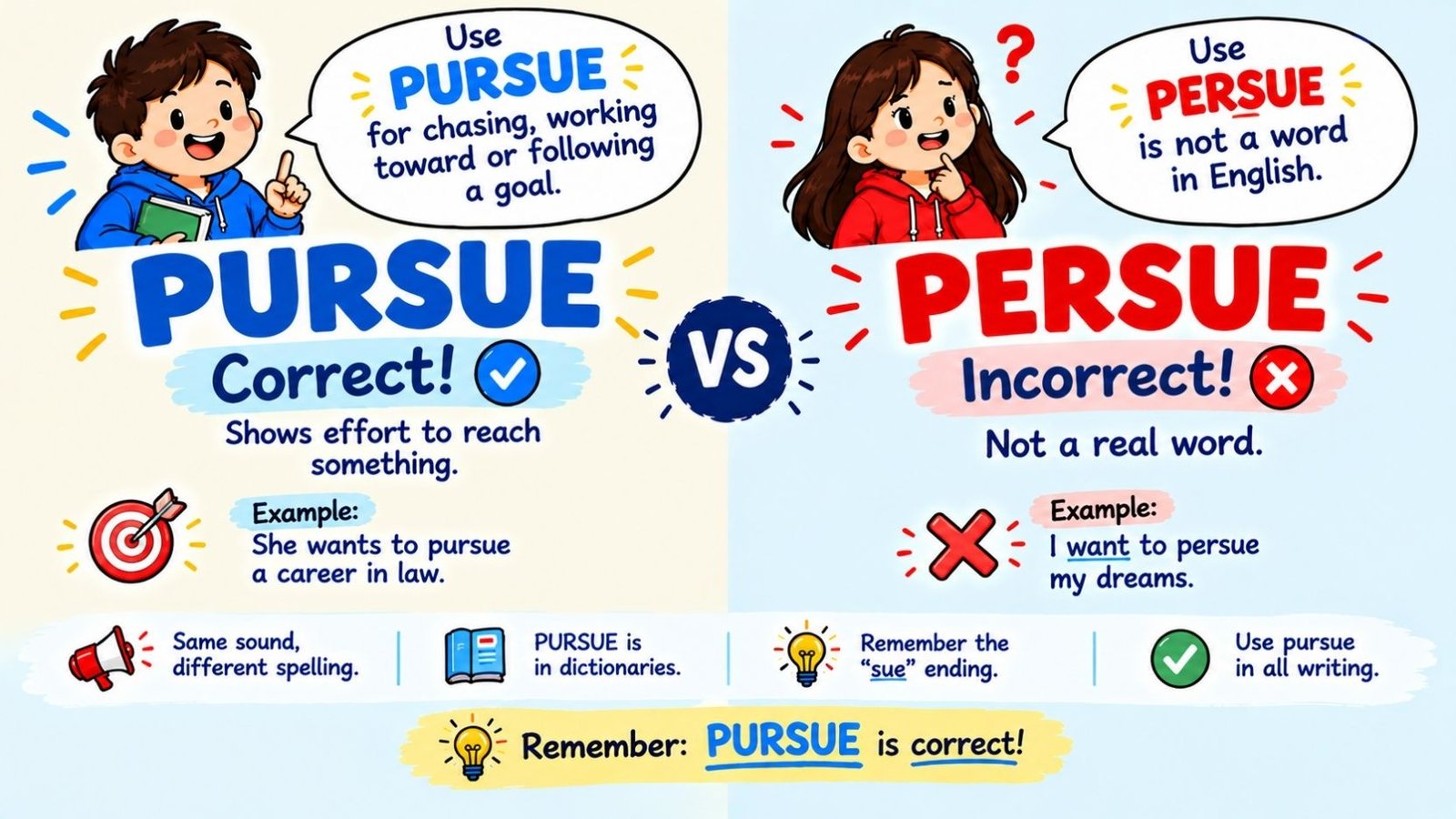
Pursue is the correct spelling. Persue is a common misspelling of the same word. Many people type persue by mistake. The confusion usually comes from how the word sounds.
This mix-up shows up often in emails and essays. Getting it right matters for clear, professional writing. Spelling mistakes like this can distract readers from your message. This guide explains the difference clearly and simply.
What Does Pursue Mean?
Pursue means to follow, chase, or work toward something. It can describe a physical action, like chasing a person. It can also describe a goal, like a career or a dream. The word carries a sense of ongoing effort or determination.
Here is a simple breakdown of its core meanings:
| Meaning | Simple Explanation | Example Use |
| To chase | To follow someone or something physically | Police pursue a suspect |
| To work toward a goal | To keep working on a plan or ambition | She wants to pursue a career in law |
| To continue an activity | To keep doing something over time | He decided to pursue his hobby seriously |
| To seek or investigate | To follow up on an idea or lead | The team will pursue the new lead |
Read More: Seamless Vs Seemless
Why Do People Write Persue Instead of Pursue?
The main reason is pronunciation. Pursue sounds like “per sue” when spoken quickly. Many English learners write words the way they sound. This leads naturally to the incorrect spelling persue.
Another reason is visual confusion with similar words. Words like pursuit and pursuant share the same root. People sometimes blend the spelling of related words together. This creates small, understandable spelling slips.
Persue or Pursue: Quick Comparison
| Spelling | Status | Notes |
| Pursue | Correct | Standard spelling used in dictionaries |
| Persue | Incorrect | Common misspelling, not a recognized word |
⚠️ Common mistake: writing “persue” in job applications or essays.
✅ Correct form: always use “pursue” in formal and informal writing.
Pursue: Grammar and Part of Speech
Pursue is a verb. It follows regular verb patterns in English. Below is a simple breakdown of its forms.
| Form | Example | Usage |
| Base form | Pursue | I want to pursue this opportunity |
| Present tense (he/she/it) | Pursues | She pursues her passion for art |
| Past tense | Pursued | They pursued the case for years |
| Present participle | Pursuing | He is pursuing a degree in medicine |
| Noun form | Pursuit | Her pursuit of excellence never stopped |
Pursue is a transitive verb. This means it needs an object to complete its meaning. For example, you pursue a goal, a career, or a person. You do not simply say “I pursue” without naming what.
How to Pronounce Pursue
Pursue is pronounced as “per SYOO.” The stress falls on the second syllable. In American English, it sounds close to “per soo.” British English pronunciation is very similar, with slight vowel differences.
There is no widely used alternate pronunciation. This consistency makes the spelling mismatch even more noticeable. Native speakers rarely misspell it once they see it written correctly.
Origin of the Word Pursue
Pursue comes from Old French “poursuivre.” That word came from Latin “prosequi,” meaning to follow after. The prefix “pro” means forward, and “sequi” means to follow. Over time, English adapted the spelling into “pursue.”
This history explains the “sue” sound at the end. It also explains why “persue” never became an accepted spelling. The word’s roots kept its structure consistent across centuries.
Pursue In Different Contexts
Pursue In A Career
People often use pursue when talking about career paths. It suggests active effort toward a professional goal.
Example: “She decided to pursue a career in engineering.”
Pursue In Relationships
Pursue can describe romantic interest or effort in a relationship. It suggests someone is actively trying to build a connection.
Example: “He continued to pursue her attention throughout the semester.”
Pursue in Legal or Formal Situations
Pursue often appears in legal and business writing. It can describe continuing legal action or formal investigation.
Example: “The company chose to pursue legal action against the supplier.”
Debt collectors may also pursue unpaid debts within legal time limits. These time limits vary by state and type of debt. A financial or legal professional can confirm specific rules that apply.
Pursue An Education
Pursue frequently appears in academic contexts too. It describes an ongoing commitment to learning or training.
Example: “Many employees choose to pursue further education while working.”
Synonyms For Pursue
Several words share meaning with pursue, but each has slight differences.
| Word | Meaning | Difference From Pursue |
| Chase | To follow quickly, often physically | More urgent, often literal |
| Seek | To search for something | Less about ongoing action |
| Follow | To go after someone or something | More neutral, less determined |
| Strive | To make a strong effort | Focuses on effort, not direction |
| Continue | To keep doing something | Lacks the sense of active chasing |
Choosing the right synonym depends on tone and context. Pursue often feels more formal and purposeful than “chase” or “follow.”
Read More: Curtesy Vs Courtesy
Common Mistakes With Pursue
Incorrect: “I want to persue my dreams.”
Correct: “I want to pursue my dreams.”
Incorrect: “She is persueing a new opportunity.”
Correct: “She is pursuing a new opportunity.”
Incorrect: “He will persue this matter further.”
Correct: “He will pursue this matter further.”
💡 Tip: If you’re unsure, say the word slowly. Focus on the “sue” ending, not the “per sue” sound. This helps you remember the correct spelling pattern.
Frequently Asked Questions
Is it persue or pursue?
The correct spelling is pursue. Persue is a common but incorrect spelling.
What does pursue mean?
Pursue means to follow, chase, or work toward a goal. It often describes ongoing effort or determination.
Is pursue a noun or a verb?
Pursue is a verb. Its related noun form is pursuit.
How do you spell the past tense of pursue?
The past tense is spelled pursued. For example: “She pursued her goal for years.”
How do you pronounce pursue?
Pursue is pronounced “per SYOO.” The stress falls on the second syllable.
What is a synonym for pursue?
Common synonyms include chase, seek, and follow. Strive is also used in more formal contexts.
Why do people misspell pursue as persue?
The misspelling usually comes from how the word sounds. Pursue sounds like “per sue,” which leads to the error.
Can pursue be used in a legal context?
Yes, pursue is often used in legal and business writing. It can describe pursuing legal action or an unpaid debt.
What is the difference between pursue and chase?
Chase usually means a more urgent, literal following. Pursue can be broader, including goals, careers, or ideas.
Is “persue” ever considered correct in any dialect?
No, persue is not a recognized spelling in any major dialect. Pursue is the only standard form in English.
Final Thoughts
Pursue is the correct spelling, and persue is not a real word. The confusion comes mostly from how the word sounds when spoken. Understanding its meaning, grammar, and origin helps prevent future mistakes. Remembering the “sue” ending is a simple way to stay accurate.
Whether you are pursuing a career, a relationship, or a goal, spelling it correctly matters. Clear writing builds trust with readers and shows attention to detail. Once you remember the correct form, you likely will not misspell it again. Pursue confidently, and let your writing reflect that same confidence.

Zunaira Qasim is the author and creator of Gramvixo, dedicated to making English grammar easier for learners and everyday writers. With 4 years of experience researching grammar, confusing words, word choices, and common language mistakes, they create clear and practical content that helps readers understand English and use it with confidence.


One Comment