
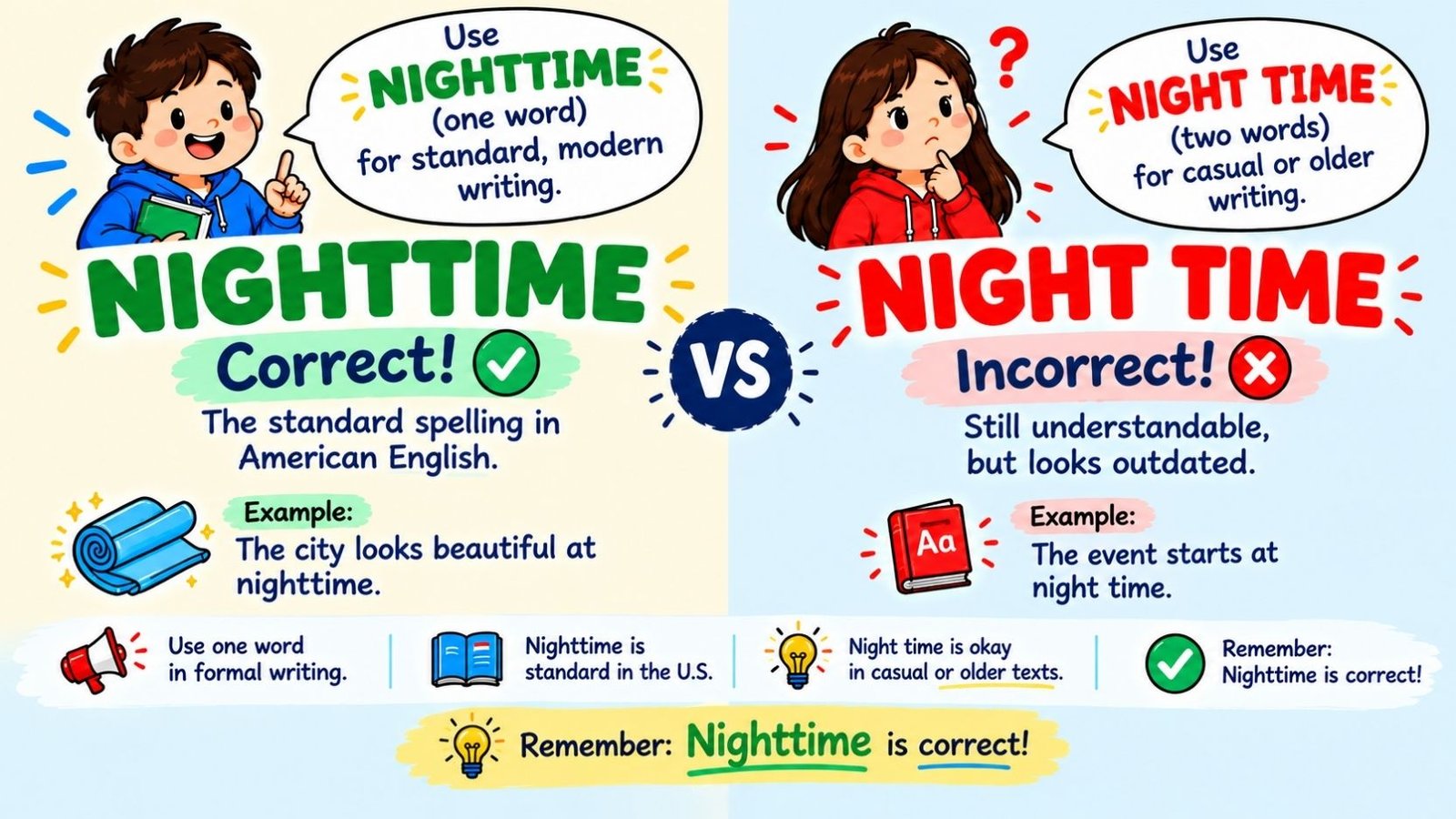
If you have ever paused mid sentence, wondering whether to write nighttime or night time, you are not alone. This confusion is common, even among careful writers. The good news is that the answer is fairly clear once you understand the pattern.
In modern American English, nighttime is the standard, preferred spelling. It is written as one word, with no hyphen and no space in between. Major dictionaries and style guides confirm this as the accepted form for everyday and professional writing.
Night time, written as two separate words, still appears in casual writing and older texts. It is not technically wrong, but it looks outdated to most modern readers. Understanding when each form fits will make your writing feel more polished and confident.
What Does Nighttime Mean?
Nighttime refers to the hours of darkness between sunset and sunrise. It is the period of a day when the sun has gone down and natural light is absent.
The word works as a noun in most sentences. It can also function as an adjective, describing something that happens during those dark hours.
For example, you might talk about nighttime activities, a nighttime routine, or simply say that something happened during the nighttime. In each case, the word points to that specific stretch of darkness within a twenty four hour cycle.
Read More: Cacoon Or Cocoon
Nighttime Or Night Time: The Short Answer
Here is the direct answer most readers are searching for.
Nighttime is the correct, standard spelling in modern American English. Dictionaries list it as a single closed compound word, and it is the form recommended by most style guides, including AP style.
Night time, written as two words, is grammatically understandable but considered less formal and less current. It shows up mostly in older writing, casual contexts, or when a writer wants to emphasize the literal time of night rather than the general period of darkness.
If you are writing for school, work, or a professional audience, choose nighttime. Save night time for casual notes or stylistic effect.
Nighttime Vs Night Time: Quick Comparison
| Form | Status | Typical Use |
| Nighttime | Standard, modern, preferred | Everyday writing, professional documents, news, academic work |
| Night time | Older, informal, less common | Casual writing, older texts, emphasis on literal clock time |
| Night-time | British variant | Common in UK publications, especially formal British writing |
This table sums up the core difference. The single word form has become the default across most English speaking regions, though British English still shows more flexibility.
Why Nighttime Became the Standard Spelling
English has a long history of merging frequently used two word phrases into single compound words. This process usually happens in stages.
A phrase often starts as two separate words. Over time, as people use it more and more together, it becomes hyphenated. Eventually, once the pairing feels completely natural, it merges into one solid word.
Nighttime followed this exact path. Early English writing used night time as two distinct words. As the phrase grew more common, it eventually became hyphenated, and later settled into the closed compound form you see today.
This pattern is not unique to nighttime. Similar shifts happened with other common word pairs:
- Day time became daytime
- Any more became anymore
- To day became today
Each of these examples shows the same underlying trend. Frequently paired words tend to fuse together as English evolves, and nighttime is simply one more example of that natural shift.
Nighttime Grammar: Part of Speech and Sentence Use
Understanding how nighttime functions grammatically helps you use it correctly in different sentences.
Nighttime As A Noun
Most commonly, nighttime works as a noun. It names the period of darkness itself.
- The city feels quieter during nighttime.
- Nighttime brings a different kind of energy to the streets.
In both examples, nighttime refers directly to the time period, acting as the subject or object of the sentence.
Nighttime As An Adjective
Nighttime can also describe another noun, functioning as an adjective. In this role, it does not take a hyphen.
- She follows a strict nighttime routine.
- The nighttime skyline looked calm and quiet.
Here, nighttime modifies routine and skyline, describing when each thing happens or exists.
Night Time As Two Words
When written as two separate words, night time is typically used to describe the literal time associated with night, almost like a measurement or a specific moment.
- What time is it during night time hours?
- The delivery arrived at night time, closer to midnight.
This usage is less common today and often reads as slightly old fashioned or overly literal compared to the smoother, more natural nighttime.
Nighttime or Night Time: American vs British English
Regional differences matter here, and this is one of the biggest sources of confusion.
Style guides in American English usually prefer the single-word form. This means nighttime is the expected spelling across nearly all American writing, from casual blogs to formal reports.
Oxford’s Lexico lists “night-time,” and the Cambridge Dictionary lists “nighttime.” This shows that even within British English sources, there is some disagreement, with Oxford leaning toward the hyphenated form while Cambridge favors the closed spelling.
Read More: What Kind Of Vs What Kinds Of
Here is a simple breakdown of regional preferences.
| Region | Preferred Spelling | Notes |
| United States | Nighttime | Strongly preferred across dictionaries and style guides |
| United Kingdom | Night-time or Nighttime | Both forms appear, with the hyphenated version common in formal writing |
| Canada | Nighttime | Generally follows American conventions |
| Australia | Nighttime | Generally follows American and modern global conventions |
If your audience is primarily American, nighttime is the safe, correct choice. If you are writing specifically for a British audience, night-time with a hyphen is also widely accepted, especially in more formal or traditional publications.
Nighttime or Night Time In AP Style
For anyone writing news content, blog posts, or professional copy that follows AP style, the answer is straightforward. AP style favors the closed, one-word form: nighttime. This aligns with how most American newspapers, magazines, and digital publications write the word today.
If you are drafting content for a professional or editorial setting, defaulting to nighttime keeps your writing consistent with widely accepted journalistic standards.
How to Pronounce Nighttime
Pronunciation is simple and consistent, regardless of which spelling you choose to write.
Nighttime is pronounced as two syllables: “nyt” followed by “tym,” said together smoothly as one word. The stress falls on the first syllable, similar to how you would say the word night on its own, followed quickly by time.
Because the pronunciation does not change between nighttime and night time, spelling confusion tends to come purely from how the word looks in writing rather than how it sounds when spoken.
Origin Of The Word Nighttime
The word traces back to the combination of two very old English words: night and time. Both have roots stretching back through Old English and, further still, into common Germanic language origins.
Originally, English speakers used these as two separate words to describe the period of darkness. As the phrase became more common in everyday speech, writers began joining the two words more consistently.
By the time formal dictionaries started standardizing English spelling, nighttime had already become the dominant written form in most contexts, particularly within American publications.
Common Mistakes With Nighttime and Night Time
Even experienced writers slip up here. Below are a few frequent mistakes worth watching for.
⚠️ Mistake 1: Adding a hyphen in American English
❌ Incorrect: night-time routine
✅ Correct: nighttime routine
American style guides do not typically use the hyphenated form. Save the hyphen for British contexts, or leave it out entirely.
⚠️ Mistake 2: Using two words in formal writing
❌ Incorrect: The event starts at night time.
✅ Correct: The event starts at nighttime.
Two word spelling can look inconsistent or outdated in professional, academic, or business writing.
⚠️ Mistake 3: Assuming both forms are always interchangeable
While both forms are understandable, they are not always equally appropriate. Nighttime fits professional and modern writing. Night time fits casual, literal, or stylistic writing far better than formal contexts.
Examples of Nighttime Used Correctly
A few clear examples make the correct usage easy to remember.
- Nighttime temperatures often drop several degrees compared to the afternoon.
- Her nighttime skincare routine includes just three simple steps.
- The city lights up beautifully once nighttime arrives.
- Many animals are more active during nighttime than during the day.
Each sentence uses nighttime naturally, without a hyphen, functioning either as a noun or an adjective depending on the context.
Synonyms And Related Words
Several related words describe similar ideas, though each carries a slightly different meaning or tone.
| Word | Meaning | Difference From Nighttime |
| Night | The period of darkness itself | Simpler, more general term |
| Evening | The time just before night, right after daytime | Refers to an earlier part of the day |
| Dusk | The moment just before full darkness | A specific transitional moment, not a full period |
| After dark | Informal phrase meaning after sunset | More casual, often used in spoken English |
While these words overlap in meaning, nighttime specifically emphasizes the entire span of darkness, rather than a single transitional moment like dusk or evening.
Nighttime vs Daytime
Since nighttime often gets compared to its opposite, it helps to briefly clarify the pairing.
Daytime refers to the hours of daylight, generally from sunrise to sunset. Nighttime refers to the opposite: the hours of darkness, from sunset to sunrise.
Both words follow the same spelling pattern, appearing as single closed compound words in modern English. This consistency makes it easier to remember: if daytime is one word, nighttime should be too.
Read More: Courtesy Vs Curtesy
Frequently Asked Questions
Is it nighttime or night time?
Nighttime, written as one word, is the standard and preferred spelling in modern American English. Night time, as two words, is understandable but considered older and less formal.
Which is correct, nighttime or night time?
Nighttime is correct for most modern writing, especially in the United States. Night time can still appear in casual or older writing, but it is not the preferred form today.
Is nighttime one word according to Oxford Dictionary?
Oxford recognizes nighttime as a standard form, though some Oxford references, particularly Lexico, also list the hyphenated night-time as acceptable in British English.
What is the AP style spelling for nighttime?
AP style favors the closed, one word spelling: nighttime. This is consistent with most American news and editorial standards.
Is nighttime spelled differently in UK English?
British English sometimes uses night-time with a hyphen, especially in formal writing. However, the single word nighttime is increasingly common there as well.
Is nighttime a noun or an adjective?
Nighttime can function as both. As a noun, it names the period of darkness. As an adjective, it describes something related to that period, such as a nighttime routine.
How do you pronounce nighttime?
Nighttime is pronounced as two syllables, said together as one smooth word, with stress on the first syllable, similar to saying night followed quickly by time.
What is the origin of the word nighttime?
Nighttime comes from combining the older English words night and time. Over centuries, the two word phrase gradually merged into the single compound word used today.
Is night time ever correct to use?
Yes, night time as two words is grammatically understandable, though it reads as more casual or literal. It works best in relaxed writing rather than formal or professional contexts.
What is the difference between nighttime and evening?
Evening refers to the time just before nightfall, while nighttime refers to the full period of darkness that follows. They describe different, though related, parts of the day.
Final Thoughts
Choosing between nighttime and night time comes down to modern usage and context. Nighttime, written as a single word, is the standard, dictionary-preferred spelling across American English, and it fits naturally into professional, academic, and everyday writing.
Night time still appears occasionally, mostly in casual or older writing, but it no longer reflects the current standard. Whenever you want your writing to feel modern, clean, and correct, nighttime is the safer and more polished choice.

Zunaira Qasim is the author and creator of Gramvixo, dedicated to making English grammar easier for learners and everyday writers. With 4 years of experience researching grammar, confusing words, word choices, and common language mistakes, they create clear and practical content that helps readers understand English and use it with confidence.

3 Comments