
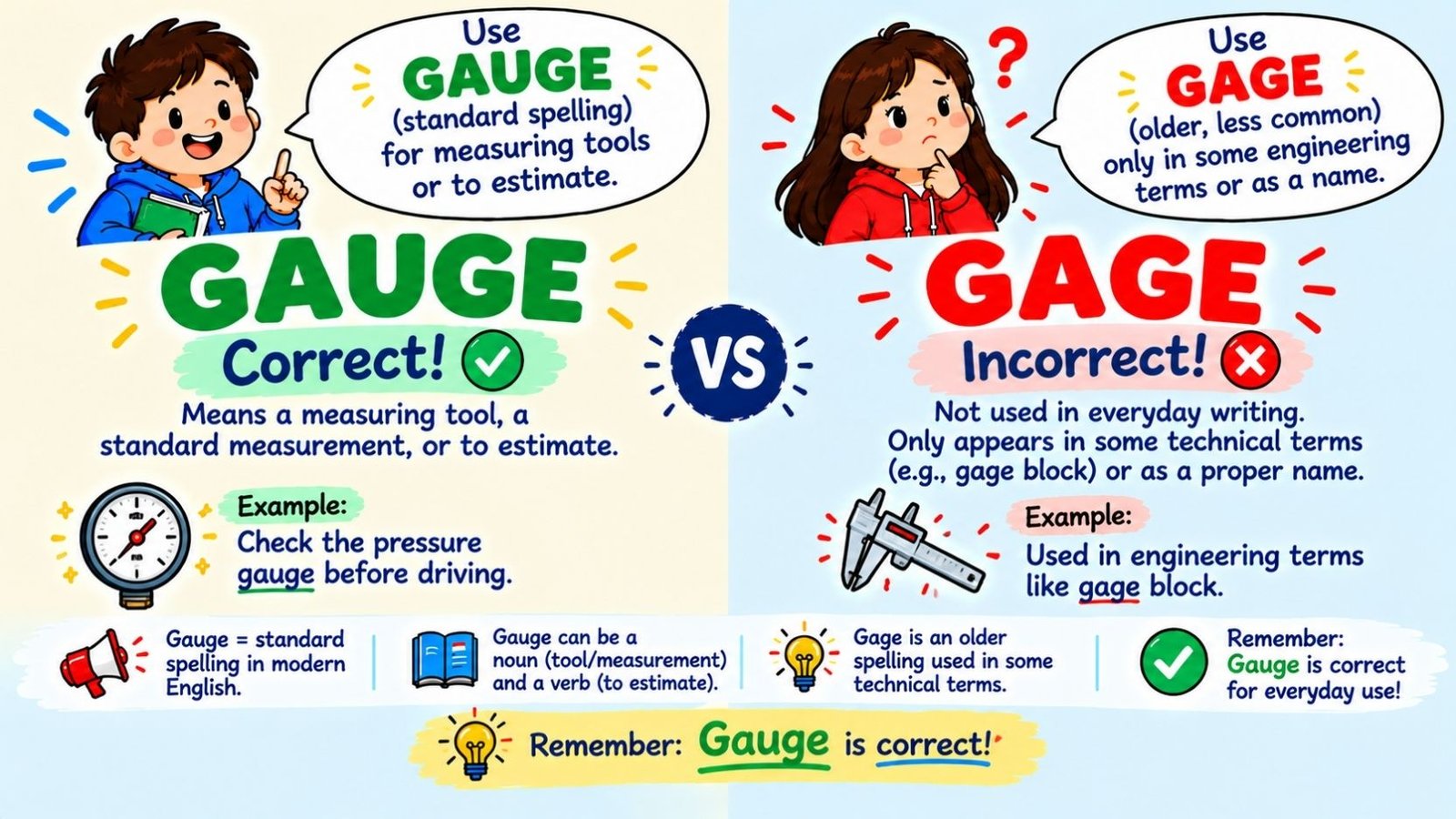
Gauge is the standard spelling for the measuring tool, the verb meaning to estimate or measure, and the word used for wire thickness, tire pressure, and rain measurement. Gage is an older, less common spelling that still shows up in American English, especially in engineering and manufacturing terms like gage block or gage R&R. In everyday writing, gauge is almost always the correct choice.
This confusion exists because both spellings were once used interchangeably in English, and old habits stick around in technical fields long after general usage settles on one form. Knowing which spelling to use matters if you write for a wire chart, a tire manual, an engineering report, or just a normal sentence where you want to sound confident. The rest of this article breaks down the meaning, the grammar, the pronunciation, and the specific situations where each spelling actually belongs.
Gauge vs Gage: The Simple Answer
If you only remember one thing, remember this: gauge is the spelling used in modern American and British English for almost every meaning of this word. Gage is a variant spelling that survives mainly in older engineering vocabulary and in a completely unrelated older meaning tied to pledges and challenges.
Here is a quick side by side view.
| Spelling | Common Use Today | Where You Will See It |
| Gauge | Standard modern spelling | Dictionaries, news, manuals, everyday writing |
| Gage | Older, technical variant | Some engineering documents, older texts, proper names |
Both words trace back to the same root, and both are pronounced the same way. The difference is almost entirely about spelling convention, not meaning.
Read More: Take Effect Or Take Affect
Gauge Definition
Gauge has two main jobs in English. It works as a noun and as a verb, and both uses are common.
As a noun, gauge refers to:
- An instrument used to measure something, such as pressure, thickness, or distance
- A standard measurement, such as the thickness of wire, sheet metal, or a shotgun barrel
- The distance between the rails of a railway track
As a verb, gauge means:
- To measure something precisely using an instrument
- To estimate or judge something, often when exact measurement is not possible
A sentence like “She tried to gauge his reaction” uses the verb form, meaning she tried to judge or estimate how he felt. A sentence like “Check the pressure gauge before you start the engine” uses the noun form, meaning the physical measuring tool.
Gage Definition
Gage has a smaller and more specific role in modern English, and it actually carries two separate meanings that are worth keeping apart.
Gage as an old English word for a pledge. In older or more formal writing, a gage was an object thrown down as a challenge, often to signal a formal dispute or a duel. This meaning survives today mostly in the phrase “throw down the gauntlet,” which grew out of the same idea, though gauntlet and gage are different words with a related history of challenge and pledge.
Gage as a technical variant spelling of gauge. In American engineering and manufacturing, some terms kept the older gage spelling even as general English moved to gauge. You will still see this in phrases like gage block, gage pin, and gage R&R, which is a quality control method used in manufacturing.
Gage as a proper name. Gage is also a common surname and given name in English. This use has nothing to do with measurement or pledges. It is simply a name, seen in cases like Phineas Gage, the well known nineteenth century railroad worker whose brain injury became a famous case study in neuroscience, and in the names of actors and public figures who share the surname or use it as a first name. When gage appears as a name, it follows normal capitalization rules for proper nouns and is not connected to the measurement meaning at all.
Gauge vs Gage: Grammar Breakdown
Both words function the same way grammatically, which is part of why people mix them up.
| Grammar Point | Gauge | Gage |
| Part of speech | Noun and verb | Noun (rare as a verb today) |
| Plural form | Gauges | Gages |
| Past tense (verb) | Gauged | Gaged (rarely used) |
| Present participle | Gauging | Gaging (rarely used) |
Because gauge is the spelling used in almost all modern contexts, its verb forms, gauged and gauging, are the ones you will see in newspapers, manuals, and everyday writing. The gage forms exist but are uncommon outside of specific technical documents.
How To Pronounce Gauge And Gage?
Here is something that surprises a lot of readers: gauge and gage are pronounced the same way.
Both are pronounced like the English word “cage,” with a long A sound. In simple terms, it rhymes with page, wage, and stage.
- Gauge: sounds like GAYJ
- Gage: sounds like GAYJ
The unusual part is the spelling of gauge itself. The “au” in the middle is silent in terms of sound, which is one reason the word trips people up when they try to spell it from memory.
Origin Of Gauge And Gage
Both words share the same root. Gauge came into English from Old French, where it referred to a standard of measurement. Gage entered English earlier, also from Old French, originally carrying the meaning of a pledge or a security deposited as part of an agreement.
Over time, English speakers used both spellings loosely for measurement related meanings, since they sounded identical and came from closely related French roots. By the time spelling became more standardized in the eighteenth and nineteenth centuries, gauge won out as the accepted form for measurement, while gage kept a narrow foothold in technical vocabulary and in its older pledge related sense.
This is a normal pattern in English. Many words had competing spellings for centuries before dictionaries and style guides settled on one preferred form.
Gauge Vs Gage In Engineering
This is where the confusion shows up most often, because engineering fields did not fully drop the gage spelling the way general English did.
Strain gauge vs gage. A strain gauge is a sensor used to measure the amount of deformation, or strain, in an object under load. Both spellings appear in technical literature, though strain gauge is now the more common and widely recognized form in published engineering standards and product names.
Gage R&R. This is a manufacturing quality control method, short for gage repeatability and reproducibility. It tests whether a measurement system produces consistent results. The gage spelling is standard here because the term originated within American manufacturing and quality assurance fields that kept the older spelling convention.
Gage blocks and gage pins. These are precision tools used to check exact measurements in machining and manufacturing. Again, gage is the traditional spelling used in these specific tool names, even though the tools themselves measure the same way a gauge does.
💡 Tip: If you are writing general content, use gauge. If you are quoting or referencing a specific technical term that traditionally uses gage, such as gage R&R or gage block, keep that spelling because it is the established name of the method or tool.
Read More: Nighttime Or Night Time
Gauge Sizes And Measurement Terms
Several everyday and technical terms use gauge specifically, and these are worth knowing individually since they come up often in search and in daily life.
- Wire gauge. Wire gauge describes the thickness of a wire. Confusingly, a lower gauge number means a thicker wire. A 10 gauge wire is thicker than a 12 gauge wire, and an 8 gauge wire is thicker still. Electricians and hobbyists rely on gauge size charts to match the right wire thickness to the right electrical load.
- Tire pressure gauge. This is the tool used to check the air pressure inside a tire, usually measured in pounds per square inch.
- Rain gauge. A rain gauge is a simple instrument that collects and measures the amount of rainfall in a given area over a set period of time.
- Pressure gauge. This general term covers any instrument that measures the pressure of a gas or liquid, from a bicycle pump to an industrial system.
- Feeler gauge. A feeler gauge is a set of thin metal strips used to measure small gaps, commonly used in mechanical work like checking spark plug gaps or valve clearances.
- Fuel pressure gauge. This measures the pressure of fuel moving through a vehicle’s fuel system, often used for diagnosing engine performance issues.
- 12 gauge. In the context of firearms, 12 gauge refers to a shotgun bore size. Gauge in this sense is based on an older system where the number relates to how many lead balls of that bore diameter would weigh one pound. A 12 gauge shotgun has a wider bore than a 20 gauge shotgun.
All of these terms use the gauge spelling consistently in modern usage.
Gauge Vs Gage Interest: What Does That Phrase Mean?
When people search for “gauge interest,” they usually mean checking how much enthusiasm or willingness other people have before committing to a plan. For example, “We want to gauge interest before booking the venue” means the organizers want to estimate how many people are actually likely to attend.
The correct spelling here is gauge, not gage. Since gauging interest means estimating or judging something, it uses the verb form of gauge, which is the standard modern spelling.
Common Mistakes
❌ Incorrect: I want to gage your opinion before we decide.
✅ Correct: I want to gauge your opinion before we decide.
The word here means to judge or estimate, which calls for gauge, the modern standard spelling, not the rarer gage form.
❌ Incorrect: Check the guage before you inflate the tire.
✅ Correct: Check the gauge before you inflate the tire.
This is a simple spelling slip. Guage is not a correct spelling of either word. The correct order is g, a, u, g, e.
❌ Incorrect: The wire gage chart shows the standard sizes.
✅ Correct: The wire gauge chart shows the standard sizes.
Wire measurement uses gauge in nearly all modern references, including electrical codes and hardware store charts.
Gauge vs Gage vs Guage: Clearing Up the Spelling Confusion
A lot of people searching for this topic are actually trying to confirm the correct spelling because “guage” looks like it could be right. It is not a recognized spelling in standard dictionaries. The three forms break down like this:
| Spelling | Status |
| Gauge | Correct, standard modern spelling |
| Gage | Valid but limited to specific technical or proper name uses |
| Guage | Not a standard English spelling |
If you are ever unsure, gauge is almost always the safe and correct choice.
Similar And Related Words
| Word | Meaning | How It Differs From Gauge |
| Gouge | A tool for cutting grooves, or to cheat someone out of money | Different word entirely, different pronunciation |
| Measure | A general term for finding the size, amount, or degree of something | Broader in meaning, not tied to a specific instrument |
| Estimate | A rough calculation or judgment | Similar to the verb sense of gauge, but less precise sounding |
| Assess | To evaluate or judge the value, quality, or extent of something | Close in meaning to gauge as a verb, often used in formal contexts |
Gouge deserves a special mention because it looks and sounds similar to gauge and gage but means something completely different, and mixing these up in writing changes the meaning of a sentence significantly.
Read More: Carrer Or Career
Frequently Asked Questions
What does gauge vs gage mean?
Gauge and gage are both measurement-related words, but gauge is the standard modern spelling used in everyday and most technical writing, while gage is an older variant still used in specific engineering terms and as a proper name.
Is gage or gauge correct for measuring metal thickness?
Gauge is the correct and expected spelling for describing metal thickness in modern usage, including sheet metal and wire.
How do you pronounce gauge and gage?
Both words are pronounced the same way, rhyming with cage, page, and stage.
Is gauge a noun or a verb?
Gauge works as both. As a noun, it refers to a measuring instrument or a standard measurement. As a verb, it means to measure or to estimate.
What is the difference between gauge and gouge?
Gauge relates to measurement, while gouge refers to a cutting tool or the act of cutting a groove, and can also mean to overcharge someone. They are unrelated words that happen to look similar.
Why do some engineering terms use gage instead of gauge?
Certain technical terms, such as gage R&R and gage block, kept the older gage spelling from earlier engineering and manufacturing conventions, even as general English usage shifted to gauge.
Is Phineas Gage related to the word gauge?
No. Phineas Gage is a proper name, unrelated in origin and meaning to the measurement word gauge or gage.
What is a strain gauge?
A strain gauge is a sensor that measures the amount of deformation or strain an object experiences under load or pressure, commonly used in engineering and structural testing.
Does British English use gage or gauge?
British English follows the same standard as American English here, using gauge as the accepted spelling in virtually all contexts.
What is the correct spelling, guage or gauge?
Gauge is correct. Guage is a common misspelling and is not recognized in standard dictionaries.
Final Thoughts
Gauge and gage share the same sound and a shared history, but modern English has settled firmly on gauge for nearly every use, from measuring wire and tire pressure to judging someone’s interest in a plan. Gage survives in a narrow set of engineering terms and as a personal name, which is exactly why it still shows up often enough to cause confusion.
When you are unsure which spelling to use, default to gauge. It covers instruments, measurements, and the verb meaning to judge or estimate, which handles the vast majority of situations you will run into. Save gage for the specific technical terms that traditionally use it, or for referring to someone whose actual name is Gage.

Zunaira Qasim is the author and creator of Gramvixo, dedicated to making English grammar easier for learners and everyday writers. With 4 years of experience researching grammar, confusing words, word choices, and common language mistakes, they create clear and practical content that helps readers understand English and use it with confidence.
One Comment