
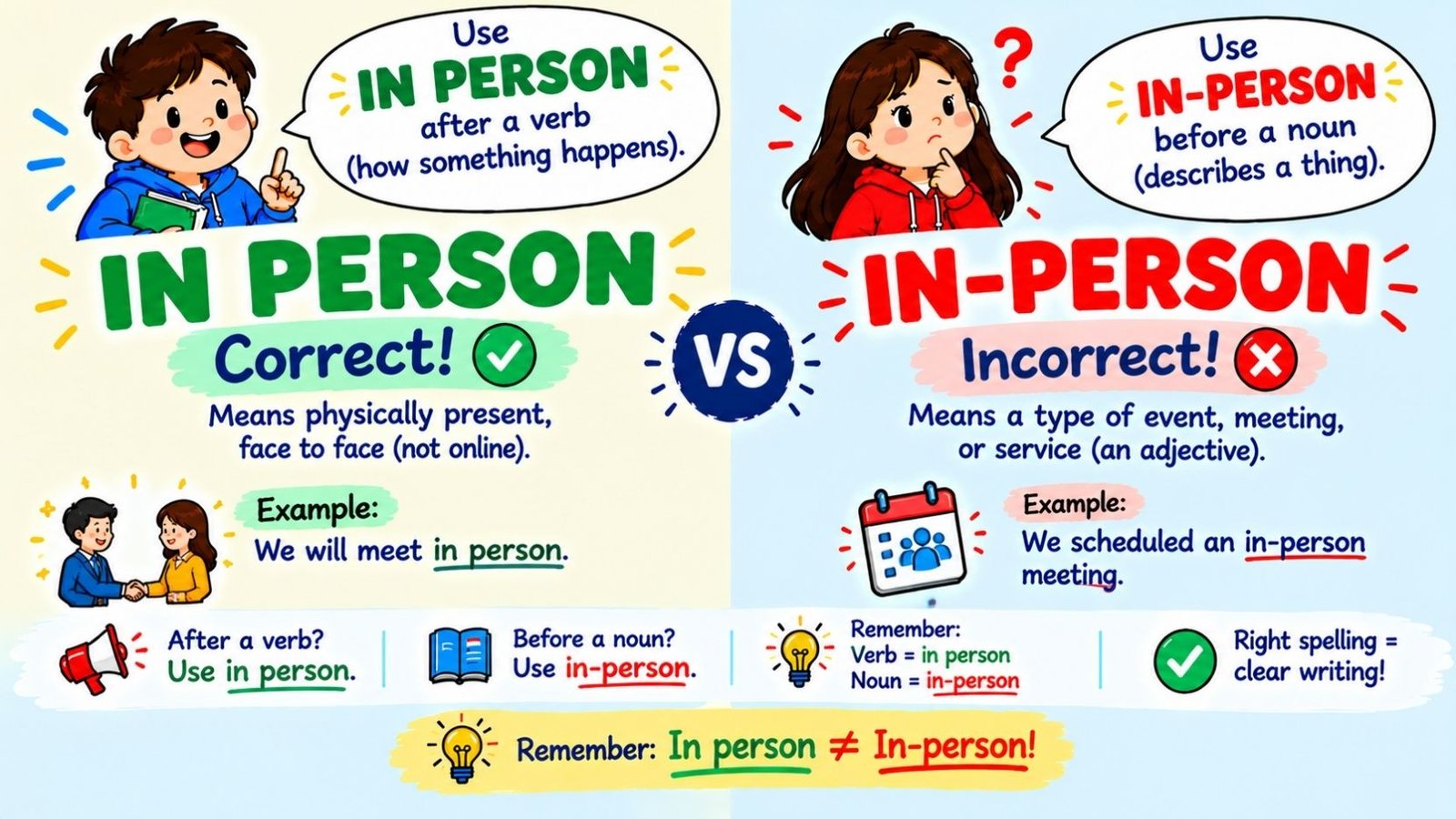
In person means physically present, face to face, rather than online or over the phone. In-person is the adjective form of the same idea, and it always comes before a noun, as in an in-person meeting or an in-person interview. The confusion between the two comes down to one simple grammar rule: whether the phrase is describing an action or describing a thing.
Getting this right matters more than it might seem. The wrong choice can look like a typo in a resume, a business email, or a website heading. Once you understand the underlying rule, though, you will never have to guess again. This guide breaks down the meaning, the grammar, and the real-world usage so you can use both forms with confidence.
In Person vs In-Person: The Quick Answer
Here is the short version before we go deeper.
| Form | Part of Speech | Where It Goes | Example |
| In person | Adverbial phrase | After the verb, describing how something happens | We will meet in person. |
| In-person | Adjective | Before a noun, describing what kind of thing it is | We scheduled an in-person meeting. |
If the phrase comes after a verb and tells you how an action is done, write it as two words with no hyphen: in person. If the phrase sits directly in front of a noun and describes that noun, hyphenate it: in-person.
Read More: Gauge Vs Gage
What Does In Person Mean?
In person means being physically present somewhere, rather than communicating by phone, video call, email, or mail. It answers the question “how” something is done.
- She wanted to thank him in person.
- You can pick up the package in person at the store.
- The judge asked the witness to appear in person.
In each of these sentences, in person modifies the verb. It explains the manner of the action, not a noun. That is why it stays unhyphenated.
What Does In-Person Mean?
In-person is the adjective version of the same concept. It describes a noun that involves face-to-face contact, as opposed to a virtual or remote version of the same thing.
- The company held an in-person conference this year.
- She prefers in-person therapy over video sessions.
- The school resumed in-person classes in the fall.
Here, in-person sits directly before conference, therapy, and classes. It is telling you what kind of conference, therapy, or classes these are, so it functions as a single compound adjective and takes the hyphen.
In Person vs In-Person Grammar: The Rule Explained
The grammar rule is straightforward once you see the pattern clearly.
Rule 1: Use “in person” after a verb.
When the phrase follows a verb and describes how the action happens, it works as an adverbial phrase. No hyphen is needed.
- I will attend in person.
- Please deliver the documents in person.
- We finally met in person after months of video calls.
Rule 2: Use “in-person” before a noun.
When the phrase comes immediately before a noun and describes that noun, it becomes a compound adjective. Compound adjectives placed before a noun are usually hyphenated in modern English style guides, which is why in-person takes a hyphen in this position.
- This is an in-person event.
- We offer in-person and online consultations.
- The company requires in-person onboarding for new hires.
A simple test: Ask whether the phrase is answering “how” (use in person) or describing “what kind” (use in-person). If you can remove the phrase and the sentence still makes sense with a noun standing alone, the phrase is acting as an adjective, so hyphenate it.
Is It In Person or In-Person? A Side-by-Side Comparison
| Sentence Type | Correct Form | Example |
| After a verb | In person | Let’s talk in person tomorrow. |
| Before a noun | In-person | Let’s schedule an in-person talk tomorrow. |
| As a standalone description | In person | The class is in person, not online. |
| Directly modifying a noun | In-person | It’s an in-person class. |
Notice that “the class is in person” does not hyphenate, even though it looks similar to “in-person class.” The difference is position. In the first sentence, in person follows the linking verb “is” and describes the subject in a predicate sense, similar to an adverb. In the second, in-person sits directly before the noun class, functioning as a true compound adjective.
Read More: Carrer Or Career
Is In Person Hyphenated? Common Confusion Explained
This is one of the most frequent questions readers search for, and the honest answer is: it depends on placement, not on the phrase itself.
- Not hyphenated when it follows a verb: We met in person.
- Hyphenated when it precedes a noun: We had an in-person meeting.
Many major style guides, including Merriam-Webster, treat “in person” as the base phrase and “in-person” as its adjectival form. This mirrors how many English compound expressions work, such as “well known” versus “well-known,” or “up to date” versus “up-to-date.” The words are the same, but hyphenation shifts based on grammatical role.
Common Mistakes With In Person and In-Person
❌ Incorrect: We will meet in-person next week.
✅ Correct: We will meet in person next week. Why: “Meet” is a verb, and “in person” describes how the meeting will happen, so no hyphen is needed.
❌ Incorrect: This is an in person interview.
✅ Correct: This is an in-person interview. Why: “Interview” is a noun, and the phrase directly modifies it, so it needs the hyphen.
❌ Incorrect: The event is inperson only.
✅ Correct: The event is in person only, or in-person only. Why: “In person” is always two separate words (or hyphenated as in-person). It is never written as one solid word.
⚠️ Common mistake: Writers often default to hyphenating the phrase everywhere out of habit, since they see “in-person” so often in headlines and marketing copy. But hyphenating it after a verb, such as “we talked in-person,” is grammatically incorrect.
In Person Or In-Person In A Sentence: More Examples
To make the rule stick, here are a few more paired examples.
- Correct: I would rather explain this in person. (after verb)
- Correct: I would rather have an in-person explanation. (before noun)
- Correct: The team decided to vote in person. (after verb)
- Correct: The in-person vote takes place on Friday. (before noun)
- Correct: Please renew your passport in person at the nearest office. (after verb)
- Correct: In-person passport renewal appointments fill up quickly. (before noun)
Renewing A Passport Or Getting A Birth Certificate In Person
Two very common real-life searches involve official documents, so it is worth addressing them directly.
Renew passport in person: Some passport situations, such as a first-time application, a lost passport, or a name change, require you to appear in person at an acceptance facility or passport agency rather than renewing by mail. In this context, “in person” is always unhyphenated, since it follows the verb “renew” or “appear.”
Getting a birth certificate in person: If you need a certified copy of a birth certificate quickly, many vital records offices allow you to request it in person rather than waiting for a mailed request. Again, this is the adverbial use, so no hyphen applies: “You can get your birth certificate in person at the county clerk’s office.”
In-Person Services: Therapy, Interviews And Classes
Several searches focus on specific in-person services. The grammar rule stays consistent across all of them, because in each case, “in-person” is functioning as an adjective before a noun.
- In-person therapy: face-to-face counseling sessions held in an office, rather than through video or phone.
- In-person interview: a job interview conducted physically at a location, rather than by phone or video call.
- In-person CPR classes: hands-on CPR and first aid training done with an instructor in the same room, which is often required for certification that includes a skills test.
- In-person coaching interviews: interviews or evaluations for coaching positions conducted face to face, common in sports and education settings.
If any of these phrases appear before a noun, keep the hyphen. If you rewrite the sentence so the idea follows a verb instead, drop it: “The class is taught in person” versus “It’s an in-person class.”
In Person Synonym: Other Ways to Say It
If you want to vary your wording, several alternatives capture a similar meaning, though none are perfect one-to-one substitutes.
| Alternative | Nuance |
| Face to face | Emphasizes direct, personal interaction |
| Physically present | More formal, often used in official or legal contexts |
| In the flesh | Informal, sometimes used for meeting someone famous or unexpected |
| On site | Focuses on location rather than personal presence |
“Personally” is close in meaning but not identical. “Personally” often means “as a personal opinion” or “done by oneself,” as in “I personally reviewed the file,” which does not always imply physical presence the way “in person” does.
In Person vs Personally: A Quick Note
Because these two phrases sometimes overlap, it helps to separate them clearly.
- In person = physically present, face to face.
- Personally = done by oneself, or expressing a personal opinion.
Example: “I will deliver the letter personally” can mean the speaker will handle it themselves, possibly even by mail or through a representative acting on their behalf, while “I will deliver the letter in person” specifically means the speaker will show up physically to hand it over.
Read More: Take Effect Or Take Affect
Frequently Asked Questions
What does in person mean?
In person means being physically present somewhere, in contrast to communicating by phone, video, or email.
Is it in person or in-person?
Both are correct, depending on placement. Use “in person” after a verb, and “in-person” before a noun.
Is in person hyphenated?
Only when it comes directly before a noun, such as “in-person meeting.” After a verb, it stays as two separate words with no hyphen.
How do you use in-person in a sentence?
Place it directly before a noun, as in “We attended an in-person workshop” or “This is an in-person event.”
Is in-person one word?
No. It is always written as two words, either as “in person” or hyphenated as “in-person.” It is never combined into a single word like “inperson.”
What is the difference between in person and in-person?
The words are the same, but the grammar role differs. “In person” is an adverbial phrase used after a verb. “In-person” is a compound adjective used before a noun.
Is in-person interview correct?
Yes. Since “in-person” comes directly before the noun “interview,” the hyphen is correct.
Can you say meet in-person?
No, this is a common mistake. “Meet” is a verb, so the correct form is “meet in person,” without a hyphen.
Conclusion
The difference between in person and in-person comes down to one clear grammar rule rather than a matter of style preference. When the phrase follows a verb and explains how something happens, write it as two separate words: in person.
When the phrase sits directly before a noun and describes that noun, hyphenate it: in-person. Once you can spot whether you are describing an action or a thing, the correct choice becomes automatic.
Whether you are writing about an in-person interview, renewing a passport in person, or scheduling in-person therapy, the same rule applies every time. Keep the verb-versus-noun test in mind, and you will never second-guess this hyphen again.

Zunaira Qasim is the author and creator of Gramvixo, dedicated to making English grammar easier for learners and everyday writers. With 4 years of experience researching grammar, confusing words, word choices, and common language mistakes, they create clear and practical content that helps readers understand English and use it with confidence.
2 Comments