
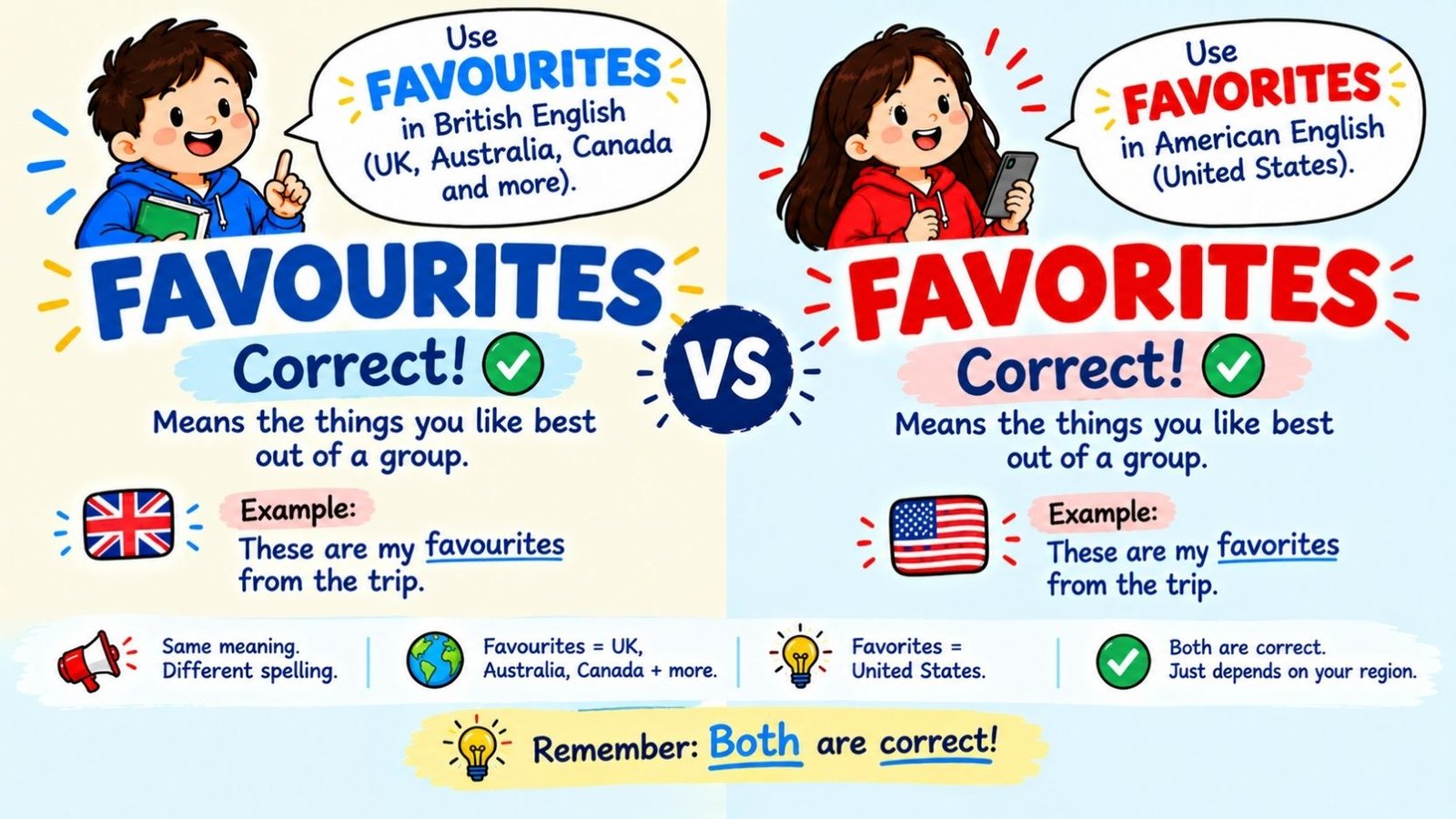
Favourites or favorites are two spellings of the same word, and both are correct English. The only real difference is regional. Favourites is the British English spelling, used across the UK, Australia, Canada, and most Commonwealth countries. Favorites is the American English spelling, used across the United States.
Neither version is grammatically wrong. Neither version is a misspelling. The confusion usually comes from seeing both forms online, in apps, or in different books, without knowing which one applies to your audience. Once you understand the regional pattern, choosing the right spelling becomes simple.
What Does Favourites Or Favorites Mean?
Favourites or favorites refers to the people, things, or items that someone likes best out of a group. It is the plural form of the word favourite (British) or favorite (American).
You use this word when you want to describe a top pick, a preferred choice, or something you return to again and again. It can apply to almost anything: a food, a song, a movie, a person, a place, or even a saved item in an app.
For example: if someone asks about your favourites or favorites in matcha, they are asking which matcha flavors, brands, or drinks you personally prefer the most.
Read More: Mei Fun Vs Chow Fun
Favourites Or Favorites: Quick Answer Table
| Spelling | Region | Example |
| Favourites | UK, Australia, Canada, India (formal writing), most Commonwealth countries | These are my favourites from the collection. |
| Favorites | United States | These are my favorites from the collection. |
Both spellings mean exactly the same thing. The difference is purely about which English variant you are writing in.
Favourites Or Favorites: Grammar Breakdown
Understanding the grammar makes the spelling choice much easier.
Part of speech: Favourite or favorite can function as a noun or an adjective.
As a noun, it names a person or thing that is preferred:
- “Pizza is one of my favourites.” (British)
- “Pizza is one of my favorites.” (American)
As an adjective, it describes something that is preferred:
- “This is my favourite song.” (British)
- “This is my favorite song.” (American)
Plural form: Favourites and favorites are the plural noun forms. You add an s to the singular word favourite or favorite, following the standard English rule for regular plural nouns.
Singular vs plural usage:
| Form | Example | Meaning |
| Favourite (singular) | This is my favourite book. | One specific top choice |
| Favourites (plural) | These are my favourites this year. | Multiple top choices |
Why Does The Spelling Difference Exist?
The difference between favourite and favorite goes back to a broader split in English spelling that happened in the 18th and 19th centuries.
British English kept the French-influenced our ending in many words, including colour, honour, and favour. This spelling pattern came from Old French and Latin influence on English after the Norman Conquest.
American English simplified many of these spellings. Noah Webster, an American lexicographer, promoted simpler spellings in his dictionaries in the early 1800s. He removed the u from words like colour, honour, and favour, turning them into color, honor, and favor. Favourite followed the same pattern and became favorite.
This is why the pattern extends beyond just this one word. It affects an entire group of English words with the our ending.
Words That Follow The Same Pattern
Favourite is not unique. Many English words follow the same British versus American spelling split.
| British Spelling | American Spelling |
| Colour | Color |
| Honour | Honor |
| Favour | Favor |
| Neighbour | Neighbor |
| Behaviour | Behavior |
If you already know whether you write in British or American English for one of these words, the same rule applies to favourite and favourites.
My Favourites Or Favorites: How To Use It Correctly
The phrase my favourites or my favorites simply adds a personal pronoun before the plural noun. The spelling rule does not change based on this phrase. You still choose the version that matches your audience or region.
- British English: “These are my favourites from the whole trip.”
- American English: “These are my favorites from the whole trip.”
This phrase is common in everyday conversation, product reviews, social media captions, and casual writing, especially when someone is listing preferred items such as movies, foods, songs, or places.
Favourites Or Favorites By Country
Spelling conventions are not random. They follow national standards taught in schools and used in official writing.
- United Kingdom: Favourites is the standard spelling. It appears in newspapers, books, government documents, and everyday writing.
- United States: Favorites is the standard spelling. It appears in American publications, education systems, and official writing.
- Canada: Canadian English generally follows British spelling for words like this, so favourites is more common, especially in formal and government writing. However, American influence means favorites also appears frequently in casual or online writing.
- Australia: Australian English follows British conventions, so favourites is the standard and expected spelling.
- India: Indian English is historically based on British English, so favourites is generally considered the more formally correct spelling in Indian academic and official writing. However, because of heavy exposure to American media and software, favorites also appears often in everyday and digital contexts.
Read More: Eventhough Vs Even Though
Favourites Or Favorites Table By Region
| Country | Preferred Spelling | Notes |
| United States | Favorites | Standard in all writing |
| United Kingdom | Favourites | Standard in all writing |
| Canada | Favourites | Standard formally, but favorites is common casually |
| Australia | Favourites | Standard in all writing |
| India | Favourites | Standard formally, though favorites appears in casual use |
How To Pronounce Favourite Or Favorite
The spelling changes, but the pronunciation does not.
Both favourite and favorite are pronounced the same way: FAY-vrit or FAY-vur-it, depending on regional accent.
- Stress falls on the first syllable: FAY.
- The word is commonly shortened in speech, so the middle syllable often sounds soft or nearly silent.
- American and British pronunciation are very close, with only minor accent differences, not spelling-based differences.
Since pronunciation does not change based on spelling, you do not need to worry about sounding different depending on which version you write.
Favourites Or Favorites In A Sentence: Examples
A few clear examples make the usage easier to understand.
British English examples:
- “Chocolate cake is one of my favourites.”
- “She listed her favourites for the school talent show.”
- “These songs became instant favourites on the radio.”
American English examples:
- “Chocolate cake is one of my favorites.”
- “She listed her favorites for the school talent show.”
- “These songs became instant favorites on the radio.”
Notice that the sentence structure never changes. Only the spelling of the word itself changes based on region.
Favourites Or Favorites: Common Mistakes
Most mistakes with this word come from mixing spelling systems within the same piece of writing.
❌ Incorrect: “My favourite things are pizza, but my favorites color is blue.”
✅ Correct (British): “My favourite things are pizza, but my favourite colour is blue.”
✅ Correct (American): “My favorite things are pizza, but my favorite color is blue.”
The mistake here is switching between British and American spelling in the same sentence or document. Once you choose a spelling system, stay consistent throughout the entire piece of writing.
❌ Incorrect: “This is one of my favorite’s.”
✅ Correct: “This is one of my favorites.”
The apostrophe is unnecessary here because favorites is simply a plural noun, not a possessive form.
Favourites Or Favorites: Which One Should You Use?
The correct choice depends entirely on your audience, not on which spelling is more correct in general.
- Writing for a US audience, US company, or American publication: use favorites.
- Writing for a UK, Australian, Canadian, or Indian audience, or in formal Commonwealth English: use favourites.
- Writing for a global or mixed audience: choose one spelling and stay consistent throughout the entire document, website, or app.
Most style guides and professional editors recommend picking a single English variant for an entire piece of content, rather than switching between British and American spelling.
Favourites Or Favorites In Everyday Contexts
The word appears in many everyday situations beyond simple lists of preferences.
In apps and technology: Many apps use the word to describe saved or bookmarked items, such as a favourites folder or a favorites list. The spelling used usually depends on whether the app was built for a British or American market.
In sports and competitions: Favourites or favorites can describe the team or player expected to win. For example, “The home team is the favourite going into the final.” This usage works the same way in both spelling systems.
In social settings: People often talk about favourites or favorites when discussing music, movies, restaurants, or hobbies in casual conversation.
Similar Words And Related Terms
A few related words are worth understanding alongside favourites or favorites.
| Word | Meaning | Difference From Favourites |
| Preferred | Something chosen over alternatives | More formal, often used in professional writing |
| Top pick | A strongly recommended item or choice | More casual, common in reviews and lists |
| Best liked | Something enjoyed the most | Descriptive phrase rather than a single noun |
These words can sometimes replace favourites or favorites, but they are not exact substitutes. Favourites or favorites specifically implies personal preference, while words like preferred can sound more neutral or formal.
Read More: Sweet Vs Sweat
Frequently Asked Questions
What does favourites or favorites mean?
It means the people, things, or items that someone likes best. Favourites is the British spelling, and favorites is the American spelling.
Is favourites or favorites correct?
Both are correct. The right choice depends on whether you are writing in British English or American English.
How do you use my favourites or favorites in a sentence?
Use it to describe your top preferred items, such as “These are my favourites from the whole menu” or “These are my favorites from the whole menu,” depending on your regional spelling.
Is favourite a noun or an adjective?
It can be both. As a noun, it names a preferred item. As an adjective, it describes something that is preferred.
How do you pronounce favourite or favorite?
Both spellings are pronounced the same way, with stress on the first syllable: FAY vrit.
Do Canada and Australia use favourites or favorites?
Canada and Australia generally use favourites, following British spelling conventions, though American influence means favorites sometimes appears in casual writing.
Does India use favourites or favorites?
India generally follows British English, so favourites is considered the more formally correct spelling, although favorites also appears in casual and digital writing due to American media influence.
Can you mix favourites and favorites in the same document?
No. Mixing British and American spelling in the same piece of writing is considered inconsistent and is generally seen as an error in professional or academic writing.
Is there a difference in meaning between favourites and favorites?
No. The meaning is identical. Only the spelling changes based on regional English conventions.
What is the singular form of favourites or favorites?
The singular form is favourite (British) or favorite (American).
Conclusion
Favourites or favorites are simply two correct spellings of the same word, separated by regional English conventions rather than meaning or grammar. Favourites belongs to British English and is used across the UK, Australia, Canada, and India in formal writing, while favorites belongs to American English and is the standard spelling across the United States.
The most important rule to remember is consistency. Once you choose a spelling based on your audience or region, use it throughout your entire piece of writing. Whether you write about your favourites or your favorites, the meaning stays exactly the same: the things, people, or items you personally like the most.

Zunaira Qasim is the author and creator of Gramvixo, dedicated to making English grammar easier for learners and everyday writers. With 4 years of experience researching grammar, confusing words, word choices, and common language mistakes, they create clear and practical content that helps readers understand English and use it with confidence.

3 Comments