
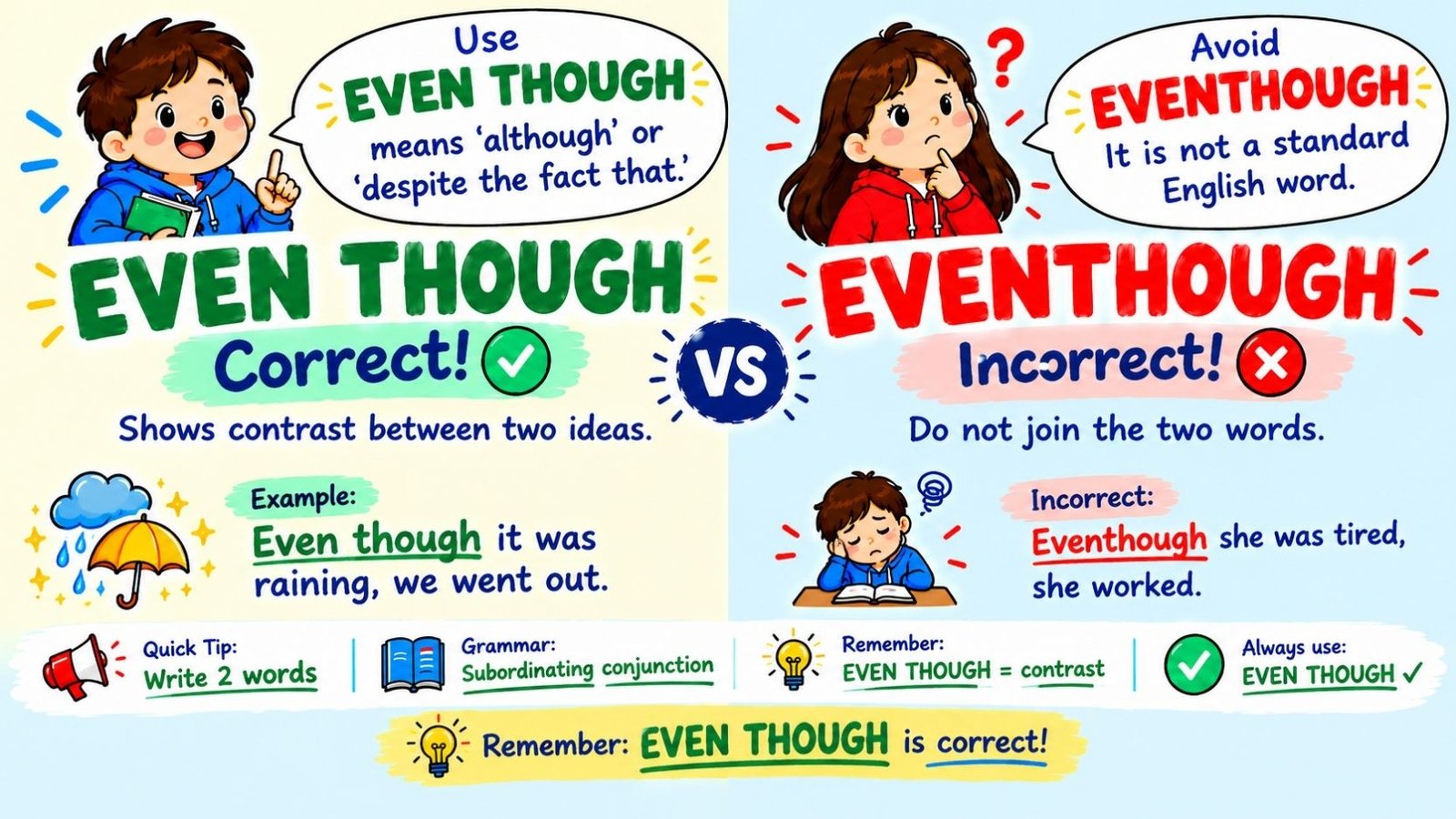
If you have ever paused mid-sentence wondering whether to type “eventhough” or “even though,” you are not alone. This mix-up is one of the most common spelling mistakes in English, and it trips up native speakers just as often as learners. The short answer is simple: even though is correct, and eventhough is not a real word. Even though is always written as two separate words in standard English.
This confusion usually happens because the phrase is spoken quickly and sounds like one word. In writing, though, English treats “even” and “though” as two separate words that work together to introduce a contrast. Getting this right matters for schoolwork, professional writing, and everyday messages where correct spelling shapes how your writing is perceived.
What Does Even Though Mean?
Even though is a subordinating conjunction. It introduces a clause that contrasts with the main idea in a sentence. It signals that something happens despite another fact that might normally prevent it.
In plain language, even though means “despite the fact that” or “although.” It connects two ideas where the second one is surprising or unexpected given the first.
Example: Even though it was raining, we went for a walk.
Here, rain would normally stop a walk. The word “though” flags that contrast, and “even” makes the contrast stronger. Together, they tell the reader: something happened that you might not expect, given the other fact.
Read More: To Many Or Too Many
Is Eventhough A Word?
No. Eventhough is not recognized as a word by any major dictionary, including Merriam Webster, Oxford, or Cambridge. It is a common misspelling, formed by merging “even” and “though” into one word because that is how the phrase sounds when spoken naturally.
If you search for eventhough meaning, you will find that it is always treated as an incorrect version of even though, never as a distinct word with its own definition. Spell checkers and grammar tools will typically flag it as an error.
| Form | Status | Correct Usage |
| Even though | Correct | Two separate words, standard English |
| Eventhough | Incorrect | Common misspelling, not a dictionary word |
| Even tho | Informal | Used casually in texting, not standard writing |
Eventhough vs Even Though: Grammar Breakdown
Understanding why even though stays as two words becomes easier once you look at each part separately.
Even is an adverb. On its own, it adds emphasis. It can intensify a statement, as in “She even brought dessert,” meaning that was somewhat unexpected or additional.
Though is a conjunction. By itself, it introduces a contrast, similar to “although” or “but.” For example: “It was cold, though we still enjoyed the trip.”
When you combine them, “even though” strengthens the contrast that “though” alone would create. It is a set phrase, but each word keeps its own grammatical identity. That is the core reason English never merges them into a single word, unlike compounds such as “although” or “notwithstanding,” which formed differently over time.
Is Even Though A Subordinating Conjunction?
Yes. Even though functions as a subordinating conjunction. It connects a dependent clause to an independent clause, and the dependent clause cannot stand alone as a complete sentence.
Example: Even though she studied all night, she still felt nervous.
“Even though she studied all night” cannot stand on its own as a full sentence. It depends on the main clause, “she still felt nervous,” to complete the thought.
Is Even Though A Transition Word?
Even though can act as a transitional expression at the start of a sentence, since it signals a shift from one idea to a contrasting one. However, it is more accurately classified as a subordinating conjunction rather than a standalone transition word like “however” or “nevertheless,” which connect two independent sentences instead of joining clauses within one sentence.
How To Use Even Though In A Sentence?
Even though can appear at the beginning or in the middle of a sentence. Both placements are correct, and the choice usually comes down to style or emphasis.
At the beginning of a sentence, use a comma after the even though clause:
- Even though he was tired, he finished the report.
- Even though the store was closed, they still let us in.
In the middle of a sentence, no comma is needed before even though:
- He finished the report even though he was tired.
- They still let us in even though the store was closed.
Both versions carry the same meaning. Placing the even though clause first tends to emphasize the contrast slightly more, while placing it second can feel more natural in casual speech.
Even Though Vs Although
Even though and although are close in meaning, and in many sentences they can be swapped without changing the meaning.
Example: Although it was late, we kept working. / Even though it was late, we kept working.
The difference is one of degree. Even though carries a bit more emphasis than although. It underlines that the contrast is especially strong or surprising. Although is slightly more neutral and often preferred in formal or academic writing because it reads as more concise.
| Word | Strength | Common Setting |
| Although | Neutral, standard | Formal writing, academic text |
| Even though | Stronger emphasis | Everyday speech, storytelling, persuasive writing |
Read More: Shiney Or Shiny
Even Though Vs Even If
These two phrases are often confused because they look similar, but they describe different situations.
Even though introduces a fact that is already true. Example: Even though I am tired, I will finish this task. (Being tired is a fact right now.)
Even if introduces a hypothetical or possible situation that has not happened yet. Example: Even if I am tired, I will finish this task. (Being tired is only a possibility.)
The distinction matters because using the wrong one changes whether you are describing something certain or something uncertain.
Even Though Vs Even So
Even so is not a conjunction like even though. It is a transitional phrase, used to connect two separate sentences, similar to “nevertheless” or “still.”
Example: The weather was terrible. Even so, they went hiking.
You cannot use even so to join a dependent clause inside one sentence the way even though does. Even so always follows a complete sentence and starts a new one.
Common Mistakes With Even Though
❌ Incorrect: Eventhough she was late, she still got the job.
✅ Correct: Even though she was late, she still got the job.
❌ Incorrect: He passed the test, eventhough he barely studied.
✅ Correct: He passed the test, even though he barely studied.
❌ Incorrect: Even though, it was cold, we stayed outside.
✅ Correct: Even though it was cold, we stayed outside.
⚠️ Common mistake: Adding a comma directly after “even though” at the start of a clause. The comma belongs after the entire dependent clause, not right after “even though” itself.
Even Though In Spanish
When translating even though into Spanish, the most common equivalents are aunque and a pesar de que.
- Aunque estaba lloviendo, salimos a caminar. (Even though it was raining, we went for a walk.)
- Aprobó el examen a pesar de que no estudió mucho. (He passed the exam even though he did not study much.)
Aunque is the more common and natural translation in everyday Spanish, while a pesar de que is slightly more formal and literally closer to “despite the fact that.”
Synonyms For Even Though
Several words and phrases can replace even though depending on tone and context.
| Synonym | Notes |
| Although | Slightly more formal, common in writing |
| Though | Shorter, often used at the end of a sentence |
| Despite the fact that | More formal, works well in academic writing |
| In spite of the fact that | Formal, slightly longer phrasing |
| Notwithstanding | Very formal, mostly used in legal or official writing |
Real World Examples Of Even Though
- Even though I walk through the valley of the shadow of death, I will fear no evil. This well known line, adapted from Psalm 23, uses even though to show unwavering faith despite a frightening situation.
- We pray even though we do not always feel certain, because faith often exists alongside doubt rather than instead of it.
- Even though we ain’t got money, we still find ways to enjoy life together.
These examples show how even though works naturally across religious language, everyday speech, and song lyrics, always signaling that something remains true or happens despite a challenging or contrasting circumstance.
Read More: Chosing Or Choosing
Frequently Asked Questions
What does eventhough mean?
Eventhough has no independent meaning. It is a misspelling of even though, which means “despite the fact that.”
Is eventhough one word?
No. Even though is always written as two separate words in standard English.
Is it even though or eventhough?
Even though is correct. Eventhough is not recognized in standard dictionaries.
Is even though a subordinating conjunction?
Yes. It joins a dependent clause to an independent clause, showing contrast.
What is the difference between even though and although?
They mean nearly the same thing, but even though adds slightly more emphasis to the contrast, while although is more neutral and common in formal writing.
What is the difference between even though and even if?
Even though refers to something that is already true. Even if refers to something that is only possible or hypothetical.
How do you use even though in a sentence?
Place it at the start of a sentence followed by a comma, or in the middle of a sentence without a comma before it.
What is another word for even though?
Although, though, despite the fact that, and in spite of the fact that are common alternatives.
How do you say even though in Spanish?
The most common translations are aunque and a pesar de que.
Final Thoughts
Even though is the only correct form, and eventhough should be avoided in any kind of writing, whether it is a text message, an essay, or a professional email. The confusion is understandable since the phrase is often spoken as one quick sound, but English keeps “even” and “though” as separate words because each one plays its own grammatical role in building the sentence.
Once you remember that even though signals a contrast between two ideas, and that it always stays as two words, the mistake becomes easy to avoid. Whether you choose even though, although, or even if depends on the exact meaning you want, but correct spelling stays the same no matter which one fits your sentence.

Zunaira Qasim is the author and creator of Gramvixo, dedicated to making English grammar easier for learners and everyday writers. With 4 years of experience researching grammar, confusing words, word choices, and common language mistakes, they create clear and practical content that helps readers understand English and use it with confidence.
2 Comments