
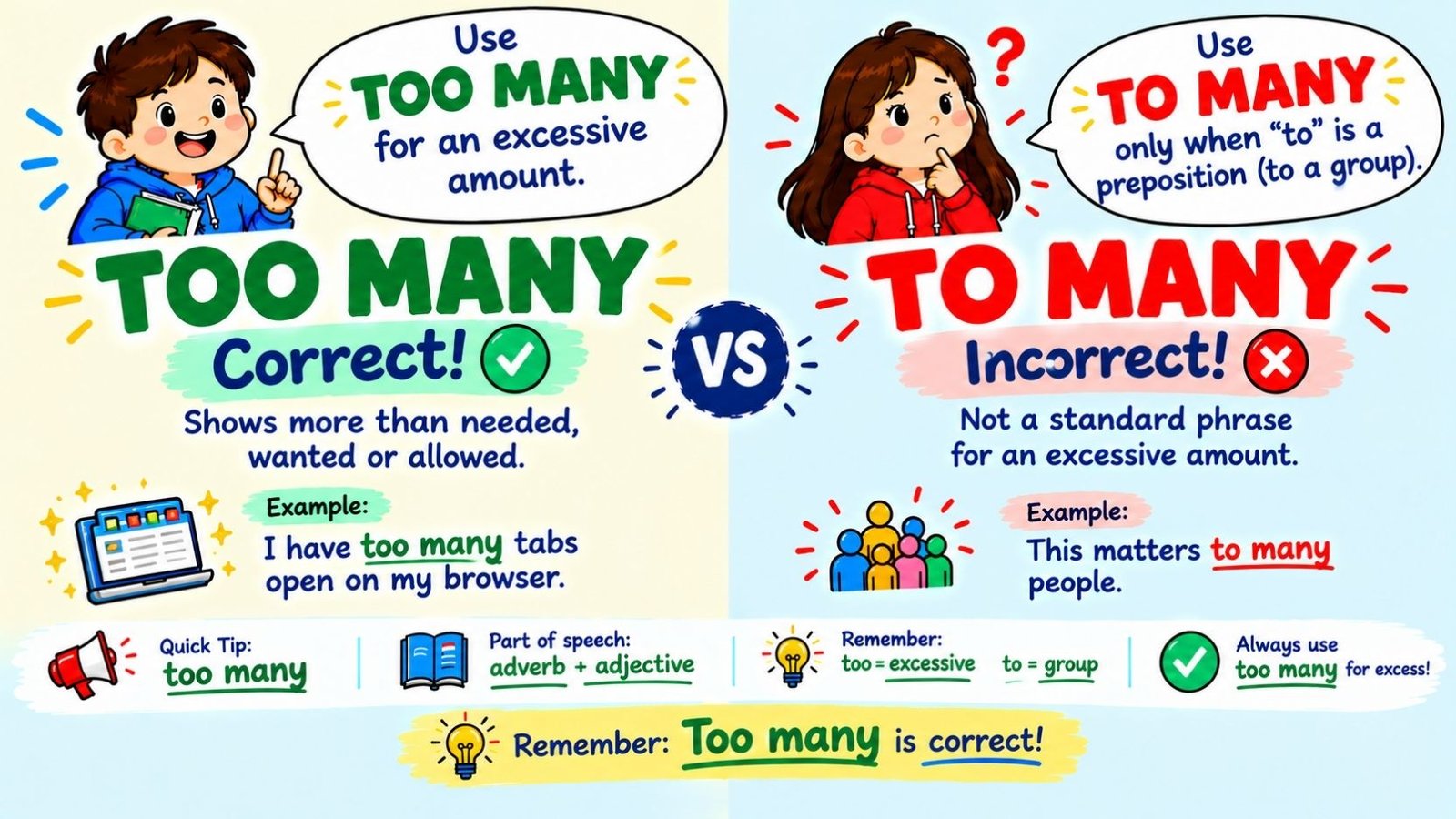
The correct phrase in almost every sentence is “too many.” It means more than what is needed, wanted, or allowed. “To many” is not wrong on its own, but it only works when “to” is a separate preposition followed by the adjective “many,” as in “to many people” or “to many readers.”
Most writers who search this question are trying to fix one small mix-up. They already know what they want to say. They just are not sure which spelling carries the meaning of “excessive amount.” This confusion is common because “to” and “too” sound identical when spoken, even though they do completely different jobs in a sentence.
This guide explains the meaning, the grammar, and the exact moment each spelling belongs. It also covers common mistakes, clear examples, and quick ways to check your own writing before you hit publish or send.
Too Many Meaning
“Too many” is used to describe a quantity that is excessive. It tells the reader that something has gone past a reasonable, comfortable, or acceptable limit.
- I have too many tabs open on my browser.
- There were too many mistakes in the report.
- She asked too many questions during the meeting.
In each example, “too many” signals that the amount is more than what is ideal. The word “too” is an adverb here, and its job is to intensify the adjective “many.” Together, they express excess.
Read More: Chosing Or Choosing
To Many Meaning
“To many” is only correct when “to” functions as a preposition, connecting an action or feeling to a group of people or things. In this case, “many” acts as an adjective describing that group.
- This song means a lot to many listeners.
- The news came as a shock to many employees.
- Thank you to many of you who supported this project.
Notice that “to many” in these sentences is not describing an excessive amount. It is showing direction, connection, or relationship, similar to how “to” works in phrases like “to some,” “to few,” or “to everyone.”
Quick Comparison Table
| Phrase | Part of Speech | What It Means | Example |
| Too many | Adverb plus adjective | An excessive amount | You sent too many emails today. |
| To many | Preposition plus adjective | Directed toward a large group | This matters a lot to many families. |
Is It to Many or Too Many?
If you are asking whether a quantity is excessive, the correct choice is always “too many.” If you are directing a statement, feeling, or action toward a group of people, “to many” is correct.
A simple test: try replacing the word with “excessive” or “an excessive number of.” If the sentence still makes sense, “too many” is right.
- Original: I have too many shoes.
- Test: I have an excessive number of shoes. (Works, so “too many” is correct.)
If replacing it with “excessive” does not work, check whether “to” is connecting the sentence to a group.
- Original: This matters to many people.
- Test: This matters an excessive number of people. (Does not work, so “to many” is correct here instead.)
To Many or Too Many Grammar
The grammar difference comes down to two separate words doing two separate jobs.
Too is an adverb. Its role is to intensify another word, usually an adjective or another adverb. It always means “more than necessary” or “excessively.” “Too” can stand alone in phrases such as “too hot,” “too fast,” or “too many.”
To is a preposition. Its role is to show direction, relationship, distance, or connection. It appears in phrases like “to school,” “to him,” or “to many.”
Many is an adjective that describes a large but usually countable number of things or people. It stays the same whether it follows “to” or “too.” What changes is the word standing in front of it.
To Many or Too Many Times
“Too many times” is the correct phrase when describing something that happened more often than it should have.
- He apologized too many times, and it started to feel insincere.
- I have explained this too many times already.
“To many times” is not standard English and should be avoided. If you want to say something happened frequently in relation to a group, you would restructure the sentence rather than write “to many times.”
To Many or Too Many More
“Too many more” is used when adding to an amount that is already excessive.
- We cannot accept too many more applications this week.
- Do not make too many more changes to the document.
“To many more” only works if “to” is connecting a statement to a group of additional people or things, which is a much rarer construction and usually sounds unnatural. In everyday writing, “too many more” is almost always what you want.
To Many More Years
“Here’s to many more years” is a common toast or well wish. In this phrase, “to” is a preposition expressing hope or celebration directed toward the future, not an excessive amount.
- Here’s to many more years of friendship.
- Here’s to many more successful projects together.
This is one of the clearest examples of “to many” being correct, since the phrase is about wishing something good will continue, not about excess.
Read More: Vender Or Vendor
Common Mistakes
Incorrect: I have to many things to do today.
Correct: I have too many things to do today.
Why: The sentence describes an excessive workload, so “too” is needed.
Incorrect: This gift means a lot too many of us.
Correct: This gift means a lot to many of us.
Why: The sentence is directing meaning toward a group, so “to” is needed.
Incorrect: She asked to many questions.
Correct: She asked too many questions.
Why: The sentence describes an excessive number of questions.
Incorrect: Thanks too many people who helped organize this.
Correct: Thanks to many people who helped organize this.
Why: “Thanks to” is a fixed phrase showing gratitude directed at a group.
Similar Words And Confusing Pairs
| Pair | Difference |
| Too many versus too much | “Too many” is for countable nouns like books or people. “Too much” is for uncountable nouns like water or advice. |
| Too many versus a lot of | “Too many” always implies excess. “A lot of” is neutral and does not suggest a problem. |
| To many versus to much | “To much” is never standard English. “Much” does not typically follow “to” as a preposition in this way. |
Too Many Followers In Settings And Privacy
Some searches ask how to manage “too many followers” in an app’s settings and privacy section. This use follows the same grammar rule: “too many” describes an amount that feels excessive to the user, such as too many followers cluttering a feed or too many people having access to personal content. The fix is usually found in the app’s privacy or audience settings, where follower limits or visibility can be adjusted.
Many To Many And One To Many Relationships
In technical fields like database design, “many to many” and “one to many” describe how records relate to each other. These are fixed technical terms and follow a different rule than everyday grammar.
- A “one to many relationship” means one record can connect to several related records.
- A “many to many relationship” means multiple records on each side can connect to multiple records on the other side.
In these terms, “to” is a preposition showing direction between two sides of a relationship, similar to its use in “to many” elsewhere. These phrases are standard in software and data documentation and should not be changed to “too many.”
Read More: Shiney Or Shiny
Frequently Asked Questions
What does “too many” mean?
“Too many” means an amount that is more than needed, wanted, or reasonable. It is used with countable nouns.
What does “to many” mean?
“To many” means directed toward a large group of people or things. “To” is a preposition here, not part of an excess phrase.
Is “to many” ever correct?
Yes. It is correct in sentences like “this matters to many people” or “thanks to many volunteers,” where “to” shows direction rather than excess.
How do you know which one to use?
Ask whether you are describing an excessive amount or directing something toward a group. Excessive amount means “too many.” Directed toward a group means “to many.”
Is “too many” a noun or a phrase?
“Too many” is not a noun. It is a phrase made of an adverb (“too”) and an adjective (“many”), used to modify a noun.
Can “too many” start a sentence?
Yes. For example, “Too many cooks spoil the broth” is a well known saying that begins with this phrase.
What is the difference between “too many” and “too much”?
“Too many” is for things you can count, like chairs or emails. “Too much” is for things you cannot count individually, like time or noise.
Is “to many more” correct?
It is grammatically possible but rare. “Too many more” is almost always the phrase intended in everyday writing.
Why do people confuse “to” and “too”?
Both words are pronounced the same way, which makes it easy to pick the wrong one while typing quickly, even when the meaning is clear in the writer’s head.
Final Thoughts
“Too many” and “to many” look similar, but they carry completely different meanings. “Too many” always points to an excessive amount, while “to many” points a sentence toward a group of people or things. Once you separate these two jobs, the choice becomes much easier to make without second guessing yourself.
The fastest way to check your own writing is to ask what the sentence is really doing. If it describes too much of something, “too many” is correct. If it connects an action, feeling, or gift to a group, “to many” is the phrase you need.

Zunaira Qasim is the author and creator of Gramvixo, dedicated to making English grammar easier for learners and everyday writers. With 4 years of experience researching grammar, confusing words, word choices, and common language mistakes, they create clear and practical content that helps readers understand English and use it with confidence.
2 Comments