
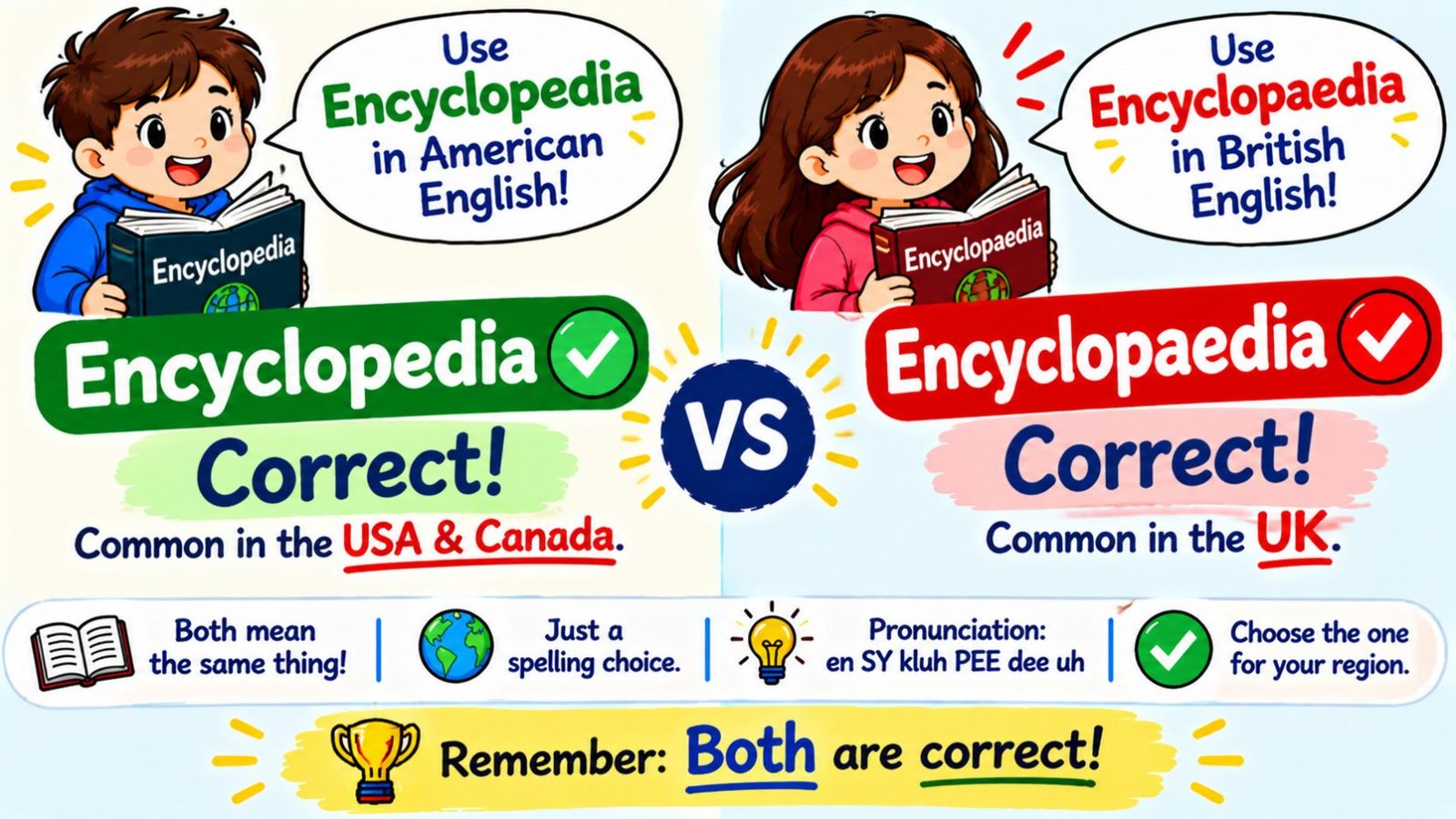
Both spellings are correct. “Encyclopedia” is the standard American spelling, and “encyclopaedia” is the traditional British spelling. They mean the same thing: a reference work with organized information on many subjects, or on one subject in depth.
If you write for a US audience, use “encyclopedia.” If you write for a UK audience, “encyclopaedia” is the safer choice. The difference is only spelling. The meaning, pronunciation, and grammar are identical, so picking one comes down to your audience and staying consistent.
What Does Encyclopedia Mean?
An encyclopedia is a book, set of books, or online resource that explains topics clearly and in an organized way. Most are arranged alphabetically or by subject. Their goal is to give reliable background knowledge, not to argue a position.
- Part of speech: noun
- Simple meaning: a reference work covering many topics, or one field in depth
- Plural: encyclopedias (or encyclopaedias in British spelling)
- Adjective form: encyclopedic, meaning very broad or complete
💡 Tip: “Encyclopedic” describes knowledge that is wide and detailed. “She has an encyclopedic knowledge of birds” means she knows a great deal about birds.
Read More: Fead Vs Feed: What Is The Real Difference And Is “Fead” Even A Word?
Encyclopedia Vs Encyclopaedia: Spelling Differences by Region
| Spelling | Where it is most common | Notes |
| Encyclopedia | United States, and usually Canada | Standard in American dictionaries |
| Encyclopaedia | United Kingdom and some Commonwealth countries | Traditional British form |
British writing often keeps the “ae” in words that came from Latin and Greek. American English simplified many of them. Spelling reform in the 1800s, often linked to Noah Webster, helped drive that change.
Other words follow the same pattern:
| American | British |
| encyclopedia | encyclopaedia |
| pediatric | paediatric |
| anesthesia | anaesthesia |
| medieval | mediaeval (less common today) |
Note that “encyclopedia” is also widely used in Britain today. Many British publishers and websites use the shorter form, so “encyclopaedia” is a preference there, not a strict rule.
Which One Should You Use?
Choose based on your reader, then stay consistent.
- Writing for a US audience: use encyclopedia.
- Writing for a UK audience: use encyclopaedia.
- Unsure of your audience: use encyclopedia, since it is understood everywhere.
⚠️ Common mistake: mixing both spellings in the same piece. Pick one and keep it throughout.
Proper Names Keep Their Own Spelling
Titles and brand names do not change to match your spelling choice. Copy them exactly as published.
- Encyclopaedia Britannica is the official name of the famous reference work, which began in Edinburgh in 1768. It was also printed as “Encyclopædia,” using the joined letters “æ.” Britannica’s own articles generally use American spelling in the text.
- Emily Wilde’s Encyclopaedia of Faeries is a novel by Heather Fawcett. The title uses the British spelling.
- Encyclopedia Brown is a children’s detective series by Donald J. Sobol, first published in 1963. It uses the American spelling.
- Encyclopaedia Metallum is the name of a heavy metal music database, and it uses the British spelling.
- Encyclopedia Titanica is a research site about the Titanic, and it uses the American spelling.
✅ Correct: “I read about it in the Encyclopaedia Britannica.”
✅ Correct: “I read about it in an encyclopedia.”
You can write “encyclopedia” in your own sentences and still use “Encyclopaedia Britannica” when naming the title.
How to Pronounce Encyclopedia
Both spellings sound the same. The stress falls on the third syllable.
- Simple guide: en SY kluh PEE dee uh
- IPA: /ɪnˌsaɪkləˈpiːdiə/
You can say it in five or six syllables depending on how quickly you speak. The “ae” in “encyclopaedia” is not pronounced differently. It is just a spelling choice.
Read More: Time Flies Or Time Flys: Which Spelling Is Correct?
Where Does The Word Come From?
The word comes from Greek by way of Latin. It is usually traced to the Greek phrase enkyklios paideia, meaning “general education” or a “circle of learning.” The idea was a complete cycle of knowledge a well educated person should have.
The word entered English in the 1500s. Later, the great French Encyclopédie edited by Denis Diderot and Jean le Rond d’Alembert, published between 1751 and 1772, helped shape the modern idea of an encyclopedia. It aimed to gather and share knowledge widely, which is the purpose encyclopedias still serve.
How To Use Encyclopedia In A Sentence
Here are two natural examples:
- “She looked up the history of Rome in an encyclopedia.”
- “The library has a children’s encyclopedia with lots of pictures.”
You can also use it in a more figurative way:
- “My grandfather is a walking encyclopedia of baseball facts.”
Encyclopedia vs. Dictionary
People often confuse the two.
| Feature | Encyclopedia | Dictionary |
| Main purpose | Explains topics, people, places, and ideas | Explains words |
| Typical content | Articles with background and context | Short definitions, spelling, pronunciation |
| Example question | “What caused the French Revolution?” | “What does ‘revolution’ mean?” |
A dictionary tells you what a word means. An encyclopedia tells you about the thing itself.
Common Types Of Encyclopedias
- General encyclopedias cover many subjects. Examples include Encyclopaedia Britannica and World Book Encyclopedia.
- Specialized encyclopedias focus on one field, such as music, medicine, or fossils.
- Online encyclopedias are digital and often updated frequently. Wikipedia, launched in 2001, is the best known and is written and edited by volunteers.
- Children’s encyclopedias use simpler language and more illustrations.
Britannica stopped printing its large multivolume set in 2012 and now focuses on its digital edition. Print sets still exist in libraries and homes, and old sets are sold secondhand.
Common Mistakes To Avoid
Mistake 1: Using the wrong plural
❌ Incorrect: “The library has three encyclopedia.”
✅ Correct: “The library has three encyclopedias.”
Mistake 2: Mixing spellings
❌ Incorrect: “The encyclopedia and the encyclopaedia entries were both useful.”
✅ Correct: “The encyclopedia entries were both useful.”
Mistake 3: Changing a proper title
❌ Incorrect: “Encyclopedia Britannica” when quoting the official title.
✅ Correct: “Encyclopaedia Britannica” when you are naming the title exactly. Many American outlets do write “Encyclopedia Britannica” in running text, so check your style guide.
Read More: Performing Vs Preforming: What Is The Real Difference?
Related Words
| Word | Meaning | Difference |
| Dictionary | A book of word meanings | Focuses on words, not topics |
| Almanac | A yearly reference of facts, dates, and data | Updated every year |
| Atlas | A collection of maps | Focuses on geography |
| Thesaurus | A book of synonyms and antonyms | Helps you find similar words |
| Encyclopedic | Very broad or thorough | Adjective, not a book |
Frequently Asked Questions
Is it encyclopedia or encyclopaedia?
Both are correct. Use “encyclopedia” for American English and “encyclopaedia” for traditional British English.
Which spelling is more common?
“Encyclopedia” is more common worldwide, largely because of American usage and the internet.
Is Encyclopaedia Britannica spelled with “ae”?
Yes, that is the official title. The name has also appeared with the joined letters “æ.” The publication’s own text generally uses the American spelling.
Is encyclopedia a noun or a verb?
It is a noun. The related word “encyclopedic” is an adjective.
How do you pronounce encyclopedia?
Say it as en SY kluh PEE dee uh, with the main stress on “PEE.” The British spelling sounds the same.
What is the plural of encyclopedia?
The plural is “encyclopedias.” The British form is “encyclopaedias.”
What is the difference between an encyclopedia and a dictionary?
A dictionary explains words. An encyclopedia explains subjects, with background and context.
What is the best encyclopedia?
It depends on your needs. Britannica and World Book are established general references, and Wikipedia is broad and free. For important research, check claims against more than one source.
Conclusion
“Encyclopedia” and “encyclopaedia” are two spellings of the same word. The American form drops the “a,” while the British form keeps it. The meaning, pronunciation, and grammar do not change, and the plural simply adds an “s.”
Choose the spelling that fits your audience and use it consistently. Leave book titles and brand names exactly as published, such as Encyclopaedia Britannica. If you remember those two rules, you will use the word correctly every time.

Zunaira Qasim is the author and creator of Gramvixo, dedicated to making English grammar easier for learners and everyday writers. With 4 years of experience researching grammar, confusing words, word choices, and common language mistakes, they create clear and practical content that helps readers understand English and use it with confidence.
One Comment