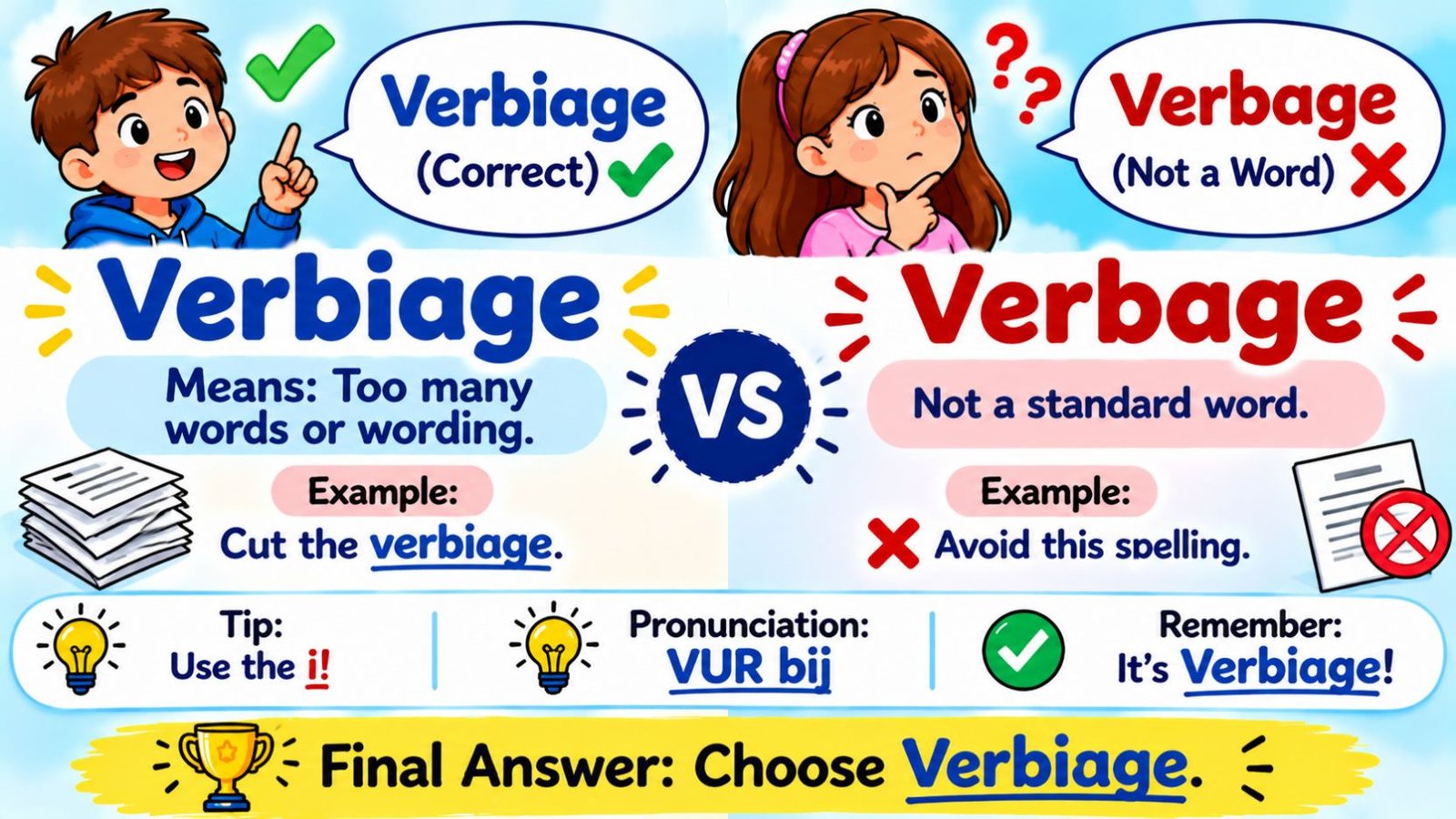
Verbiage is the correct spelling. Verbage is a misspelling. Verbage is not a word, so use verbiage instead. Verbiage is a noun. It usually means too many words, or words used in a heavy or unclear way. It can also mean the wording of something in a neutral way, such as the wording of a contract.
The mix-up happens because of how people say the word. Many speakers drop the middle sound, so it comes out sounding like “VUR bij.” Then they write what they hear. Dictionaries only list verbiage, so using verbage in a resume, contract, or email can look careless.
Verbiage Vs Verbage At A Glance
| Verbiage | Verbage | |
| Correct? | ✅ Yes | ❌ No, a misspelling |
| Part of speech | Noun | None, since it is not a standard word |
| Meaning | Excess words, or the wording of something | Usually an attempt to write verbiage |
| Safe in formal writing? | Yes | No |
💡 Quick tip: Verbiage has an i in it. If you write it with the i, you are correct.
Read More: Salvadoran Or Salvadorian: Which Is Correct?
What Does Verbiage Mean?
The simplest definition is “too many words.” Verbiage is a noun for excessive or technical use of words, and it usually has a negative feel. Merriam-Webster also notes a second sense, which simply means “wording,” with no suggestion of excess.
Meaning 1: Too many words
This is the traditional meaning. The writer says in fifty words what could be said in ten. The reader has to dig for the point.
- The editor cut the extra verbiage from the report.
- The email was full of verbiage and said almost nothing.
Meaning 2: The wording of something
This is the neutral meaning. It points to the exact words used in a document, sign, or message. This use is more common in US English than in UK English.
- Please check the verbiage on the contract before we sign.
- The legal team approved the verbiage for the new policy.
Some careful writers still prefer “wording” for this meaning. That is a style choice, not a spelling rule.
Is Verbage A Word?
No. Dictionaries generally do not treat verbage as a real word, and it is best avoided. You will see it online, but being common in casual writing does not make it standard.
Where did verbage come from? Nobody knows for sure. Some sources say it was formed by blending verbiage with garbage, but the origin is unclear. Treat that explanation as a guess, not a fact. The more likely cause is simple: people say the word in two syllables and spell it that way.
How Do You Pronounce Verbiage?
Both pronunciations are accepted in American English. Merriam-Webster’s Collegiate Dictionary and the American Heritage Dictionary list both a three syllable and a two syllable version as standard.
- Three syllables: VUR bee ij
- Two syllables: VUR bij
The stress falls on the first syllable either way. The spelling stays the same. Even if you say “VUR bij,” you still write verbiage.
Where Does Verbiage Come From?
Verbiage came into English from French. Merriam-Webster’s note on the French word says it was influenced by verbe, meaning “word” or “verb.”
The first known use in English was around 1721. Behind French sits the Latin word verbum, which means “word.” That is why the word is tied to wordiness.
Verbiage Vs Similar Words
These words look alike but do different jobs.
| Word | Meaning | Example |
| Verbiage | Excess words, or the wording used | Cut the verbiage. |
| Wording | The exact words chosen | I like the wording of this sentence. |
| Language | Words and style in general | The language of the contract is formal. |
| Verbatim | Word for word, exactly | She repeated his words verbatim. |
| Verbose | Using too many words (an adjective) | His speech was verbose. |
| Verb | A word that shows action or state | Run is a verb. |
A few quick notes:
- Verbiage vs wording: Wording is neutral. Verbiage can be neutral or negative, depending on context.
- Verbiage vs verbose: Verbiage is a noun. Verbose is an adjective. You can say “verbose writing is full of verbiage.”
- Verbiage vs verbatim: Verbatim means exact, not excessive. A verbatim quote has no extra words added.
- Verb vs verbiage: They share a root, but a verb is a grammar term. Verbiage is about the amount or style of words.
Does Verbiage Have A Negative Connotation?
Often, yes. In its traditional sense, it criticizes wordiness. It usually carries a negative tone, though the neutral sense is common too.
Context tells you which one is meant. “Too much verbiage” is clearly negative. “Update the verbiage on the sign” is neutral. If your reader might take it the wrong way, “wording” is the safer choice.
Some people say “excess verbiage” is redundant, since verbiage already implies excess. Merriam-Webster notes that this is not necessarily true, because verbiage also has the neutral meaning of “wording.”
Read More: Diverse Vs Divers: Meaning, Difference And How To Use Each Word
Verbiage In Common Searches
People often search the word together with a specific document type. The spelling rule is the same in every case.
- Notary verbiage: This means the exact wording on a notarial certificate. Required wording varies by state, so follow your state’s rules.
- Wedding invitation verbiage: This means the wording of the invitation, such as the host line and the request line.
- Verbiage for an attorney certification: This means the exact wording of a certification statement. An attorney or the receiving office should confirm what is required.
In all three, the word is spelled verbiage, never verbage.
Verbiage In Urdu
The negative meaning of verbiage is close to لفاظی, which refers to wordiness or empty talk. The neutral meaning is closer to “wording” or “the words used.” Urdu readers should choose the translation that fits the sentence.
Verbiage In A Sentence
Two examples are enough to show both meanings:
- Negative: The report was buried under pages of verbiage.
- Neutral: The verbiage on the form needs to match the law.
Common Mistakes to Avoid
⚠️ Mistake 1: Spelling it without the i
- ❌ Incorrect: Please review the verbage in the agreement.
- ✅ Correct: Please review the verbiage in the agreement.
The correct spelling keeps the “bi” in the middle.
⚠️ Mistake 2: Saying “excess verbiage” in formal editing
Some editors see this as repeating yourself. The phrase is common and not wrong in every case. If you want to be safe, say “verbiage” alone or “unnecessary words.”
⚠️ Mistake 3: Using verbiage when you mean “language”
Verbiage points to the words on a page. “Language” is broader. Use whichever fits the sentence.
Read More: Strep Vs Allergies: How To Tell The Difference
How To Remember The Spelling
Use this one line: “I should use verbiage.” The letter i reminds you that the correct spelling contains an i. Verbage has no i and is not standard. Spell checkers also catch it quickly, so a quick check helps.
Frequently Asked Questions
Is verbage a word?
No. Dictionaries do not list it as a standard word. Use verbiage.
Is it verbage or verbiage?
It is verbiage. The extra i is part of the correct spelling.
What does verbiage mean?
It means too many words, or the wording used in something. The first meaning is negative. The second is neutral.
How do you spell verbiage?
V-E-R-B-I-A-G-E. It has three syllables when fully pronounced, though two syllable speech is also accepted.
Is verbiage a noun or a verb?
It is a noun. Do not confuse it with “verb,” which is a grammar term for action words.
What are good synonyms for verbiage?
For the negative meaning: wordiness, verbosity, and long windedness. For the neutral meaning: wording, phrasing, and language. Related terms include diction, redundancy, verboseness, and wordage.
What is the difference between verbiage and verbatim?
Verbiage is about the words used, or too many of them. Verbatim means exactly word for word.
Is verbiage formal or informal?
It works in both. In business and legal writing, it often means “the exact wording.” In editing and everyday talk, it often means unneeded words.
Conclusion
The verbiage vs verbage question has one clear answer. Verbiage is the correct spelling. Verbage is a misspelling that comes from how the word is spoken. Verbiage can mean too many words, or simply the wording of a text.
Next time you write the word, add the i and you will be right. When you want to avoid the negative sense, pick “wording” or “phrasing.” That keeps your meaning clear and your spelling safe.

Zunaira Qasim is the author and creator of Gramvixo, dedicated to making English grammar easier for learners and everyday writers. With 4 years of experience researching grammar, confusing words, word choices, and common language mistakes, they create clear and practical content that helps readers understand English and use it with confidence.