
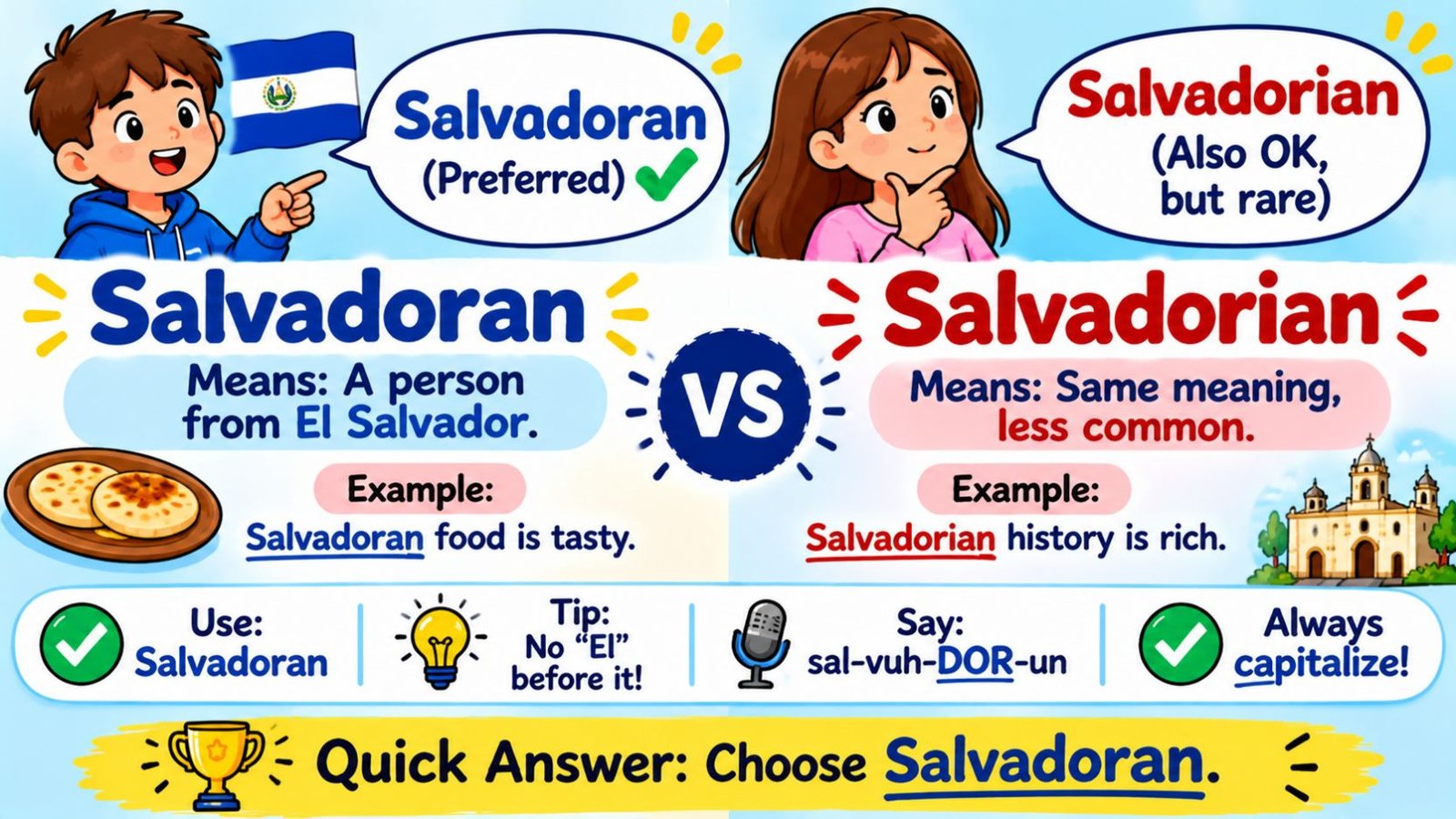
Salvadoran is the preferred and most widely used form in American English. It means a person from El Salvador, or anything connected to that country, such as food, culture, or history. Salvadorian also exists and some dictionaries list it. It is a less common variant, and most formal writing avoids it.
This small spelling choice comes up often. People write about Salvadoran food, Salvadoran family, or Salvadoran history and want the right word. Both forms are understood, so neither will confuse a reader. Still, Salvadoran looks more polished and matches what most US writers, news outlets, and Salvadorans themselves use.
Quick Answer: Salvadoran vs. Salvadorian
| Form | Status | Best use |
| Salvadoran | Standard, preferred | Almost all writing in the US |
| Salvadorian | Accepted variant, less common | Rare, mostly informal |
| Salvadorean | Older variant, more British looking | Rare in the US |
| El Salvadoran | Incorrect | Avoid |
💡 Tip: If you are unsure, write Salvadoran. You will not go wrong.
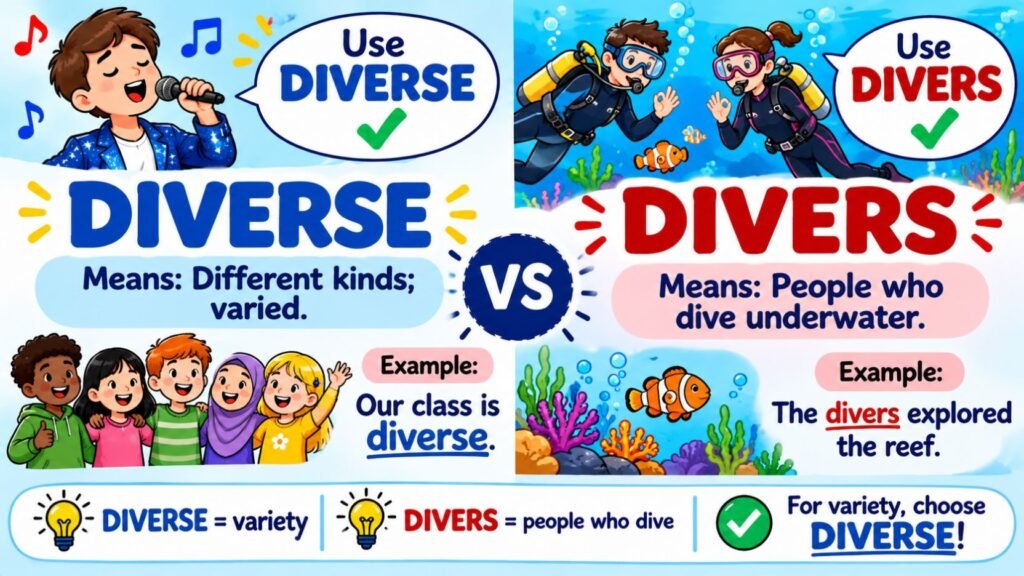
Read More: Diverse Vs Divers: Meaning, Difference And How To Use Each Word
What Does Salvadoran Mean?
Salvadoran works as both an adjective and a noun. Dictionaries define the adjective as relating to El Salvador or its people. The noun means a native or inhabitant of El Salvador.
As an adjective, it describes things:
- A Salvadoran recipe
- Salvadoran coffee
- A Salvadoran flag
As a noun, it names people:
- She is a Salvadoran who grew up in Houston.
- Many Salvadorans live in the United States.
Is Salvadorian Wrong?
No, it is not wrong. It is just less common. Collins English Dictionary, as shown on Dictionary.com, lists Salvadorian as a noun and an adjective with the same meaning. So the word is real and understood.
Several things still favor Salvadoran:
- It is the form most US news outlets and writers use.
- It sits closer to the Spanish word, salvadoreño.
- It is the form many Salvadorans use when writing in English.
- It is shorter and cleaner.
Because style guides differ, choose one form and stay consistent in a single piece of writing. If you write for a publication, check its style guide. If you write for yourself, use Salvadoran.
Why Is There More Than One Spelling?
English has no single rule for turning a country name into a demonym, the word for people from a place. Some countries take an, as in Guatemalan and Honduran. Others take ian, as in Panamanian and Colombian. A few take both forms over time.
El Salvador landed in the middle. Speakers added an in some cases and ian in others. Over time, Salvadoran became the favorite in American English. Salvadorian stayed around as an alternate.
Another variant is Salvadorean. Vocabulary.com lists Salvadorean as a synonym of Salvadoran. It is rare in American writing.
Why Is “El Salvadoran” Incorrect?
El Salvador is the name of the country. The word El is the Spanish article meaning “the.” It belongs to the country name only. It does not carry over into the adjective.
❌ Incorrect: El Salvadoran food is delicious.
✅ Correct: Salvadoran food is delicious.
❌ Incorrect: She is El Salvadorian.
✅ Correct: She is Salvadoran.
If you want to use the country name directly, you can say “food from El Salvador.” That is correct and natural. People also say “El Salvador food” in casual speech, but Salvadoran food reads better.
How To Pronounce Salvadoran
Say it in four short beats: sal, vuh, DOR, un. The stress falls on the third syllable.
| Word | Simple spelling | Stress |
| Salvadoran | sal vuh DOR un | Third syllable |
| Salvadorian | sal vuh DOR ee un | Third syllable |
| El Salvador | el SAL vuh dor | First syllable of Salvador, in English |
Vocabulary.com gives the US pronunciation as roughly sal-vuh-DOR-in, with a soft last syllable. In everyday speech, the last syllable sounds quick and light.
In Spanish, the country name is stressed on the last syllable: sal-va-DOR. Many English speakers say SAL-vuh-dor instead. Both are heard in the US.
Salvadoran Grammar: Word Forms And Capitalization
Salvadoran is always capitalized because it comes from a proper noun. This is true whether it is an adjective or a noun.
| Form | Example |
| Singular noun | A Salvadoran won the award. |
| Plural noun | Salvadorans celebrate Independence Day on September 15. |
| Adjective | We ate at a Salvadoran restaurant. |
| Possessive | The Salvadoran’s story was moving. |
📝 Note: Treat it as a noun only when it refers to people. Do not write “the Salvadoran” to mean the whole country. Say El Salvador.
For women, you can say Salvadoran woman or Salvadoran women. In Spanish, the feminine form is salvadoreña and the masculine is salvadoreño. English does not change the word by gender.
Are Salvadorans Hispanic?
Yes. Salvadorans are generally considered Hispanic or Latino. Spanish is the main language of El Salvador and the country sits in Central America. In the US, Hispanic and Latino are broad ethnic labels that include people with roots in Spanish speaking Latin America.
This is a question of ethnicity, not race. A Salvadoran can be of any race. Many Salvadorans have mixed European and Indigenous ancestry, often described as mestizo. Pipil, a Nahua people, are among the Indigenous groups of the region.
What Language Do Salvadorans Speak?
Spanish is the official and main language. It has its own flavor in El Salvador.
- Voseo: Salvadorans often use vos instead of tú for informal “you.”
- Caliche: This is the popular name for Salvadoran slang.
- Nawat: An Indigenous language related to Nahuatl. It has very few speakers today and revival efforts exist.
Read More: Encyclopedia Or Encyclopaedia: Which Spelling Is Correct?
Salvadoran Slang
Salvadoran slang adds color to everyday speech. A few well known words:
| Word | Meaning |
| cipote / cipota | Boy / girl, or kid |
| chivo | Cool |
| pisto | Money |
| chele | Light skinned person, often used affectionately |
| cheque | Okay, agreed |
⚠️ Common mistake: Slang changes by region, age, and setting. Use it with care, and be sure of the tone before you use it with someone you do not know.
Salvadoran Food
Food is one of the biggest reasons people search these spellings. Restaurants and writers use both Salvadoran and Salvadorian in menus and reviews, but Salvadoran is more common.
Pupusas are the national dish. They are thick corn tortillas stuffed with cheese, beans, pork, or other fillings. They are usually served with curtido, a lightly fermented cabbage slaw, and a thin tomato salsa. A restaurant that specializes in them is called a pupusería. National Pupusa Day is celebrated in El Salvador each November.
Other well known dishes and drinks:
- Salvadoran tamales: Often wrapped in banana leaves, and different in style from many Mexican tamales.
- Salvadoran quesadilla: A sweet, cheesy cake made with rice flour, often topped with sesame seeds. It is not the folded tortilla many Americans expect.
- Pan con pollo: A warm chicken sandwich on a crusty roll, often with vegetables and a rich sauce. It is also found as pan con pavo, made with turkey.
- Horchata: The Salvadoran version is made from morro seeds and spices, and tastes different from the rice based drink common in Mexico.
- Yuca frita: Fried cassava, often served with crispy pork.
Salvadoran Breakfast
A traditional Salvadoran breakfast is hearty. It often includes eggs, refried beans, fried plantains, fresh cheese, cream, and tortillas. Coffee is a common drink, and El Salvador has a long coffee growing tradition.
Salvadoran Desserts
Common sweets include the sweet quesadilla, fried plantains with cream, and sweet breads. Many desserts use cheese, corn, plantain, or coconut.
💡 Tip for finding food: If you search for “Salvadoran restaurant near me,” search tools usually understand both spellings. If results look thin, try “pupusería near me.”
The Salvadoran Flag
The flag of El Salvador has three horizontal stripes. The top and bottom stripes are blue and the middle stripe is white. The national coat of arms sits in the center of the white stripe. The design echoes the flag of the old Central American federation that the region once belonged to.
Blue and white are often described as standing for the two oceans, or the sea and the sky, and for peace. Explanations vary, so treat symbolism as tradition rather than strict fact.
Salvadoran History And Culture
A few terms often appear alongside the word Salvadoran:
- Salvadoran Civil War: A conflict that lasted from 1980 to 1992. It ended with the Chapultepec Peace Accords in January 1992. It displaced many people, and it is a major reason for the large Salvadoran community in the United States.
- Salvadoran Primera División: The top level of professional football (soccer) in El Salvador.
- Salvadoran Americans: People in the US with Salvadoran roots. They are one of the largest Hispanic groups in the country, with big communities in places such as Los Angeles, Washington DC, and Houston.
Salvadoran culture also includes music, handmade crafts, festivals, and a strong family tradition. Because the word covers so much ground, a clear spelling helps readers find and trust what you write.
Where Does The Word Come From?
The word comes from El Salvador, which means “The Savior” in Spanish. The name refers to Jesus Christ, and Spanish colonizers gave it to the region in the 1500s. The capital, San Salvador, carries the same religious root.
The ending an is a standard English way to turn a place name into a word for its people or things. Salvadoran follows that pattern, just as Honduran and Guatemalan do.
Similar Words And Related Terms
| Word | Meaning | Note |
| Salvadoran | From El Salvador | Standard form |
| Salvadoreño / Salvadoreña | Spanish form, male and female | Use in Spanish text or as a cultural term |
| Guatemalan | From Guatemala | Neighboring country |
| Honduran | From Honduras | Neighboring country |
| Central American | From Central America | Wider region label |
| Latino / Hispanic | Broad ethnic labels | Not the same as nationality |
Read More: Strep Vs Allergies: How To Tell The Difference
Common Mistakes To Avoid
- Using El before the adjective.
❌ El Salvadoran culture is rich.
✅ Salvadoran culture is rich. - Forgetting the capital letter.
❌ She is a salvadoran chef.
✅ She is a Salvadoran chef. - Mixing spellings in one article.
❌ Salvadoran food and Salvadorian recipes.
✅ Salvadoran food and Salvadoran recipes. - Confusing nationality with ethnicity. Salvadoran is a nationality or heritage. Hispanic and Latino are broader ethnic labels.
- Using the country name as an adjective.
❌ El Salvador people are friendly.
✅ Salvadoran people are friendly.
Frequently Asked Questions
Is it Salvadoran or Salvadorian?
Salvadoran is the preferred form in American English. Salvadorian is an accepted variant but less common.
Which is correct, Salvadoran or Salvadorian?
Both appear in dictionaries, but Salvadoran is the standard choice for formal and general writing.
Is it El Salvadoran or Salvadoran?
Salvadoran. The word El belongs only to the country name, El Salvador.
How do you say Salvadoran?
Say sal-vuh-DOR-un, with the stress on the third syllable.
Is Salvadoran a noun or an adjective?
It is both. As a noun it means a person from El Salvador. As an adjective it describes things related to the country.
Do you capitalize Salvadoran?
Yes. It comes from a proper noun, so it is always capitalized.
Is Salvadoran Hispanic?
Yes. Salvadorans are generally considered Hispanic or Latino because of their Spanish speaking Latin American heritage.
What do people from El Salvador call themselves?
In Spanish, they say salvadoreño or salvadoreña. In English, most use Salvadoran. They also use the informal term guanaco, which is a friendly nickname among Salvadorans but may not suit every setting.
Conclusion
Salvadoran or Salvadorian? Salvadoran is the clear winner for everyday and formal writing in American English. It works as a noun and an adjective, it is always capitalized, and it never takes the word El before it. Salvadorian is an accepted variant, but it is less common, and El Salvadoran is simply a mistake.
When you write about Salvadoran food, people, flag, or history, pick Salvadoran and use it throughout. Say it as sal-vuh-DOR-un and you will be understood anywhere. A small detail like this shows care, and readers and Salvadorans alike will notice it.

Zunaira Qasim is the author and creator of Gramvixo, dedicated to making English grammar easier for learners and everyday writers. With 4 years of experience researching grammar, confusing words, word choices, and common language mistakes, they create clear and practical content that helps readers understand English and use it with confidence.

One Comment