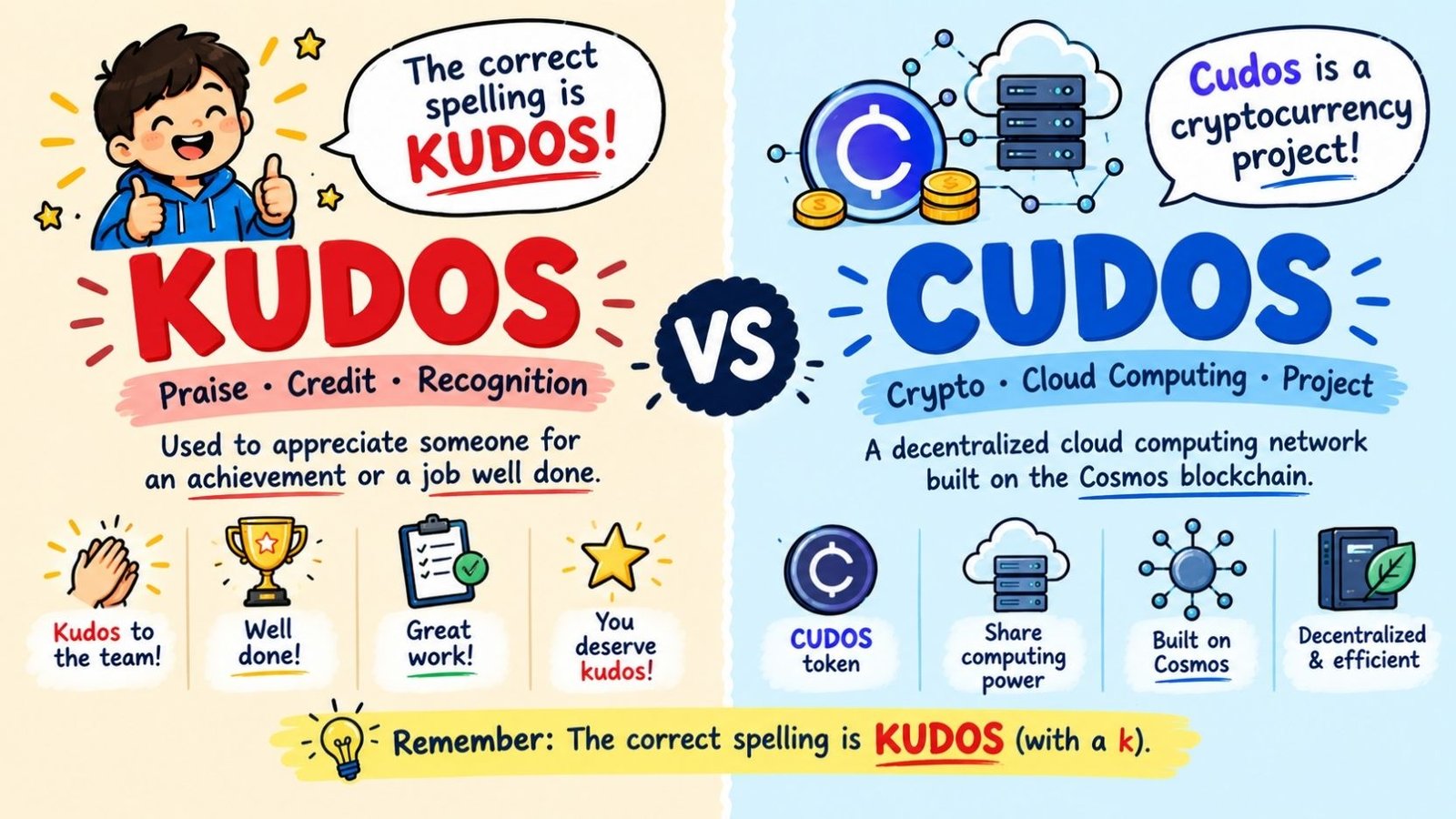
Kudos is the correct spelling. Cudos is a misspelling, and it happens because the word sounds like it could start with a hard “c.” The correct English word for praise, credit, or recognition for an achievement has always been kudos, spelled with a k.
There is one exception worth knowing about. Cudos, spelled with a c, is also the name of a cryptocurrency and cloud computing project. That is a proper noun and a brand name, not an alternate spelling of the English word. This article covers both, starting with the word everyone is really asking about.
Kudos Meaning: The Simple Definition
Kudos means praise, credit, or honor given for something impressive that a person has done. It is used when someone deserves recognition for an achievement, a good decision, or a job well done.
Dictionaries generally treat kudos as an uncountable noun, similar to words like “praise” or “credit.” You do not usually say “a kudos” the way you would say “an award.” Instead, kudos works more like a general compliment.
A few common ways people define it:
- Praise or credit for doing something well
- Fame or renown that comes from an achievement
- Recognition or approval, often given informally
Example sentence: “Kudos to the whole team for finishing the project early.”
Read More: You Did It Vs You Made It
Is It Cudos or Kudos? Quick Answer
Here is a fast comparison so you can settle the question in a few seconds.
| Spelling | Correct English Word? | Meaning |
| Kudos | Yes | Praise, credit, or recognition for an achievement |
| Cudos | No, as a word | It is only correct as the name of a specific cryptocurrency project (see below) |
If you are writing an email, a message, or an article and you mean “well done,” the spelling you want is kudos. Cudos is not recognized in standard English dictionaries as a variant spelling.
Kudos In A Sentence
Seeing the word in context helps confirm how it is actually used. Here are a few natural examples.
- “Kudos to you for handling that difficult client so calmly.”
- “She got a lot of kudos for volunteering every weekend.”
- “Big kudos to the design team on the new logo.”
- “He deserves kudos for finishing the marathon despite the injury.”
Notice that kudos is almost always followed by “to” when you are praising a specific person or group, as in “kudos to her” or “kudos to the team.”
Read More: Mines Vs Mine
Why Do People Write Cudos Instead of Kudos?
This mix-up is common, and there is a simple explanation for it.
It comes down to sound, not spelling logic. Kudos starts with a “k” sound, but many English words that start with that same hard sound are spelled with a c instead, like “credit,” “custom,” or “cushion.” Because of that pattern, some writers guess that kudos should follow the same rule and spell it “cudos.”
There is also a second, newer reason. Since a cryptocurrency project uses the spelling Cudos, some people who have seen that name online assume it is simply another way to spell the everyday word. It is not. The crypto project chose that spelling as a brand name, and it exists separately from the English word.
💡 Tip: If you are ever unsure, remember that kudos comes from a Greek word that starts with a k sound, and English kept that original letter.
Kudos Grammar: Noun, Not A Verb
Kudos is a noun. It is not a verb, and it does not have a verb form like “to kudo.”
Singular or plural? This is where kudos causes real confusion, even among native English speakers.
Kudos looks plural because it ends in “s,” similar to words like “kids” or “cards.” But in its original Greek form, kudos was already a singular noun, and English borrowed it that way. Grammatically, kudos is treated as a mass noun, similar to words like “praise” or “advice.” You do not usually pluralize it, and you do not typically pair it with “a” the way you would with a countable noun.
That means:
- ✅ Correct: “Kudos to everyone who helped.”
- ✅ Correct: “You deserve a lot of kudos for this.”
- ❌ Incorrect: “You deserve a kudos for this.”
- ⚠️ Debated: “He received several kudos.” Some modern dictionaries now list this looser, more countable usage, but careful writers usually avoid it.
What about “kudo”? Because kudos looks plural, some people have started treating “kudo” as if it were the singular form, as in “he got one kudo.” Most usage guides and dictionaries still consider “kudo” nonstandard. It shows up in casual speech, but it is not the historically correct form of the word.
How To Pronounce Kudos?
Pronunciation varies a little between British and American English, and that variation is part of why the spelling gets confused too.
| Style | Pronunciation | Sounds Like |
| British English | /ˈkjuːdɒs/ | “KYOO-doss” |
| American English | /ˈkuːdoʊs/ | “KOO-dohss” or “KOO-dohz” |
The ending sound is the tricky part. In careful speech, the final “s” is a soft “s” sound, as in “loss.” In casual American speech, it often shifts toward a “z” sound, which is part of why some listeners assume the word is plural.
Either pronunciation is widely accepted. What matters most is keeping the spelling correct: kudos, with a k.
Origin Of Kudos
Kudos comes from Classical Greek. The original word, κῦδος (kydos), meant glory, fame, or renown, and it shows up in ancient Greek poetry, including Homer’s Iliad and Odyssey, where it was used to describe glory earned in battle or through great achievement.
The word entered English relatively late compared to many Greek borrowings. It first appeared in English around the late 1700s to early 1800s, originally as British university slang. Students who studied Greek literature picked up the word and started using it informally, and it eventually spread into wider English usage, especially in journalism and headlines by the early twentieth century.
Because kudos was borrowed directly from a Greek singular noun, English speakers inherited its singular grammar too, even though the final “s” makes it look plural. That mismatch between how the word looks and how it originally worked is the root of most of the confusion people still have today, including the cudos spelling mistake.
What Is Cudos? The Cryptocurrency Project
Separate from the English word, Cudos is the name of a real cryptocurrency and cloud computing project. If you searched for terms like “cudos price,” “cudos token,” or “cudos staking,” this is what you are likely looking for, and it is worth explaining clearly so there is no confusion with the word kudos.
Cudos is a decentralized cloud computing network built on the Cosmos blockchain ecosystem. The idea behind the project is to let people share unused computing power, such as spare capacity on servers or graphics cards, in exchange for the CUDOS token. Businesses and developers can then use that shared computing power instead of relying only on traditional cloud providers.
Key facts about the Cudos project:
- It functions as a layer-1 blockchain built within the Cosmos ecosystem.
- The CUDOS token is used for staking, network governance, and paying for computing resources.
- The project positions itself as a more distributed and potentially more energy-efficient alternative to centralized cloud computing companies.
- The network has gone through changes over time, including updates to its infrastructure and token arrangements as the project has developed.
⚠️ Important distinction: Cudos the cryptocurrency project is a proper noun and a brand name. It has no connection to the English word kudos, and it does not make “cudos” a correct spelling of the word meaning “praise.”
If you are asking about crypto prices, staking, or the token itself, that is a completely separate topic from English word meaning and grammar. For current price data, always check a live financial source, since token values change constantly.
Kudos Synonyms And Related Words
Kudos has several close synonyms, though each one carries a slightly different shade of meaning.
| Word | Meaning | Typical Usage |
| Praise | General approval or a positive comment about something well done | Everyday, common in both speech and writing |
| Credit | Recognition for being responsible for something good | Often used in professional or academic settings |
| Acclaim | Enthusiastic public praise or approval | Common for creative or public achievements |
| Accolade | An expression of praise or an award | Slightly more formal than kudos |
| Recognition | Formal or informal acknowledgment of effort or success | Common in workplace settings |
Kudos tends to sound a little more casual and conversational than words like “acclaim” or “accolade,” which makes it popular in everyday speech, social media, and informal workplace messages like “kudos to the team on Slack.”
Common Mistakes With Kudos
Here are the mistakes people make most often, along with the correct version.
Mistake 1: Spelling it “cudos”
- ❌ Incorrect: “Cudos on the presentation.”
- ✅ Correct: “Kudos on the presentation.”
Mistake 2: Using “a kudos” as if it were countable
- ❌ Incorrect: “She earned a kudos for her hard work.”
- ✅ Correct: “She earned kudos for her hard work.”
Mistake 3: Treating “kudo” as a standard singular form
- ❌ Nonstandard: “He got one kudo from his manager.”
- ✅ Standard: “He got kudos from his manager.”
Mistake 4: Confusing it with “congratulations” Kudos and congratulations are related but not identical. Congratulations is typically said directly to the person who achieved something, almost like a greeting. Kudos can be said about someone, even when they are not present, and it leans more toward praising the quality of the achievement itself.
- “Congratulations on your promotion!” (said to the person)
- “Kudos to Sarah for landing that promotion.” (said about the person, to others)
Kudos in Different Contexts
The core meaning of kudos stays consistent, but the tone shifts a little depending on where it is used.
In the workplace: Kudos is common in emails, team chats, and performance feedback. It is a quick, informal way to publicly acknowledge someone’s contribution without writing a full compliment. Many companies even use “kudos” as a feature name inside employee recognition software, sometimes called a kudos board, where coworkers can post shout-outs to each other.
In casual conversation: Among friends, kudos is often shortened emotionally into a light, almost playful compliment, similar to saying “nice job” or “well played.”
In writing and journalism: Kudos frequently appears in headlines and reviews to praise achievements briefly, since it fits well in short, punchy phrasing.
As a brand or product name: Because the word carries a positive, achievement-related meaning, several unrelated brands and products have borrowed the name “Kudos” for themselves. These are proper nouns, not new meanings of the word:
- Kudos granola bars, a snack food brand
- Kudos diapers and wipes, a baby care brand
- Kudos, an online casino brand
- A Kudos point system used in the game Old School RuneScape, where completing certain in-game achievements is called earning “kudos”
None of these brand names change the grammar or spelling rules for the actual English word. They simply borrowed a word that already means recognition and achievement, which fits their branding.
Read More: Chrysalis Vs Cocoon
Frequently Asked Questions
Is it spelled kudos or cudos?
It is spelled kudos, with a k. Cudos is a misspelling of the word, except when it refers specifically to the Cudos cryptocurrency project, which is a separate proper noun.
What does kudos mean?
Kudos means praise, credit, or recognition given for an achievement or a job well done.
Is kudos a noun or a verb?
Kudos is a noun. There is no verb form such as “to kudo.”
Is kudos singular or plural?
Kudos is grammatically singular, even though it ends in “s.” It is treated as a mass noun, similar to “praise” or “advice,” so you do not usually say “a kudos” or pluralize it as “kudoses.”
Is “kudo” a real word?
“Kudo” is a back-formation that some people use as a singular version of kudos. Most dictionaries and usage guides still consider it nonstandard, though it does appear in casual usage.
How do you use kudos in a sentence?
You typically use it with “to,” as in “Kudos to the team” or “Kudos to you for finishing early.” It can also stand alone, as in “That deserves kudos.”
What is the difference between kudos and congratulations?
Congratulations is usually said directly to the person, almost like a greeting for a specific event. Kudos can be said about someone’s achievement, even to a third party, and focuses more on praising the accomplishment itself.
Where does the word kudos come from?
It comes from the ancient Greek word κῦδος (kydos), meaning glory, fame, or renown. It entered English in the late 1700s to early 1800s as university slang before spreading into everyday and journalistic use.
What is Cudos the cryptocurrency?
Cudos is a decentralized cloud computing project built on the Cosmos blockchain. Its CUDOS token is used for staking, governance, and paying for shared computing resources. It has no connection to the meaning of the English word kudos.
How do you pronounce kudos?
In British English, it is usually pronounced “KYOO-doss.” In American English, it is often pronounced “KOO-dohss,” with the ending sometimes softened toward a “z” sound in casual speech.
Final Thoughts
Kudos is the correct spelling for the English word meaning praise, credit, or recognition, and cudos is simply a common misspelling based on how the word sounds. The confusion is understandable, since kudos looks plural, ends unusually for an English word, and now shares its spelling with an unrelated cryptocurrency brand. Once you remember that kudos traces back to a Greek word starting with a k, the correct spelling becomes much easier to keep straight.
Whether you are praising a coworker, complimenting a friend, or writing a quick note of appreciation, kudos is the word you want, spelled with a k, treated as singular, and followed by “to” when you are naming who deserves the credit. If you are instead researching the crypto project, just remember that Cudos with a c is its own separate name, unrelated to the grammar and meaning covered here.

Zunaira Qasim is the author and creator of Gramvixo, dedicated to making English grammar easier for learners and everyday writers. With 4 years of experience researching grammar, confusing words, word choices, and common language mistakes, they create clear and practical content that helps readers understand English and use it with confidence.