
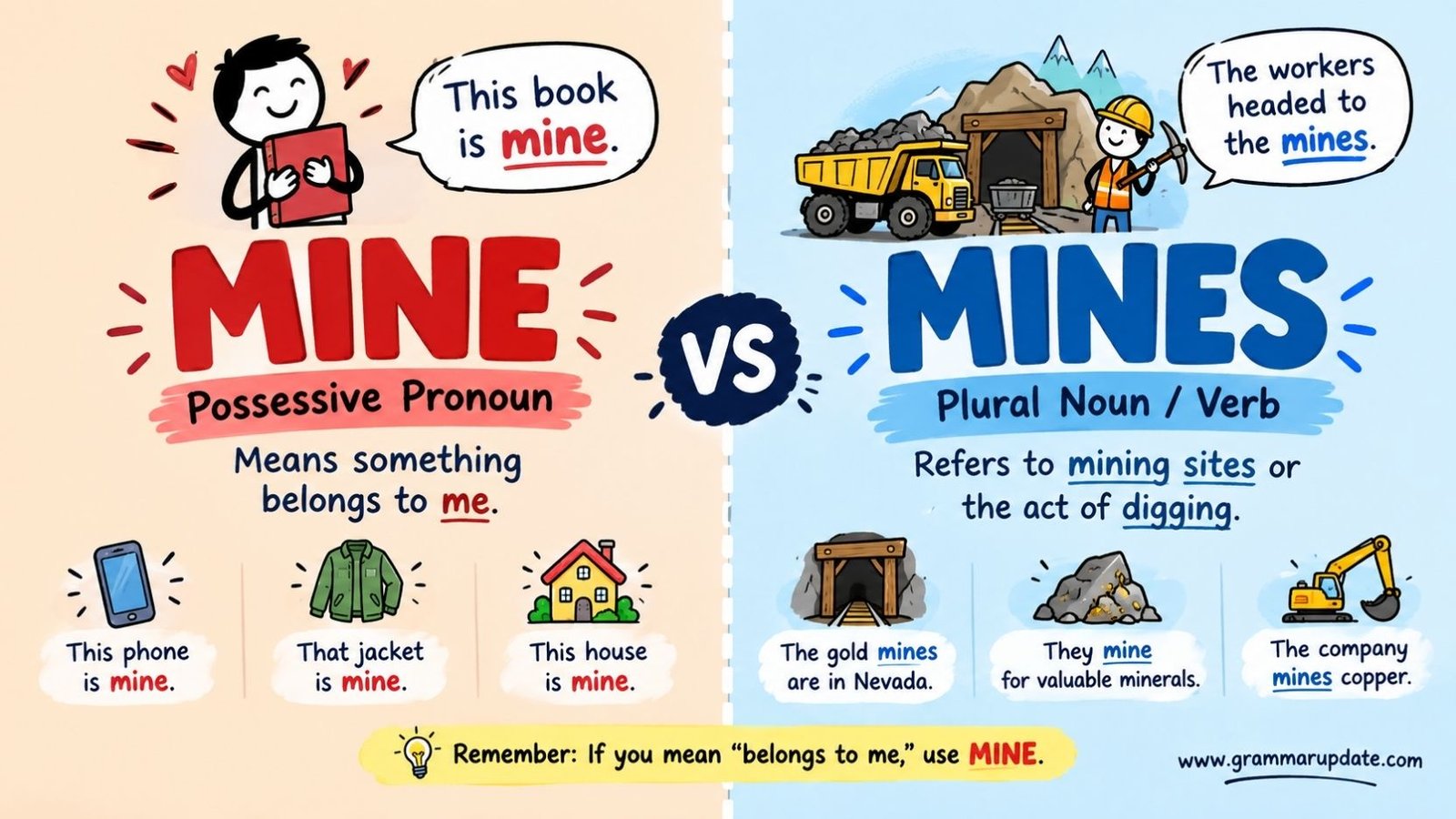
“Mine” is a possessive pronoun that means something belongs to you, as in “this book is mine.” “Mines” is different: it usually works as a plural noun for places where people dig out coal, gold, or other minerals, as in “the salt mines of Poland.” In everyday grammar, you almost never say “mines” to mean “belongs to me.”
This mix up trips up a lot of English learners, and even some native speakers pause over it. The confusion often starts with other possessive pronouns like “his” or “hers,” which can sometimes look similar in casual speech. Understanding the real difference between mine and mines will clear up your writing, your speech, and even some famous song titles that use these words.
Mine Vs Mines At A Glance
Before going deeper, here is a quick summary table that answers the core question in seconds.
| Word | Part of Speech | Meaning | Example |
| Mine | Possessive pronoun | Belongs to me | “That jacket is mine.” |
| Mines | Plural noun | Places where minerals are dug from the ground | “The workers headed to the mines.” |
| Mines | Verb (third person singular) | Digs for minerals, or extracts something | “The company mines gold in Nevada.” |
| Mine | Verb (base form) | To dig for minerals, or to plant explosive devices | “They plan to mine the old riverbed.” |
💡 Tip: If you are trying to say something belongs to you, the correct word is almost always “mine,” not “mines.”
What Does “Mine” Mean?
“Mine” has two completely separate jobs in English. Knowing which one is being used depends entirely on context.
Meaning 1: Mine As A Possessive Pronoun
This is the meaning most people are searching for. “Mine” replaces a noun and shows ownership, without needing to repeat the object.
- “This is my phone” becomes “This phone is mine.”
- “Is that your coat or her coat?” becomes “Is that yours or hers? That one is mine.”
You never add an apostrophe here, and you never add an “s.” “Mine” already carries the full meaning of possession on its own, similar to “yours,” “his,” “hers,” “ours,” and “theirs.”
Meaning 2: Mine As A Noun Or Verb Related To Digging
“Mine” can also refer to a single excavation site or the act of digging for resources.
- Noun: “The old mine has been closed for decades.”
- Verb: “Companies mine copper in this region every year.”
There is also a military and gaming sense of “mine,” referring to an explosive device placed underground or underwater, or a defensive placement in a strategy game.
- “The soldiers had to avoid the buried mine.”
- “In the game, players place a mine to block the enemy’s path.”
What Does “Mines” Mean?
“Mines” is almost always the plural form of the noun “mine,” referring to more than one excavation site, or it is the verb “mine” conjugated for a third person singular subject.
Meaning 1: Mines As A Plural Noun
This is the most common everyday use of “mines.” It refers to physical sites where people extract coal, salt, gold, diamonds, or other materials from the earth.
- “The pink salt mines of Pakistan attract thousands of visitors.”
- “Nevada Gold Mines is one of the largest gold producing operations in the world.”
Meaning 2: Mines As A Verb
When the subject of a sentence is singular, such as “he,” “she,” “it,” or a company name, the verb “mine” takes an “s” at the end, following standard English verb conjugation rules.
- “The company mines lithium for electric car batteries.”
- “That machine mines data from thousands of records every second.”
⚠️ Common mistake: “Mines” is not a standard possessive pronoun. Some speakers say “that’s mines” instead of “that’s mine,” but this is considered nonstandard or informal in most English dialects, and it is generally avoided in writing.
Is “Mines” A Word For Possession?
This is one of the most searched questions about this topic, so it deserves a direct answer.
In standard English grammar, “mines” is not a recognized possessive pronoun. The correct possessive form is always “mine.” However, “mines” used to express possession does appear in some casual speech patterns and regional dialects, particularly in informal spoken English in parts of the United States and the Caribbean.
- Standard: “This seat is mine.”
- Nonstandard, dialect based: “This seat is mines.”
For formal writing, school assignments, professional emails, and most everyday communication, stick with “mine.” Save “mines” for talking about mining sites, mining activity, or explosive devices.
Mine Vs Mines: Grammar Explained
Here is the grammar rule broken down as simply as possible.
Mine functions as:
- An absolute possessive pronoun, meaning it stands alone and replaces a possessive noun phrase.
- A verb in its base form, meaning “to dig for resources.”
- A noun referring to one excavation site or one explosive device.
Mines functions as:
- The plural noun form, referring to more than one excavation site.
- The third person singular verb form, used with “he,” “she,” “it,” or a singular subject.
Because “mine” already means “belongs to me” on its own, it does not need to be pluralized the way regular nouns do. You would never say “mines” to mean “several things that belong to me.” Instead, you would restructure the sentence, such as “these books are mine” rather than trying to pluralize the pronoun itself.
Mine Vs Mine’s: Another Common Confusion
Some readers also wonder about “mine’s” with an apostrophe. This form does not exist in standard English grammar. Possessive pronouns like “mine,” “yours,” “his,” “hers,” “ours,” and “theirs” never take an apostrophe.
| Incorrect | Correct | Why |
| That car is mine’s. | That car is mine. | “Mine” is already possessive; no apostrophe needed. |
| Is this book mine’s? | Is this book mine? | Adding an apostrophe creates a nonstandard form. |
| The mines’s entrance was blocked. | The mine’s entrance was blocked. | Here, “mine” is a singular noun, so it correctly takes an apostrophe plus “s” to show something belongs to the mine. |
Notice the last example. When “mine” refers to an actual mining site, it behaves like a regular noun and can take a normal possessive apostrophe, such as “the mine’s deepest tunnel.” This is different from the pronoun “mine,” which never uses an apostrophe.
Examples Of Correct Usage
Using “mine” as a possessive pronoun:
- “That idea was mine, not yours.”
- “The choice is entirely mine to make.”
- “Of the two seats, the window one is mine.”
Using “mine” as a noun or verb:
- “The old coal mine sits just outside of town.”
- “Workers still mine gypsum here every winter.”
Using “mines” as a plural noun:
- “The paint mines in Colorado are known for their colorful rock formations.”
- “Salt mines have existed in some regions for thousands of years.”
Using “mines” as a verb:
- “The equipment mines several tons of ore each day.”
- “This program mines large data sets for useful patterns.”
Mines In Place Names And Proper Nouns
Several well known place names and institutions use “mines” as part of their official title, referring to their connection to mining history or mining education. These are proper nouns, so the word “mines” here is simply part of the name rather than a grammar choice.
- Colorado School of Mines, a public research university in Golden, Colorado, known for engineering and applied science programs, including a well documented and often searched acceptance rate.
- South Dakota School of Mines and Technology, a public university focused on science and engineering.
- Kingston Mines, a historic blues club in Chicago.
- Paint Mines Interpretive Park, a scenic natural area in Calhan, Colorado, known for its painted rock formations, sometimes searched as “painted mines” or “paint mines colorado.”
- The Mines Golf Course, a golf course built on reclaimed mining land in several locations.
- Nevada Gold Mines, a major gold mining operation formed as a joint venture in Nevada.
These names follow the plural noun meaning of “mines,” referring to mining land, mining heritage, or mining related institutions, not the possessive pronoun.
Mine And Mines In Pop Culture And Titles
Because “mine” expresses such a personal, emotional idea of belonging, it shows up often in song titles, movies, and books. It is worth noting these purely as naming examples, since the word choice reflects the pronoun meaning of ownership or closeness.
- “Sweet Child o’ Mine” by Guns N’ Roses uses “mine” as a possessive pronoun in an affectionate, poetic way.
- “The Boy Is Mine,” originally performed by Brandy and Monica, and later toured as “The Boy Is Mine Tour,” centers on the possessive pronoun meaning.
- “She Used to Be Mine” is a ballad from the musical “Waitrose,” known widely from its Broadway and film adaptations.
- “This Little Light of Mine” is a well known gospel and folk song, again using “mine” as a possessive pronoun after the noun “light.”
- “My Love, Mine All Mine” is a song title that repeats the pronoun for emotional emphasis.
- “Yours, Mine and Ours” is a film title that lines up three possessive pronouns together to describe a blended family.
- “Your Place or Mine” is a film title using “mine” as a short answer meaning “my place.”
On the fantasy and mining side of things, titles like “Mines of Moria” from “The Lord of the Rings” and “Lost Mines of Phandelver,” a well known Dungeons and Dragons adventure module, use “mines” in its literal sense as underground excavation sites.
King Solomon’s Mines, a classic adventure novel, and its later adaptations, including “The Librarian: Return to King Solomon’s Mines,” also use “mines” as a plural noun referring to legendary treasure filled excavation sites.
Related Words That Sound Like Mines Or Mine
Some searches around this topic come from unrelated words that simply look or sound similar. It helps to separate these clearly so there is no confusion.
| Word | Meaning | Example |
| Minesweeper | A classic computer puzzle game, or a naval vessel that clears underwater mines | “She played a round of Minesweeper on her break.” |
| Mine hunter | A specialized naval ship designed to locate underwater mines | “The mine hunter patrolled the coastal waters.” |
| Mineshaft | A vertical or sloped passage used to access an underground mine | “The old mineshaft was sealed off decades ago.” |
| Color Me Mine | A pottery painting studio franchise, using “mine” as a possessive pronoun in its brand name | “We booked a table at Color Me Mine for the birthday party.” |
| Mr. Mine | A popular idle mining video game | “He has been playing Mr. Mine for weeks.” |
| Enemy Mine | A science fiction film title, using “mine” in the sense of a shared bond or possibly a play on the buried explosive device | “Enemy Mine is considered a cult classic.” |
These names are helpful to recognize, but they do not change the underlying grammar rule for “mine” versus “mines.”
Common Mistakes With Mine and Mines
Here are the most frequent errors people make, along with the correct versions.
❌ Incorrect: “This backpack is mines.”
✅ Correct: “This backpack is mine.”
❌ Incorrect: “All of this stuff over here is mines.”
✅ Correct: “All of this stuff over here is mine.”
❌ Incorrect: “Is that book yours or mines?”
✅ Correct: “Is that book yours or mine?”
❌ Incorrect: “The mine’s are closed for the season,” when referring to more than one mining site.
✅ Correct: “The mines are closed for the season.”
The core rule to remember: “mine” never becomes “mines” when it means “belongs to me.” “Mines” only applies when you are talking about actual mining locations, mining activity, or the third person verb form.
Pronunciation
Both words are simple to pronounce and follow standard English spelling patterns.
- Mine is pronounced like the word “mine” in “coal mine,” rhyming with “sign” or “wine.” In IPA, it is written as /maɪn/.
- Mines is pronounced the same way with an added “z” sound at the end, similar to “vines” or “signs.” In IPA, it is written as /maɪnz/.
There is no difference in pronunciation between the pronoun “mine” and the noun or verb “mine.” Context alone tells the listener which meaning is intended.
Origin Of Mine And Mines
Both words trace back to older forms of English and share a common root.
“Mine” as a possessive pronoun comes from Old English “mīn,” which itself developed from an older Germanic root related to “me.” This possessive form has existed in English for well over a thousand years, gradually settling into its modern spelling and use.
“Mine” and “mines” referring to digging for minerals come from a different path. This sense entered English from Old French “mine” and Medieval Latin “mina,” both connected to underground excavation and metal extraction. This meaning became common in English by the medieval period, as mining grew into an important economic activity across Europe.
Although the two meanings sound identical today, they developed from separate historical roots that happened to converge into the same spelling and pronunciation over time.
Synonyms And Related Words
Because “mine” and “mines” carry very different meanings depending on context, their synonyms are just as different.
| Word | Meaning | Difference From Mine or Mines |
| My own | Possession, similar to “mine” | Used before a noun, such as “my own choice,” rather than standing alone |
| Belonging to me | Possession, similar to “mine” | A longer phrase used for clarity or emphasis |
| Quarry | A place where stone or minerals are extracted, similar to “mine” | Usually refers to open pit extraction rather than underground tunnels |
| Pit | A place where materials are dug from the ground, similar to “mine” | More general and less specific to formal mining operations |
| Excavate | To dig, similar to the verb “mine” | Broader term not limited to mineral extraction |
Frequently Asked Questions
What does “mines” mean?
“Mines” usually means more than one mining site, such as coal mines or salt mines. It can also be the verb form used with “he,” “she,” or “it,” as in “the company mines copper.”
What does “mine” mean?
“Mine” most often means something belongs to you, as in “that seat is mine.” It can also mean a single mining site or the act of digging for resources.
Is “mines” a word for possession?
No. Standard English uses “mine” for possession, not “mines.” Some dialects use “mines” informally, but it is not considered correct in formal writing.
How do you use “mine” in a sentence?
Use “mine” after a linking verb to show ownership, such as “This laptop is mine,” or use it to replace a possessive noun phrase, such as “Her book is on the table, and mine is in my bag.”
Is “mines” a noun or a verb?
“Mines” can be both. As a noun, it means multiple mining sites. As a verb, it is the third person singular form of “mine,” meaning to dig or extract resources.
What is the difference between mine and mines in grammar?
“Mine” is a possessive pronoun and can also be a singular noun or base verb related to mining. “Mines” is the plural noun form, or the verb form used with a singular subject like “he” or “she.”
Can “mine’s” ever be correct?
Not as a possessive pronoun. However, “mine’s” can appear correctly when “mine” is a noun referring to an actual mining site, as in “the mine’s entrance.”
Why do some song titles use “mine” instead of “mines”?
Songs like “Sweet Child o’ Mine” and “This Little Light of Mine” use “mine” as a possessive pronoun, expressing something as belonging to or being deeply connected to the speaker.
Is “the boy is mine” grammatically correct?
Yes. “Mine” here is used correctly as a possessive pronoun, meaning the boy belongs to or is connected to the speaker in the context of the song.
What is the correct plural of “mine” when talking about mining?
The plural is “mines,” used for more than one mining location, such as “the gold mines of Nevada.”
Conclusion
The difference between mine and mines comes down to one simple rule. “Mine” shows possession and never changes form for that meaning, while “mines” refers to actual mining locations or acts as the verb form for a singular subject. Mixing these up is a common but easily avoidable mistake, and remembering that “mine” never needs an added “s” for possession will keep your writing accurate.
Whether you are describing something that belongs to you, referencing famous mining sites like the pink salt mines or the paint mines of Colorado, or simply trying to get a grammar question right, the key is context. Once you separate the possessive pronoun from the mining related noun and verb, mine and mines become easy to use correctly every time.

Zunaira Qasim is the author and creator of Gramvixo, dedicated to making English grammar easier for learners and everyday writers. With 4 years of experience researching grammar, confusing words, word choices, and common language mistakes, they create clear and practical content that helps readers understand English and use it with confidence.

2 Comments