
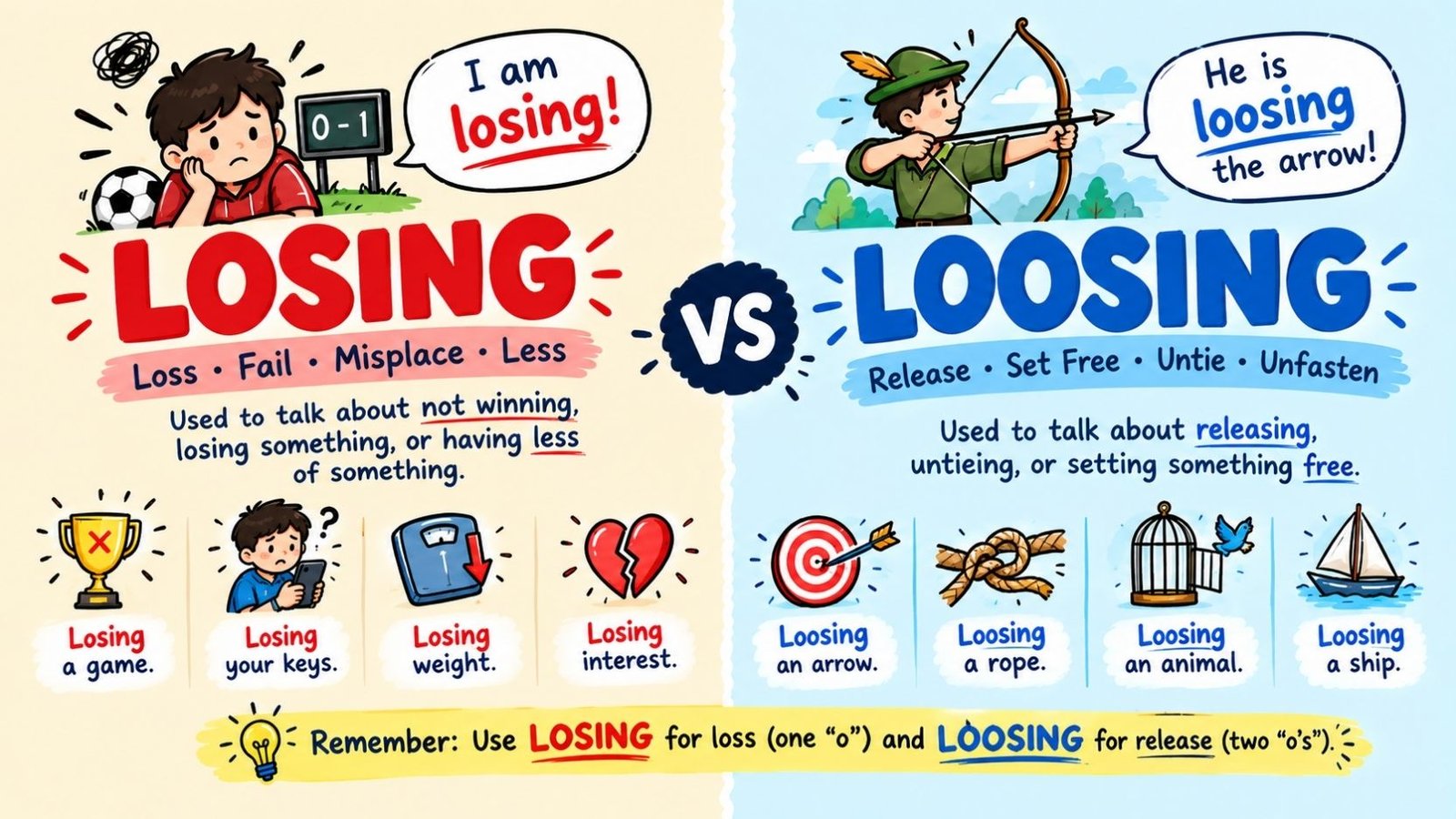
If you have ever paused mid sentence and wondered whether to type “losing” or “loosing,” you are not alone. These two words look almost identical, but they mean completely different things. Losing is the correct word when you are talking about not winning, misplacing something, or having less of something over time. Loosing is a much rarer word that means to release, free, or let something go.
Most of the time, when people search for “losing or loosing,” they actually mean losing. Whether you are losing a game, losing weight, losing your keys, or losing interest in something, the word you want is almost always “losing.” The confusion happens because both words come from similar roots and sound close when spoken quickly. Understanding the small but important spelling difference will help you avoid one of the most common mix ups in English writing.
Losing or Loosing: The Quick Answer
Here is the short version before we go deeper.
- Losing means failing to keep, win, or maintain something. It comes from the verb “lose.”
- Loosing means setting something free or making something less tight. It comes from the verb “loose.”
In everyday writing, you will use “losing” about 99 percent of the time. “Loosing” is uncommon outside of specific contexts like archery, sailing, or older biblical language.
Read More: Mines Vs Mine
Losing Meaning
“Losing” is the present participle form of the verb “lose.” It describes an ongoing action related to loss.
Losing can mean:
- Failing to win a game, match, or competition
- Misplacing an object
- Having less of something you once had, such as weight, money, or hair
- No longer having a feeling, ability, or relationship
- Being unable to find your way
For example, a sentence like “The team is losing the match” tells you that the game is not going well for them right now. Similarly, “I keep losing my phone charger” means the charger keeps getting misplaced.
Loosing Meaning
“Loosing” is the present participle form of the verb “loose,” which is different from the adjective “loose” that describes something not tight. As a verb, “to loose” means to release, untie, or set free.
Loosing can mean:
- Releasing an arrow from a bow
- Untying a rope, knot, or restraint
- Setting an animal or person free
- Letting go of control over something
This word shows up in phrases like “loosing an arrow” in archery, or in older texts such as “loosing the ship from its moorings.” It also appears in religious writing, particularly in phrases like “binding and loosing,” which we will cover later.
Losing or Loosing Grammar
Understanding the grammar behind these two words makes the difference much easier to remember.
| Word | Base Verb | Part of Speech | Meaning |
| Losing | Lose | Present participle / gerund | To fail to keep or win something |
| Loosing | Loose | Present participle / gerund | To release or set free |
Both words are formed the same way. You take the base verb and add “ing.” The tricky part is that “lose” drops nothing when you add the ending, while “loose” simply adds “ing” onto its existing spelling. This is exactly where the confusion starts.
Why the Spelling Looks So Similar
English spelling does not always predictably match pronunciation. The word “lose” is spelled with one “o,” but it rhymes with “choose.” The word “loose” is spelled with two “o’s,” and it rhymes with “goose.”
When you add “ing” to each one, the spelling pattern stays consistent with the base word, but many writers instinctively want to add an extra “o” because “loose” looks more familiar or more “complete” to the eye. This is the main reason people accidentally write “loosing” when they mean “losing.”
How to Spell Losing or Loosing Correctly
A simple trick can help you remember which spelling to use.
💡 Tip: If the word is about winning or not winning, money, weight, or something disappearing, use losing with one “o.” If the word is about setting something free or untying it, use loosing with two “o’s.”
Another helpful memory trick: “loose” has an extra “o,” just like it has extra room. Something loose is not tight, so picture the second “o” as extra space. “Lose” has only one “o,” matching the idea of losing something and having less.
Losing Or Loosing: Which Is Correct In Common Phrases
Below are some of the most frequently searched phrases, along with the correct spelling and a short explanation.
Losing or Loosing a Game
Correct: Losing a game
When a team or player does not win, they are losing. No version of this phrase uses “loosing,” since a game is not something you release or untie.
Example: “Our team kept losing every match this season.”
Losing or Loosing Weight
Correct: Losing weight
Weight is something you have less of over time, so “losing” is correct. “Loosing weight” is a common misspelling, but it is incorrect.
Example: “She has been losing weight steadily since she started jogging.”
Losing or Loosing Someone
Correct: Losing someone
This phrase usually refers to a person dying, ending a relationship, or drifting apart from someone emotionally.
Example: “Losing someone you love is one of the hardest experiences in life.”
Losing or Loosing Interest
Correct: Losing interest
When your enthusiasm for something fades, you are losing interest, not loosing it.
Example: “He started losing interest in the project after the first few weeks.”
Read More: You Did It Vs You Made It
Losing or Loosing My Mind
Correct: Losing my mind
This is an informal expression that means feeling overwhelmed, stressed, or like you cannot think clearly. It has nothing to do with releasing anything.
Example: “I have three deadlines today, I am losing my mind.”
Losing or Loosing Money
Correct: Losing money
Money that is spent, wasted, or lost in a bad investment falls under “losing.”
Example: “The company has been losing money for two straight quarters.”
When Loosing Is Actually the Correct Word
While “losing” fits almost every everyday sentence, “loosing” does have real, correct uses. Here are the situations where you genuinely need it.
Archery and Loosing an Arrow
In archery, “loosing” describes the exact moment an arrow is released from the bowstring. This is a specialized, traditional use of the word that still appears in archery instruction and historical writing.
Example: “The archer took a breath before loosing the arrow toward the target.”
Sailing and Loosing a Ship
In nautical language, “loosing” can describe untying a ship from a dock or releasing its sails.
Example: “The sailors began loosing the ropes before setting off.”
Binding and Loosing in the Bible
The phrase “binding and loosing” appears in religious texts, most notably in the Gospel of Matthew. In this context, “loosing” refers to permitting or releasing something, often used alongside “binding,” which refers to forbidding or restricting. This phrase is widely discussed in theological and spiritual contexts, and its meaning has been interpreted in different ways across denominations.
Because this is a specific area of interpretation, readers researching the theological meaning in depth should consult a trusted religious or academic source rather than relying on a general grammar explanation.
Losing or Loosing: Side by Side Comparison
| Feature | Losing | Loosing |
| Base word | Lose | Loose |
| Meaning | Failing to win, keep, or maintain | Releasing or setting free |
| Common usage | Very common in everyday English | Rare, mostly specialized |
| Example | Losing a game | Loosing an arrow |
| Opposite word | Winning, gaining | Tightening, binding |
Common Mistakes with Losing and Loosing
Even confident writers slip up on this pair. Here are the most frequent errors.
❌ Incorrect: “I don’t want to loose you.”
✅ Correct: “I don’t want to lose you.”
❌ Incorrect: “She is loosing weight fast.”
✅ Correct: “She is losing weight fast.”
❌ Incorrect: “He keeps loosing his keys.”
✅ Correct: “He keeps losing his keys.”
❌ Incorrect: “The dog is loose in the yard, so we are losing it before the storm.”
✅ Correct: “The dog is loose in the yard, so we are loosing it before the storm.” (Only correct if you genuinely mean releasing the dog, which is rare phrasing. In everyday speech, most people would simply say “letting the dog loose.”)
⚠️ Common mistake: Writers often add an extra “o” to “losing” because “loose” feels like the more familiar spelling. Always check whether your sentence is about winning or losing something, not about releasing something.
Losing vs Loose: A Related Confusion
Many people who search for “losing or loosing” are actually mixing up “losing” and “loose,” which is a slightly different but related problem.
- Loose is an adjective that describes something not tight or not fixed in place. Example: “This shirt is too loose.”
- Losing is a verb form related to “lose.” Example: “I am losing weight, so my shirt feels loose.”
Notice how both words can appear in the same sentence with completely different meanings. “Loose” describes the shirt. “Losing” describes the action of losing weight.
Synonyms For Losing
Depending on context, these words can sometimes replace “losing.”
| Word | Meaning | Best Used For |
| Misplacing | Not being able to find something | Objects, items |
| Dropping | Falling behind or giving up something | Games, scores |
| Shedding | Gradually losing something, often weight or hair | Weight, hair |
| Fading | Slowly disappearing | Interest, memory |
These words are not always interchangeable with “losing,” so always check that the replacement fits the sentence naturally.
Synonyms For Loosing
| Word | Meaning | Best Used For |
| Releasing | Letting something go | Animals, restraints |
| Untying | Undoing a knot or fastening | Ropes, ties |
| Freeing | Removing restriction | People, animals |
| Unleashing | Letting something out with force | Energy, animals |
Pronunciation Of Losing And Loosing
The pronunciation difference is subtle but noticeable once you know what to listen for.
- Losing is pronounced with a soft “z” sound: “LOO-zing.”
- Loosing is pronounced with a soft “s” sound: “LOO-sing.”
This is because “lose” itself is pronounced with a “z” sound, while “loose” is pronounced with an “s” sound. When “ing” is added, that sound carries through to the new word. Listening carefully to how someone pronounces “lose” and “loose” can help you remember which spelling matches which meaning.
Origin Of Losing And Loosing
Both words trace back to Old English, though through slightly different paths.
“Lose” comes from the Old English word “losian,” which meant to perish or be lost. Over centuries, its spelling and pronunciation evolved into the modern “lose,” and its participle form became “losing.”
“Loose” comes from the Old Norse word “lauss,” meaning free or not fastened. It entered English through Middle English usage and kept its double “o” spelling, which carried over into “loosing.”
Because these two words developed from different root languages, their spellings never fully aligned, even though they sound similar today. This historical difference is part of why the confusion persists in modern English.
Read More: Cudos Or Kudos
Losing Or Loosing In A Sentence: More Examples
Here are a few more natural examples that show correct usage in real contexts.
- “After losing the championship, the players were disappointed but proud of their effort.”
- “The archer focused on his breathing before loosing the final arrow of the competition.”
- “I have been losing sleep over this decision.”
- “The farmer began loosing the animals from their pen at sunrise.”
- “We are losing daylight, so we should hurry.”
Notice that “loosing” almost always appears in a very specific, physical context involving release, while “losing” fits nearly every general situation involving loss.
Frequently Asked Questions
Is it losing or loosing?
In almost all everyday writing, the correct word is “losing.” Use “loosing” only when you mean releasing or setting something free, such as loosing an arrow.
Is it losing or loosing weight?
It is “losing weight.” Weight is something you have less of, which matches the meaning of “lose,” not “loose.”
Is it losing or loosing a person?
It is “losing a person.” This refers to someone dying, drifting away, or ending a relationship, which relates to loss, not release.
How do you spell losing or loosing correctly?
“Losing” has one “o” and relates to loss. “Loosing” has two “o’s” and relates to release. Most people looking for everyday usage want “losing.”
What is the difference between losing and loosing?
“Losing” means failing to keep, win, or maintain something. “Loosing” means setting something free or making it less tight.
Is loosing a real word?
Yes, “loosing” is a real word. It is the present participle of “loose” used as a verb, meaning to release. It is simply much less common than “losing.”
Why do people confuse losing and loosing?
The confusion happens because “loose” and “lose” look similar and sound close when spoken. Writers often add an extra “o” by habit, even when the sentence calls for “losing.”
Is it losing my mind or loosing my mind?
It is “losing my mind.” This informal expression means feeling overwhelmed, and it has no connection to releasing or freeing anything.
What is the opposite of losing?
The opposite of losing is winning or gaining, depending on the context.
What is the opposite of loosing?
The opposite of loosing is binding, tightening, or restraining.
Final Thoughts
The difference between losing and loosing comes down to one letter, but that single letter changes the entire meaning of a sentence. “Losing” relates to loss, whether that is losing a game, losing weight, or losing someone close to you. “Loosing” relates to release, a word you will mostly encounter in archery, sailing, or older religious writing.
When in doubt, ask yourself whether the sentence is about something disappearing or something being set free. If it is about loss, use “losing.” If it is about release, use “loosing.” With this simple check, you will be able to choose the correct word with confidence every time.

Zunaira Qasim is the author and creator of Gramvixo, dedicated to making English grammar easier for learners and everyday writers. With 4 years of experience researching grammar, confusing words, word choices, and common language mistakes, they create clear and practical content that helps readers understand English and use it with confidence.
3 Comments