
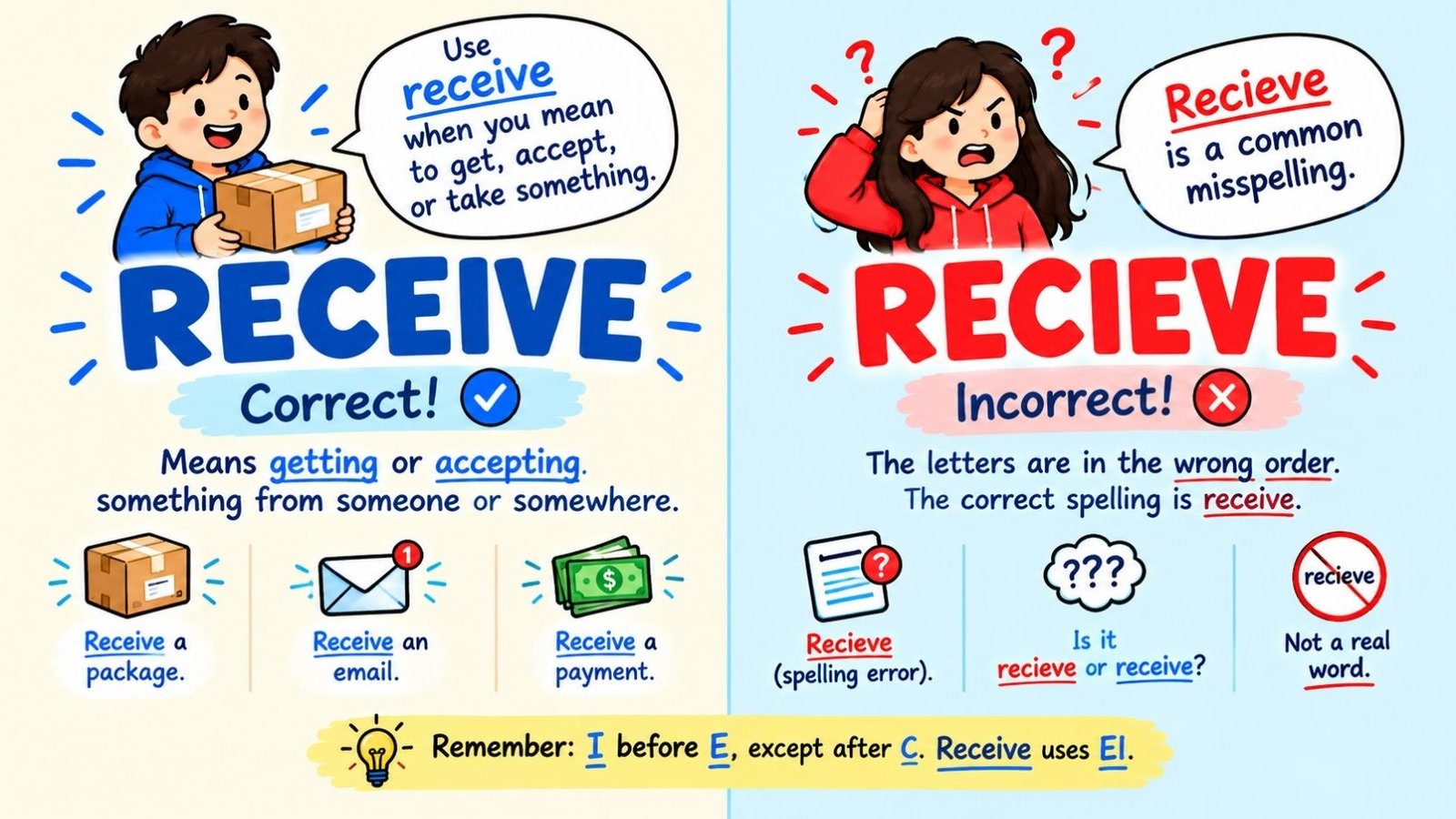
The correct spelling is receive, not recieve. Recieve is one of the most common misspellings in English, and it happens because writers mix up the order of the letters i and e. If you remember one simple rule, you will get this word right every time: e comes before i after the letter c.
This mix up is easy to understand. English has a well known rhyme about i and e, and receive is one of the clearest examples of it in action. Once you see why the rule works here, the correct spelling becomes much easier to recall, whether you are writing an email, a text message, or a formal document. This article walks through the meaning, the spelling rule, the grammar, and the everyday situations where people usually get this word wrong.
What Does Receive Mean?
Receive is a verb. It means to get, accept, or take something that is given, sent, or delivered to you.
You can receive:
- A letter, package, or email
- Money, a payment, or a gift
- News, information, or instructions
- Treatment, care, or a service
- Praise, criticism, or feedback
In simple terms, if something comes to you from somewhere else and you accept it, you receive it.
Example: She will receive the results by Friday.
Example: He receives a monthly salary from his employer.
See More: Choosing Or Chosing
Why Is It Recieve or Receive? The Spelling Rule Explained
Recieve is always incorrect. The confusion comes from a classic spelling rule taught in English schools:
I before E, except after C.
Since receive contains the letter c right before the i and e, the rule tells you to reverse the usual order. Instead of writing ie, you write ei.
| Rule | Example | Spelling |
| I before E | Friend, believe, chief | ie |
| Except after C | Receive, deceive, ceiling | ei |
This is why receive is spelled with e-i, not i-e. Recieve breaks this rule, which is exactly why it looks wrong once you know the pattern.
Quick tip: If a word has the letter c right before the ie or ei sound, and it sounds like ee, the letters usually flip to ei. Receive, deceive, ceiling, and perceive all follow this same rule.
It is worth knowing that this rhyme has plenty of exceptions elsewhere in English, such as weird, science, and seize. But for the specific case of receive, the rule holds perfectly, which makes it a genuinely useful way to remember the correct spelling.
Receive Or Recieve: Which One Is Correct?
There is no debate here. Receive is correct in every English speaking country and in every style of writing, whether formal or casual. Recieve is not a regional variant, an informal spelling, or an alternative form. It is simply a spelling mistake.
This applies across the board:
- Receive is correct in American English.
- Receive is correct in British English.
- Receive is correct in Australian, Canadian, and Indian English.
- Receive is correct in academic writing, business writing, and everyday conversation.
If you have seen recieve written somewhere and assumed it might be acceptable in certain contexts, it is not. Dictionaries, style guides, and spell checkers all recognize only one correct spelling: receive.
Part Of Speech And Grammar
Receive is a regular verb, and it follows standard English verb patterns.
| Form | Word | Example |
| Base form | Receive | I receive packages weekly. |
| Third person singular | Receives | She receives calls every morning. |
| Past tense | Received | They received the invoice yesterday. |
| Past participle | Received | The order has been received. |
| Present participle | Receiving | We are receiving updates now. |
Notice that the past tense and past participle are the same word: received. This is common with regular verbs in English, since you simply add ed to the base form.
Example, present tense: The store receives new stock every Monday.
Example, past tense: I received your message this morning.
Example, present participle: She is currently receiving training for her new role.
How To Pronounce Receive
Receive is pronounced with two syllables: ri-SEEV.
- The stress falls on the second syllable, SEEV.
- The first syllable sounds like a short “rih.”
- The ei combination is pronounced like a long ee sound, similar to the word “seen.”
In IPA, it is written as /rɪˈsiːv/.
This pronunciation is the same in both American and British English, with only slight regional differences in accent, not in the actual sounds used.
See More: Noteable Or Notable
Origin Of the Word Receive
Receive comes from Old French recevoir, which itself developed from the Latin word recipere. In Latin, re means “back” and capere means “to take.” Together, the original sense was close to “to take back” or “to take in.”
Over time, as the word passed into Middle English, the spelling shifted toward the modern form receive. The Latin root capere also gave English several related words, including capture, accept, and recipe, all of which share the idea of taking or holding something.
Understanding this origin helps explain why so many similar words, like conceive, deceive, and perceive, follow the same ei spelling pattern. They all descend from Latin verbs built on the same “cipere” or “capere” root, filtered through French before arriving in English.
Receive In Different Contexts
The core meaning of receive stays the same, but the word appears naturally across many everyday situations.
Receiving Money
People often search for how to receive money through digital platforms. In this context, receive simply means accepting a payment sent to you.
- Example: To receive money on PayPal, the sender only needs your email address or phone number.
- Example: You can receive money through Zelle directly into your linked bank account, usually within minutes.
Receiving Messages
Receive is also common in the context of communication.
- Example: I did not receive your text message until later that evening.
- Example: You can receive SMS messages online using a temporary number service, often used for account verification.
Receiving News or Information
- Example: The team received the updated schedule this morning.
- Example: She received the news of her promotion with quiet excitement.
Receiving In Sports
In some sports, particularly volleyball, receive refers to the specific action of taking the opposing team’s serve.
Example: The libero is responsible for receiving the serve and setting up the next play.
Formal And Business Usage
In professional writing, receive often appears in polite or formal phrasing.
- Example: Please confirm once you receive the attached documents.
- Example: We look forward to receiving your response by the end of the week.
Common Mistakes With Recieve Or Receive
Because this word is so frequently searched and typed, several patterns of error show up again and again.
❌ Incorrect: I did not recieve your email.
✅ Correct: I did not receive your email.
❌ Incorrect: Please let me know when you recieve the package.
✅ Correct: Please let me know when you receive the package.
❌ Incorrect: She recieved a warm welcome.
✅ Correct: She received a warm welcome.
The mistake almost always comes from applying the general “i before e” rule without remembering the exception for words that contain c. Autocorrect tools usually catch this error automatically, but it is worth learning the rule so you can write it correctly without relying on spell check every time.
Another related mix up worth mentioning briefly is the confusion between receive and recieve versus similar sounding or similarly structured words like relieve or believe. Those words do not contain c before the vowel sound, so they correctly keep the ie order: relieve, believe, achieve. Receive is the odd one out only because of the c that comes right before it.
Synonyms And Related Words
Depending on context, several words can work as alternatives to receive, though the exact meaning can shift slightly.
| Word | Meaning | Typical Use |
| Get | General, informal way to obtain something | I got your message. |
| Accept | To take something willingly, often after an offer | She accepted the award. |
| Obtain | To acquire something, often through effort | He obtained a copy of the report. |
| Collect | To gather or pick up something, often in person | Please collect your parcel from the desk. |
| Acquire | To gain something, often gradually or formally | The company acquired new equipment. |
Get is the most casual synonym and works well in everyday speech. Accept carries a sense of choice or agreement, while receive is more neutral and simply describes something arriving or being given to you, regardless of whether you actively chose it.
Antonyms Of Receive
The opposite of receive generally involves giving or sending rather than getting.
- Give
- Send
- Deliver
- Provide
- Donate
Example: He will send the documents, and she will receive them by tomorrow.
See More: Boujee Vs Bougie
Frequently Asked Questions
Is it recieve or receive?
It is always receive. Recieve is a misspelling and is never correct in any form of English.
Why is receive spelled with ei instead of ie?
Because it follows the rule “i before e, except after c.” Since the letter c comes right before the vowel sound, the letters flip to ei.
What does receive mean?
Receive means to get, accept, or take something that has been given, sent, or delivered to you.
Is receive a noun or a verb?
Receive is a verb. The related noun form is receipt, and the related adjective form for something obtained is often expressed as received, as in “received wisdom.”
How do you pronounce receive?
Receive is pronounced ri-SEEV, with the stress on the second syllable.
What is the past tense of receive?
The past tense is received, formed by simply adding ed to the base verb.
What is a synonym for receive?
Common synonyms include get, accept, obtain, and collect, depending on the context.
Is recieve ever correct in British English?
No. Recieve is incorrect in British English, American English, and every other variety of English. Receive is the only correct spelling worldwide.
What is the difference between receive and receipt?
Receive is the verb describing the action of getting something. Receipt is the noun, often referring to the paper or digital proof that something was received, such as after a purchase.
How do you receive money through Zelle or PayPal?
To receive money through these platforms, you generally only need to share your registered email address or phone number with the sender, and the funds are transferred directly to your linked account.
Final Thoughts
Receive is the only correct spelling, and recieve is a common but avoidable mistake. The confusion almost always comes down to one simple grammar rule: i before e, except after c. Because receive contains the letter c directly before the vowel sound, the letters are reversed to ei rather than ie.
Once this rule clicks, the spelling becomes much easier to remember, whether you are writing a quick text, a formal email, or a longer piece of writing. The next time you are unsure whether to write recieve or receive, just picture that simple rule, and the correct spelling should come naturally.

Zunaira Qasim is the author and creator of Gramvixo, dedicated to making English grammar easier for learners and everyday writers. With 4 years of experience researching grammar, confusing words, word choices, and common language mistakes, they create clear and practical content that helps readers understand English and use it with confidence.
One Comment