
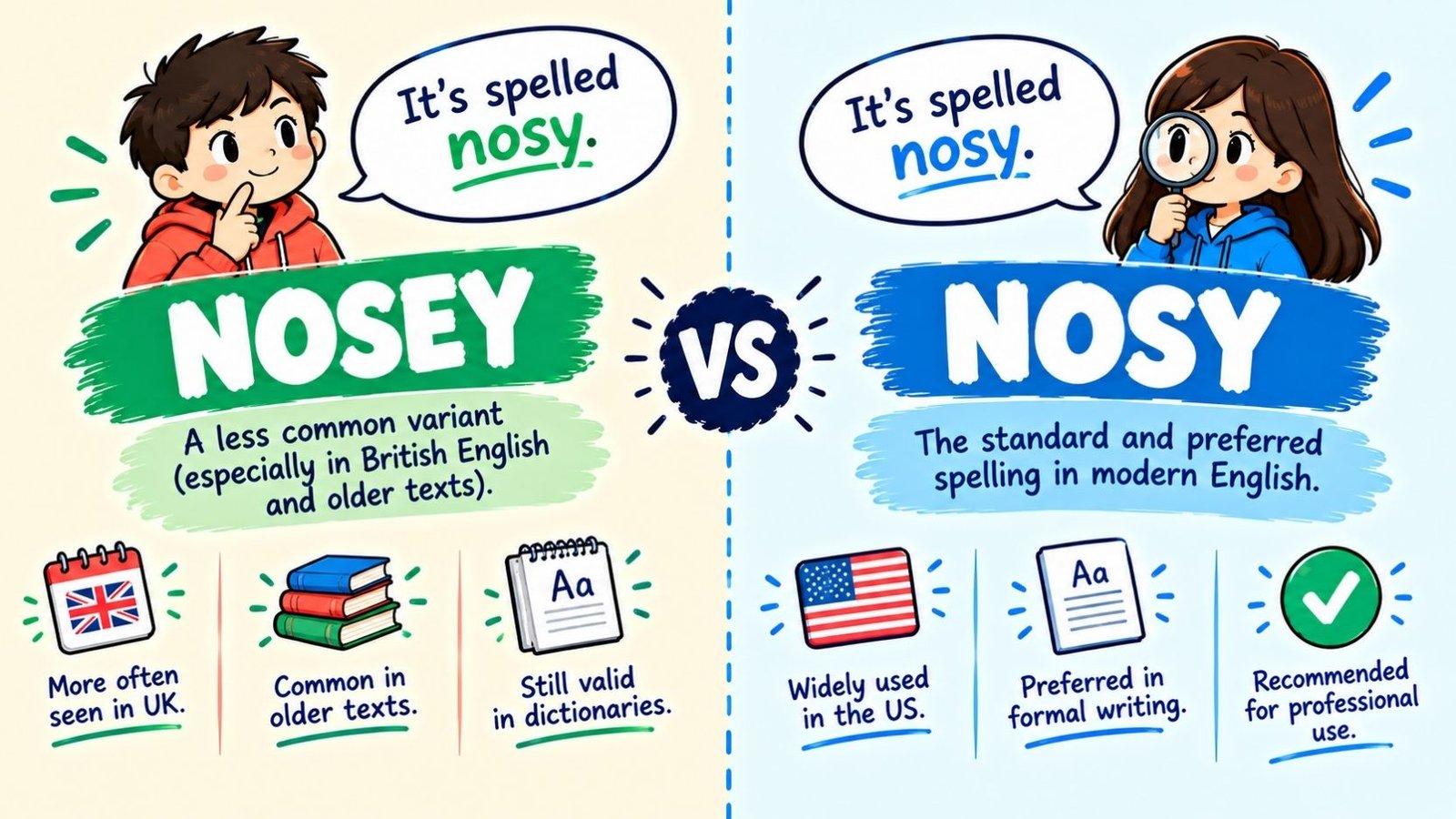
If someone keeps asking about your personal business, you might call them nosy. Or is it nosey? Both spellings exist, and both are pronounced the same way. The short answer is that nosy is the standard spelling used in most dictionaries and formal writing today.
Nosey is not wrong. It is simply the less common variant, more often seen in British English and older texts. Understanding the difference matters if you want your writing to look polished, whether you are texting a friend or writing a professional email. This guide breaks down the meaning, grammar, origin, and correct usage of both spellings.
Nosey or Nosy: The Quick Answer
Nosy is the preferred and more widely accepted spelling in both American and British English today. Nosey is a valid alternative spelling, still found in dictionaries, but it appears far less often in modern writing.
Here is a simple breakdown:
| Spelling | Status | Common Region |
| Nosy | Standard, preferred spelling | United States, increasingly UK |
| Nosey | Accepted variant spelling | More often seen in British and older texts |
💡 Tip: If you are unsure which spelling to use, choose “nosy.” It is the safer choice for essays, professional writing, and formal communication.
See More: Input Or Imput
What Does Nosy (Or Nosey) Mean?
Nosy means being overly curious about other people’s private business. It describes someone who asks too many personal questions, pries into things that are not their concern, or tries to find out information that was not offered to them.
The word usually carries a mildly negative tone, though it can also be used playfully among friends. Calling someone nosy is rarely a serious insult. It often points to harmless curiosity rather than genuine bad intent.
Common Ways the Word Is Used
- Describing a person who constantly asks personal questions
- Describing behavior, such as “a nosy question” or “nosy comment”
- Describing someone who eavesdrops or listens to conversations that are not theirs
- Describing a neighbor who watches or comments on other people’s activities
Nosy Or Nosey: Grammar And Part Of Speech
Both nosy and nosey are adjectives. An adjective describes a noun, and in this case, it describes a person, question, look, or behavior that shows excessive curiosity.
Word Forms
Nosy and nosey follow the same grammar rules as other adjectives ending in a consonant plus “y.”
| Form | Nosy Spelling | Nosey Spelling |
| Base form | nosy | nosey |
| Comparative | nosier | nosier |
| Superlative | nosiest | nosiest |
| Adverb | nosily | nosily |
| Noun | nosiness | nosiness |
Notice that the comparative, superlative, adverb, and noun forms almost always use the “nosy” spelling, even when someone prefers “nosey” for the base word. This is one more reason “nosy” has become the standard choice.
Example Sentences
- My coworker is so nosy that she reads emails left open on other people’s screens.
- He asked a nosy question about my salary during lunch.
- Of all my neighbors, Mrs. Carter is the nosiest.
- She nosily peeked through the fence to see what we were doing.
How To Pronounce Nosy Or Nosey
Both spellings are pronounced exactly the same way.
- American English: NOH-zee (/ˈnoʊzi/)
- British English: /ˈnəʊzi/
The pronunciation does not change based on spelling, so this is never a source of confusion. Only the written form differs.
Nosey Or Nosy In British English
British English shows more flexibility here than American English. Older British dictionaries and everyday writing still use “nosey” fairly often, especially in casual contexts like conversation, informal notes, or older literature.
However, modern British style guides and major dictionaries, including Collins and Oxford references, now list “nosy” as the primary spelling, with “nosey” noted as a valid but secondary variant. If you are writing for a UK audience today, “nosy” is still the safer and more widely recognized choice, even though “nosey” will not confuse anyone.
Nosey Or Nosy In American English
American English strongly favors “nosy.” Major dictionaries such as Merriam-Webster and Dictionary.com list “nosy” as the standard entry, with “nosey” appearing only as a secondary or less common form. In American professional writing, academic papers, and journalism, “nosy” is used almost exclusively.
Origin of the Word Nosy
The word comes directly from “nose” combined with the suffix “-y,” which is commonly used to turn a noun into a descriptive adjective, similar to how “rain” becomes “rainy” or “luck” becomes “lucky.”
The connection makes sense visually and figuratively. Someone who is nosy is metaphorically “sticking their nose” into matters that are not theirs. This ties into related expressions like “nose around” and “stick your nose in,” both of which describe similar behavior.
The “nosy” spelling appeared first in written English, with “nosey” showing up somewhat later as a natural variant. Over time, “nosy” became the dominant form in dictionaries, while “nosey” remained in casual use, particularly in the UK.
See More: Seemless Or Seamless
Nosy or Nosey: Common Mistakes
Because both spellings sound identical, mistakes usually happen in writing rather than speech. Here are a few things to watch for.
❌ Incorrect: She has a real nosey attitude in professional emails.
✅ Correct: She has a real nosy attitude, which is unprofessional in emails.
While “nosey” is not technically wrong, most style guides recommend “nosy” for formal or professional writing, so treat “nosey” as informal at best.
❌ Incorrect: He is the noisiest person on the team. (confused with “noisy”)
✅ Correct: He is the nosiest person on the team.
This is one of the most common mix-ups related to this word.
Nosy Vs Noisy: Do Not Confuse Them
“Nosy” and “noisy” look similar but mean completely different things.
| Word | Meaning | Example |
| Nosy | Overly curious about others’ business | My nosy neighbor asks too many questions. |
| Noisy | Making a lot of sound or noise | The noisy neighbors kept us up all night. |
A simple way to remember the difference: “nosy” relates to the nose, meaning curiosity. “Noisy” relates to noise, meaning sound. The spelling difference is only one letter, but the meanings do not overlap at all.
Nosy Parker: A Related British Expression
“Nosy Parker” is an informal British phrase used to describe someone who is excessively curious or meddlesome, often in an annoying way. It is typically used as a light scolding, such as telling a child to stop being a “nosy Parker” when they ask too many questions about adult conversations.
The exact origin of “Parker” in this phrase is debated among language historians, and no single explanation has been fully confirmed, so it is best treated as a colorful idiom rather than a term with a clearly documented history.
Synonyms For Nosy
Several words share a similar meaning to nosy, though each carries a slightly different tone.
| Word | Meaning | Difference in Tone |
| Curious | Interested in learning something | Neutral, not necessarily negative |
| Prying | Trying to find out private details | Slightly more negative than nosy |
| Snoopy | Secretly investigating others’ business | Often implies sneaking around |
| Inquisitive | Eager to ask questions or learn | Can be positive, especially about learning |
| Meddlesome | Interfering in others’ affairs | Stronger negative tone than nosy |
Choosing the right synonym depends on how negative or neutral you want the description to sound. “Curious” and “inquisitive” are the gentlest options, while “meddlesome” and “prying” carry a sharper edge.
Nosy In Everyday Conversation
In casual speech, “nosy” is often used without any real harshness. Friends might jokingly call each other nosy when asking about a new relationship or a surprise party detail. It becomes a more serious label only when paired with words like “intrusive” or when describing repeated unwanted behavior.
- Playful: “Okay, nosy, you’ll find out what I got you for your birthday soon enough.”
- Neutral: “She’s just naturally nosy about how things work.”
- Critical: “He’s way too nosy about things that don’t concern him.”
See More: Hassle Or Hastle
Frequently Asked Questions
Is it nosey or nosy?
“Nosy” is the standard and more widely accepted spelling. “Nosey” is a recognized variant but is used far less often, especially in formal writing.
How do you spell nosey or nosy correctly?
For formal writing, spell it “nosy.” “Nosey” is not incorrect, but dictionaries and style guides list “nosy” as the primary form.
What does nosy mean?
Nosy means being overly curious or interested in other people’s private business, often by asking personal questions or prying into matters that are not one’s concern.
Is nosy a noun or an adjective?
Nosy is an adjective. It describes a person, question, look, or behavior. The related noun form is “nosiness.”
Is nosey or nosy more common in the UK?
“Nosey” appears more often in British English than in American English, but modern British dictionaries now list “nosy” as the primary spelling as well.
What is the difference between nosy and noisy?
“Nosy” means overly curious about others’ affairs. “Noisy” means loud or full of sound. They are unrelated words that only look similar in spelling.
What is a nosy Parker?
“Nosy Parker” is a British informal expression for someone who is excessively curious or meddlesome about other people’s business.
Is calling someone nosy offensive?
Usually not. It is typically a mild, sometimes playful description of curious behavior rather than a harsh insult, though tone and context matter.
What is the plural or other forms of nosy?
Nosy does not have a plural form since it is an adjective. Its related forms include nosier, nosiest, nosily, and nosiness.
Which spelling should I use in professional writing?
Use “nosy.” It is the spelling recognized across most dictionaries and is considered standard in professional and academic contexts.
Final Thoughts
Nosy and nosey mean exactly the same thing and sound identical when spoken. The real difference comes down to spelling convention: nosy is the standard, dictionary-preferred form used across the United States and increasingly in the United Kingdom, while nosey survives mainly as an informal or regional variant.
When in doubt, especially for emails, essays, or professional writing, go with “nosy.” It is the safer, more widely recognized choice, and it matches the comparative and noun forms, nosier, nosiest, and nosiness, that almost everyone already uses. Save “nosey” for casual writing where either spelling reads naturally.

Zunaira Qasim is the author and creator of Gramvixo, dedicated to making English grammar easier for learners and everyday writers. With 4 years of experience researching grammar, confusing words, word choices, and common language mistakes, they create clear and practical content that helps readers understand English and use it with confidence.
3 Comments