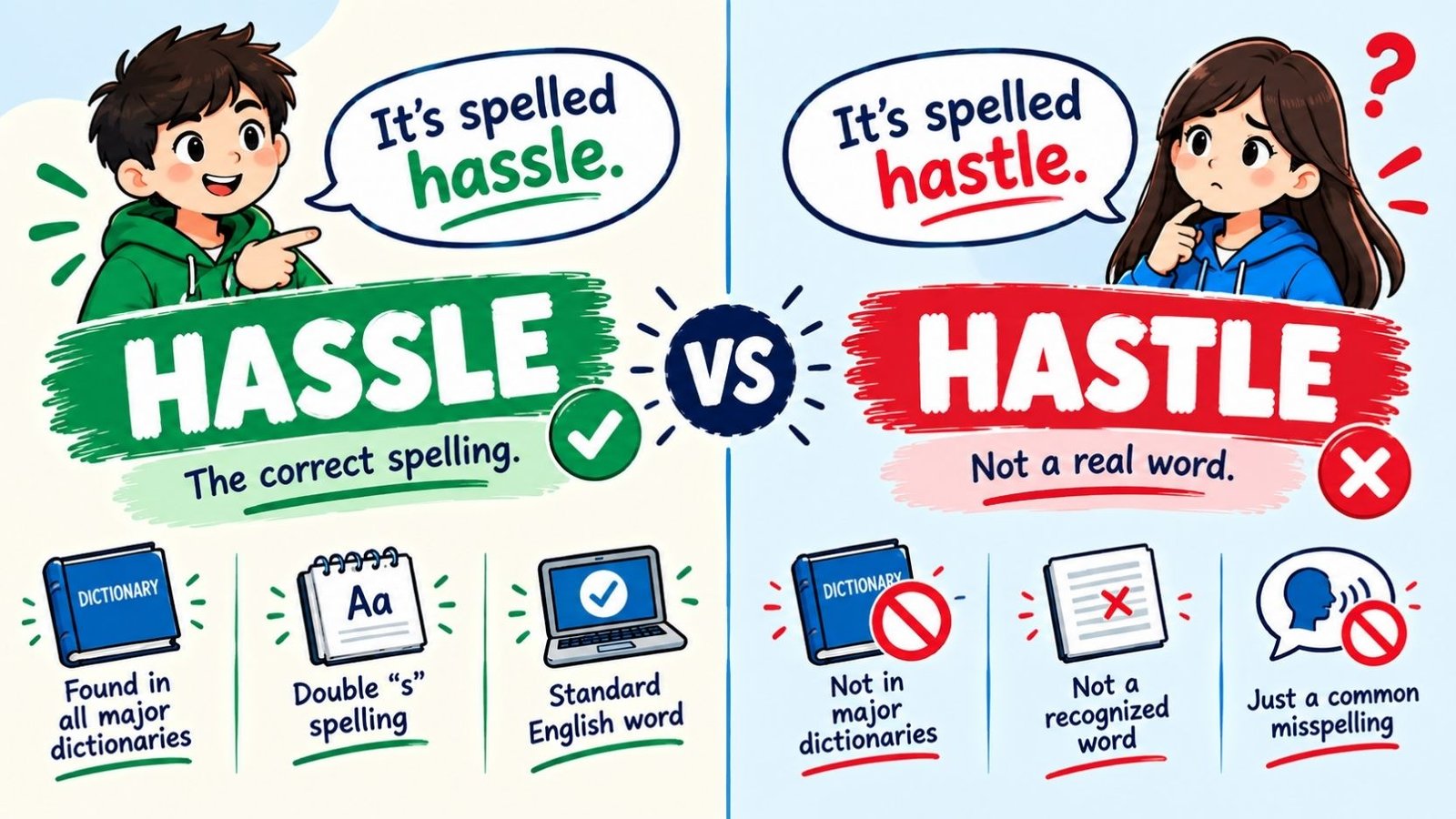
If you are searching for hassle or hastle, you want a quick, clear answer. The correct spelling is hassle. Hastle is not a real word in standard English, even though it appears often in casual writing and online searches. Hassle is the only form recognized by major dictionaries, and it means a difficult, annoying, or time-consuming situation.
This mix-up happens for a simple reason. The two words sound almost identical when spoken quickly, and the extra letter in hastle feels like it could belong there. But English spelling does not always follow sound alone, and this is one of those cases where a small letter swap changes a real word into a nonstandard one. Understanding why hassle is correct, and how to use it properly, makes it easier to write with confidence.
What Does Hassle Mean?
Hassle refers to a situation, task, or interaction that causes trouble, stress, or extra effort. It can describe something mildly annoying, like waiting in a long line, or something more draining, like dealing with a confusing bureaucratic process.
The word works as both a noun and a verb, which is one reason it shows up so often in everyday conversation.
As a noun, hassle means a bothersome situation or problem.
- Renewing my passport turned into a real hassle.
- Moving apartments is always such a hassle.
As a verb, hassle means to bother, pressure, or harass someone, usually through repeated requests or pestering.
- Stop hassling me about the deadline; I know it is coming.
- The sales rep kept hassling customers outside the store.
In both forms, the core idea stays the same: friction, inconvenience, or unwanted pressure.
See More: Any Problem Or Any Problems
Is It Hassle Or Hastle? A Simple Spelling Breakdown
There is no ambiguity here. Hassle is the standard, dictionary-approved spelling in both American and British English. Hastle does not appear in Merriam-Webster, the Oxford English Dictionary, Cambridge Dictionary, or any other established reference.
| Spelling | Status | Notes |
| Hassle | Correct | Standard spelling in all major dictionaries |
| Hastle | Incorrect | Common misspelling, not a recognized word |
| Hassel | Incorrect | Another frequent misspelling, sometimes confused with the surname Hasselhoff |
💡 Tip: If you are ever unsure while typing quickly, remember that hassle has a double “s,” just like the words “puzzle” and “muscle” have double letters in similar spots. That small pattern can help the correct spelling stick.
Why Do People Misspell Hassle As Hastle?
The confusion is not random. A few factors make hastle a tempting but incorrect spelling.
- Sound similarity. When spoken at normal speed, hassle and hastle can sound nearly the same, especially in casual speech or regional accents.
- Letter transposition. Hastle simply swaps the order of the “s” and “t” sounds compared to a word like “haste,” which may create a subconscious blend between “hassle” and “haste.”
- Autocorrect gaps. Some keyboards and messaging apps do not always flag hastle as an error, especially in fast typing or voice-to-text situations.
- Visual pattern confusion. English has several words ending in “-stle” that are pronounced with a silent “t,” such as castle, whistle, and bristle. This pattern may lead writers to assume hastle follows the same rule, when in fact hassle is a completely different word with a different structure.
None of these reasons make hastle correct. They simply explain why the mistake is common.
Hassle vs Hastle: Quick Comparison Table
| Word | Real Word? | Meaning | Example |
| Hassle | Yes | Trouble, annoyance, or to bother someone | The paperwork was a huge hassle. |
| Hastle | No | Not a standard English word | Incorrect: This was such a hastle. |
If you see hastle in a text, email, or article, treat it as a spelling error and correct it to hassle.
Grammar And Word Forms Of Hassle
Hassle is a fairly flexible word. Knowing its different forms helps you use it correctly in various sentence structures.
Noun forms
- Singular: hassle — “That was a real hassle.”
- Plural: hassles — “I dealt with several hassles this week.”
Verb forms
- Base form: hassle — “Don’t hassle your sister.”
- Third person singular: hassles — “He always hassles the new employees.”
- Past tense: hassled — “She hassled him until he agreed.”
- Present participle: hassling — “They keep hassling us for updates.”
See More: Puting Or Putting
Common adjective phrase
- Hassle free — describing something that avoids trouble or difficulty entirely.
- “We offer hassle free returns on every order.”
- “It was a hassle free move, thanks to the moving company.”
Notice that hassle free is typically written as two words or with a hyphen (hassle-free) depending on style guide preference, but never as “hastle free.”
How To Pronounce Hassle
Hassle is pronounced HASS-uhl, with two syllables and stress on the first syllable. The double “s” is pronounced as a single, slightly emphasized “s” sound, similar to how it sounds in “castle” or “muscle,” though hassle does not have a silent “t.”
In IPA, it is written as /ˈhæs.əl/.
There is no correct pronunciation for hastle, since it is not a standard word. If someone says “hastle,” they are likely either mispronouncing hassle or genuinely unaware of the correct spelling.
Hassle In Everyday Context
The word hassle appears constantly in daily conversation, marketing, and casual writing because it captures a very relatable feeling: minor friction in daily life.
In customer service and business language:
- No hassle loans
- Hassle free storage rentals
- No hassle home selling
- No hassle car buying
- Hassle free returns
Businesses use “hassle free” or “no hassle” as a selling point because it promises simplicity and ease, which customers value highly.
In casual conversation:
- “I don’t want the hassle of cooking tonight.”
- “It’s not worth the hassle, just let it go.”
- “Can you handle this? I don’t have time for the hassle.”
In workplace or formal settings:
- “We want to minimize the hassle for our clients during the transition.”
- “Sorry for the hassle this delay has caused.”
This last phrase, “sorry for the hassle,” is a common polite apology used in customer service emails and support messages. It softens an inconvenience while acknowledging the reader’s frustration.
Synonyms And Related Words
Hassle has several close synonyms, though each carries a slightly different tone or intensity.
| Word | Meaning | Difference From Hassle |
| Inconvenience | Something that causes minor difficulty | More formal and neutral in tone |
| Bother | Something mildly annoying or irritating | Slightly softer and more casual |
| Trouble | A more general term for difficulty | Can suggest a more serious problem |
| Nuisance | Something persistently annoying | Often used for repeated or ongoing irritation |
| Pester | To bother someone repeatedly | Used only as a verb, similar to hassle as a verb |
Antonyms include words like ease, convenience, and simplicity, which describe the opposite of a hassle.
Common Mistakes To Avoid
❌ Incorrect: This project has been such a hastle.
✅ Correct: This project has been such a hassle.
❌ Incorrect: Please don’t hastle me right now.
✅ Correct: Please don’t hassle me right now.
❌ Incorrect: We offer a hastle free experience.
✅ Correct: We offer a hassle free experience.
The correction is always the same: replace “hastle” with “hassle.” There is no context, formal or informal, where “hastle” is the accepted spelling.
⚠️ Common mistake: Confusing hassle with hustle. These two words look similar but mean very different things.
- Hassle means trouble or annoyance.
- Hustle means to work energetically, or in slang, a side income activity, as in “side hustle.”
“Side hastle” and “side hassle” are both incorrect. The correct phrase is “side hustle.”
Hassle vs Hustle: A Quick Clarification
Because hassle and hustle share several letters and a similar rhythm, they are sometimes confused, especially in phrases like “side hustle.”
| Word | Meaning | Example |
| Hassle | Trouble or annoyance | Dealing with insurance claims is a hassle. |
| Hustle | To work hard or move quickly; also a side job | She started a side hustle selling candles. |
If you are searching for a term related to extra income or entrepreneurial effort, the word you want is hustle, not hassle or hastle.
Origin Of The Word Hassle
Hassle is a relatively modern English word. Language historians trace it to American English in the mid-20th century, with its earliest documented uses appearing around the 1940s and gaining wider popularity through the 1950s and 1960s. Its exact origin is debated, but many etymologists connect it to a blend or informal evolution involving older words like “haggle” and “tussle,” both of which describe struggle, argument, or effortful disagreement.
By the mid-1900s, hassle had settled into its current meaning: a source of trouble, annoyance, or extra effort. Over time, it moved from informal slang into widely accepted standard English, and it now appears comfortably in everyday speech, business language, and published writing.
Hastle has no equivalent etymology because it was never an independent word. It exists only as a spelling error of hassle.
See More: Unforgivable Vs Unforgiven
Frequently Asked Questions
Is it hassle or hastle?
It is hassle. Hastle is a common misspelling and is not recognized by any standard English dictionary.
What does hassle mean?
Hassle means a difficult, annoying, or troublesome situation. It can also work as a verb meaning to bother or pressure someone.
Is hassle a noun or a verb?
Hassle can be both. As a noun, it describes trouble or inconvenience. As a verb, it means to bother or pester someone.
How do you pronounce hassle?
Hassle is pronounced HASS-uhl, with stress on the first syllable and a double “s” sound.
What is the difference between hassle and hustle?
Hassle means trouble or annoyance, while hustle means to work energetically or refers to a side job, as in “side hustle.” They are unrelated in meaning despite looking similar.
Is hastle ever correct in any dialect or informal usage?
No. Even in informal writing, texting, or slang, hastle is considered a spelling mistake, not an alternate accepted form.
What does hassle free mean?
Hassle free describes something that is simple, smooth, and does not involve extra difficulty or inconvenience, such as a hassle free return policy.
Why do people confuse hassle with hastle?
The confusion usually comes from how similar the words sound when spoken quickly, along with some influence from words like “haste” and silent-t patterns in words like “castle” or “whistle.”
Can hassle be used in formal writing?
Yes. Hassle is considered standard English and appears in professional emails, business communication, and published articles, though very formal writing may prefer synonyms like “inconvenience” or “difficulty.”
What is a synonym for hassle?
Common synonyms include inconvenience, bother, trouble, and nuisance, each with a slightly different tone.
Final Takeaway
The spelling debate between hassle or hastle has a clear answer: hassle is correct, and hastle is simply a common misspelling with no dictionary standing. Once you recognize the pattern, the double “s” in hassle becomes easy to remember, especially alongside similar words like puzzle and muscle.
Whether you are writing a customer service email, a casual text, or a formal document, sticking with hassle ensures your writing stays accurate and professional. The next time you are unsure while typing, trust the version with the double “s,” and leave hastle out of your vocabulary for good.

Zunaira Qasim is the author and creator of Gramvixo, dedicated to making English grammar easier for learners and everyday writers. With 4 years of experience researching grammar, confusing words, word choices, and common language mistakes, they create clear and practical content that helps readers understand English and use it with confidence.