
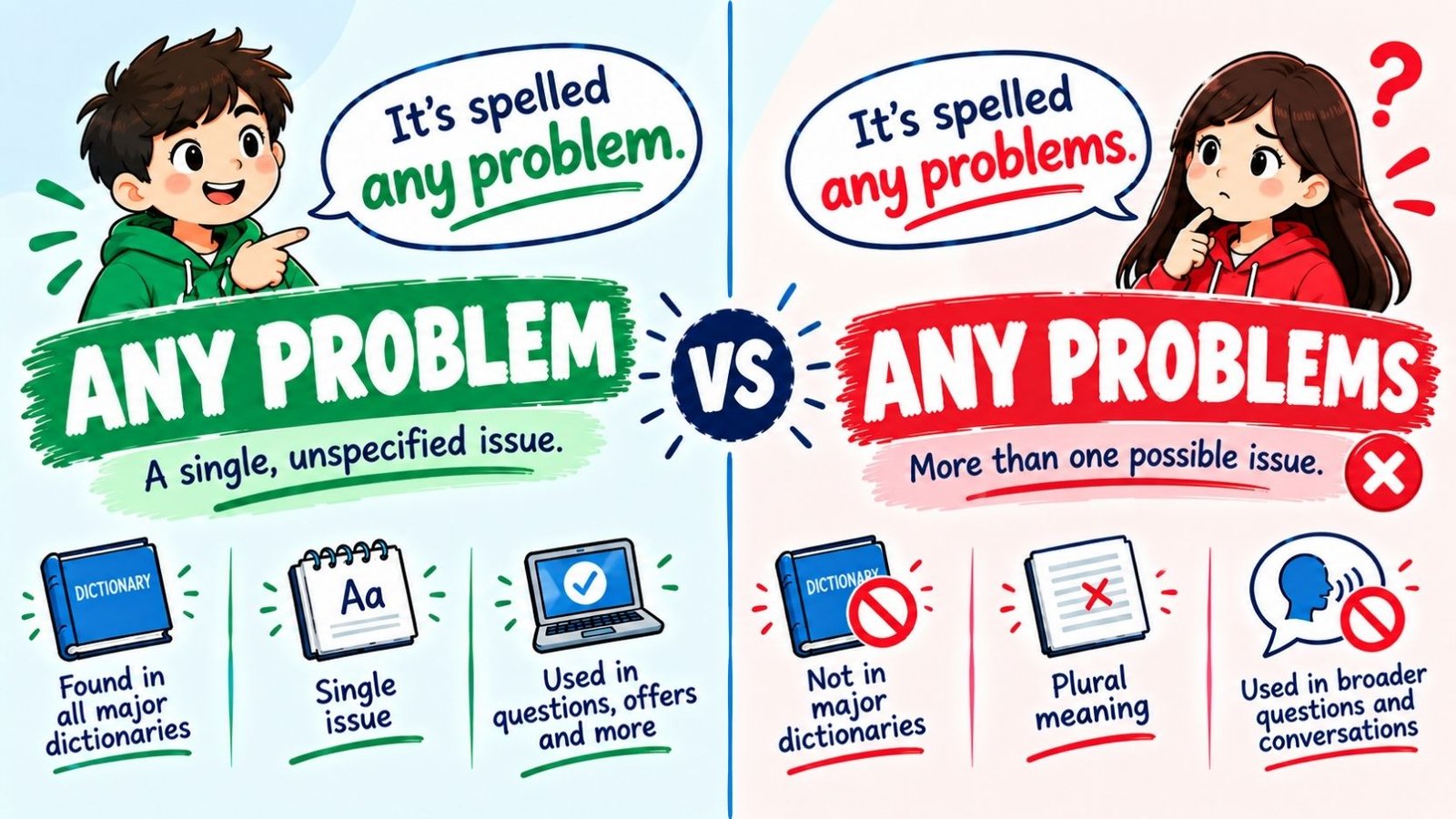
“Any problem” and “any problems” are both correct English phrases, but they are used in different situations. “Any problem” refers to a single, unspecified issue, while “any problems” refers to more than one possible issue. The word “any” works with both singular and plural nouns, so the choice depends entirely on what you mean, not on a fixed grammar rule.
Understanding this difference matters because the wrong form can sound slightly unnatural or change the meaning of a sentence. Native speakers often switch between “problem” and “problems” without thinking about it, but learners frequently get stuck here. This guide explains the meaning, the grammar behind it, and how to use each version correctly in real conversation, writing, and everyday questions.
What Does Any Problem Mean
“Any problem” means a single difficulty, issue, or obstacle, without specifying which one. The word “any” here signals that you are not pointing to a particular problem. You are asking about the possibility of one existing at all.
For example, “Is there any problem with the delivery?” is asking whether one issue exists, even though the speaker does not know what it might be. The sentence treats “problem” as a general, singular concept rather than naming a specific difficulty.
“Any problem” is also common in offers of help, such as “Let me know if you have any problem.” In this use, “any problem” still refers to one issue at a time, even though the sentence leaves room for multiple possible situations in the future.
See More: Null Hypothesis Vs Alternzative Hypothesis
Any Problem or Any Problems: Which Is Correct
Both forms are grammatically correct. English allows “any” to modify singular countable nouns, plural countable nouns, and uncountable nouns. The correct choice depends on how many problems you are actually referring to.
Use “any problem” when:
- You mean one unspecified issue
- You are asking a general yes or no question about a single difficulty
- The sentence treats the noun as singular, such as “Is there any problem?”
Use “any problems” when:
- You mean more than one possible issue
- You are asking about a broader range of difficulties
- The sentence naturally expects a plural answer, such as “Are there any problems?”
Neither version is more formal or more correct than the other. The difference is about number, not about style.
The Grammar Behind Any Plus A Noun
“Any” is a determiner. It can appear before singular countable nouns, plural countable nouns, and uncountable nouns, which is why both “any problem” and “any problems” are valid.
| Noun type | Example with any | Meaning |
| Singular countable | Any problem | One unspecified issue |
| Plural countable | Any problems | More than one unspecified issue |
| Uncountable | Any trouble | An unspecified amount of difficulty |
When “any” modifies a singular countable noun like “problem,” it usually appears in questions, conditionals, or negative sentences, and it implies “even one.” When it modifies a plural noun like “problems,” it implies “even a few” or “any number of them.”
This is why “Do you have any problem with that?” and “Do you have any problems with that?” are both natural. The first asks about a single objection. The second leaves room for several.
Any Problem In A Sentence: Examples
Seeing the phrase in context makes the meaning clearer. Below are natural examples using “any problem” as a singular reference.
- “If you have any problem, call the front desk.”
- “There isn’t any problem with your order.”
- “Is there any problem I should know about?”
- “We didn’t encounter any problem during the test.”
In each case, the speaker is asking about or denying the existence of a single issue, even though the exact nature of that issue is unknown.
Any Problems In A Sentence: Examples
Here are examples using the plural form, “any problems.”
- “Are there any problems with the new software?”
- “We haven’t had any problems so far.”
- “Do you see any problems with this plan?”
- “Let us know if you notice any problems.”
These sentences leave open the possibility of multiple issues at once, rather than asking about a single specific one.
Is There Any Problem Or Are There Any Problems
This is one of the most searched versions of this question, and the answer follows the same singular versus plural rule.
“Is there any problem?” treats the situation as a single, general issue. It is common in customer service, casual conversation, and short check ins, such as “Is there any problem with my account?”
“Are there any problems?” treats the situation as potentially involving several issues. It often appears when someone expects a more detailed answer, such as “Are there any problems with the system that I should report?”
Both are correct. Speakers often choose based on habit rather than a conscious grammar decision, but the underlying logic still follows singular and plural agreement.
See More: Puting Or Putting
Without Any Problem or Without Any Problems
Both versions appear frequently, and again, the meaning shifts slightly with number.
“Without any problem” usually describes a single smooth outcome, such as “The flight landed without any problem.” It suggests nothing went wrong at all, framed as one overall result.
“Without any problems” suggests the same idea but frames the absence of trouble as covering multiple possible issues, such as “The move went without any problems.” Many native speakers treat these two as interchangeable in casual speech, since both essentially mean “smoothly” or “with no trouble.”
If There Is Any Problem Or If There Are Any Problems
This conditional structure follows the same rule as the question form.
“If there is any problem, contact support” treats the possible issue as one general matter. “If there are any problems, contact support” opens the door to more than one. In everyday writing, especially in instructions, emails, and customer notices, both versions are common and equally acceptable.
Common Mistakes
Even though both “any problem” and “any problems” are correct, learners sometimes make small errors around them. Here are the most frequent ones.
⚠️ Mixing singular verbs with the plural noun
❌ Incorrect: “Is there any problems with this?”
✅ Correct: “Are there any problems with this?” or “Is there any problem with this?”
⚠️ Using “problem” with a plural meaning but singular verb
❌ Incorrect: “There is any problems I need to fix.”
✅ Correct: “There are any problems I need to fix” sounds unnatural on its own; the more natural correct form is “There are some problems I need to fix.”
⚠️ Forgetting subject and verb agreement
❌ Incorrect: “Any problems is fine to report.”
✅ Correct: “Any problems are fine to report.”
The core mistake to avoid is pairing a plural noun with a singular verb, or a singular noun with a plural verb, since “any” itself does not fix number agreement automatically.
Any Problem vs Any Problems: Quick Comparison
| Phrase | Number | Common use | Example |
| Any problem | Singular | General yes or no question about one issue | Is there any problem with my order? |
| Any problems | Plural | Question about multiple possible issues | Are there any problems with my order? |
Difference Between Problem, Issue, And Trouble
These three words often appear together in questions about “any problem,” and while they overlap, they carry slightly different tones.
| Word | Typical meaning | Typical tone |
| Problem | A difficulty that needs a solution | Neutral, everyday |
| Issue | A matter, concern, or topic, sometimes more formal | Slightly more formal or diplomatic |
| Trouble | Difficulty, inconvenience, or a state of distress | Can sound more personal or emotional |
“Problem” is the most direct and widely used of the three. “Issue” is often chosen in professional or customer service settings because it can sound softer, such as “We are looking into the issue” instead of “We are looking into the problem.” “Trouble” tends to describe an ongoing state of difficulty rather than a single defined item, as in “having trouble logging in” versus “having a problem logging in.”
Synonyms And Related Words
Depending on context, these words can replace “problem” in similar sentences.
- Issue: a matter needing attention, often used in formal or technical contexts
- Difficulty: something hard to manage or accomplish
- Obstacle: something blocking progress
- Trouble: general difficulty or inconvenience
- Complication: a problem that makes a situation more complex
- Glitch: a small, often technical problem
These words are not always interchangeable. “Glitch,” for instance, almost always refers to a minor technical fault, while “obstacle” often refers to something blocking a goal rather than a technical fault.
Any Problem Or Any Problems In Real Situations
This phrase shows up constantly in everyday and digital contexts, which is part of why it is searched so often.
Customer service: “Do you have any problem with your recent purchase?” is a common opening line for support agents, since it invites a simple yes or no response.
Technical status checks: People frequently search variations like “is there any problem with the internet today” or “any problems with a specific service today” when they suspect an outage. In these cases, the plural form is more common because multiple users are often reporting different symptoms at once.
Workplace communication: Phrases like “let me know if there are any problems with the report” are standard in professional emails, since they invite the reader to raise more than one concern if needed.
Casual conversation: “Any problem?” on its own, without a full sentence, is a very casual, sometimes slightly confrontational way to ask if something is wrong, often used in spoken English rather than writing.
Pronunciation
“Problem” is pronounced as PROB lum, with the stress on the first syllable. The plural, “problems,” simply adds an s sound at the end, pronounced PROB lumz. Neither word changes stress or rhythm when paired with “any.”
See More: Unforgivable Vs Unforgiven
Frequently Asked Questions
What does “any problem” mean?
“Any problem” means a single, unspecified difficulty or issue. It is used when the speaker is not referring to a particular known problem, only asking whether one exists.
Is it “any problem” or “any problems”?
Both are correct. “Any problem” is singular and refers to one possible issue. “Any problems” is plural and refers to more than one possible issue. The correct choice depends on the number you intend.
Can “any problem” be used with a plural verb?
No. “Any problem” is singular, so it should pair with a singular verb, as in “Is there any problem” rather than “Are there any problem.”
What is the difference between problem and issue?
“Problem” is a direct, everyday word for a difficulty. “Issue” often sounds slightly more formal or diplomatic and is common in professional or customer service language.
What is the difference between problem, trouble, and issue?
“Problem” refers to a specific difficulty. “Trouble” often describes an ongoing state of difficulty or inconvenience. “Issue” tends to sound more formal and is often used to describe a topic or concern rather than a defined difficulty.
Is “any problems” grammatically correct?
Yes. “Any problems” is correct when referring to more than one possible issue, such as “Are there any problems with the plan?”
How do you use “any problem” in a sentence?
“Any problem” is often used in questions or conditional sentences, such as “If you have any problem, let me know” or “Is there any problem with the schedule?”
Conclusion
“Any problem” and “any problems” are both correct forms of the same idea, and the choice between them comes down to number rather than formality or region. “Any problem” points to a single, unspecified issue, while “any problems” leaves room for more than one. The grammar rule behind this is simple: “any” can modify singular or plural nouns, and the verb in the sentence should agree with whichever form is used.
The most useful takeaway is to think about how many issues you actually mean before choosing between the two. If you are unsure, “any problems” is often the safer default in questions expecting a detailed answer, while “any problem” works well for short, general yes or no checks. Once this small distinction is clear, both forms become easy to use naturally and correctly in everyday speech and writing.

Zunaira Qasim is the author and creator of Gramvixo, dedicated to making English grammar easier for learners and everyday writers. With 4 years of experience researching grammar, confusing words, word choices, and common language mistakes, they create clear and practical content that helps readers understand English and use it with confidence.
3 Comments