
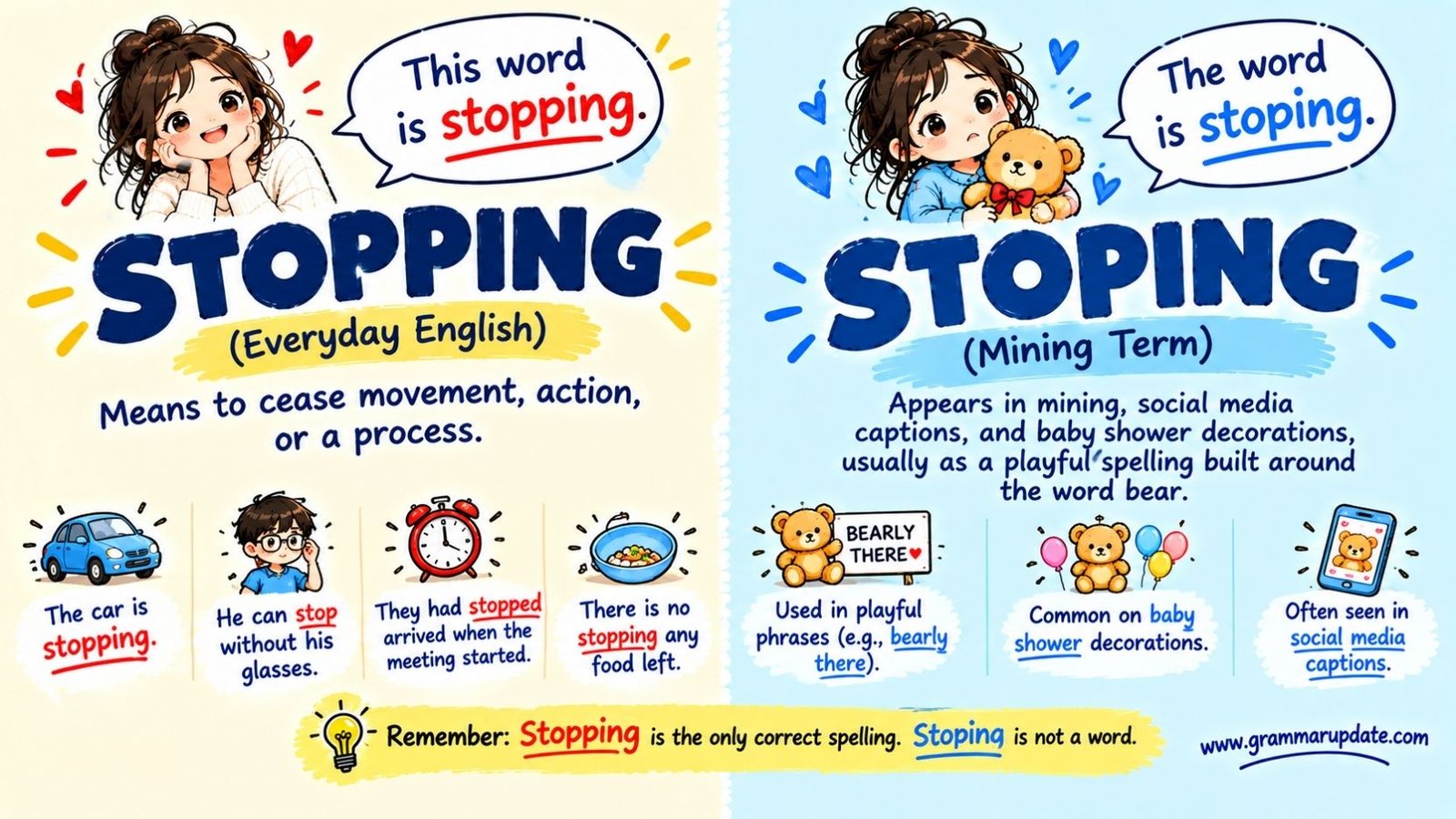
The correct word for ending an action or bringing something to a halt is stopping. It comes from the verb stop plus the ending ing, with the final letter p doubled. Stoping is a completely different word. It is a real term, but it belongs to mining, not everyday grammar.
Many people search for stoping or stopping because the two words look almost identical. Only one letter separates them. This mix-up is common in emails, text messages, and even published writing. Understanding why the confusion happens makes it much easier to use the right word every time.
Quick Answer
| Word | Meaning | Word Type | Common Use |
| Stopping | Ceasing movement, action, or a process | Verb (gerund or present participle of stop) | Everyday English |
| Stoping | Removing ore from underground in mining | Verb (gerund of stope) / Noun | Mining and geology |
If you are writing about ending an action, pausing, or coming to a halt, stopping is almost always the word you want. Stoping only applies in a mining context.
See More: Jewelry Or Jewellery
What Does Stopping Mean?
Stopping means bringing movement, action, or a process to an end. It can describe a car coming to a halt, a habit being ended, or a process being paused.
Simple definition: Stopping is the act of causing something to stop or coming to a stop yourself.
Stopping works as the ing form of the verb stop. In grammar, this form can act two ways:
- As a present participle, showing an action in progress: “The bus is stopping at the corner.”
- As a gerund, acting like a noun: “Stopping suddenly can be dangerous.”
Why Stopping Has A Double P
The doubling comes from a standard English spelling rule, not from a special exception. Here is the rule in plain terms:
When a short verb ends in one vowel followed by one consonant, and the last syllable is stressed, you double the final consonant before adding ing.
Stop fits this pattern exactly:
- One syllable
- Ends in a single vowel (o) followed by a single consonant (p)
- The syllable is stressed, since it is the only syllable
So stop becomes stopping, not stoping. The same rule explains other familiar words.
| Base Word | Correct Ing Form | Why |
| Stop | Stopping | Ends in one vowel plus one consonant |
| Run | Running | Same pattern |
| Shop | Shopping | Same pattern |
| Plan | Planning | Same pattern |
| Open | Opening | Stress falls on the first syllable, so no doubling |
That last example matters. Words like open do not double their final consonant, because the stress lands on the first syllable, not the last one. This is also why people sometimes misspell opening as “openning.” The rule about stress is often the missing piece that explains both mistakes.
💡 Tip: If a one syllable verb ends in a single vowel and single consonant, double the consonant before ing. If it does not follow that pattern, do not double it.
Why Do People Write Stoping Instead Of Stopping?
The spelling stoping usually appears for one of these reasons:
- The writer forgets the consonant doubling rule and simply adds ing to stop.
- Autocorrect or fast typing drops one letter by accident.
- The writer has seen the mining term stoping somewhere and assumes it is a variant spelling of stopping.
This last point is worth explaining clearly, because stoping is not a misspelling in every case. It is a genuine English word with its own separate meaning.
What Does Stoping Mean?
Stoping is a mining term. It refers to the process of extracting ore or valuable rock from underground by removing it in a series of horizontal or vertical sections called stopes.
Simple definition: Stoping is the underground mining method used to excavate ore from a deposit once the ore body has been accessed.
The word comes from stope, a noun for the underground excavation created when ore is removed. Stoping is the verb form describing that removal process in action.
Common Types of Stoping
Mining and geology sources describe several stoping methods, each suited to different rock conditions and ore shapes.
- Open stoping: Ore is removed from an open underground cavity, and the empty space is left unsupported or lightly supported.
- Sublevel stoping: Ore is extracted through a series of horizontal levels called sublevels, stacked above one another.
- Shrinkage stoping: Broken ore is kept in the stope after blasting and used as a working platform, with some ore drawn off gradually.
- Longhole stoping: Long, deep blast holes are drilled to break large volumes of ore at once, often used in sublevel operations.
These terms explain many of the mining related searches connected to stoping, including sublevel stoping, longhole stoping, and shrinkage stoping. They all describe variations of the same underground ore removal process, not different spellings of stopping.
⚠️ Common mistake: Reading “stoping method” in a mining article and assuming it is a typo for “stopping method.” In that context, stoping is correct and intentional.
See More: Any Problem Or Any Problems
Stoping Or Stopping: Side By Side Comparison
| Feature | Stopping | Stoping |
| Base word | Stop | Stope |
| Field | General English | Mining and geology |
| Part of speech | Verb (gerund/participle) | Verb (gerund) / Noun |
| Everyday use | Very common | Rare outside mining |
| Example sentence | She is stopping at the next station. | The company is stoping the lower ore zone this month. |
Examples Of Stopping In A Sentence
- The driver was stopping for every red light on Main Street.
- Stopping smoking is one of the hardest habits to change.
- We are stopping the software update until the bug is fixed.
- The train kept stopping at each small town along the route.
Examples Of Stoping In A Sentence
- The mine switched from open stoping to sublevel stoping last year.
- Longhole stoping allowed the crew to break more ore per blast.
- Stoping operations paused during the safety inspection.
Common Mistakes With Stoping and Stopping
❌ Incorrect: I need to stoping this bad habit.
✅ Correct: I need to stop this bad habit, or I am stopping this bad habit.
❌ Incorrect: The car is stoping too fast.
✅ Correct: The car is stopping too fast.
❌ Incorrect: Please stoping the noise.
✅ Correct: Please stop the noise, or Please stop making the noise.
In each incorrect example, the writer meant the everyday word stopping but dropped a letter. Outside of mining writing, stoping should almost never appear in a sentence about halting an action.
Pronunciation
Stopping is pronounced STOP-ing, with the stress on the first syllable and a short o sound, similar to the o in “hot.”
Stoping is pronounced STOH-ping, with a long o sound, similar to the o in “hope.” The two words are not pronounced the same way, even though they look close in spelling. This difference in sound is a useful memory tool: stopping has a short vowel sound, stoping has a long one, just like the word stope itself.
Origin of Stopping
Stop traces back to Old English stoppian, meaning to plug or block, which itself connects to a Late Latin word for stuffing or plugging something with a stopper.
Over time, the meaning widened from physically blocking an opening to the broader idea of ending any action or movement. The ing form, stopping, follows regular English grammar rules once that base verb was established.
Origin of Stoping
Stoping comes from the mining noun stope, a term used in English mining language for an underground excavation shaped like a step or terrace. The verb stope, meaning to mine ore using this stepped excavation method, developed from that noun.
Stoping is simply the ing form of stope, following the same regular pattern as other verbs, without any consonant doubling because stope already ends in a silent e.
Synonyms and Related Words
| Word | Meaning | Difference From Stopping |
| Halting | Coming to a pause or stop | Often suggests a sudden or temporary stop |
| Ceasing | Ending an action or process | More formal, often used for ongoing processes |
| Ending | Bringing something to a close | Broader term, not limited to motion |
| Pausing | Stopping briefly | Implies the action may continue later |
There is no true synonym for stoping in everyday English, since it is a specialized mining term rather than a general concept with many alternative words.
Stopping in Everyday Phrases and Titles
The word stopping appears in several familiar phrases and titles. Robert Frost wrote a well known poem with the word “stopping” in its title, describing a quiet moment of pausing by snowy woods. A popular song built around the phrase “ain’t no stopping us now” uses the word to mean nothing will halt forward progress. In psychology, thought stopping refers to a technique some people use to interrupt unwanted or repetitive thoughts.
None of these uses involve stoping. They all rely on the standard spelling, stopping, because they describe pausing, halting, or interrupting something, not underground ore extraction.
A Note On Health Related Searches
Some people search phrases like stopping birth control, stopping statins, or stopping an antidepressant, and occasionally misspell stopping as stoping while typing quickly. In every one of these cases, the intended word is stopping, since the topic is discontinuing a medication or treatment.
Questions about side effects after stopping any medication should be directed to a doctor or pharmacist, since individual health situations vary and general spelling guidance cannot substitute for medical advice.
See More: Bearly Or Barely
Frequently Asked Questions
Is it stoping or stopping?
Stopping is the correct word for ending an action, pausing, or coming to a halt. Stoping is a separate, correct word used only in mining.
What does stoping mean?
Stoping means removing ore from underground rock through a mining process, using methods such as open stoping, sublevel stoping, or shrinkage stoping.
What does stopping mean?
Stopping means bringing movement, action, or a process to an end, or the act of coming to a stop.
Is stopping a noun or a verb?
Stopping is most often used as a verb form, either as a present participle showing an action in progress or as a gerund acting like a noun.
Why does stop become stopping with two p’s?
Because stop ends in one vowel followed by one consonant in a stressed syllable, English spelling rules require doubling the final consonant before adding ing.
Is stoping ever correct?
Yes. Stoping is correct and expected in mining, geology, and engineering writing that describes underground ore extraction.
What is the difference between stopping and stoping?
Stopping relates to halting or ending something in everyday English. Stoping relates specifically to a mining method for removing ore.
What is a synonym for stopping?
Common alternatives include halting, ceasing, ending, and pausing, depending on the context.
How do you pronounce stoping?
Stoping is pronounced with a long o sound, similar to the word hope, unlike stopping, which has a short o sound.
Conclusion
Stopping and stoping are two different words that happen to look similar. Stopping is the everyday word for ending an action, movement, or process, formed correctly by doubling the final consonant of stop before adding ing. Stoping is a specialized mining term describing the underground removal of ore, built from the noun stope.
If your sentence is about halting, pausing, or ending something in daily life, stopping is almost always the right choice. Save stoping for mining and geology contexts, where it refers to a specific and well established extraction method. Keeping these two words separate in your mind, along with their different pronunciations, makes it easy to choose correctly every time.

Zunaira Qasim is the author and creator of Gramvixo, dedicated to making English grammar easier for learners and everyday writers. With 4 years of experience researching grammar, confusing words, word choices, and common language mistakes, they create clear and practical content that helps readers understand English and use it with confidence.
2 Comments