
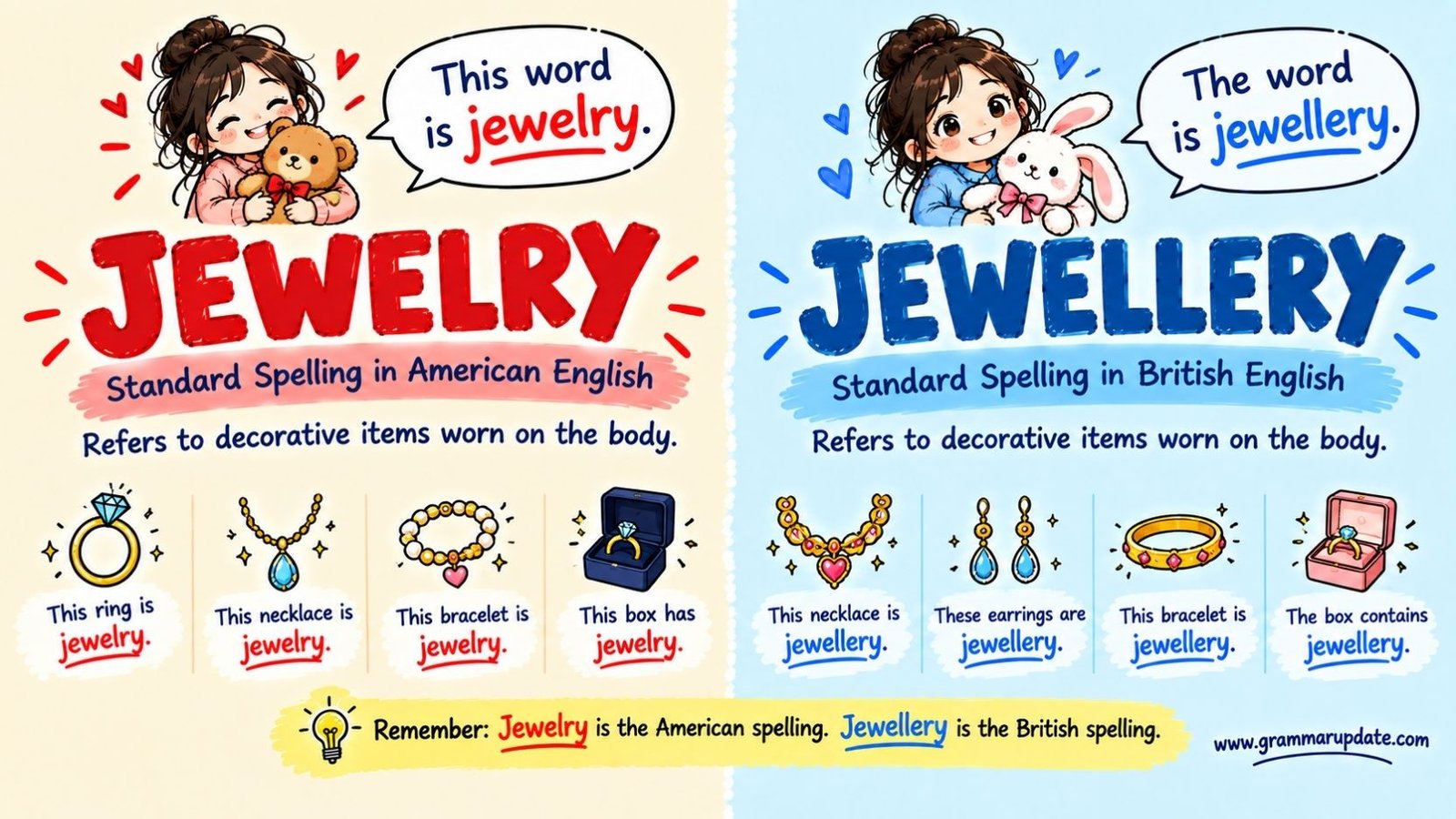
Both jewelry and jewellery are correct. The difference is not about right or wrong. It is about which country you are writing for. Jewelry is the standard spelling in American English, while jewellery is the standard spelling in British English.
This small spelling difference confuses a lot of people, especially online shoppers and writers who move between American and British sources. Understanding which form to use, and why the two forms exist, makes your writing look more polished and helps you match the expectations of your reader, whether that reader is in New York or London.
Jewelry or Jewellery: The Simple Answer
Here is the short version before we go deeper.
| Region | Correct spelling | Common examples |
| United States | jewelry | gold jewelry, jewelry box, jewelry store |
| Canada | jewelry (jewellery also used) | jewelry store, jewellery shop |
| United Kingdom | jewellery | gold jewellery, jewellery box, jewellery shop |
| Australia | jewellery | jewellery store, jewellery box |
| South Africa | jewellery | jewellery shop |
| India | jewellery (often written jewellery) | jewellery store, jewellery shop |
Neither word is a typo. Neither word is slang. They are two accepted spellings of the same word, shaped by two different traditions of English.
See More: Bearly Or Barely
What Does Jewelry or Jewellery Mean?
Jewelry, or jewellery, refers to decorative items worn on the body. This includes rings, necklaces, bracelets, earrings, bangles, brooches, and similar accessories.
The word usually points to items made from precious materials such as gold, silver, platinum, or gemstones. It can also describe costume pieces made from less expensive materials, as long as the purpose is decoration rather than function.
A simple way to remember the meaning: if you can wear it, and its main job is to look good rather than to serve a practical use, it is likely jewelry.
Jewelry Or Jewellery: The Spelling Difference Explained
The two spellings did not appear by accident. They reflect a broader pattern in English where American spelling often removes extra letters that British spelling keeps.
You can see the same pattern in other word pairs:
- Color (American) and colour (British)
- Center (American) and centre (British)
- Traveler (American) and traveller (British)
Jewelry follows this same simplification. American English dropped one of the letters found in the older British form, resulting in a shorter word. British English kept the fuller historical spelling.
Neither version is more “correct” in a global sense. Each is correct within its own regional standard.
Jewelry Or Jewellery: Which Is Correct In Grammar Terms?
Grammatically, jewelry and jewellery behave the same way. Both are:
- Nouns
- Uncountable (also called mass nouns)
- Used without a plural form in standard usage
Because jewelry is uncountable, you do not say “two jewelries.” Instead, you describe quantity using phrases such as:
- A piece of jewelry
- Several pieces of jewelry
- A collection of jewelry
✅ Correct: She owns a lot of jewelry.
❌ Incorrect: She owns a lot of jewelries.
✅ Correct: He bought two pieces of jewellery for the wedding.
❌ Incorrect: He bought two jewelleries for the wedding.
This rule applies the same way in both American and British English. The spelling changes, but the grammar does not.
Plural of Jewelry or Jewellery
Since jewelry and jewellery are uncountable nouns, they do not have a true plural form. If you need to refer to multiple individual items, use a counting phrase instead of trying to pluralize the word itself.
Examples:
- One earring is a piece of jewelry.
- A necklace, a ring, and a bracelet are three pieces of jewelry.
- The store sells many types of jewellery, including rings and pendants.
This is similar to how you would treat other uncountable nouns, such as furniture, luggage, or equipment.
See More: Heals Or Heels
How to Pronounce Jewelry and Jewellery
The pronunciation is almost identical between the two spellings, since the extra letter in jewellery does not change how most speakers say the word aloud.
- American pronunciation: JOO uhl ree
- British pronunciation: JOO uhl ree, sometimes JOO uh luh ree with a slightly softer middle sound
The stress falls on the first syllable in both versions. Listeners rarely notice a spoken difference between jewelry and jewellery, even though the written spelling clearly separates American and British usage.
Origin of Jewelry or Jewellery
The word traces back to the Old French term “jouel,” which referred to an ornament or a decorative object. This word entered Middle English and slowly evolved through several spellings before settling into the two modern forms.
Over time, English speakers in Britain kept a version closer to the original longer spelling. American English, influenced by simplification trends in the nineteenth century, adjusted the word to the shorter jewelry.
This pattern matches a wider historical shift. American English generally favored simpler, shorter spellings, partly influenced by reformers such as Noah Webster, who wanted American English to look distinct from British English.
Jewelry Or Jewellery In Different Countries
Spelling preference generally follows the type of English used in each country, rather than personal choice.
Jewelry or Jewellery in the United States
American English always uses jewelry. This applies to marketing, retail, packaging, and everyday writing across the United States.
Jewelry or Jewellery in the United Kingdom
British English always uses jewellery. This includes UK based retailers, UK news publications, and formal writing in Britain.
Jewelry or Jewellery in Canada
Canadian English sits between American and British spelling conventions. You will see both jewelry and jewellery used in Canada, though jewelry appears more frequently in everyday commercial use, partly due to strong American cultural and business influence.
Jewelry or Jewellery in Australia and South Africa
Australia and South Africa generally follow British spelling conventions, so jewellery is the expected form in both countries.
Jewelry or Jewellery in India
India largely follows British English spelling patterns due to historical ties, so jewellery is the more common written form, even though many local businesses use either spelling depending on their target audience.
Common Mistakes With Jewelry or Jewellery
A few small errors show up often, even among fluent English speakers.
Mistake 1: Mixing spellings in the same piece of writing
❌ Incorrect: We sell gold jewelry and silver jewellery.
✅ Correct: Choose one spelling and stay consistent throughout the entire piece.
Mistake 2: Treating jewelry as a countable noun
❌ Incorrect: I bought three jewelries yesterday.
✅ Correct: I bought three pieces of jewelry yesterday.
Mistake 3: Assuming one spelling is wrong
❌ Incorrect: Jewellery is a misspelling of jewelry.
✅ Correct: Jewellery is the standard British spelling, and jewelry is the standard American spelling. Both are accepted.
Mistake 4: Ignoring audience location in professional writing
If you are writing for a British audience but use only jewelry, your content may look slightly off to local readers, even though the word is understood everywhere.
Jewelry or Jewellery: Synonyms and Related Words
While jewelry and jewellery describe the general category, several related words describe specific items or styles.
| Word | Meaning | Typical usage |
| Ornament | A decorative item, often broader than jewelry | Used for home decor or the body |
| Accessory | A general term for items that complement an outfit | Includes jewelry, bags, and belts |
| Gem | A cut and polished precious stone | Used inside jewelry pieces |
| Trinket | A small, often inexpensive decorative item | Casual or informal jewelry |
| Bling | Informal slang for flashy jewelry | Used in casual conversation |
These words are related to jewelry but are not direct substitutes. Jewelry and jewellery remain the standard terms for describing wearable decorative items as a category.
See More: Mommies Or Mommy’s
Frequently Asked Questions
Is it jewelry or jewellery?
Both spellings are correct. Jewelry is used in American English, and jewellery is used in British English.
Which is correct, jewelry or jewellery, in Canada?
Canada uses both, though jewelry is more common in commercial and everyday writing due to American influence.
What is the plural of jewelry or jewellery?
Neither word has a true plural. Both are uncountable nouns, so you describe quantity using phrases like “pieces of jewelry.”
How do you pronounce jewelry or jewellery?
Both are pronounced the same way in most cases, with stress on the first syllable, roughly “JOO uhl ree.”
Is jewelry a noun or a verb?
Jewelry, and jewellery, are always nouns. Neither has a verb form.
Which spelling should I use on my website?
Use jewelry if your main audience is in the United States or Canada. Use jewellery if your main audience is in the United Kingdom, Australia, South Africa, or India.
Does jewelry include watches?
Watches are sometimes grouped with jewelry in retail contexts, but strictly speaking, jewelry refers to decorative items rather than functional timekeeping devices.
Why does British English keep the extra letter in jewellery?
British English generally preserved older, fuller spellings from historical French and Latin influenced vocabulary, while American English simplified many of these words in the nineteenth century.
Final Thoughts
Jewelry and jewellery mean exactly the same thing. The only real difference is regional spelling, shaped by the long standing split between American and British English. Once you know your audience, choosing the right form becomes simple: jewelry for American readers, jewellery for readers in the United Kingdom, Australia, South Africa, and much of India.
Consistency matters more than which spelling you pick. Whether you write jewelry or jewellery, keep the same form throughout your writing, match it to your target audience, and remember that both spellings are fully correct within their own regional standard.

Zunaira Qasim is the author and creator of Gramvixo, dedicated to making English grammar easier for learners and everyday writers. With 4 years of experience researching grammar, confusing words, word choices, and common language mistakes, they create clear and practical content that helps readers understand English and use it with confidence.
2 Comments