If you are typing a sentence and pause halfway through, unsure whether to write “mommies” or “mommy’s,” you are not alone. These two words sound almost identical, but they do very different jobs in a sentence. One shows that there is more than one mommy. The other shows that something belongs to a mommy.
Getting this right matters more than it seems. A single apostrophe can change the entire meaning of a sentence, turning a simple plural into a statement about ownership. This guide breaks down the difference in plain English, shows you exactly when to use each form, and walks through the common phrases that confuse people the most.
The Quick Answer
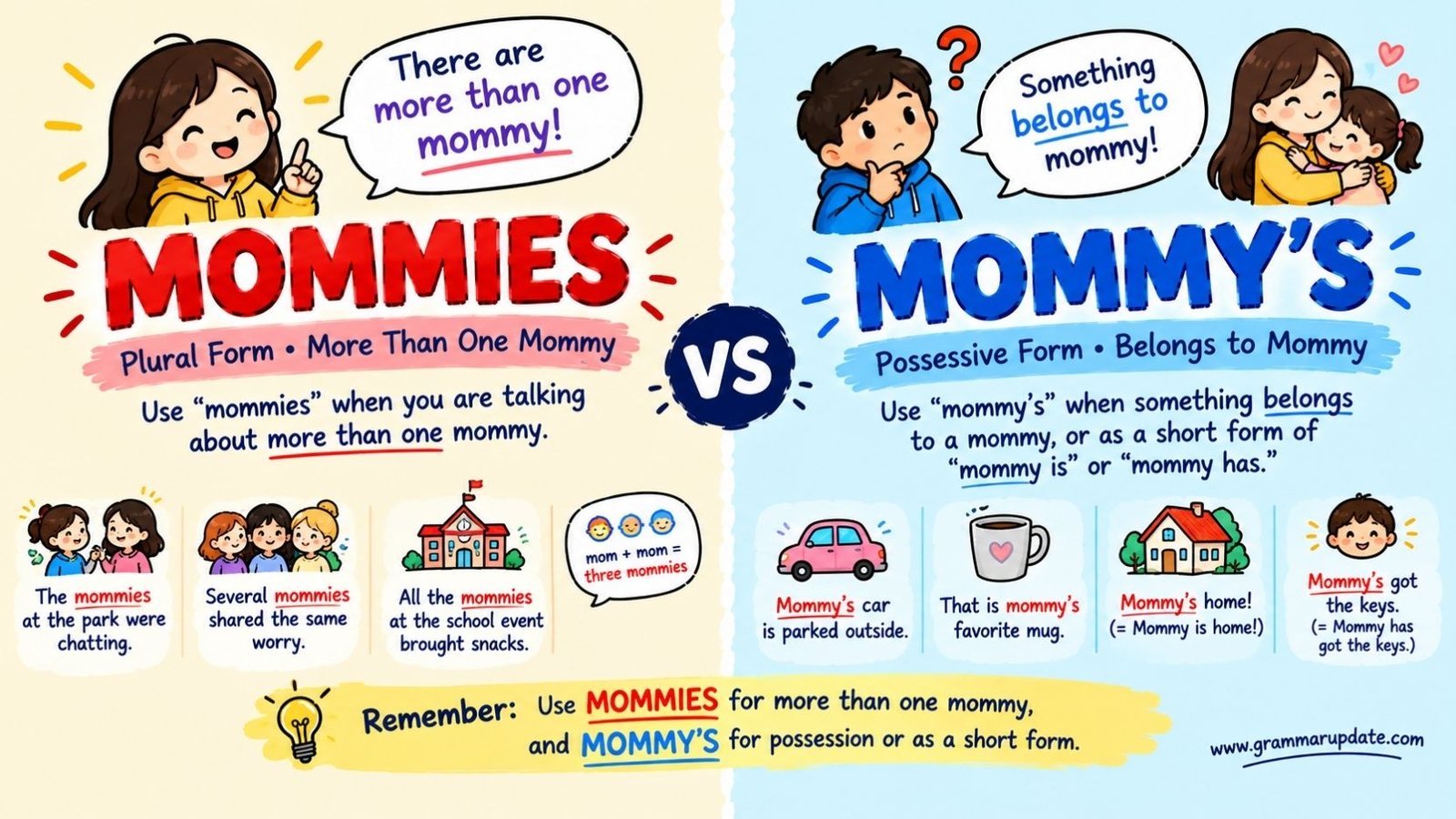
Mommies is the plural form of “mommy.” Use it when you are talking about more than one mommy. Mommy’s is the possessive form of “mommy.” Use it when something belongs to a mommy, or as a contraction of “mommy is” or “mommy has.”
Here is the difference side by side:
| Word | What It Shows | Example |
| Mommies | More than one mommy | Both mommies came to pick up their kids. |
| Mommy’s | Something belongs to mommy | Mommy’s car is parked outside. |
| Mommy’s | Short for “mommy is” or “mommy has” | Mommy’s coming home soon. |
See More: Realising Or Realizing
Mommies: The Plural Form
“Mommy” is a noun. Most English nouns become plural by adding an “s.” But “mommy” ends in a consonant plus “y,” and that changes the spelling rule.
When a noun ends in a consonant followed by “y,” you drop the “y” and add “ies” to make it plural. This is the same rule that turns “baby” into “babies” and “puppy” into “puppies.”
So the plural of “mommy” is spelled mommies, not “mommys” and not “mommy’s.”
Examples of Mommies in a Sentence
- The two mommies at the park were chatting while their kids played.
- Several mommies in the group chat shared the same worry.
- All the mommies at the school event brought snacks to share.
Notice that none of these sentences involve ownership. They are simply describing more than one person who is a mommy.
Mommy’s: The Possessive Form
An apostrophe followed by “s” usually signals possession in English. This is true for “mommy” as well. When you want to show that something belongs to a mommy, you write mommy’s.
Examples of Mommy’s Showing Possession
- Mommy’s phone is on the kitchen table.
- That is mommy’s favorite mug.
- Mommy’s shoes are by the front door.
In each case, the word right after “mommy’s” is a thing that belongs to mommy: a phone, a mug, shoes.
Mommy’s as a Contraction
“Mommy’s” also works as a shortened form of “mommy is” or “mommy has.” This is common in casual speech and children’s books.
- Mommy’s home! (Mommy is home!)
- Mommy’s got the keys. (Mommy has got the keys.)
- Mommy’s tired today. (Mommy is tired today.)
You can usually tell this apart from the possessive form because no object of ownership follows it. “Mommy’s home” does not mean “the home that belongs to mommy.” It means mommy has arrived.
Mommies’ With An Apostrophe After The S
There is a third form worth mentioning, even though it comes up less often: mommies’. This is the plural possessive. It shows that something belongs to more than one mommy.
- Both mommies’ names were on the sign-up sheet.
- The mommies’ group decided to meet every Friday.
The apostrophe goes after the “s” because “mommies” is already plural. You are not adding another “s”; you are just marking that the plural group owns something.
See More: Buisness Or Business
A Simple Way To Remember The Difference
Here is a quick mental test you can use whenever you are unsure:
- Ask yourself: does something belong to mommy, or am I talking about more than one mommy?
- If it is about ownership, or you can replace the word with “mommy is” or “mommy has,” use mommy’s.
- If you are simply counting more than one mommy, use mommies.
- If more than one mommy owns something together, use mommies’.
Common Mistakes To Avoid
Mixing up these forms is one of the most frequent small grammar errors people make, largely because “mommies” and “mommy’s” sound identical when spoken aloud.
❌ Incorrect: The mommy’s at the daycare all know each other.
✅ Correct: The mommies at the daycare all know each other.
Here, there is no ownership involved. The sentence just needs the plural form.
❌ Incorrect: Mommies car needs gas.
✅ Correct: Mommy’s car needs gas.
Here, the car belongs to mommy, so the possessive apostrophe is required.
❌ Incorrect: Both mommy’s showed up early.
✅ Correct: Both mommies showed up early.
The word “both” is a strong clue that you need a plural, not a possessive.
Related Phrases That Follow The Same Rule
The same logic applies to related words like “mommy’s boy” and “mommy’s girl,” both of which use the possessive form because the phrase describes a child who belongs to, or is closely attached to, mommy. You will sometimes see these written without the apostrophe, but the grammatically correct forms are mommy’s boy and mommy’s girl.
- He has always been a mommy’s boy, calling his mother every single day.
- Some people jokingly call themselves a mommy’s girl when they stay close to their mom into adulthood.
These are set phrases used to describe someone with a very close, sometimes dependent, relationship with their mother. The tone can be affectionate or slightly teasing depending on context.
Mommies As A Modifier In Modern Slang
Outside of strict family use, “mommies” has taken on informal, playful meanings in online culture, especially in gaming, anime fandoms, and social media communities. In these contexts, “mommies” is almost always the plural word, not the possessive, because it describes a category of people or characters rather than showing ownership.
- Goth mommies refers informally to women with a goth aesthetic who are seen as confident or nurturing figures within a fan community.
- Muscle mommies describes women with visibly strong, muscular builds, often used as an affectionate or admiring label in fitness and fandom spaces.
- Anime mommies and anime muscle mommies refer to fictional female anime characters who fans describe with the same nurturing or commanding qualities.
- Sugar mommies is slang for women who financially support a younger partner, mirroring the more widely known term “sugar daddy.”
These are informal, culturally specific uses rather than dictionary definitions, and they are always spelled as the plural “mommies,” since they describe a type or group rather than something owned by one person.
See More: Cringy Or Cringey
Frequently Asked Questions
Is it “mommy’s boy” or “mommies boy”?
The correct form is “mommy’s boy,” using the possessive apostrophe, because the phrase describes a boy closely attached to his mommy.
Is it “mommy’s girl” or “mommys girl”?
“Mommy’s girl” is correct. “Mommys” without an apostrophe is not a standard English word.
How do you spell the plural of mommy?
Drop the “y” and add “ies,” giving you “mommies.” This follows the standard English rule for nouns ending in a consonant plus “y.”
What does “mommy’s” mean if there is no object after it?
It is most likely a contraction of “mommy is” or “mommy has,” as in “Mommy’s on her way.”
Is “mommys” ever correct without an apostrophe?
No. “Mommys” is a common misspelling. The plural is “mommies,” and the possessive is “mommy’s.”
What is the plural possessive form?
“Mommies'” is used when something belongs to more than one mommy, with the apostrophe placed after the final “s.”
Final Thoughts
The difference between “mommies” and “mommy’s” comes down to one question: are you counting mommies, or are you showing that something belongs to mommy? “Mommies” is the plural form used for more than one mommy, while “mommy’s” shows possession or works as a short form of “mommy is” or “mommy has.”
Once you keep that one distinction in mind, the confusion clears up quickly. Whether you are writing about two mommies at a school event, describing mommy’s favorite chair, or using informal terms like muscle mommies or sugar mommies in casual conversation, the underlying grammar rule never changes. A quick mental check before you hit publish or send is usually all it takes to get it right every time.

Zunaira Qasim is the author and creator of Gramvixo, dedicated to making English grammar easier for learners and everyday writers. With 4 years of experience researching grammar, confusing words, word choices, and common language mistakes, they create clear and practical content that helps readers understand English and use it with confidence.