
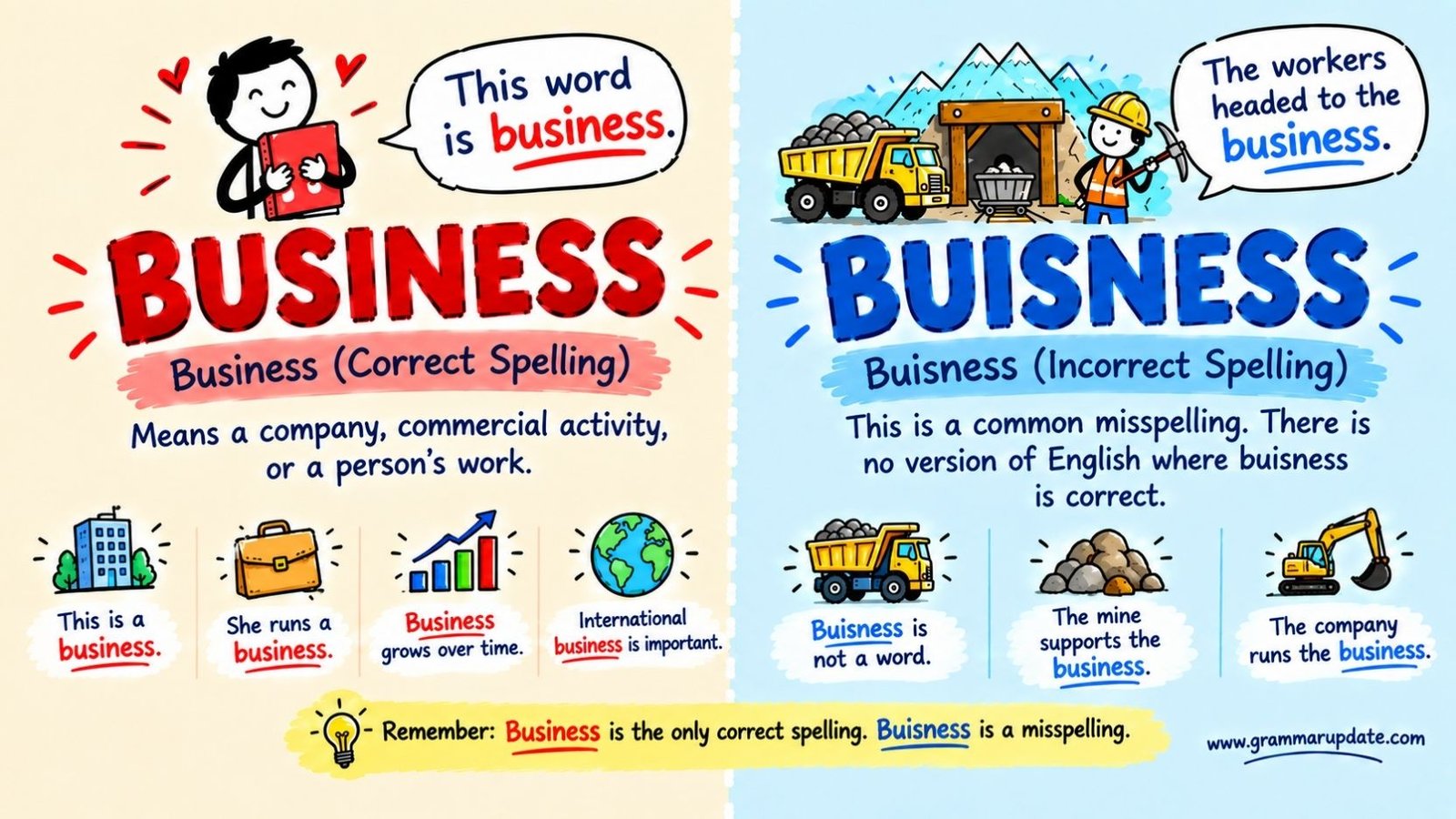
Business is the correct spelling. Buisness is a common misspelling that happens because the letters i and u get swapped by accident while typing or writing quickly. There is no version of English, formal or informal, American or British, where buisness is treated as correct. If you have typed buisness and then paused to double check it, you are not alone. It is one of the most frequently searched misspellings in the English language.
Understanding why this mistake happens can actually help you stop making it. The word business comes from an Old English root, and its spelling does not follow a simple phonetic pattern. That mismatch between how the word sounds and how it is spelled is exactly why so many people accidentally write buisness instead. Once you see the pattern behind the mistake, it becomes much easier to remember the correct order of letters for good.
Buisness or Business: The Simple Answer
Business is always the correct spelling in English. Buisness does not appear in any standard dictionary, whether British, American, Canadian, or Australian. If you search for buisness in a dictionary, most tools will automatically redirect you to business, since spell checkers recognize it as a typo rather than an alternate spelling.
There is only one accepted spelling of this word across all English speaking countries. Unlike words such as color and colour, which genuinely differ between American and British English, business does not have regional variants. The spelling stays the same everywhere the word is used.
See More: Cringy Or Cringey
Why People Write Buisness Instead Of Business
The mistake usually comes down to one simple habit: swapping the order of i and u. Business is pronounced roughly as “BIZ nis,” and that pronunciation does not clearly signal which vowel comes first in the spelling. Because English spelling often does not match pronunciation exactly, the brain sometimes defaults to whichever order feels more natural while typing fast.
A few common reasons this typo happens so often:
- The word is used constantly in emails, documents, and casual writing, which increases the chance of a quick typing slip
- Autocorrect on some devices does not always catch it if a similar looking word exists nearby
- Many people learn the word by ear before they learn to spell it, so the visual order of letters is not fully locked in
- The “ui” combination is less common in English than “iu” appearing in reverse, which can confuse muscle memory
Recognizing that this is a spelling error rather than a legitimate alternative is the first step to fixing it permanently.
Business: Meaning and Part of Speech
Business is a noun. It refers to several closely related ideas, and the correct meaning usually depends on context.
Meaning 1: An organization that sells goods or services. A business is a company, shop, or organization that produces or sells products or services to earn money. Example: She started a small business selling handmade candles.
Meaning 2: Commercial activity in general. Business can also refer to buying, selling, and trading as a broad concept. Example: International business has grown rapidly over the last decade.
Meaning 3: A person’s occupation or work. Business sometimes refers to someone’s professional duties or the reason they are somewhere. Example: I am here on business, not on vacation.
Meaning 4: A personal matter or concern. In everyday conversation, business can mean something that is someone’s personal affair. Example: What I do in my free time is my own business.
Each of these meanings is common, and native speakers move between them naturally depending on the sentence.
How To Pronounce Business
Business is pronounced BIZ nis, with the stress on the first syllable. In the International Phonetic Alphabet, it is written as /ˈbɪznɪs/. Notice that the pronunciation does not include a clear “oo” or “you” sound for the letters u and i, which is part of why the spelling trips people up.
The pronunciation gives very few clues about the correct letter order, so it has to be memorized visually rather than sounded out.
Origin Of The Word Business
Business comes from the Old English word “bisignis,” which combined “bisig,” meaning busy, with a suffix indicating a state or condition. In its earliest use, business simply meant a state of being occupied or busy with something. Over several centuries, the meaning narrowed and shifted toward commercial activity, occupation, and trade, which is the meaning most commonly used today.
This history explains the connection between the words busy and business. They share the same root, even though modern spelling has pulled them apart. Knowing this link can also help with memory: business is, at its core, related to being busy.
Common Mistakes With Business
| Incorrect | Correct | Why |
| Buisness | Business | The i and u are reversed by mistake |
| Buisiness | Business | An extra i is added along with the reversed letters |
| Bussiness | Business | An extra s is added, often from mixing it up with words like “possess” |
| Busines | Business | The second s is dropped |
💡 Tip: A simple memory trick is to remember that business contains the word “bus,” followed by “i,” then “ness.” Thinking of it as bus, plus i, plus ness can help lock in the correct order.
✅ Correct: The business opened a new office downtown.
❌ Incorrect: The buisness opened a new office downtown.
See More: Plushy Or Plushie
Business In Different Contexts
The word business shows up constantly in everyday English, and its exact meaning shifts slightly depending on the setting.
- Business casual: This refers to a dress code that is more relaxed than a full suit but still professional. It typically includes items like collared shirts, blouses, dress pants, and skirts, without requiring a full suit or tie.
- Business card: A small printed card containing a person’s name, job title, company, and contact information, typically exchanged during professional meetings or networking events.
- Business plan: A written document that outlines a company’s goals, strategy, target market, and financial projections. It is often used to guide a new company or to seek funding from investors.
- Business cycle: An economic term describing the natural rise and fall of economic activity over time, including periods of growth, peak, decline, and recovery.
- Small business: A privately owned company that is generally smaller in size, revenue, or number of employees compared to large corporations. Definitions of “small” vary by country and industry.
- Business to business: Often shortened to B2B, this describes commercial transactions between two companies rather than between a company and an individual consumer.
Business As A Noun: Singular And Plural Forms
Business can be both countable and uncountable, depending on the meaning.
| Form | Example | Meaning |
| Business (uncountable) | She works in business. | Commercial activity in general |
| A business (countable, singular) | He owns a business. | One specific company |
| Businesses (countable, plural) | Several businesses closed last year. | Multiple companies |
Note that the plural form is businesses, not buisnesses. The same correct letter order applies no matter how the word is used in a sentence.
Synonyms and Related Words
| Word | Meaning | Difference From Business |
| Company | An organization formed to conduct commercial activity | More formal and often implies legal structure |
| Enterprise | A business or company, often one involving risk or ambition | Suggests initiative or a bold undertaking |
| Firm | A business, especially one offering professional services | Common in legal, financial, or consulting contexts |
| Corporation | A large legal business entity, often publicly traded | Refers to a specific legal structure, not business in general |
| Trade | The activity of buying and selling goods | Focuses specifically on exchange, not the organization itself |
These words overlap with business but are not always interchangeable. Choosing the right one depends on tone and context.
Buisness Or Business In American And British English
There is no difference between American and British English when it comes to this word. Business is spelled the same way in both varieties.
This sets it apart from many other words that do split along regional lines, such as color versus colour or organize versus organise. No matter which English speaking country you are writing for, business remains the only correct spelling.
Examples Of Business Used Correctly
- My business has grown steadily over the past three years.
- She is studying business at university.
- It is not really any of your business.
- They discussed the new business proposal during the meeting.
- Small businesses often struggle with cash flow in their first year.
Each of these examples uses the word naturally, in the sense that fits the sentence.
See More: Heals Or Heels
Frequently Asked Questions
Is it buisness or business?
Business is the only correct spelling. Buisness is a common misspelling.
What does business mean?
Business generally refers to a company that sells goods or services, or to commercial activity in general. It can also mean a person’s occupation or a personal matter.
Is business a noun or a verb?
Business is a noun. There is no verb form of business itself, though related words like “conduct” or “run” are often used alongside it, as in “run a business.”
How do you pronounce business?
Business is pronounced BIZ nis, with stress on the first syllable.
What is the plural of business?
The plural of business is businesses.
Why do people misspell business as buisness?
The mistake usually happens because the letters i and u get reversed, often due to fast typing or the way the word sounds compared to how it is spelled.
Is buisness ever correct in British English?
No. Business is spelled the same way in British English, American English, and all other varieties of English.
What is the difference between business and buisness?
There is no real difference in meaning, because buisness is not a real word. It is simply a misspelling of business.
Does the word business come from the word busy?
Yes. Business comes from an Old English word related to being busy or occupied, and the two words share the same root.
Conclusion
Business is the correct spelling, and buisness is a misspelling caused by reversing the letters i and u. This mix up is extremely common because the pronunciation of the word does not clearly show the correct letter order, which makes it easy to type the wrong way without noticing. Understanding the word’s origin, its connection to the word busy, and a few simple memory tricks can make it much easier to spell correctly every time.
Whether you are writing a business plan, a business card, or a casual email, getting the spelling right helps your writing look polished and professional. The next time you find yourself unsure, remember that business always uses the order bus, i, ness, and buisness is never the correct choice in any form of English.

Zunaira Qasim is the author and creator of Gramvixo, dedicated to making English grammar easier for learners and everyday writers. With 4 years of experience researching grammar, confusing words, word choices, and common language mistakes, they create clear and practical content that helps readers understand English and use it with confidence.
2 Comments