
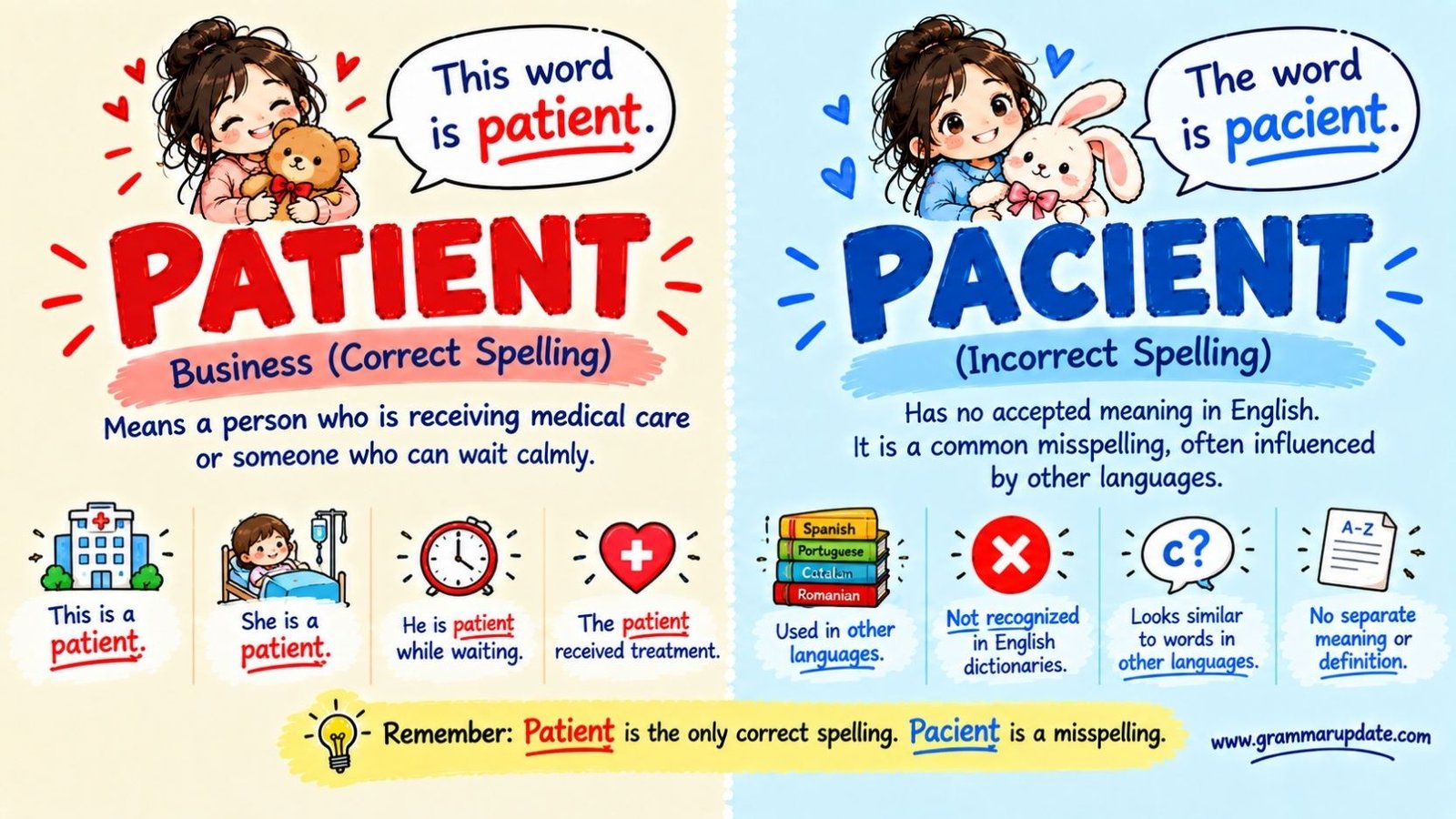
The correct spelling is patient, not pacient. Patient is the only form recognized in standard English dictionaries, whether you mean someone receiving medical care or the quality of staying calm while waiting. Pacient is simply a common misspelling, often shaped by how the word sounds or how similar words appear in other languages.
This mix up happens more often than people expect. Many languages spell this word with a “c” instead of a “t”, so English speakers who are multilingual, or who type quickly, sometimes carry that spelling over. Understanding why patient is correct, and why pacient keeps showing up anyway, makes it much easier to remember going forward.
Patient Meaning
Patient works as two different parts of speech in English, and the meaning changes depending on which one is being used.
As a noun: a patient is a person who is receiving medical care or treatment from a doctor, nurse, dentist, or other healthcare provider. For example: The patient arrived early for her appointment.
As an adjective: patient describes someone who can wait calmly, without getting frustrated or rushing things. For example: He stayed patient even though the line barely moved.
Both meanings come from the same root, but they are used in noticeably different situations, so it helps to keep them separate in your mind.
See More: Stoping Or Stopping
Pacient Meaning
Pacient has no accepted meaning in English. It is not listed in any major English dictionary, and it does not represent a separate word with its own definition. It is simply an incorrect spelling of patient.
That said, pacient is not a made up sequence of letters. It closely resembles the word for “patient” in several other languages, including Spanish, Portuguese, Catalan, and Romanian, all of which use a “c” in that position. This is the main reason the spelling shows up so often, even among fluent English writers.
Patient or Pacient: Quick Comparison
| Spelling | Correct in English? | Notes |
| Patient | Yes | Standard spelling for both the noun and the adjective |
| Pacient | No | Common misspelling, often influenced by other languages |
Why People Confuse Patient And Pacient
A few clear reasons explain why this mix up is so common.
- Several Romance languages spell the equivalent word with a “c”, so bilingual speakers sometimes transfer that spelling into English.
- The “t” in patient can sound close to a soft “c” sound when spoken quickly, especially in casual speech.
- Autocorrect does not always catch the error immediately, since pacient looks close enough to a real word.
- Many learners memorize the word by sound rather than by spelling, which makes the substitution easy to miss.
None of these reasons make pacient acceptable in written English. They simply explain why the mistake happens so frequently.
How To Pronounce Patient
Patient is pronounced PAY shunt, with the stress on the first syllable. The middle “t” combines with the following vowel sound to create a “sh” sound, which is why the word does not sound like it is spelled letter by letter.
💡 Tip: If you can remember that patient rhymes with the ending of words like “ancient”, the spelling becomes much easier to recall, since both end in the same “tient” pattern rather than a “cient” pattern.
Origin Of The Word Patient
Patient comes from the Latin word patiens, meaning “suffering” or “enduring”, which itself comes from the verb pati, meaning “to suffer” or “to bear”. This root explains both meanings of the modern English word.
The medical sense developed because someone under treatment was traditionally seen as a person enduring illness or discomfort while waiting for care. The personality sense developed from the same idea of enduring something difficult, in this case waiting or hardship, without losing composure.
English absorbed the word through Old French, which kept the Latin spelling pattern with a “t” rather than shifting to a “c”, unlike some of the other Romance languages that developed differently over time.
Patient In Different Contexts
The word patient shows up across several everyday situations, and the meaning shifts slightly depending on context.
- In healthcare: A patient is anyone receiving medical attention, whether in a hospital, clinic, dental office, or therapy session. This is the most common noun use of the word.
- In everyday conversation: Patient usually describes a person’s temperament. Someone who does not rush, complain, or lose their temper while waiting is described as patient.
- In business and customer service: Patient often describes how staff should treat customers, especially during delays or complaints, since staying calm improves the overall experience.
- In relationships: Being patient with another person means giving them time, space, or understanding rather than reacting with frustration.
Patient Grammar
Patient can function as a noun or an adjective, and each form follows its own grammar pattern.
Patient as a Noun
| Form | Example |
| Singular | The patient waited quietly. |
| Plural | The patients waited quietly. |
| Possessive | The patient’s chart was updated. |
The plural of patient is patients, formed with a simple “s”. The possessive form, patient’s, refers to something belonging to one patient, while patients’ refers to something belonging to more than one patient.
Patient As An Adjective
As an adjective, patient does not change form for number or gender. It stays the same whether describing one person or several.
Examples:
- She is very patient with new employees.
- They remained patient throughout the long delay.
See More: Jewelry Or Jewellery
Patient Vs Patience
Patient and patience are related but not interchangeable.
Patient is a noun or adjective, describing a person or a quality that person has.
Patience is a noun that names the quality itself, similar to words like kindness or honesty.
Correct: She showed great patience while training the new team.
Incorrect: She showed great patient while training the new team.
Correct: He is a patient teacher.
Incorrect: He is a patience teacher.
A simple way to check which word fits is to ask whether you are describing a person or naming a quality. If it is a person, use patient. If it is the quality itself, use patience.
Common Mistakes With Patient and Pacient
❌ Incorrect: The pacient was waiting in the lobby.
✅ Correct: The patient was waiting in the lobby.
❌ Incorrect: Please be pacient with the process.
✅ Correct: Please be patient with the process.
❌ Incorrect: She has a lot of patient.
✅ Correct: She has a lot of patience.
The correct form always uses patient with a “t”, and the word patience should be used instead of patient whenever you are naming the quality rather than describing a person.
Synonyms And Related Words
Depending on which meaning of patient is intended, different synonyms apply.
| Meaning | Related Words | Difference |
| Person receiving care | Case, individual, client | Case is more clinical, client is used in some therapy or private care settings |
| Calm and tolerant | Tolerant, calm, composed | Tolerant emphasizes accepting difficulty, composed emphasizes emotional control |
None of these words are exact replacements, but they can be useful alternatives depending on tone and context.
Examples Of Patient In A Sentence
Noun use:
- The nurse checked on the patient every hour.
- Every patient in the waiting room had an appointment card.
Adjective use:
- Try to stay patient while the software updates.
- He answered every question in a calm, patient tone.
Two examples for each use are enough to show the pattern clearly, since the grammar does not change much beyond these basic structures.
Popular Phrases Using Patient
Several well known expressions use the word patient, and understanding them can add helpful context.
“ Love is patient, love is kind” is a widely recognized phrase from a passage often quoted at weddings and in discussions about relationships. Here, patient describes a quality of enduring calmness and tolerance within love.
Be patient is common advice meaning “wait calmly” or “do not rush the outcome.”
Patient first is a phrase often used in healthcare settings to describe an approach that prioritizes the needs of the person receiving care above administrative or procedural concerns.
See More: Mommies Or Mommy’s
Frequently Asked Questions
Is patient or pacient the correct spelling?
Patient is correct. Pacient is a common misspelling with no accepted meaning in English.
What does patient mean?
Patient can mean a person receiving medical care, or it can describe someone who stays calm while waiting or dealing with difficulty.
Is patient a noun or an adjective?
Patient can be both, depending on the sentence. As a noun, it refers to a person under medical care. As an adjective, it describes a calm temperament.
What is the plural of patient?
The plural is patients, formed by adding an “s”.
Is patient and patience the same word?
No. Patient describes a person or quality, while patience is the noun that names the quality of being patient.
How do you pronounce patient?
Patient is pronounced PAY shunt, with stress on the first syllable.
Where does the word patient come from?
Patient comes from the Latin word patiens, meaning “suffering” or “enduring”, through Old French into English.
Why do people spell it pacient?
Because several other languages spell the equivalent word with a “c”, and that spelling sometimes carries over into English by habit or influence.
Is pacient used in any language?
Yes, in languages such as Spanish, Portuguese, Catalan, and Romanian, though the spelling and pronunciation differ from the English word patient.
What is the correct way to say someone is being patient?
You can say “She is being patient” or “She is showing patience”, depending on whether you want to describe her directly or name the quality she is showing.
Final Thoughts
Patient is the correct spelling in English, whether you are talking about someone receiving medical treatment or describing a calm, tolerant attitude. Pacient is not a recognized English word, even though it looks reasonable because of how similar words are spelled in other languages.
Once you remember that patient shares its root with words like patience, and that the “tient” ending stays consistent across related words, the correct spelling becomes much easier to recall without hesitation.

Zunaira Qasim is the author and creator of Gramvixo, dedicated to making English grammar easier for learners and everyday writers. With 4 years of experience researching grammar, confusing words, word choices, and common language mistakes, they create clear and practical content that helps readers understand English and use it with confidence.

One Comment