
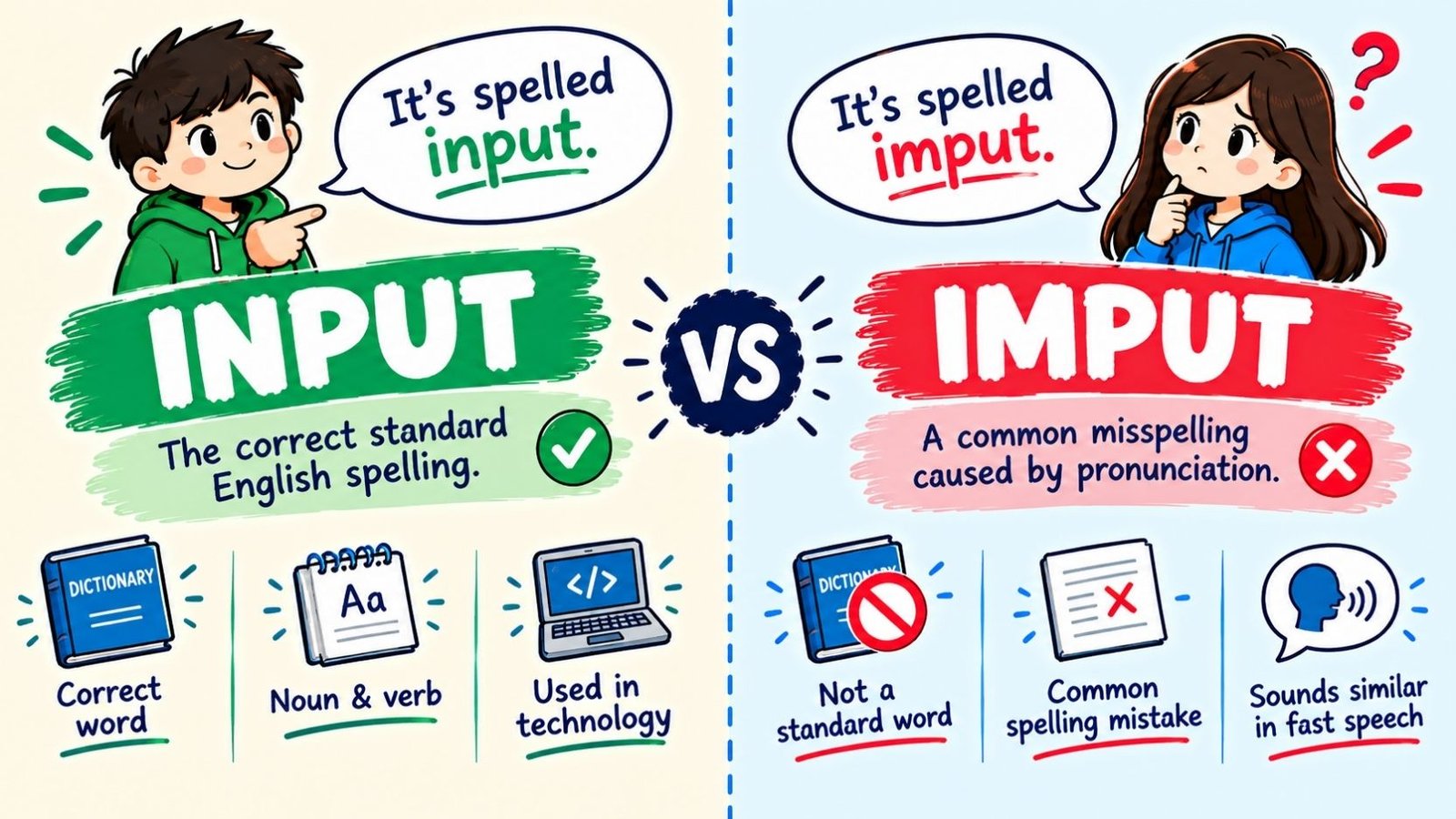
If you have ever paused mid sentence wondering whether to type input or imput, you are not alone. Many people hear this word spoken quickly and assume there is an “m” hiding in the middle. This short guide settles the question clearly and explains why the confusion happens in the first place.
The correct word is input. Imput is not a recognized English word, and you will not find it in any major dictionary. Input is a noun and a verb, and it is used constantly in technology, business, education, and everyday conversation. Understanding why imput feels so natural to say will help you avoid the mistake for good.
Input or Imput: The Simple Answer
Input is correct. Imput is incorrect.
There is no dictionary, style guide, or grammar authority that lists imput as an accepted spelling or alternative form. It does not appear in Merriam Webster, Cambridge, Oxford, or Collins. Whenever you see imput in writing, it is either a typo or a mishearing of the real word.
Here is the quick breakdown:
| Form | Status | Notes |
| Input | Correct | Standard English word, noun and verb |
| Imput | Incorrect | Not a recognized word in any major dictionary |
If you remember nothing else from this article, remember this: input, not imput.
See More: Chrysalis Vs Cocoon
Why Do So Many People Write Imput?
The mistake is extremely common, and there is a clear reason for it. It comes down to how the word sounds when spoken casually.
When people say input out loud, especially in fast or casual speech, the “n” sound before the “p” can shift slightly. In natural speech, an “n” sound followed by a “p” or “b” often blends toward an “m” sound. This is a normal feature of spoken English, not a mistake in speaking. The problem happens when someone tries to spell the word based purely on how it sounded rather than how it is actually written.
This same pattern shows up in other words too. Think about how people sometimes hear “impossible” correctly because it is genuinely spelled with an “m,” but then mistakenly assume input follows the same pattern. It does not. Input keeps its “n” in the spelling even though the pronunciation can sound slightly blended.
Another factor is simple visual similarity. Input and imput look almost identical at a glance, especially when reading quickly or typing on a small keyboard. A single letter swap is an easy typo to make and an easy one to miss during proofreading.
Input Meaning
Input has two main uses in English: as a noun and as a verb. Both meanings are common, and understanding the difference will help you use the word correctly in any sentence.
Input As A Noun
As a noun, input refers to something that is put into a system, process, or discussion. It can be information, energy, data, opinions, or physical material.
Simple examples:
- We need your input before finalizing the report.
- The machine requires a steady input of electricity.
- Sensory input helps the brain understand the environment.
In each case, input refers to something being contributed or fed into something else.
Input As A Verb
As a verb, input means to enter or feed information into a system, usually a computer, database, or program.
Simple examples:
- Please input your details into the form.
- The technician will input the new codes tomorrow.
- She inputted the sales figures into the spreadsheet.
Notice the past tense form: inputted. Some style guides also accept input as its own past tense (as in “she input the data yesterday”), but inputted is widely used and generally considered correct in everyday and technical writing.
Input In Different Contexts
The word input shows up across many fields, and its exact meaning shifts slightly depending on the setting. Here is how it works in a few common contexts.
Input in Technology
In computing, input refers to any data or signal a system receives before processing it. A keyboard, mouse, microphone, and touchscreen are all input devices. When a user types a command or clicks a button, that action becomes input for the software to process.
For example, in programming languages like Python, input() is an actual built-in function. It pauses the program and waits for the user to type something, then uses that response as data. This is a very literal, technical use of the word, separate from its more general everyday meaning.
Input and Output
Input and output are almost always discussed together, especially in technology and systems thinking. Input is what goes into a system. Output is what comes out after the system processes it.
| Term | Meaning | Example |
| Input | Information or material entering a system | Typing a search query |
| Output | Result produced after processing | The search results shown on screen |
This input and output relationship applies to computers, but also to simpler systems like a conversation, a recipe, or a business process. You put something in, and something comes out based on it.
See More: Hassle Or Hastle
Input Devices
An input device is any hardware tool used to send data into a computer or electronic system. Common input devices include:
- Keyboard
- Mouse
- Microphone
- Touchscreen
- Scanner
- Webcam
Each of these tools allows a user to send information into a system so it can be processed or stored.
Sensory Input And Proprioceptive Input
Outside of technology, input also appears in psychology, biology, and health related fields.
Sensory input refers to information the brain receives through the senses, such as sight, sound, touch, taste, and smell. The brain constantly processes sensory input to understand and respond to the surrounding environment.
Proprioceptive input is a more specific type of sensory input. It refers to the information the body receives about its own position, movement, and balance, mainly through muscles, joints, and the inner ear. This kind of input helps a person walk, sit upright, or catch a ball without needing to consciously think about every movement.
Both terms use input in the same core sense: something being received and processed, this time by the nervous system rather than a machine.
Input In Business And Everyday Conversation
In everyday and professional settings, input often means an opinion, suggestion, or contribution to a discussion or decision.
Examples:
- Thank you for your input during the meeting.
- We value employee input when planning changes.
- I would appreciate your input on this proposal.
Here, input is not data in a technical sense. It is a person’s ideas or feedback being added into a larger conversation or decision-making process.
Input Is A Grammar Term
Input is a countable and uncountable noun depending on context.
Used as an uncountable noun, it refers to a general contribution:
- We need more input before deciding.
Used as a countable noun, it can refer to specific pieces of information or signals, especially in technical writing:
- The system has three separate inputs.
As a verb, input follows this basic pattern:
| Tense | Form | Example |
| Present | input | I input the data daily. |
| Past | input or inputted | She input the numbers yesterday. |
| Past Participle | input or inputted | The data has been inputted correctly. |
| Present Participle | inputting | He is inputting the results now. |
Both input and inputted are used for the past tense, though inputted is more common in general and technical writing, while input as its own past form appears more often in strict technical or engineering contexts.
How To Pronounce Input
Input is pronounced as two syllables: IN put.
The stress falls on the first syllable. In IPA, it is written as ˈɪn.pʊt.
Saying the word slowly and clearly, syllable by syllable, is the easiest way to avoid slipping into the imput mispronunciation. Try saying “in” and “put” as two separate, deliberate parts, then blend them together naturally.
Is Imput a Word?
No. Imput is not a word in standard English.
It does not appear in any major dictionary, it has no accepted grammatical function, and no style guide recognizes it as a variant spelling of input. If you search for imput in a dictionary, you will either get no results or be redirected to input as the intended word.
Imput is best understood as a common misspelling driven by pronunciation, not as an alternate or informal version of a real word. Unlike some informal spellings that eventually gain acceptance through wide use, imput has not been adopted by dictionaries or formal writing standards.
Common Mistakes With Input and Imput
Here are a few frequent errors people make, along with the correct version.
❌ Incorrect: I need your imput on this decision.
✅ Correct: I need your input on this decision.
❌ Incorrect: Please imput your password below.
✅ Correct: Please input your password below.
❌ Incorrect: The imput devices are not working.
✅ Correct: The input devices are not working.
❌ Incorrect: Sensory imput affects behavior.
✅ Correct: Sensory input affects behavior.
💡 Tip: If you are ever unsure while typing, say the word slowly in your head as “in put” rather than relying on how it sounds when spoken quickly. This small habit prevents the mistake almost every time.
Input Synonyms
Depending on context, several words can work as synonyms for input.
| Context | Possible Synonym | Notes |
| General contribution | Feedback | Common in workplace or discussion settings |
| General contribution | Opinion | Works when referring to personal views |
| Technical or data related | Data | Broader term, not always interchangeable |
| Technical or data related | Entry | Used in database or form related contexts |
These words are not always perfect substitutes. Input often implies something contributed toward a process or system, while feedback and opinion are more personal and conversational. Choosing the right synonym depends on whether you are discussing a technical process or a human contribution to a conversation.
See More: Any Problem Or Any Problems
Input Or Imput: Quick Reference Table
| Question | Answer |
| Which spelling is correct? | Input |
| Is imput a real word? | No |
| Is input a noun or verb? | Both |
| Past tense of input | Input or inputted |
| Pronunciation | IN put |
| Common cause of the mistake | Blended pronunciation and typing errors |
Frequently Asked Questions
Is it input or imput?
It is input. Imput is not a standard English word and does not appear in dictionaries.
What does input mean?
Input means something entered or contributed into a system, process, or discussion. It can refer to data, information, opinions, or physical material depending on context.
Is imput a word?
No. Imput is a common misspelling of input, likely caused by how the word sounds in fast speech.
What is the difference between input and imput?
Input is the correct, dictionary recognized spelling. Imput has no accepted meaning and is simply an error.
How do you pronounce input?
Input is pronounced as two syllables, IN put, with stress on the first syllable.
Is input a noun or a verb?
Input works as both. As a noun, it refers to something contributed or entered. As a verb, it means to enter or feed information into a system.
What is the past tense of input?
Both input and inputted are used as past tense forms, though inputted is more common in general writing.
What are input devices?
Input devices are hardware tools that send data into a computer, such as a keyboard, mouse, microphone, or touchscreen.
What is sensory input?
Sensory input refers to information the brain receives through the senses, such as sight, sound, and touch, which the brain then processes to understand the environment.
Why do people confuse input and imput?
The confusion usually comes from pronunciation. In fast speech, the “n” sound before “p” can blend toward an “m” sound, leading some people to spell the word the way it sounds rather than the way it is actually written.
Final Thoughts
Input is the only correct spelling, whether you are talking about typing information into a computer, offering an opinion in a meeting, or describing how the brain processes sensory signals. Imput may sound natural when spoken quickly, but it has no real place in written English and will not appear in any dictionary or accepted style guide.
The easiest way to avoid the mistake is to slow down and picture the word as two clear parts: in and put. Once that image sticks, choosing between input or imput stops being a guessing game and becomes second nature.

Zunaira Qasim is the author and creator of Gramvixo, dedicated to making English grammar easier for learners and everyday writers. With 4 years of experience researching grammar, confusing words, word choices, and common language mistakes, they create clear and practical content that helps readers understand English and use it with confidence.



3 Comments