
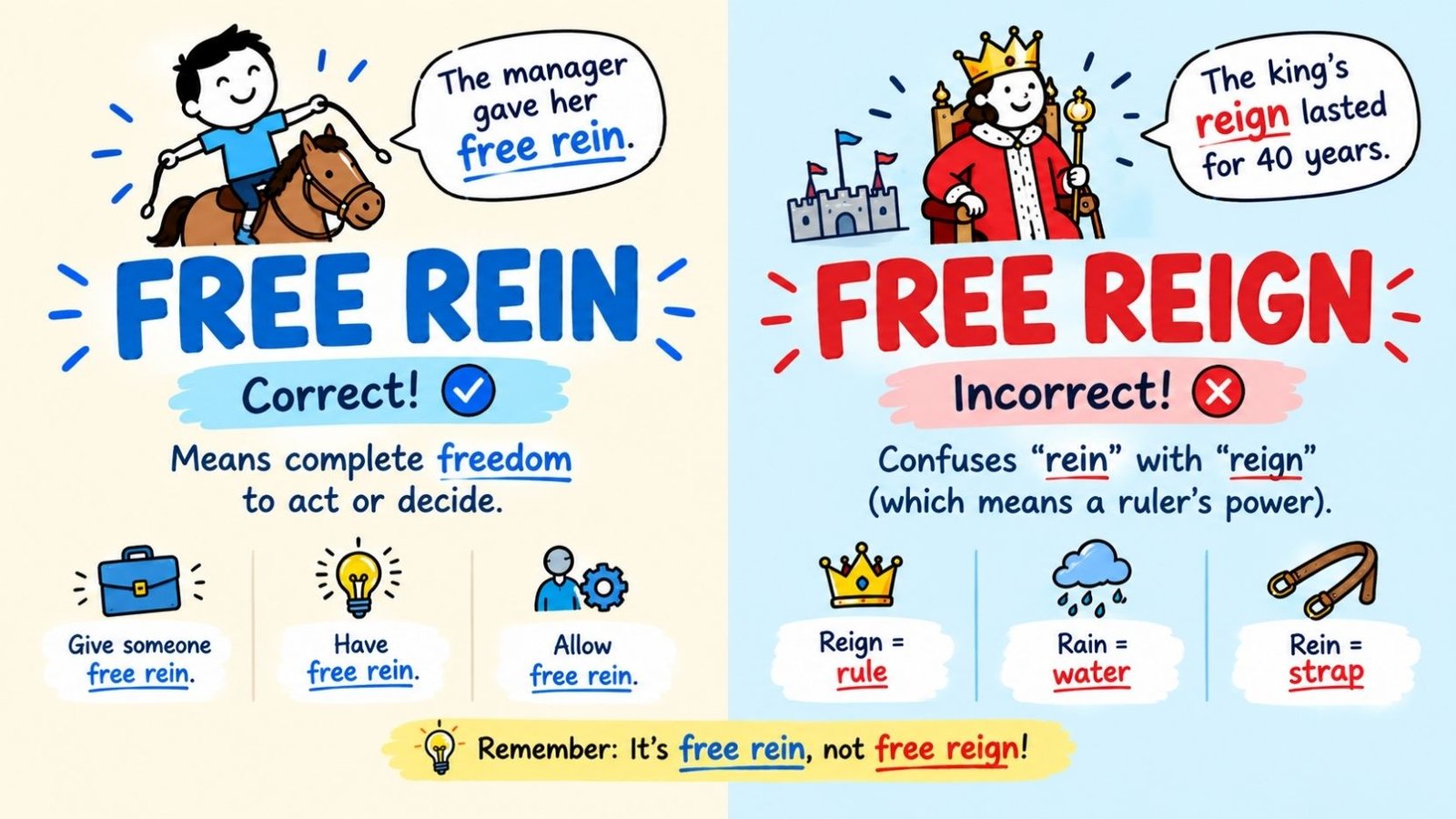
If someone gave you complete freedom to make your own choices, would you say they gave you “free rein” or “free reign”? Most people hear the phrase spoken out loud and never see it written down, which is exactly why this mix up happens so often. The short answer: the correct expression is free rein, not free reign.
“Free rein” comes from horseback riding. It refers to loosening a horse’s reins so the animal can move freely, without guidance or restriction. Over time, English speakers borrowed this image to describe giving a person full freedom to act, decide, or create without interference. “Free reign” looks like it should work too, since “reign” is about a ruler’s power, but that is not where this particular phrase comes from.
Free Rein Or Free Reign: The Quick Answer
| Phrase | Correct? | Why |
| Free rein | Yes | Refers to loosening a horse’s reins, meaning full freedom of action |
| Free reign | No, common error | Confuses “rein” with “reign,” which means the period a monarch rules |
| Free range | No, unrelated | A separate phrase describing animals raised without cages, not freedom of action |
💡 Quick tip: If you can picture a rider loosening the leather straps on a horse, you are picturing the correct phrase. Rein is the strap. Reign is a monarch’s rule. They sound identical but mean completely different things.
See More: Input Or Imput
What Does Free Rein Mean?
Free rein means complete freedom to act, decide, or behave as one chooses, without restriction or supervision. It usually describes a situation where someone in authority steps back and allows another person full control over how a task gets done.
Meaning 1: Freedom of action or decision
This is the most common modern use. A manager who gives an employee free rein trusts that employee to make decisions without needing constant approval.
Meaning 2: Literal horse riding sense
In its original, literal use, giving a horse free rein meant loosening the reins so the animal could move at its own pace and in its own direction, rather than being steered or held back by the rider.
Example sentence: “The director gave the young writer free rein over the script, and the final story reflected her own voice from start to finish.”
Free Rein Or Free Reign: Why The Confusion Happens
English has three words that sound exactly the same but mean very different things: rein, reign, and rain. Linguists call these homophones, which are words that sound alike but differ in spelling and meaning. Because people hear the phrase spoken far more often than they read it, it is easy to guess the wrong spelling based on sound alone.
Here is where each word actually comes from and what it means on its own.
| Word | Part of Speech | Meaning | Example |
| Rein | Noun or verb | A leather strap used to control a horse; also used to mean control in general | She pulled the reins to slow the horse |
| Reign | Noun or verb | The period during which a monarch or ruler holds power | The queen’s reign lasted over sixty years |
| Rain | Noun or verb | Water falling from clouds | It began to rain heavily in the afternoon |
Because “reign” is about power and rule, it feels like a natural fit for a phrase about freedom and control. That is the exact trap. The phrase is not about a ruler’s authority at all. It is about loosening a literal strap so an animal, or by extension a person, can move without restriction.
Correct vs Incorrect: Free Rein Examples
✅ Correct: She gave her team free rein to redesign the office layout.
❌ Incorrect: She gave her team free reign to redesign the office layout.
✅ Correct: The chef was given free rein over the restaurant’s new menu.
❌ Incorrect: The chef was given free reign over the restaurant’s new menu.
✅ Correct: Parents sometimes give teenagers too much free rein during summer break.
❌ Incorrect: Parents sometimes give teenagers too much free reign during summer break.
A short note on why the correct version works: in every one of these sentences, the phrase describes someone being released from control, the same way a rider releases a horse’s reins. None of these sentences are about a monarchy or a ruling period, so “reign” never actually fits, even though it sounds right.
Free Rein Grammar And Part Of Speech
“Free rein” functions as a noun phrase. “Free” is an adjective describing “rein,” and “rein” is a noun borrowed from horse riding equipment.
The phrase is almost always used with a verb like give, allow, have, or grant.
Common patterns:
- Give someone free rein
- Have free rein
- Allow free rein
- Grant free rein over something
You will also sometimes see “rein” used on its own as a verb, as in “rein in,” meaning to bring something under control. This is the opposite action of giving free rein, and it uses the same horse riding image.
Example: “After the budget grew out of control, the finance team had to rein in spending.”
Notice that this expression also uses “rein,” never “reign,” for the same reason: it is about pulling on the physical strap that controls a horse, not about ruling a kingdom.
See More: Thumb In Or Thumb Out
Free Rein In A Sentence: More Natural Examples
- The new manager was given free rein to hire her own team.
- Because he trusted his son completely, the owner allowed him free rein over the family business.
- The film’s investors gave the director free rein, and the movie became one of his most personal projects.
- Teachers who give students free rein during creative writing often see more original work.
- The coach let the veteran players have free rein to call plays during practice.
Free Rein Leadership: A Common Business Use
In workplace and leadership writing, “free rein” describes a management style where a leader steps back and allows employees to make their own decisions with minimal oversight. This is sometimes discussed alongside laissez faire leadership, a related management style that also emphasizes independence and minimal direct control.
A manager who practices this kind of leadership trusts the team’s expertise and focuses on outcomes rather than the exact process used to reach them. It works well with experienced, self motivated teams, but it can create confusion in teams that need more structure or guidance.
Is It Free Rein or Free Reign in British English?
The correct spelling, free rein, is standard in both American and British English. This is not a regional difference like “color” versus “colour.” Major dictionaries on both sides of the Atlantic list “free rein” as the accepted form, and “free reign” is treated as a common misspelling everywhere the phrase is used, not just in the United States.
If you have seen “free reign” used confidently in British writing or in casual online posts, it is simply the same widespread error, not an accepted regional variant.
Free Rein Vs Free Reign Vs Free Range
These three phrases are easy to jumble together because they share similar sounds and a loose sense of “freedom.”
| Phrase | Meaning | Correct Use |
| Free rein | Full freedom to act or decide | She was given free rein to plan the event |
| Free reign | Not a standard phrase | Common misspelling of free rein |
| Free range | Animals raised without cages or enclosures | The eggs came from free range chickens |
“Free range” is a completely different, entirely correct expression. It describes farming methods where animals can move around outdoors instead of being confined. It has nothing to do with giving someone freedom of action, even though the word “free” appears in both phrases.
Origin Of Free Rein
The phrase comes directly from horse riding. A rein is one of the two long straps attached to a horse’s bit, used by a rider to steer, slow, or stop the animal. When a rider loosens or drops the reins entirely, the horse is free to move at its own pace and choose its own direction.
Writers began using this image figuratively, applying it to any situation where a person is released from control or supervision. Over time, “free rein” became a fixed expression in English, used far more often in its figurative sense than in its original literal one. Most people who use the phrase today have never ridden a horse, yet the image of loosened reins still shapes the meaning perfectly.
Free Rein Synonyms And Related Words
| Word or Phrase | Meaning | Slight Difference |
| Free hand | Freedom to act as one wishes | Slightly more informal, often used in creative or business settings |
| Carte blanche | Complete freedom to do as one chooses | Borrowed from French, often used for high level or total freedom |
| Autonomy | The right or ability to act independently | More formal, often used in academic or organizational writing |
| Latitude | Room for freedom of action or choice | Common in professional or legal writing |
None of these phrases are interchangeable with “free rein” in every context, but they all describe some version of independence or freedom from control.
Free Rein In Pop Culture And Business Names
Because the phrase sounds catchy, “Free Rein” and “Free Reign” both show up as names for shows, products, and businesses, sometimes deliberately using the less common spelling for style.
Free Rein: The television series
Free Rein is a Netflix drama starring Jaylen Barron as Zoe, with Navia Robinson as her sister Rosie, alongside Celine Buckens, Kerry Ingram, and Natalie Gumede. The series was created and written by Vicki Lutas and Anna McCleery, and it follows Zoe’s experience bonding with a horse during a summer spent at her mother’s childhood home in the United Kingdom.
Freddy Carter played Pin, and Bruce Herbelin Earle played Marcus, two of the show’s other central characters. The show correctly uses the standard spelling, “Free Rein,” which fits neatly with its horse riding storyline.
Free Rein Coffee Company
Free Rein Coffee Company was founded by Cole Hauser, an actor known for his role in Yellowstone, along with his friends Karl Pfluger, Aron Marquez, and Paul Anderson, with an established San Angelo, Texas roasting family producing the coffee. The company was founded in San Angelo in 2023 and has since expanded to stores across Texas. This brand also uses the correct grammatical spelling, “Rein,” rather than “Reign.”
You may also come across business names, farms, or supply companies that use “Free Reign” as a stylized name. A business is free to choose any spelling it likes for branding purposes, but that does not change the grammar rule. In standard writing, when you mean full freedom of action, “free rein” remains the correct choice.
Common Mistakes To Avoid
⚠️ Common mistake: Writing “free reign” because it sounds more impressive or powerful, since “reign” suggests a ruler’s authority.
✅ Correct approach: Remember that the phrase is about loosening a horse’s reins, not about anyone ruling a kingdom. If you can swap in “loosen the reins” and the sentence still makes sense, “rein” is the correct spelling.
⚠️ Common mistake: Confusing “free rein” with “free range” because both phrases involve the word “free” and a sense of openness.
✅ Correct approach: Use “free range” only for animals raised outside of cages or enclosures. Use “free rein” for freedom of action or decision.
⚠️ Common mistake: Assuming “free reign” is an accepted British spelling variation.
✅ Correct approach: “Free rein” is standard in both American and British English. There is no regional exception here.
See More: Nosey Or Nosy
Frequently Asked Questions
Is it free rein or free reign?
It is free rein. The phrase comes from horse riding, where loosening the reins allows a horse to move freely. “Free reign” is a common but incorrect spelling based on the word “reign,” which relates to a ruler’s period of power.
What does free rein mean?
Free rein means complete freedom to act, decide, or behave without restriction, usually because someone in authority has chosen not to interfere or supervise closely.
Is free rein a noun or a verb?
“Free rein” is a noun phrase. “Free” acts as an adjective, and “rein” is the noun, borrowed from the leather strap used to control a horse.
How do you use free rein in a sentence?
You typically pair it with a verb like give, allow, have, or grant. For example: “The editor gave the writer free rein to choose the book’s tone and structure.”
Is free rein or free range correct for chickens?
Free range is correct for chickens and other farm animals raised without cages. Free rein is used for freedom of action or decision, not for farming methods.
Why do so many people write free reign instead of free rein?
Because “rein,” “reign,” and “rain” are homophones, meaning they sound identical but have different spellings and meanings. Since most people hear this phrase spoken rather than reading it, they often guess the spelling that seems to fit the idea of power or authority, which is “reign,” even though it is incorrect here.
Does free reign ever mean something different from free rein?
No. “Free reign” is not a separate expression with its own meaning. It is simply an incorrect spelling of “free rein,” even though it is widely used online and in casual writing.
Is free rein used the same way in British and American English?
\Yes. Free rein is the standard spelling in both American and British English, along with other major English speaking regions. This is not a case where regional spelling rules apply differently.
What is the origin of free rein?
The phrase comes from horseback riding. A rein is the strap used to steer and control a horse, and loosening it lets the horse move freely. English speakers began using this image figuratively to describe giving someone full freedom of action.
Is carte blanche the same as free rein?
They are closely related but not perfectly identical. Both describe freedom to act without restriction, but “carte blanche,” borrowed from French, often implies an even more complete or formal grant of authority, while “free rein” is more commonly used in everyday and workplace contexts.
Final Thoughts
Free rein is the correct phrase whenever you mean full freedom of action or decision, and free reign is simply a spelling mistake, even though it shows up constantly in casual writing and conversation. The confusion makes sense once you understand why it happens: rein, reign, and rain all sound the same, and reign’s connection to power makes it feel like a believable fit. But the actual image behind this phrase is a loosened horse rein, not a monarch’s rule.
Once you remember that origin, the correct spelling becomes much easier to recall. Picture a rider dropping the reins and letting the horse move on its own, and you will always land on free rein, whether you are writing a business email, a school essay, or a casual message to a friend.

Zunaira Qasim is the author and creator of Gramvixo, dedicated to making English grammar easier for learners and everyday writers. With 4 years of experience researching grammar, confusing words, word choices, and common language mistakes, they create clear and practical content that helps readers understand English and use it with confidence.
One Comment