
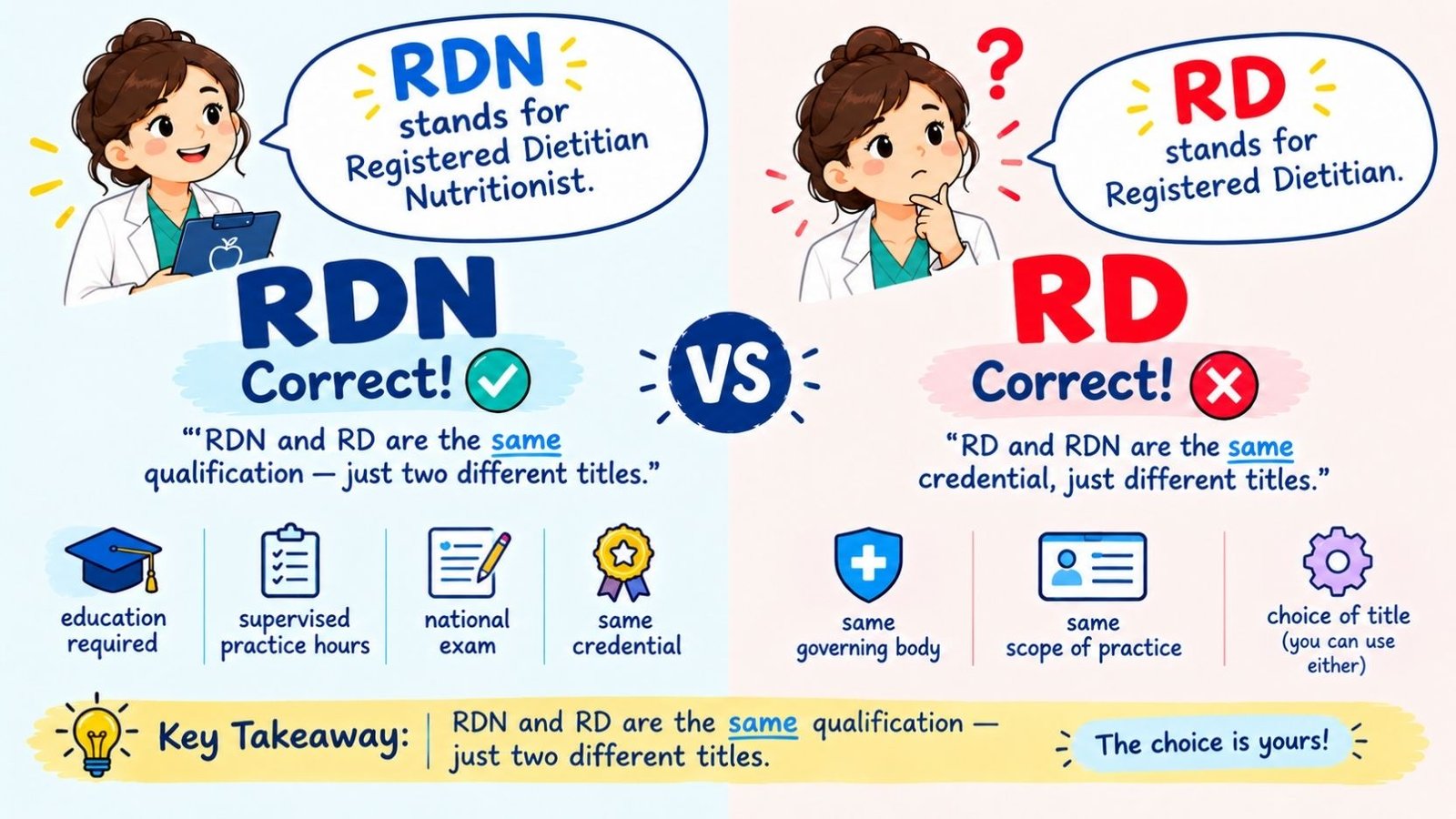
RDN vs RD is a comparison people search for when they see both letters used by nutrition professionals and assume they must be different jobs. The short answer is simple. RDN stands for Registered Dietitian Nutritionist, and RD stands for Registered Dietitian. Both titles come from the same credential, awarded by the same governing body, after the same education and testing requirements.
Understanding this distinction matters if you are choosing a nutrition provider, applying to a nutrition program, or writing about health credentials yourself. The confusion is understandable, since two different sets of letters usually signal two different qualifications.
Here, that is not the case. This guide explains exactly where the terms came from, how they are used today, and where real differences do appear, such as state licensing and optional specialty certifications.
RDN Meaning: The Quick Answer
RDN means Registered Dietitian Nutritionist. It is a credential granted to a person who has completed the required nutrition education, finished supervised practice hours, and passed a national exam administered by the Commission on Dietetic Registration, known as CDR. The CDR operates under the Academy of Nutrition and Dietetics.
RD means Registered Dietitian. It refers to the exact same credential as RDN. The Academy of Nutrition and Dietetics added the RDN credential option in 2013, giving dietitians the choice of using either the RD or RDN title. Neither title is more advanced, more current, or more qualified than the other. A professional can legally choose either one, and many switch between them depending on the setting.
See More: Heals Or Heels
RD Vs RDN: Same Credential, Two Titles
This is the part that trips up most readers, so it is worth stating plainly.
RD and RDN are not two different professions. They are two acceptable names for one credential. Anyone can call themselves a nutritionist, but only RDs and RDNs have completed the education and training established by the Accreditation Council for Education in Nutrition and Dietetics.
Here is a simple table that shows how the two titles compare.
| Feature | RD | RDN |
| Full title | Registered Dietitian | Registered Dietitian Nutritionist |
| Governing body | Commission on Dietetic Registration | Commission on Dietetic Registration |
| Education required | Same as RDN | Same as RD |
| Exam required | Same national exam | Same national exam |
| Legal scope of practice | Identical | Identical |
| Why the letters differ | Personal or employer preference | Personal or employer preference |
Some professionals prefer RDN because the word “nutritionist” is instantly recognizable to the public. “Nutritionist” was added to the credential name to encompass a broader concept of wellness, along with the prevention and treatment of health conditions. Others keep RD because it is the shorter, more traditional form. Neither choice changes what the person is legally allowed to do.
Where Did The RDN Title Come From?
The history here is short and well documented.
For decades, “Registered Dietitian” was the only credential title available. In 2013, the Academy of Nutrition and Dietetics added the RDN credential and gave dietitians the option of using either the RD or RDN title.
The change was not a new certification or a harder exam. It was an updated name for the same credential, meant to make the nutrition side of the role clearer to patients, employers, and the general public.
So when you see “RDN” on a modern nutrition website and “RD” on an older hospital badge, you are looking at the same qualification, just described with different words.
What Does RDN Stand For In A Medical Setting?
In hospitals, clinics, and insurance paperwork, RDN is a medical abbreviation for Registered Dietitian Nutritionist. Registered Dietitian Nutritionists are food and nutrition experts who hold, at minimum, a graduate degree from an accredited dietetics program, have completed a supervised practice requirement, passed a national exam, and continue professional development throughout their careers.
This is why you will see “RDN” listed after a clinician’s name on a treatment plan, a hospital directory, or a discharge summary. It signals that the person providing nutrition guidance holds the full national credential, not just a general interest in nutrition.
How to Become an RDN or RD: The Certification Path
Becoming an RDN, or equivalently an RD, follows a defined process set by CDR. The steps below apply whether the person chooses to use “RD” or “RDN” once certified.
- Complete an ACEND-accredited program. ACEND is the Accreditation Council for Education in Nutrition and Dietetics, and it approves the coursework required for the credential.
- Earn a graduate degree. Starting January 1, 2024, aspiring registered dietitians must hold a minimum graduate degree from a regionally accredited institution to take the CDR exam. This raised the previous requirement, which had been a bachelor’s degree.
- Finish supervised practice hours. Candidates still need a minimum of 1,000 hours of supervised practice, though most programs require approximately 1,200 hours.
- Pass the CDR national exam. This is the credentialing exam administered by the Commission on Dietetic Registration.
- Maintain the credential. RDNs complete ongoing professional development to keep the credential active.
One important note for anyone already working in the field: the graduate degree requirement only applies to people becoming eligible for the exam for the first time on or after January 1, 2024. Dietitians who were already registration eligible, or already practicing, are not affected. Dietetic technicians are also unaffected by this change.
See More: Bellow Or Below
Quick Reference: Requirements Before and After 2024
| Requirement | Before January 1, 2024 | From January 1, 2024 Onward |
| Minimum degree | Bachelor’s degree | Graduate degree, master’s or doctoral |
| ACEND-accredited coursework | Required | Required |
| Supervised practice hours | About 1,000 to 1,200 | About 1,000 to 1,200 |
| National exam | Required | Required |
| Affects current RDs and RDNs? | Not applicable | No, only new candidates |
RDN vs RD vs Nutritionist: Why This Comparison Matters More
While RD and RDN mean the same thing, the comparison between either title and the word “nutritionist” is where real differences show up.
| Term | Legally Protected? | Typical Education | Can Provide Medical Nutrition Therapy? |
| RD or RDN | Yes, nationally regulated | Graduate degree plus supervised practice plus national exam | Yes |
| Nutritionist | Varies by state | Ranges from a short course to a full master’s degree | Usually no, unless separately licensed |
Dietitians, formally known as Registered Dietitians or Registered Dietitian Nutritionists, have credentials and scope of practice that go beyond stand-alone nutritionists. All RDNs are nutritionists, but not all nutritionists are RDNs. Only RDNs are trained in medical nutrition therapy, which includes prescribing therapeutic diets and managing tube feeding or IV nutrition.
In many states, “dietitian” is a legally protected title, while “nutritionist” is not. Using the title “nutritionist” may not require any formal education or licensing in some states, but calling yourself a “dietitian” without the proper credential is prohibited by law.
RDN vs RD vs LD: Adding Licensure Into the Picture
You may also come across the letters LD, which stand for Licensed Dietitian. This is a separate, state-level credential.
- RD or RDN is the national credential from CDR.
- LD is a state license that many, but not all, states require in addition to the RD or RDN credential in order to legally practice or use the title “dietitian” within that state.
A person can be an RDN without an LD if their state does not require licensure, though most states do require it. This is why some professionals list “RDN, LD” together, showing both the national credential and the state permission to practice.
RDN vs RD Salary: Is There A Pay Difference?
There is no salary difference based on which title a person uses. Pay depends on experience, work setting, specialty certification, and geographic location, not on whether someone lists “RD” or “RDN” after their name.
Registered dietitians generally have strong job security because of their protected scope of practice and their ability to work in medical settings. Continued demand for nutrition expertise in disease prevention and treatment keeps this need steady.
Additional specialty credentials, such as sports dietetics or renal nutrition certifications, can also affect earning potential, separate from the RD or RDN title itself.
RDN Grammar And Usage
RDN and RD are both abbreviations, not full words, so they follow the grammar rules of professional credentials rather than ordinary nouns.
- They are written in capital letters: RD, RDN.
- They usually appear after a person’s name, separated by a comma: “Maria Chen, RDN.”
- They function as a noun phrase describing a professional title, similar to how “MD” follows a physician’s name.
- Plural form: more than one professional is described as “RDs” or “RDNs,” without an apostrophe.
Correct: She consulted an RDN about her meal plan.
Correct: Two RDNs reviewed the hospital’s nutrition protocol.
Incorrect: She consulted an RDN’s about her meal plan.
Common Mistakes People Make With RD and RDN
⚠️ Mistake 1: Assuming RDN requires more education than RD.
✅ Correct: They require the identical education, exam, and supervised practice hours. The only difference is the title chosen.
⚠️ Mistake 2: Assuming “nutritionist” and “RDN” always mean the same thing. ✅ Correct: Every RDN can be called a nutritionist, but not every nutritionist has met the requirements to be an RDN.
⚠️ Mistake 3: Confusing RDN with LD.
✅ Correct: RDN is the national credential. LD is a separate state license that many states require alongside it.
⚠️ Mistake 4: Assuming the 2024 master’s degree rule applies to everyone.
✅ Correct: It only applies to people becoming eligible for the exam for the first time on or after January 1, 2024. Currently practicing dietitians are not affected.
RDN Certification And Specialty Credentials
Once someone holds the RD or RDN credential, they can pursue optional specialty certifications through CDR. These include specialty credentials in gerontological nutrition, sports dietetics, pediatric nutrition, renal nutrition, and oncology nutrition.
These specialty letters appear in addition to RD or RDN, not instead of them, and they show extra training in a specific area of practice.
See More: Free Rein Or Free Reign
Frequently Asked Questions
What does RDN stand for?
RDN stands for Registered Dietitian Nutritionist, a national credential from the Commission on Dietetic Registration.
What is the difference between RD and RDN?
There is no practical difference. RDN is the same credential as RD, and the Academy of Nutrition and Dietetics has allowed dietitians to use either title since 2013.
Is RDN a medical abbreviation?
Yes. RDN appears in medical charts, hospital directories, and insurance documents to identify a credentialed nutrition professional.
Do I need a master’s degree to become an RDN?
If you are becoming eligible for the exam for the first time on or after January 1, 2024, yes, a graduate degree is required. Dietitians who were already practicing or already eligible before that date are not required to go back for a master’s degree.
Is an RDN the same as a nutritionist?
Not exactly. All Registered Dietitians are nutritionists, but not all nutritionists are Registered Dietitians. The term “nutritionist” does not legally require specific certifications or credentials in every state.
What is an RDN vs RD vs LD?
RD and RDN are the same national credential. LD is a separate state license that many states also require before a person can practice or use the title “dietitian” locally.
Why do some dietitians use RD instead of RDN?
It comes down to personal or employer preference. Both titles carry identical legal weight and requirements.
Does RDN pay more than RD?
No. Pay depends on experience, setting, and specialty certifications, not on which title a professional chooses to use.
Can an RDN provide medical nutrition therapy?
Yes. Only RDNs are trained in medical nutrition therapy, including prescribing therapeutic diets and managing specialized feeding plans.
How many supervised hours does an RDN need?
Most programs require approximately 1,200 supervised practice hours, with a stated minimum of 1,000 hours.
Final Thoughts
The comparison between RDN and RD often starts with an assumption that two different sets of letters must mean two different qualifications. In this case, that assumption does not hold up.
Both titles represent the exact same national credential, awarded by the same commission, after the same graduate education, supervised practice, and exam requirements. The choice between RD and RDN is a matter of personal or workplace preference, nothing more.
If you are choosing a provider, look past the specific letters and instead check for the credential itself, along with any state license such as LD that your area requires. If you are pursuing the career yourself, focus your planning on the graduate degree requirement, the supervised practice hours, and the national exam, since those are the parts of the path that actually determine whether someone can use either title at all.

Zunaira Qasim is the author and creator of Gramvixo, dedicated to making English grammar easier for learners and everyday writers. With 4 years of experience researching grammar, confusing words, word choices, and common language mistakes, they create clear and practical content that helps readers understand English and use it with confidence.

2 Comments