
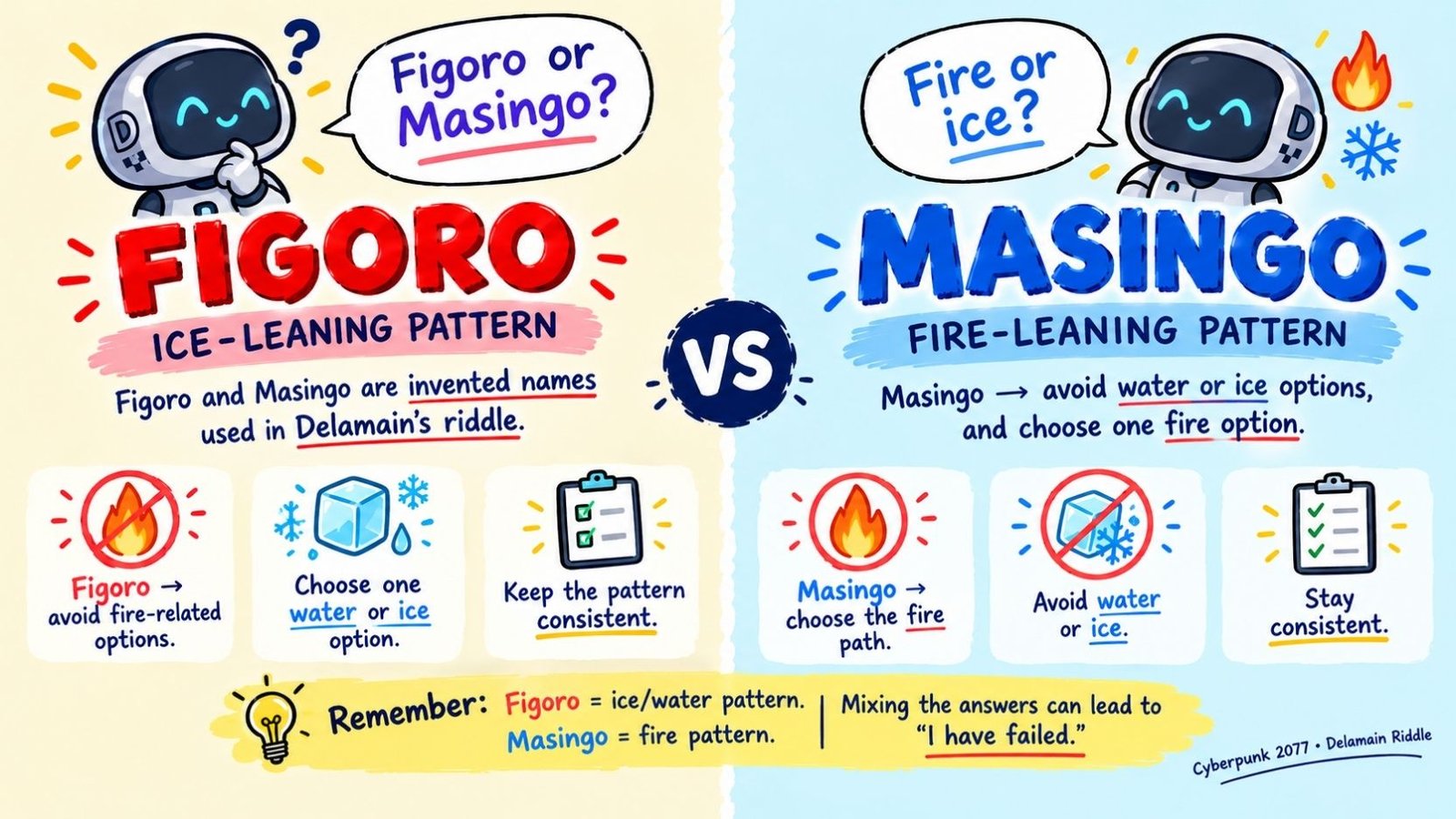
Figoro or Masingo is a strange question that Delamain, the AI taxi company in Cyberpunk 2077, texts the player during a side job. It is not a real English word, and it does not appear in any dictionary. It comes entirely from the game, and it is used as a kind of code word inside a riddle that Delamain sends after certain choices in the Don’t Lose Your Mind quest.
If you searched for this phrase hoping to find a hidden meaning outside the game, there isn’t one. Figoro and Masingo were invented by the writers at CD Projekt Red. What matters is not the dictionary definition, since there isn’t one, but how the question works inside the story, what each answer represents, and why the AI is asking it in the first place. That is what this guide walks through.
What Does Figoro Or Masingo Mean?
In plain terms, Figoro or Masingo is the opening line of a strange text message sequence sent by one of Delamain’s personality fragments. It is not slang, it is not a foreign word, and it is not a reference to anything from mythology or literature.
Here is the short version:
- Figoro and Masingo are two made-up names used in a riddle.
- The riddle appears after you help resolve the Delamain questline in a specific way.
- Your answer, along with follow-up answers about fire, ice, and burning or drowning, changes how the conversation plays out.
- A third option, sometimes called “your mom,” is a joke response players can pick instead of either name.
Because the words have no independent meaning, most of the confusion comes from context, not vocabulary. People searching for this phrase usually want to know where it came from and what picking one over the other does in the game.
See More: Flatform Vs Platform
Where Figoro Or Masingo Comes From
Delamain is the name of a self-driving taxi company in Night City, run by a single advanced AI. Early in the main story, one of Delamain’s cars is involved in an incident, and the AI later asks the player, V, for help tracking down several rogue cars that have split off from its main personality.
This request kicks off the Don’t Lose Your Mind side job. Near the end of it, V has to decide how to deal with the fragmented pieces of Delamain’s mind: keep them separate, merge them back together, or destroy the unstable core entirely.
If the player chooses to destroy the core, Delamain later sends a series of odd, dreamlike text messages. The Figoro or Masingo question is the first line in that sequence. Because the questline can end in more than one way, not every player sees this particular exchange, which is part of why it confused so many people when it first appeared.
The Full Message Sequence
The riddle is not a single question. It unfolds as a short back-and-forth over text, and each answer leads into the next line. The general structure looks like this:
- Delamain asks: Figoro or Masingo?
- Delamain follows up: Do they hide below the ice, or behind the fire?
- Delamain asks whether you should burn or drown “their leader.”
Depending on which name and elements you pick, Delamain either responds with an odd, almost satisfied message, or it replies with “I have failed,” which suggests you answered outside the pattern it expected.
How The Answers Work
Players spent a fair amount of time comparing notes after this quest line appeared, since the game gives no clear explanation for what counts as a correct answer. Based on community testing, the pattern that leads to a completed, non-failed conversation looks like this:
| Choice | Pattern That Keeps the Conversation Going |
| Figoro | Avoid every fire-related option, and pick only one water or ice option |
| Masingo | Avoid every water or ice option, and pick only one fire option |
| “Your mom” or similar joke answers | Deliberately mix opposite elements, or refuse to answer at all |
💡 Tip: If you pick fire and ice answers inconsistently without following either the Figoro or Masingo pattern, Delamain is likely to respond with “I have failed,” ending the exchange early.
There is no confirmed reward, unlock, or story consequence tied to any specific answer. It functions as flavor text rather than a branching decision with mechanical weight.
See More: RDN Vs RD
Is Figoro Or Masingo A Real Word?
No. Figoro and Masingo are not established English words, and they are not documented as loanwords from another language. They are original terms created for this quest.
Some players have noted that Figoro sounds close to Figaro, a name associated with opera characters such as the barber in Gioachino Rossini’s “The Barber of Seville.” That similarity appears to be coincidental rather than a confirmed reference, since the developers have not stated that the name is drawn from opera.
Grammar And Part Of Speech
Because Figoro and Masingo are proper nouns invented for a game, they don’t behave like ordinary vocabulary words. Here is how they function grammatically:
- Part of speech: Both act as proper nouns, similar to character names or code names.
- Capitalization: Both are typically capitalized, since they function as names within the dialogue.
- Plural form: Neither word has an established plural form, since each refers to a single option in the riddle rather than a category of things.
- Sentence use: They are almost always used as direct answers to Delamain’s question, for example, “I chose Figoro” or “I always pick Masingo.”
How to Pronounce Figoro And Masingo
The game does not include voiced dialogue for these lines, since the exchange happens entirely through text messages. Based on standard English pronunciation patterns, most players and content creators say them as:
- Figoro: fih GOR oh
- Masingo: mah SING oh
There is no official audio confirmation of either pronunciation from CD Projekt Red, so these are reasonable readings based on spelling rather than verified voice acting.
Common Misspellings
Because the words are unfamiliar, they get typed inconsistently across search engines and forums. Common variations include:
- Figaro or Masingo
- Figoro or Masigno
- Figoro or Masongo
- Figoro ou Masingo
If you see any of these while searching, they refer to the same Delamain riddle. The correct in-game spelling is Figoro and Masingo.
Figoro Or Masingo Versus “Your Mom”
Alongside the two main names, some players are given a third option along the lines of “your mom,” or dismissive answers like “I don’t care” or “leave them alone.” This isn’t a hidden third path with its own reward. It works more like a joke response for players who want to opt out of playing along with Delamain’s logic puzzle.
Choosing this route, or mixing your fire and ice answers unpredictably afterward, generally leads to the same “I have failed” response you’d get from picking Figoro or Masingo incorrectly.
Why This Confuses So Many Players
A few things make this phrase harder to search for than a typical game term:
- It only appears if you resolve the Delamain questline a specific way, so plenty of players never see it and later can’t find it referenced elsewhere.
- The words are invented, so there’s no dictionary, wiki glossary, or language resource to check them against.
- The message sequence looks like it should have a “correct” answer with a real reward, when it mostly functions as narrative flavor showing Delamain’s fractured, unstable mental state after the quest.
See More: Bellow Or Below
Frequently Asked Questions
What does Figoro or Masingo mean in Cyberpunk 2077?
It’s a line from a text message riddle sent by the Delamain AI after a specific ending to the Don’t Lose Your Mind side job. Figoro and Masingo are invented names, not real words with independent meaning.
Is Figoro or Masingo a real word or phrase outside the game?
No. It does not appear in any English dictionary or established language reference. It was created specifically for this quest.
Does choosing Figoro or Masingo affect the story or give a reward?
As far as players have documented, no. There’s no confirmed unlock, item, or story branch tied to either answer. It reads as atmospheric dialogue rather than a meaningful choice.
What happens if you answer wrong?
Delamain typically responds with “I have failed,” ending the exchange without further explanation.
Is Figoro related to the opera character Figaro?
The names sound similar, but there is no official confirmation that Figoro is a reference to Figaro from “The Barber of Seville.” Any connection appears to be a coincidence noticed by players rather than a stated influence.
Why does Delamain ask this question at all?
It happens after the AI’s mind has been fractured and partially destroyed during the side job, and the riddle is part of a set of increasingly strange messages that reflect its unstable state afterward.
Is “Masingo” also used outside of Cyberpunk 2077?
Yes, separately from the game, “Masingo” is also a brand name used for a line of karaoke machines, such as the Masingo Soprano X1. That product has no connection to the Cyberpunk 2077 quest; it’s simply the same word used as an unrelated brand name.
Final Thoughts
Figoro or Masingo isn’t a phrase with a dictionary meaning waiting to be uncovered. It’s a piece of invented dialogue from Cyberpunk 2077, tied to one specific ending of Delamain’s side job, and its two names function as code words in a short riddle rather than terms with outside significance.
Once you know that context, the phrase stops feeling like a puzzle to solve and starts making sense as exactly what it is: a strange, memorable moment written to show an AI character losing its grip after a traumatic questline.
If you run into this text sequence in your own playthrough, the safest way to keep the conversation going is to stay consistent, either leaning fully into Figoro’s ice-leaning pattern or Masingo’s fire-leaning pattern, rather than mixing the two. And if you’d rather just see what Delamain says when you don’t play along, picking the joke answer is a perfectly valid way to experience the scene too.

Zunaira Qasim is the author and creator of Gramvixo, dedicated to making English grammar easier for learners and everyday writers. With 4 years of experience researching grammar, confusing words, word choices, and common language mistakes, they create clear and practical content that helps readers understand English and use it with confidence.

2 Comments