
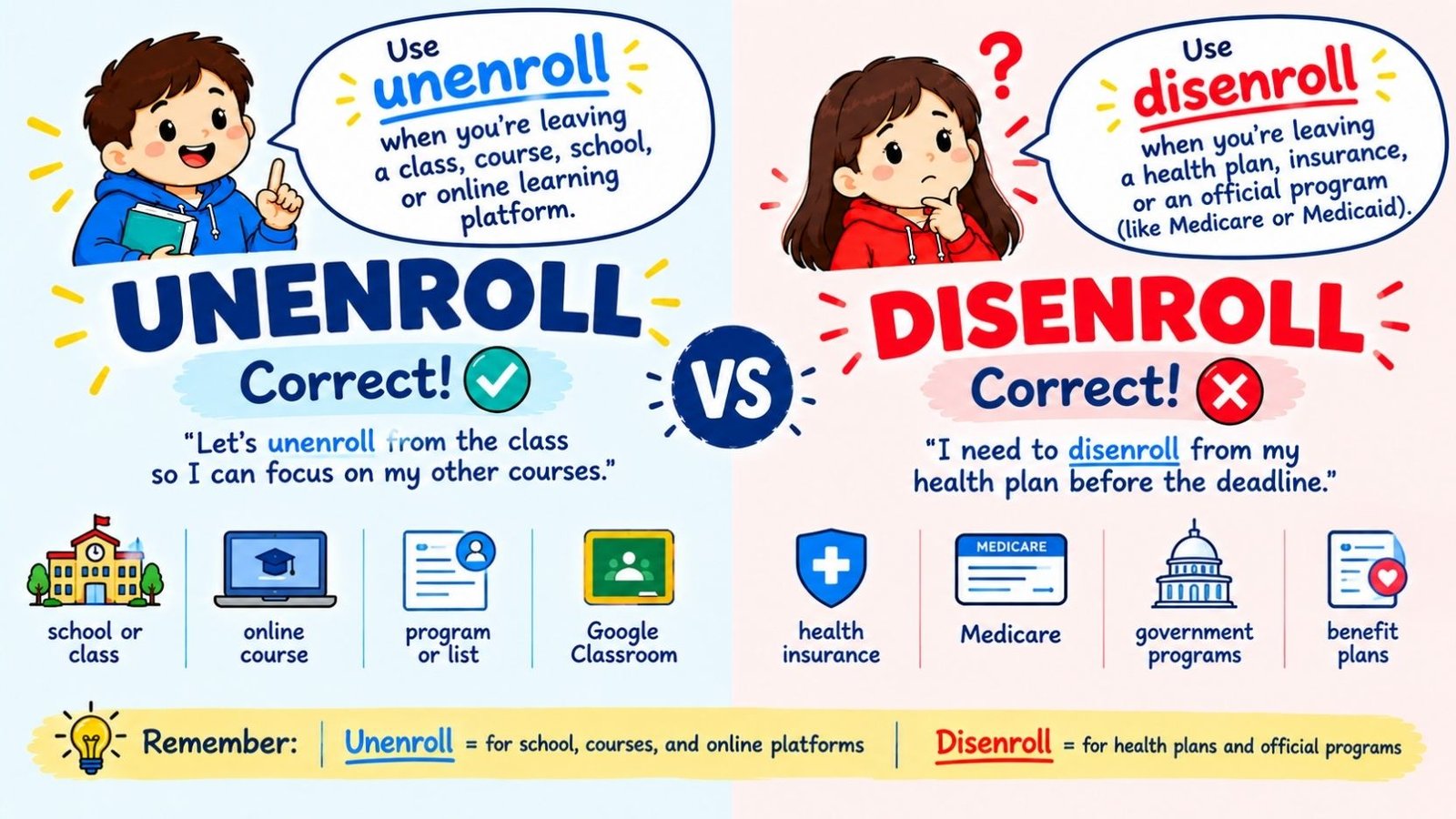
Unenroll vs disenroll is a question that comes up the moment you try to leave a class, a school, or a health plan and you are not sure which word actually applies. Both words mean the same basic thing: to stop being enrolled in something.
Unenroll is the word people use most often in everyday life, especially for school, college, and online learning platforms. Disenroll is the more formal word, and it shows up mainly in official or institutional settings, especially health insurance and Medicare.
Neither word is wrong, and neither one is a typo of the other. They grew from the same root idea but settled into slightly different homes over time. Knowing which one fits your situation makes your writing sound more natural and helps you find the right instructions faster. This guide walks through the meaning, the grammar, and the real-world usage of both words so you never have to guess again.
Unenroll Meaning
Unenroll means to remove yourself, or to be removed, from a class, course, school, program, or list that you had previously joined. It is the direct opposite of enroll.
If you enroll in a yoga class, you sign up and join it. If you unenroll from that class, you leave it and your name comes off the roster. The word works for almost any situation where someone joined something and now wants out.
Simple definition: to cancel your registration or membership in something you had previously joined.
Unenroll is the word most people reach for naturally, without thinking about grammar rules. It sounds normal in conversation, in emails, and in instructions on a website. This is why it dominates searches related to schools, colleges, and digital classroom tools.
See More: Figoro Or Masingo
Disenroll Meaning
Disenroll carries the exact same core meaning: to end someone’s enrollment or membership. The difference is tone and setting, not meaning. Disenroll leans formal and technical.
You will see disenroll most often in:
- Health insurance documents
- Medicare and Medicaid materials
- Government forms
- Official policy language
Simple definition: to formally remove someone from a plan, program, or list, usually through an official process.
Because disenroll shows up in paperwork and policy, it can sound stiffer than unenroll. That stiffness is not a flaw. It fits the serious, rule-bound nature of insurance and benefits, where every action needs to follow a documented process.
Is Unenroll A Word? Is Disenroll A Word?
Yes. Both unenroll and disenroll are real, recognized English words.
- Unenroll: built from the prefix “un” (meaning “not” or “reverse of”) plus “enroll.” It reverses the action of enrolling.
- Disenroll: built from the prefix “dis” (meaning “apart” or “away from”) plus “enroll.” It also reverses enrollment, but through a slightly older, more formal word pattern.
Some dictionaries list both spellings with a double “l” (unenroll, disenroll), which is standard American English. A small number of style guides in British or international English trim it to one “l” (unenrol, disenrol) to match the British spelling of “enrol.” In the United States, the double “l” spelling is the one you should use.
Unenroll or Disenroll: Which One Should You Use?
This is the heart of the unenroll vs disenroll question, and the honest answer is: it depends on the setting, not on strict grammar rules.
| Situation | Preferred Word | Why |
| Leaving a school, college, or class | Unenroll | Common, informal, widely used in education |
| Leaving Google Classroom or Canvas | Unenroll | Matches the language used by the platforms themselves |
| Leaving a Medicare or Medicaid plan | Disenroll | Standard term in health insurance and government documents |
| Leaving a health insurance plan generally | Disenroll (formal) / Unenroll (casual) | Both appear, but disenroll is the official term |
| Leaving an automatic payment service like Zelle | Unenroll | Matches everyday consumer language |
| General conversation | Unenroll | Sounds more natural to most English speakers |
If you are ever unsure, unenroll is the safer everyday choice. Reach for disenroll only when you are dealing with a formal health plan, government benefit, or official policy document that already uses that word.
Do You Unenroll Or Disenroll From School?
For school, unenroll is the standard and expected word. “Unenroll from school” and “unenroll from a class” both sound natural and are widely used by school districts, colleges, and universities in their own instructions.
Disenroll can technically apply to school withdrawal too, and some university administrative offices do use it in formal paperwork. But if you are a student or parent asking how to leave a school or class, unenroll is what you will hear and what you should use.
Unenroll Vs Disenroll From School Or College
When people search “unenroll or disenroll from school,” they usually want a clear answer for their specific situation, whether that is withdrawing a child from K to 12 education or leaving a college program.
- Unenrolling from K through 12 school usually means notifying the school office, submitting a withdrawal form, and often providing proof of enrollment elsewhere if required by your state.
- Unenrolling from college usually means contacting the registrar’s office, since simply stopping attendance without formal withdrawal can affect your transcript, financial aid, and tuition charges.
Every school and college has its own process. If you need to unenroll from a specific institution, such as Howard University or any other college, check that school’s official registrar or student services page for their exact steps, deadlines, and any forms required, since these procedures vary from one institution to another.
How To Unenroll From College: General Steps
While exact steps differ by institution, most colleges follow a similar general pattern when a student wants to leave a course or the school entirely.
- Log in to the student portal. Most colleges manage enrollment through an online system.
- Locate your class or program list. Look for an option labeled “drop,” “withdraw,” or “unenroll.”
- Check the deadline. Many schools have cutoff dates after which unenrolling still results in a grade or a charge.
- Contact the registrar if needed. Full withdrawal from a college, rather than a single class, usually requires a formal request through the registrar’s office.
- Confirm the change. Always get written or emailed confirmation that you have been unenrolled.
💡 Tip: Unenrolling from a single class is different from unenrolling from the entire college. Dropping one class rarely affects your enrollment status, while full withdrawal usually does.
How To Unenroll From Google Classroom
Google Classroom uses the word “unenroll” directly, so this is one of the clearest cases in the unenroll vs disenroll comparison.
To unenroll from a class in Google Classroom:
- Open Google Classroom and select the class you want to leave.
- Click the three-dot menu in the top corner of the class card.
- Select “Unenroll.”
- Confirm your choice when prompted.
If you are a teacher who created the class, you generally cannot unenroll yourself the same way a student does. Instead, you would need to delete or archive the class.
⚠️ Common mistake: Trying to leave a class by simply ignoring it. This does not remove you from the roster. You must actively select “Unenroll” for your name to come off the class list.
How To Unenroll From A Canvas Course
Canvas, another popular learning platform, does not always give students a self-service “unenroll” button the way Google Classroom does. In most cases, unenrolling from a Canvas course depends on your institution’s settings.
General steps to try:
- Check your Canvas dashboard for a course settings or enrollment option.
- If no self-unenroll option appears, contact your instructor or the school’s IT or registrar office.
- Ask them to remove your enrollment from the course roster.
Because Canvas is configured differently by each school, the exact path to unenroll can vary. When in doubt, your school’s help desk is the fastest way to get an accurate answer.
See More: Cringy Or Cringey
How To Unenroll From Zelle
“Unenroll” is also the term Zelle and many banking apps use when you want to stop using the service.
To unenroll from Zelle:
- Open your banking app or the Zelle app.
- Go to the Zelle or payments settings section.
- Look for an option such as “manage Zelle” or “unenroll from Zelle.”
- Confirm you want to stop using Zelle through that account.
Since Zelle is usually offered through your bank, the exact menu location can differ slightly between banking apps. If you cannot find the option, your bank’s customer support can unenroll the account for you.
Disenroll Meaning In Medicare And Medicaid
This is where disenroll becomes the dominant word. Medicare, Medicaid, and most health insurers use “disenroll” as their official term for leaving a plan.
Disenroll meaning in health insurance: to formally end your membership in a specific health plan, either voluntarily or because you no longer qualify for it.
Common examples include:
- How to disenroll from Medicare
- How to disenroll from Medicare Part A
- How to disenroll from Medicare Part B
- How to disenroll from Medicare Part D
- How to disenroll from a Medicare Advantage plan
- How to disenroll from Medicaid
- How to disenroll from Humana or another specific insurer’s plan
Can You Unenroll From Health Insurance?
Yes, and in casual conversation people often say “unenroll” even though the official term in most insurance paperwork is “disenroll.” If you call your insurer and say you want to unenroll, they will understand you. If you are filling out an official form, however, you will usually see the word “disenroll” printed on it.
When Can I Disenroll From A Medicare Advantage Plan?
Medicare Advantage plans do not allow disenrollment at any random time of year. There are set enrollment periods, and the two most important ones are:
- The Annual Enrollment Period, which runs from October 15 to December 7 each year. During this window, anyone with Medicare can join, switch, or drop a Medicare Advantage plan.
- The Medicare Advantage Open Enrollment Period, which runs from January 1 to March 31 each year. This period is only for people already enrolled in a Medicare Advantage plan as of January 1. It allows a one-time switch to a different Medicare Advantage plan, or a return to Original Medicare.
Outside of these windows, disenrollment is usually only possible if you qualify for a Special Enrollment Period, such as moving to a new address outside your plan’s service area or losing other coverage.
⚠️ Important reminder: Because enrollment periods and rules can change from year to year, always confirm current dates and eligibility directly with Medicare or your plan provider before making a decision.
How To Disenroll From Medicare: General Approach
The exact steps depend on which part of Medicare you are leaving, but the general approach usually involves one of the following:
- Calling Medicare directly to request disenrollment from a specific part or plan.
- Contacting your plan provider, such as Humana or another private insurer, if you are in a Medicare Advantage or Part D plan.
- Submitting a written request if your plan or Medicare requires formal documentation.
- Enrolling in a new plan first, which can automatically disenroll you from your previous plan in some cases.
Because Medicare rules involve real financial and coverage consequences, it is worth confirming the current process and any deadlines directly with Medicare or your insurer rather than relying on secondhand instructions.
How To Disenroll From Medicare Advantage 2026
If you are specifically trying to leave a Medicare Advantage plan during a particular year, the process generally follows the same enrollment period structure described above.
Because plan details, provider networks, and enrollment rules are reviewed and can be updated annually, always check the current year’s dates and options directly with Medicare or your plan before submitting a disenrollment request.
Disenroll In Spanish
If you need to explain disenroll in Spanish, the closest and most natural translation is “darse de baja,” which literally means “to take oneself off” a list or plan.
In official Spanish-language health insurance materials, you may also see “cancelar la inscripción,” meaning “to cancel the enrollment.” Both phrases carry the same idea as disenroll in English: formally ending membership in a plan or program.
Unenroll Vs Disenroll: Grammar And Part Of Speech
Both words are verbs. Here is how they behave grammatically.
| Form | Unenroll | Disenroll |
| Base form | unenroll | disenroll |
| Past tense | unenrolled | disenrolled |
| Present participle | unenrolling | disenrolling |
| Third person singular | unenrolls | disenrolls |
| Noun form | unenrollment | disenrollment |
Example sentences:
- She decided to unenroll from the online course after the first week.
- He was disenrolled from the health plan after missing the payment deadline.
- The school confirmed her unenrollment before the semester began.
- The insurer processed his disenrollment within five business days.
Is “unenrollment” a word? Yes. It is the standard noun form of unenroll, used to describe the act or process of unenrolling, just as “disenrollment” is the noun form of disenroll.
How To Pronounce Unenroll And Disenroll
- Unenroll: un-en-ROLL (stress on the final syllable)
- Disenroll: dis-en-ROLL (stress on the final syllable)
Both words follow the natural rhythm of the base word “enroll,” with the added prefix pronounced quickly and lightly before it.
Origin Of Unenroll And Disenroll
Both words trace back to “enroll,” which itself comes from Old French “enroller,” meaning to enter something into a roll or register, referring literally to a rolled document used for record-keeping.
- “Un” is a native English prefix used to reverse the meaning of a verb, which is why “unenroll” feels so intuitive and modern to English speakers.
- “Dis” comes from Latin, also used to reverse or negate a verb, giving “disenroll” a slightly older, more formal tone that fits well in legal and institutional English.
Neither word is new. Both have been used in English for a long time, but disenroll became especially common in insurance and government writing because that language often favors Latin-based formal vocabulary.
Unenroll Synonym And Related Words
| Word | Meaning | Typical Use |
| Withdraw | To formally remove yourself from a program or course | Common in college and academic contexts |
| Drop | To leave a single class or course | Common in casual student language |
| Cancel | To end a service, subscription, or membership | Common for subscriptions and services |
| Opt out | To choose not to participate, often after being automatically included | Common for programs with automatic enrollment |
| Terminate | To formally end a contract or membership | Common in insurance and legal writing |
Re-enroll is the opposite action of both unenroll and disenroll. It means to enroll again after having left, such as re-enrolling in a class you previously dropped or re-enrolling in a health plan during the next open enrollment period.
Common Mistakes With Unenroll And Disenroll
❌ Incorrect: “I want to un-enroll from the insurance, right?” (using it in a formal insurance context where “disenroll” is the standard official term)
✅ Correct: “I want to disenroll from the insurance plan.”
❌ Incorrect: “Please disenroll me from Google Classroom.”
✅ Correct: “Please unenroll me from Google Classroom.”
❌ Incorrect: Treating “unenroll” and “disenroll” as spelling variations of the same exact word in every context.
✅ Correct: Recognizing that both are valid, but each fits a different setting best.
Using either word will usually still be understood, but matching the word to its typical setting makes your writing sound more accurate and professional.
See More: Flatform Vs Platform
Frequently Asked Questions
What does unenroll mean?
Unenroll means to remove yourself, or be removed, from a class, course, program, or list you had previously joined.
What does disenroll mean?
Disenroll means to formally end someone’s membership or enrollment, most often used in health insurance, Medicare, and official program settings.
Is it unenroll or disenroll?
Both are correct English words. Unenroll fits everyday and educational settings. Disenroll fits formal, insurance, and government settings.
Is unenroll a word?
Yes, unenroll is a standard, recognized English verb.
Is disenroll a word?
Yes, disenroll is also a standard, recognized English verb.
How do you use unenroll in a sentence?
“She unenrolled from the summer course because her schedule changed.”
How do you use disenroll in a sentence?
“He was disenrolled from the Medicare Advantage plan after he moved out of state.”
What is the noun form of unenroll?
The noun form is “unenrollment.”
What is the noun form of disenroll?
The noun form is “disenrollment.”
How do you say disenroll in Spanish?
The most natural equivalent is “darse de baja,” or more formally, “cancelar la inscripción.”
Final Thoughts
Unenroll and disenroll both describe the same basic action: leaving something you had previously joined. The real difference comes down to setting rather than meaning. Unenroll feels natural in schools, colleges, online classrooms, and everyday digital services. Disenroll feels natural in health insurance, Medicare, Medicaid, and other official, rule-driven programs.
If you remember one simple guideline, let it be this: use unenroll for everyday life and education, and use disenroll for health plans and formal government programs. Either word will usually be understood no matter which one you choose, but picking the one that matches your situation will make your writing sound clearer, more accurate, and more natural to the reader.

Zunaira Qasim is the author and creator of Gramvixo, dedicated to making English grammar easier for learners and everyday writers. With 4 years of experience researching grammar, confusing words, word choices, and common language mistakes, they create clear and practical content that helps readers understand English and use it with confidence.
One Comment