
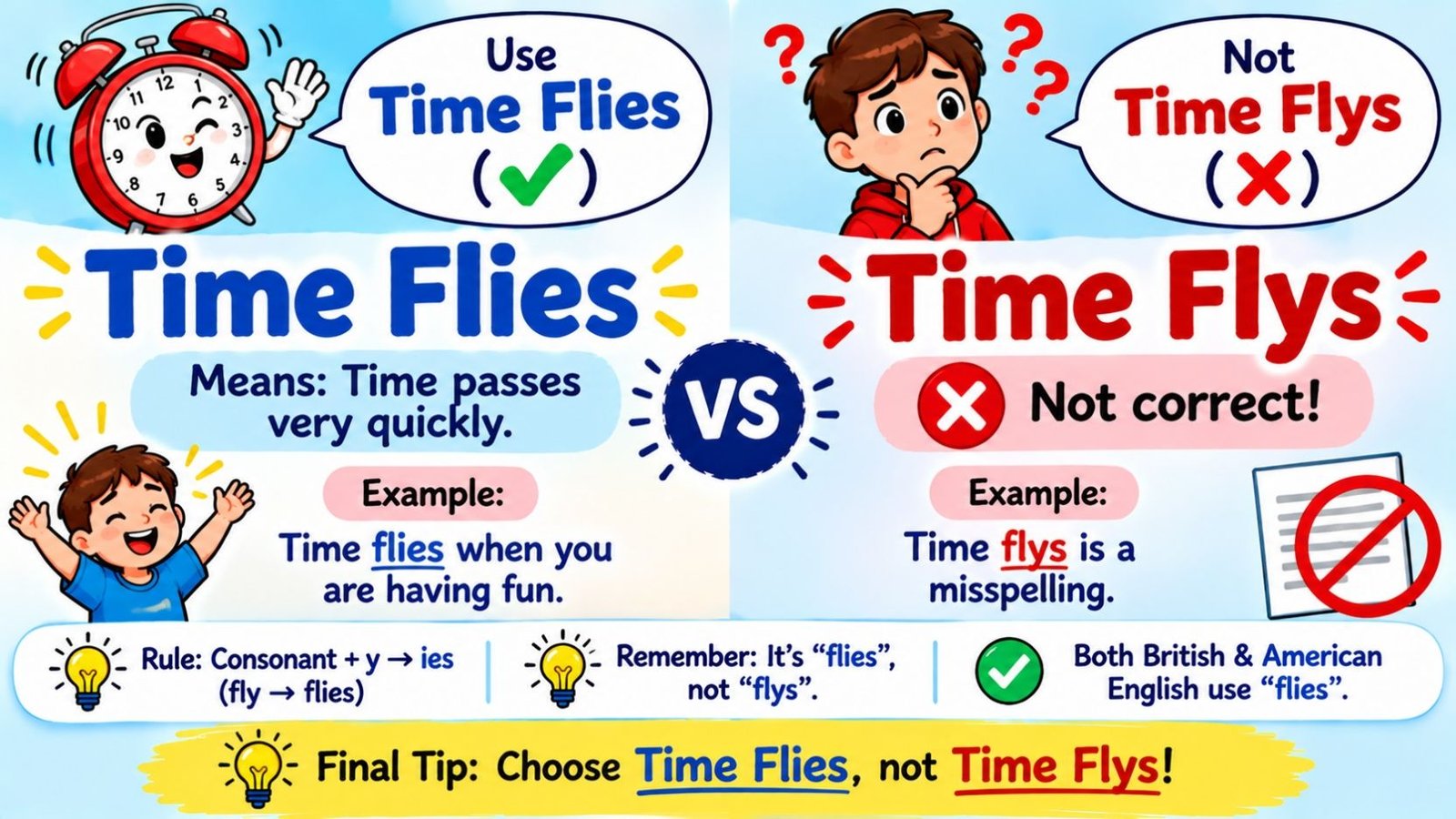
“Time flies” is the correct spelling. “Time flys” is a common misspelling that shows up often in casual writing, texts, and social media captions, but it does not follow standard English grammar rules for verb spelling.
This mix-up happens for a simple reason. Many English words that end in a consonant plus “y” change that “y” to “ies” when they become plural or shift into certain verb forms. “Fly” follows this exact pattern, which is why “flies” is correct and “flys” is not.
Understanding why this happens makes the rule easy to remember for good. Once you see the pattern behind “fly” turning into “flies,” you can apply the same logic to dozens of other everyday English words.
This matters beyond just one phrase, too. Getting comfortable with this small grammar rule helps you write more confidently in emails, essays, and everyday conversation.
What Does Time Flies Mean?
“Time flies” is an idiom, not a literal description of time moving through the air. It means that time seems to pass very quickly, especially when you are enjoying yourself or deeply focused on something.
People usually say it when they look back and realize how much time has gone by without them noticing.
Here is a simple breakdown of the phrase:
| Part of Phrase | Meaning |
| Time | Refers to the hours, days, or years passing |
| Flies | Used figuratively to mean “moves quickly” |
| Time flies | An idiom meaning time seems to pass fast |
The phrase is almost always used casually. You will hear it at parties, reunions, birthdays, and in everyday small talk about how fast a week, a school year, or someone’s childhood went by.
Read More: Emaculate Vs Immaculate: What Is The Correct Word And What Does It Mean?
Why Is It Flies And Not Flys?
The confusion comes from a basic English spelling rule involving words that end in a consonant followed by “y.” When this happens, the “y” usually changes to “i” before adding “es.”
This rule applies to both nouns and verbs. It does not matter whether “fly” is acting as a noun for the insect or as a verb meaning to move through the air. The same spelling change applies either way.
Here is the rule in action:
| Base Word | Rule Applied | Correct Form |
| Fly | Consonant + y, change y to ies | Flies |
| Try | Consonant + y, change y to ies | Tries |
| Cry | Consonant + y, change y to ies | Cries |
| Study | Consonant + y, change y to ies | Studies |
Because “fly” ends in a consonant (“l”) plus “y,” it follows this same pattern. That is why “flies” is correct in every context, including “time flies,” “the bird flies,” and “a swarm of flies.”
Is Flys Ever Correct?
“Flys” is not considered standard or acceptable in modern English. Some older or highly specialized texts have used “flys” as a plural for a type of horse-drawn carriage once called a “fly,” but this usage is historical, extremely rare, and not something a general reader would encounter today.
For every normal, everyday context, including grammar, insects, sports terminology, and idioms like “time flies,” the correct spelling is always “flies.”
If you see “flys” in a caption, meme, or informal post online, treat it as a common spelling mistake rather than an accepted alternative.
Time Flies Grammar Explained
In the phrase “time flies,” “time” is the subject and “flies” is the verb. This follows standard subject-verb agreement rules in English.
When a subject is singular, such as “time,” “he,” “she,” or “it,” the verb usually takes an “s” or “es” ending in the present tense. “Fly” becomes “flies” for the same reason “run” becomes “runs” and “watch” becomes “watches.”
Here is how the pattern breaks down:
| Subject | Verb Form | Example |
| I / You / We / They | Fly | They fly to Chicago every summer. |
| He / She / It / Time | Flies | Time flies when you are busy. |
This is simply the third person singular present tense form of the verb “fly.” The subject “time” is treated as singular, so it takes the “flies” form, never “flys.”
How To Use Time Flies In A Sentence
“Time flies” works well as a complete short sentence on its own, or as part of a longer sentence describing how quickly time has passed.
Correct examples:
- Time flies when you are having fun.
- I cannot believe it is already December. Time really flies.
- Time flies so fast once you start a new job.
- Looking at old photos reminds me how time flies.
- Time flies, and before you know it, the kids are grown.
Notice that “flies” stays the same in every example. It does not change form based on the rest of the sentence, since “time” remains the singular subject throughout.
Read More: Neighbour Or Neighbor: Which Spelling Is Correct?
Common Mistakes With Time Flies Or Time Flys
✅ Correct: Time flies when you are having fun.
❌ Incorrect: Time flys when you are having fun.
✅ Correct: I cannot believe how fast time flies.
❌ Incorrect: I cannot believe how fast time flys.
✅ Correct: As time flies, priorities change.
❌ Incorrect: As time flys, priorities change.
The mistake usually happens because “flys” looks like a more straightforward plural, similar to how “boys” or “toys” are formed. But “fly” does not follow that pattern because it ends in a consonant plus “y,” not a vowel plus “y.” Words like “boy” and “toy” end in a vowel before the “y,” so they simply add an “s.” “Fly” does not, which is why it needs the “ies” ending instead.
Time Flies In Different Contexts
The phrase and the word “flies” show up in more than one setting. Separating these contexts helps avoid confusion.
As an idiom about time. “Time flies” describes the feeling that time is passing quickly, usually during enjoyable or busy moments.
As a description of insects. “Flies” is also the standard plural of the insect called a “fly,” as in “there are flies in the kitchen.”
As a verb for movement. “Flies” describes something moving through the air, such as “the plane flies at high altitude” or “she flies to Tokyo every month for work.”
In sports. In baseball, a “fly ball” or “pop fly” refers to a ball hit high into the air, and a batter is sometimes said to have “flied out,” though this specific past tense form is an exception within baseball terminology rather than standard grammar.
In every one of these contexts, “flies” remains the correct spelling. “Flys” does not belong in any of them.
Origin Of The Phrase Time Flies
The idea behind “time flies” traces back to a much older Latin phrase, “tempus fugit,” which translates roughly to “time flees” or “time flies.” This phrase appears in classical Latin poetry, most notably in the work of the Roman poet Virgil, where it expresses the idea that time slips away quickly and cannot be recovered.
Over centuries, the concept moved into English and other European languages, eventually settling into the shorter, more casual expression “time flies” that English speakers use today. The phrase kept its core meaning: time moves fast, and people often do not notice until it has already passed.
This background also explains why the phrase feels timeless. The observation that time seems to speed up during meaningful moments is not a modern idea. It has been expressed in similar ways across many cultures and centuries.
Time Flies Quotes And Popular Usage
“Time flies” is one of the most recognizable idioms in English, and it often appears in quotes, sayings, and casual reflections on life.
A common extended version is: “Time flies when you’re having fun,” which adds the idea that enjoyable experiences make time feel especially short.
You will also see the phrase used in:
- Graduation speeches and yearbook messages
- Birthday cards and anniversary posts
- Captions on social media, often paired with throwback photos
- Everyday conversation about how quickly a season, job, or relationship has progressed
Because the phrase is so widely used, it also appears in music, with several songs referencing the idea that “time flies,” and in casual sheet music arrangements for instruments like flute, clarinet, and alto sax, which are sometimes searched under similar titles. These musical references are separate from the grammar question itself, but they explain why some searches for the phrase are mixed in with music-related results.
Time Flies Or Flies By
Both “time flies” and “time flies by” are used in everyday English, and both are grammatically correct.
“Time flies” works as a complete statement on its own.
“Time flies by” adds the word “by,” which slightly emphasizes the sense of time passing and moving away, similar to how someone might say a car “drives by” or a stranger “walks by.”
Neither version uses “flys” in any correct form. The addition of “by” does not change the spelling of “flies” in any way.
Similar Words People Often Confuse
Several other English words follow the same “y to ies” pattern as “fly,” and people sometimes make similar mistakes with them.
| Word | Confusing Form | Correct Form |
| Fly | Flys | Flies |
| Cry | Crys | Cries |
| Try | Trys | Tries |
| Reply | Replys | Replies |
| Deny | Denys | Denies |
Learning the “fly to flies” rule can help you avoid the same mistake with dozens of similar words in English, since they all follow the identical spelling pattern.
Read More: Symptomology Vs Symptomatology: What Is The Correct Word?
How To Pronounce Time Flies
“Time flies” is pronounced the same way it looks, with no silent letters or unusual sounds.
- Time is pronounced like “tyme,” rhyming with “climb” or “rhyme.”
- Flies is pronounced like “flyz,” with a long “i” sound, similar to “eyes” or “skies.”
Put together, the phrase sounds like “tyme-flyz.” There is no difference in pronunciation between how “flies” would sound if someone mistakenly wrote it as “flys,” since English speakers pronounce both spellings the same way. The difference only shows up in writing, which is exactly why the misspelling is so easy to miss when people are typing quickly.
Frequently Asked Questions
Is it time flies or time flys?
It is always “time flies.” “Flys” is a common misspelling and is not considered correct in standard English.
What does time flies mean?
It means that time seems to pass very quickly, especially during moments that are enjoyable, busy, or memorable.
Why is it flies and not flys?
Because “fly” ends in a consonant plus “y,” it follows the English spelling rule of changing “y” to “ies” for verb forms like “flies” and noun plurals like “flies.”
Is flies a noun or a verb in this phrase?
In “time flies,” “flies” functions as a verb, describing what time does. “Flies” can also function as a noun, referring to the insect, depending on the sentence.
Is flys ever a correct spelling of anything?
Rarely. “Flys” has appeared historically as the plural of an old type of horse-drawn carriage, but this usage is outdated and not relevant to modern everyday English.
How do you use time flies in a sentence?
You can use it as a standalone sentence, such as “Time flies,” or as part of a longer sentence, such as “I can’t believe how fast time flies.”
What is the origin of the phrase time flies?
It comes from the Latin phrase “tempus fugit,” meaning “time flees” or “time flies,” which appears in classical Roman poetry, most notably by Virgil.
Is time flies by correct grammar?
Yes. “Time flies by” is a correct and common variation that adds slight emphasis to the sense of time passing.
What other words follow the same spelling rule as flies?
Words like “cries,” “tries,” “replies,” and “denies” all follow the same pattern of changing a consonant plus “y” ending to “ies.”
Do British and American English spell it differently?
No. “Flies” is the correct spelling in both British and American English. There is no regional variation for this word.
Final Thoughts
“Time flies” is the correct and only accepted spelling in standard English, while “time flys” is simply a common typing mistake. The confusion usually comes down to one small spelling rule: when a word ends in a consonant followed by “y,” that “y” changes to “ies” in certain verb and plural forms, and “fly” follows this rule exactly like “try,” “cry,” and “reply.”
Beyond the spelling itself, “time flies” remains one of the most familiar idioms in English, rooted in an old Latin expression and still used every day to describe how quickly meaningful moments pass. Once you remember the simple “y to ies” pattern, you will never second guess whether to write “flies” or “flys” again.

Zunaira Qasim is the author and creator of Gramvixo, dedicated to making English grammar easier for learners and everyday writers. With 4 years of experience researching grammar, confusing words, word choices, and common language mistakes, they create clear and practical content that helps readers understand English and use it with confidence.



One Comment