
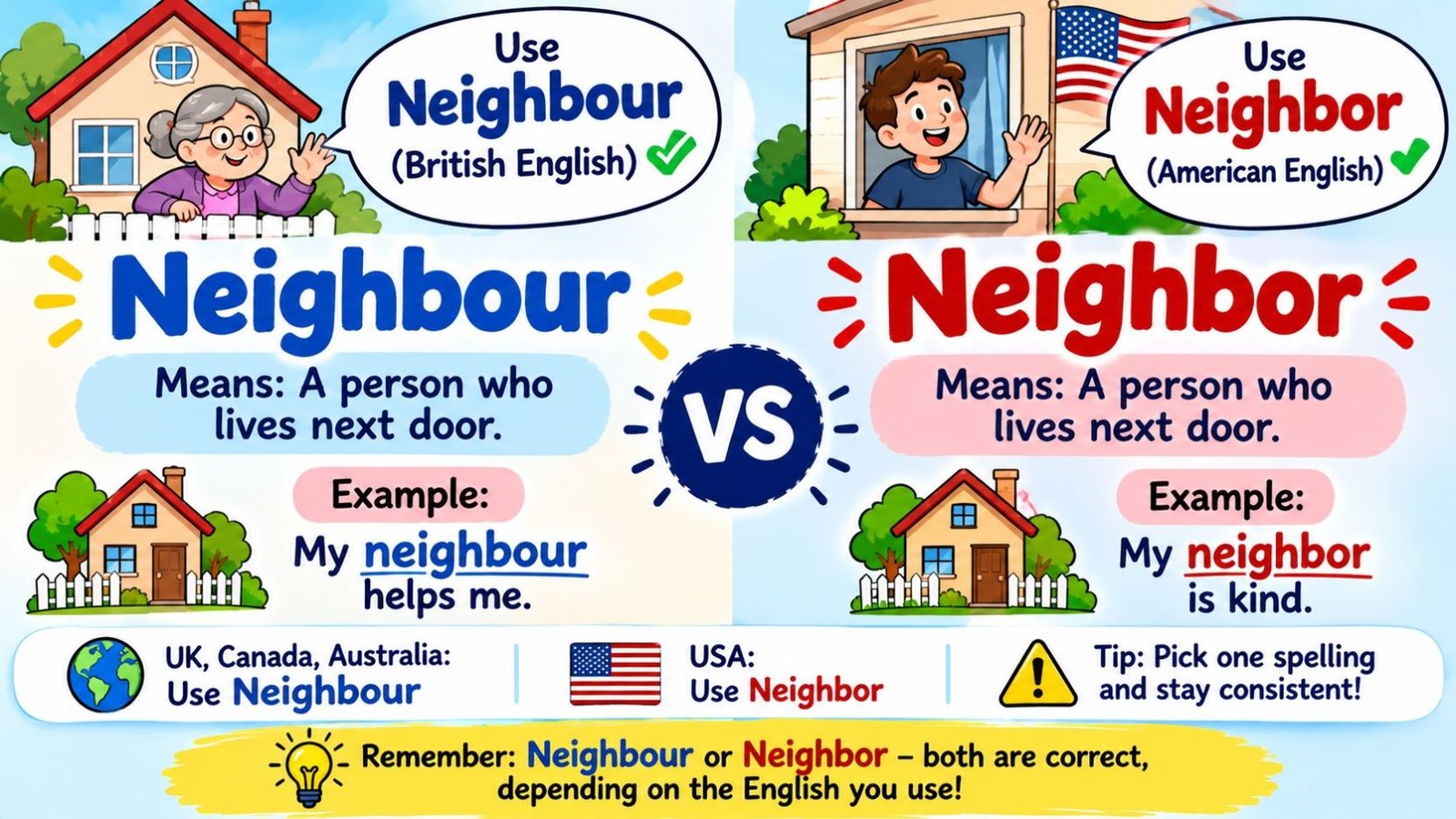
Both neighbour and neighbor are correct. The difference is not about right or wrong. It is about which English you are writing. Neighbour is the standard spelling in British English, Canadian English, and Australian English. Neighbor is the standard spelling in American English.
This small spelling difference confuses a lot of writers, especially when writing for an international audience or switching between British and American style guides. Understanding which form to use, and why the difference exists, makes your writing look more polished and consistent. It also helps you avoid the kind of small error that spell checkers sometimes miss.
Neighbour Or Neighbor: Quick Answer
If you are writing for a reader in the United States, use neighbor. If you are writing for a reader in the United Kingdom, Canada, Australia, New Zealand, Ireland, or most other English-speaking countries outside the US, use neighbour.
| Region | Correct Spelling |
| United States | Neighbor |
| United Kingdom | Neighbour |
| Canada | Neighbour |
| Australia | Neighbour |
| New Zealand | Neighbour |
| Ireland | Neighbour |
| South Africa | Neighbour |
Both spellings describe the exact same thing: a person who lives near you. The meaning never changes. Only the spelling changes based on regional English conventions.
Read More: Disregulated Or Dysregulated: Which One Is Actually Correct?
What Does Neighbour or Neighbor Mean?
A neighbour, or neighbor, is a person who lives close to you, often in the next house, apartment, or property. The word can also describe something that is located next to or near something else, not just people.
As a noun, it refers to:
- A person living in the house, flat, or property next to yours
- Someone living nearby in the same street or building
- A country, region, or object positioned close to another
As a verb, “to neighbour” or “to neighbor” means to be located next to something, or to be adjacent to it. This verb form is less common in everyday speech but still appears in formal or descriptive writing.
For example:
- “My neighbour waters my plants when I travel.” (person)
- “France neighbours Spain and Germany.” (adjacent, verb form)
Neighbour Or Neighbor: Which Is Correct?
Neither spelling is more correct than the other in an absolute sense. The correct choice depends entirely on which variety of English you are using.
✅ Correct in American English: neighbor, neighbors, neighboring, neighborhood
✅ Correct in British English: neighbour, neighbours, neighbouring, neighbourhood
❌ Incorrect: Mixing the two spellings within the same document. For example, writing “neighbour” in one sentence and “neighboring” in another creates an inconsistency that looks like a careless mistake, even though each word is spelled correctly on its own.
The safest rule is simple: pick one English variety for your entire document, then stay consistent with it from start to finish.
Why Are There Two Spellings?
The difference goes back to the work of American lexicographer Noah Webster in the early nineteenth century. Webster believed American English should have its own identity, separate from British spelling conventions inherited from England. In his dictionaries, he simplified many words that contained the letters “our,” dropping the “u” to create a shorter, more phonetic American form.
This is why American English uses:
- Color instead of colour
- Favor instead of favour
- Honor instead of honour
- Neighbor instead of neighbour
British English kept the older spelling pattern, which came from French influence on the English language after the Norman Conquest. Many “our” words in British English trace back to French words that ended in “-our” or similar patterns, and British English simply preserved that older form.
So neighbour or neighbor is really one small example of a much larger, well documented pattern of spelling differences between American and British English.
Origin Of The Word Neighbour
The word has much older roots than the American and British spelling split. It comes from Old English “neahgebur,” a combination of two parts:
- “Neah,” meaning near
- “Gebur,” meaning dweller or farmer
Put together, the word originally meant something close to “near dweller,” describing someone who lived close by, often in a farming or rural community. Over centuries, the spelling evolved through Middle English forms like “neghebor” before settling into the modern spellings used today.
This origin explains why the word has always carried a sense of physical closeness and community, not just a technical or legal meaning.
Grammar: Part Of Speech And Word Forms
Neighbour or neighbor is most commonly used as a noun, though it also works as a verb.
| Form | British English | American English |
| Singular noun | Neighbour | Neighbor |
| Plural noun | Neighbours | Neighbors |
| Verb (present) | Neighbours | Neighbors |
| Verb (present participle) | Neighbouring | Neighboring |
| Verb (past tense) | Neighboured | Neighbored |
| Adjective form | Neighbouring | Neighboring |
| Related noun | Neighbourhood | Neighborhood |
| Adverb-style phrase | Neighbourly | Neighborly |
Plural Form
The plural is formed the regular way, simply by adding an “s”:
- One neighbour, two neighbours (British)
- One neighbor, two neighbors (American)
There is no irregular plural. The word follows standard English pluralization rules in both spelling systems.
Using It as an Adjective
“Neighbouring” or “neighboring” works as an adjective to describe something close by or adjacent.
- “The neighbouring town has a large market on Sundays.” (British)
- “The neighboring town has a large market on Sundays.” (American)
Neighbourly or Neighborly
This adjective describes friendly, helpful, or considerate behavior typical of a good neighbour.
- “It was very neighbourly of her to bring soup when I was sick.” (British)
- “It was very neighborly of her to bring soup when I was sick.” (American)
How To Pronounce Neighbour Or Neighbor?
Despite the spelling difference, the pronunciation is nearly identical in both British and American English.
Pronunciation: NAY-bur
The word has two syllables. The first syllable, “neigh,” rhymes with the sound a horse makes, and with words like “weigh” or “sleigh.” The second syllable is a soft “bur” sound, similar to the ending of “labor” or “labour.”
There is no meaningful pronunciation difference between neighbour and neighbor. Regional accents may shift the vowel sound slightly, but the spelling variation itself does not change how the word sounds.
Read More: Tomorrow Vs Tommorrow: Which Spelling Is Correct?
Neighbour Or Neighbor By Country
United States
Neighbor is the only correct spelling in American English. This applies to all forms: neighbors, neighboring, neighborhood, and neighborly. American dictionaries, style guides, newspapers, and schools consistently use this spelling.
United Kingdom
Neighbour is the standard British spelling. UK publications, schools, and official documents use neighbour, neighbours, neighbouring, neighbourhood, and neighbourly.
Canada
Canadian English generally follows British spelling for words like this one, so neighbour is the standard and expected form in Canada. Canadian newspapers, government documents, and most style guides use neighbour rather than neighbor, even though Canadian English blends some American vocabulary and spelling elsewhere.
Australia
Australian English also follows British spelling conventions for this word. Neighbour is correct and standard across Australian writing, media, and education.
Other English Speaking Countries
Most other English speaking countries, including Ireland, New Zealand, South Africa, and India, generally follow British spelling and use neighbour rather than neighbor.
Common Mistakes With Neighbour or Neighbor
⚠️ Mixing spellings within one document
❌ Incorrect: “My neighbour helped me move, and my neighbors are always friendly.”
✅ Correct (British): “My neighbour helped me move, and my neighbours are always friendly.”
✅ Correct (American): “My neighbor helped me move, and my neighbors are always friendly.”
⚠️ Misspelling the related word “neighborhood” or “neighbourhood”
❌ Incorrect: “neighberhood” or “nieghbourhood”
✅ Correct (British): neighbourhood
✅ Correct (American): neighborhood
⚠️ Adding an unnecessary “u” in American English or removing it in British English
This usually happens when writers switch between reading British and American sources without noticing the spelling shift, or when autocorrect tools default to one region without the writer realizing it.
💡 Tip: If you are unsure which spelling your document should use, check your word processor’s language setting. Setting the document language to “English (US)” or “English (UK)” will make spell check flag the wrong regional spelling automatically.
Neighbour Or Neighbor In A Sentence
Here are natural examples showing the word used in everyday context.
British English (neighbour):
- “Our new neighbour just moved in last week.”
- “She has a good relationship with her neighbours.”
- “The neighbouring house has been empty for months.”
- “Being neighbourly, he offered to cut her grass.”
American English (neighbor):
- “Our new neighbor just moved in last week.”
- “She has a good relationship with her neighbors.”
- “The neighboring house has been empty for months.”
- “Being neighborly, he offered to cut her grass.”
Notice that the sentences are identical in structure and meaning. Only the spelling of the key word changes based on regional English.
Synonyms And Related Words
While neighbour or neighbor has no exact one-word synonym, several related words describe similar ideas depending on context.
| Word | Meaning | Difference From Neighbour or Neighbor |
| Neighboring resident | A person who lives nearby | More formal, often used in legal or official writing |
| Next-door neighbour or next-door neighbor | Someone in the immediately adjacent home | More specific, refers to direct proximity |
| Fellow resident | Someone who shares the same building or area | Broader, does not imply close proximity |
| Adjacent | Located next to something | Not used for people, only places or objects |
Unlike some synonym pairs, these words are not interchangeable in every context. “Neighbour” or “neighbor” carries a warmer, more personal tone, often tied to community and everyday relationships, while words like “adjacent” or “fellow resident” sound more formal or technical.
Cultural And Everyday Context
The word appears often in everyday speech, but it also shows up in well known cultural references. The phrase “love thy neighbour” or “love thy neighbor,” rooted in a widely recognized biblical teaching, uses the older, more formal “thy” and reflects how deeply the concept of neighbourly kindness is tied to community values across English speaking cultures.
The word also appears in popular titles and phrases such as neighbourhood watch programs, children’s shows, and idiomatic expressions about being a “good neighbour” or “good neighbor,” meaning someone considerate, helpful, and easy to live near.
Read More: It’s Called Vs It Called: Which One Is Correct?
Neighbour Or Neighbor: Side-by-Side Comparison
| Feature | British Spelling | American Spelling |
| Noun (singular) | Neighbour | Neighbor |
| Noun (plural) | Neighbours | Neighbors |
| Verb form | Neighbours, neighboured | Neighbors, neighbored |
| Adjective | Neighbouring | Neighboring |
| Related noun | Neighbourhood | Neighborhood |
| Adjective (friendly) | Neighbourly | Neighborly |
| Pronunciation | NAY-bur | NAY-bur |
| Used in | UK, Canada, Australia, Ireland, NZ | United States |
Frequently Asked Questions
Is it neighbour or neighbor?
Both are correct. Neighbour is British spelling, and neighbor is American spelling. The choice depends on which English variety you are writing in.
What does neighbour or neighbor mean?
It means a person who lives near you, often in the next house or nearby property. It can also describe something located close to something else.
Which spelling is used in Canada, neighbour or neighbor?
Canada generally uses neighbour, following British spelling conventions, even though Canadian English mixes in some American vocabulary elsewhere.
Which spelling is used in Australia, neighbour or neighbor?
Australia uses neighbour, following British English spelling.
How do you pronounce neighbour or neighbor?
Both spellings are pronounced the same way, as NAY-bur. The spelling difference does not affect pronunciation.
Is neighbour a noun or a verb?
It can be both. As a noun, it means a person who lives nearby. As a verb, it means to be located next to or adjacent to something.
What is the plural of neighbour or neighbor?
The plural is formed regularly by adding an “s”: neighbours in British English, and neighbors in American English.
Why does American English spell it neighbor without a u?
This comes from Noah Webster’s efforts in the early 1800s to simplify American spelling and separate it from British conventions, which removed the “u” from many words ending in “-our.”
Is neighbourhood or neighborhood the correct spelling?
Both are correct, depending on region. Neighbourhood is British spelling, and neighborhood is American spelling, following the same pattern as neighbour and neighbor.
Can I use neighbour and neighbor in the same document?
It is best to avoid this. Pick one spelling system based on your target audience or style guide, and use it consistently throughout the entire document.
Conclusion
Neighbour or neighbor is not a question of right versus wrong. It is a question of regional English. Neighbour is the standard form in British, Canadian, Australian, and most other varieties of English outside the United States, while neighbor is the standard American spelling. Both words carry the same meaning, describing a person who lives nearby or something located close to something else, and both are pronounced the same way regardless of spelling.
The most important habit to build is consistency. Choose the spelling that matches your audience or your style guide, then use it throughout every related word, including neighbours or neighbors, neighbouring or neighboring, and neighbourhood or neighborhood. Getting this small detail right makes your writing look more careful, more professional, and more tailored to the reader you are actually writing for

Zunaira Qasim is the author and creator of Gramvixo, dedicated to making English grammar easier for learners and everyday writers. With 4 years of experience researching grammar, confusing words, word choices, and common language mistakes, they create clear and practical content that helps readers understand English and use it with confidence.



One Comment