
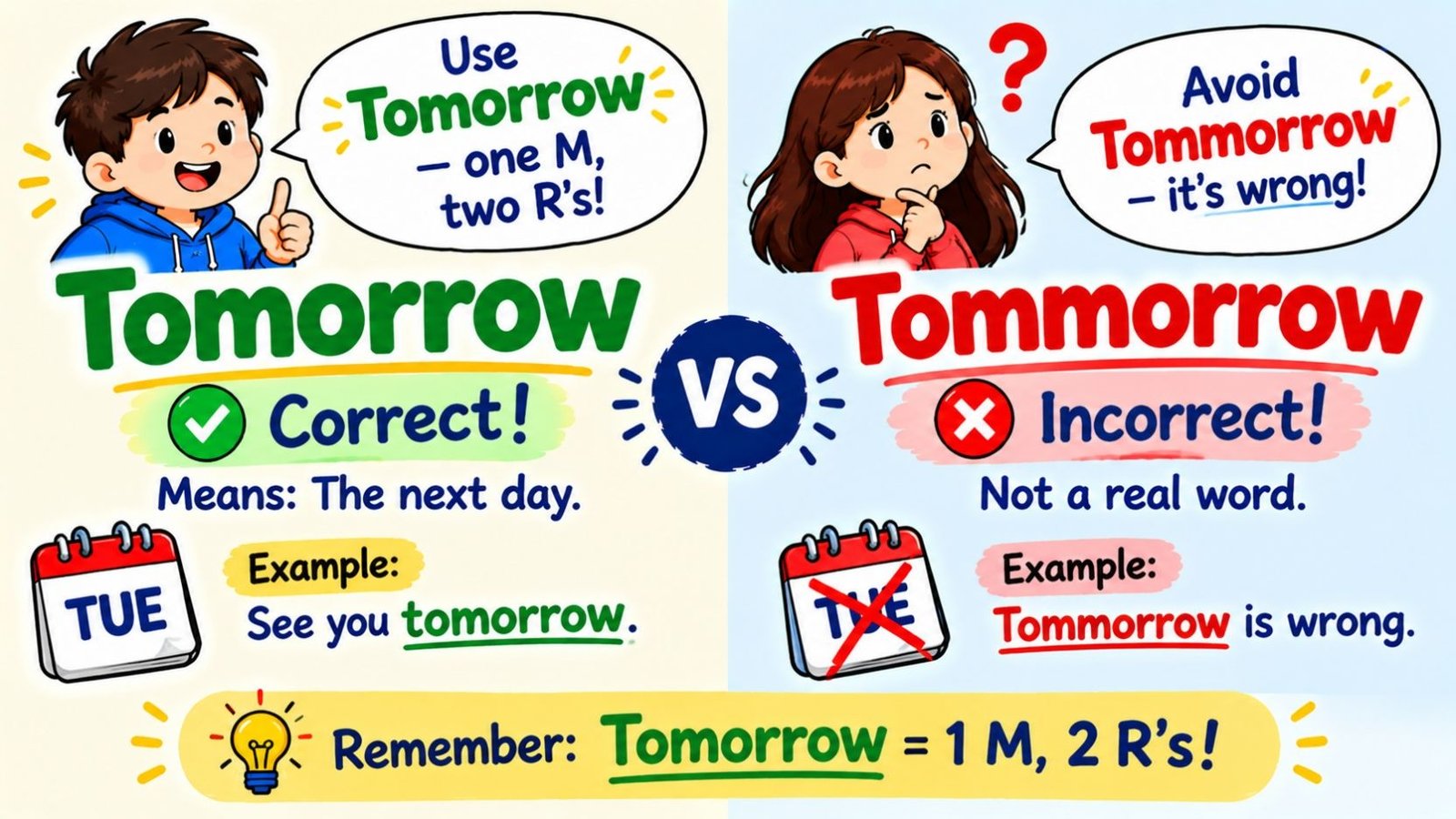
Many people search for tomorrow vs tommorrow because the second spelling shows up so often online. Only one of these two spellings is actually correct in standard English. This guide explains the right spelling and why it matters.
Getting this word right matters for schoolwork, emails, and everyday writing. A single extra letter can make a word look careless or unclear to a reader. Understanding tomorrow vs tommorrow helps you write with more confidence every day.
Tomorrow Vs Tommorrow: The Simple Answer
The correct spelling is tomorrow, with one letter M and one letter R after the O. The spelling tommorrow is incorrect and does not appear in any standard dictionary. It is one of the most common typing mistakes in English.
| Spelling | Status | Why |
| Tomorrow | Correct | Standard dictionary spelling in all English varieties |
| Tommorrow | Incorrect | Extra letter M added by mistake, not a real word |
What Does Tomorrow Mean?
Tomorrow has a simple, everyday meaning that most people already know. It refers to the day that comes right after today. It is one of the most commonly used time words in the entire English language.
Meaning 1: The next calendar day
This is the most basic meaning of the word. If today is Monday, then tomorrow means Tuesday. This meaning applies in calendars, schedules, weather reports, and daily conversation across nearly every English-speaking country.
Meaning 2: The near future in a general sense
Tomorrow can also describe the future in a broader, less exact way. A sentence like the leaders of tomorrow does not mean the next day literally. It refers to people or events that belong to the future generally.
Read More: Unkept Or Unkempt: Which Word Is Correct?
Grammar: What Part of Speech Is Tomorrow?
Tomorrow can work as more than one part of speech, depending on how it is placed in a sentence. This flexibility is part of why the word feels so natural and common in everyday English writing and speech.
- As an adverb: I will call you tomorrow.
- As a noun: Tomorrow is a new day.
- As an adjective (informal use): the tomorrow generation.
Most everyday sentences use tomorrow as an adverb or a noun. The adjective use is far less common and usually appears in creative writing, marketing language, or titles rather than in standard formal English.
How Do You Pronounce Tomorrow?
Tomorrow is pronounced with three syllables and a clear stress on the middle syllable. In simple terms, it sounds like tuh MOR oh. The second syllable carries the main weight of the word when spoken aloud.
In the International Phonetic Alphabet, this is written as /təˈmɒr.oʊ/ in American English. British English speakers often pronounce the vowel slightly differently, but the stress pattern on the middle syllable stays the same.
Origin of the Word Tomorrow
Tomorrow comes from Middle English, formed by combining to and morrow. Morrow itself is an older English word that simply meant morning or the next day. Over time, these two smaller words merged into the single word we use now.
This origin explains the double letters in the correct spelling. The word keeps a trace of morrow inside it, which is why it needs both an R and a following sound pattern that people often get wrong when typing quickly.
Read More: Stent Vs Stint: What Is The Difference And How Do You Use Each Word Correctly
Why Do People Misspell It as Tommorrow?
The mistake usually happens because of how the word sounds when spoken quickly. Speakers do not clearly separate every letter sound, so writers guess at the spelling based on rhythm instead of the word’s actual structure.
⚠️ Common mistake pattern: writers often double the wrong letter. Instead of doubling the R, as in tomorrow, they mistakenly double the M, producing the incorrect form tommorrow. This is a simple letter order mix up.
✅ A helpful memory trick is to remember that tomorrow has one M and two Rs, not two Ms and one R. Thinking of the word morrow hidden inside tomorrow can also help you remember the correct spelling pattern.
Correct vs Incorrect Usage
| Type | Example |
| ❌ Incorrect | See you tommorrow at the office. |
| ✅ Correct | See you tomorrow at the office. |
| ❌ Incorrect | Tommorrow is going to be a busy day. |
| ✅ Correct | Tomorrow is going to be a busy day. |
Tomorrow In Everyday Sentences
Seeing the word used correctly in real sentences can help the correct spelling feel more natural over time. Below are a few simple examples that show tomorrow used in common, everyday situations that most people encounter.
- The meeting has been moved to tomorrow morning.
- What is the weather tomorrow supposed to be like?
- I still need to finish this report by tomorrow.
- Tomorrow marks the start of a new work week.
Common Phrases And Searches With Tomorrow
The word tomorrow appears in many everyday questions and phrases beyond simple scheduling. People frequently search for information tied to a specific day just ahead of today, using tomorrow as the anchor word in the phrase.
Common examples include questions like what is tomorrow, is tomorrow a holiday, and what is the weather tomorrow. Sports fans also search for phrases such as NFL games tomorrow or NBA games tomorrow when checking upcoming schedules.
Because these results change daily, this article focuses on the word itself rather than specific dates, scores, or forecasts. For real time information, a live weather site, sports schedule, or search engine will give the current answer.
Tomorrow in Pop Culture And Titles
The word tomorrow shows up often in movie titles, book titles, and famous quotations, which adds to its search popularity. These titles use the word in a symbolic or future looking sense rather than a literal calendar meaning.
- The Tomorrow War: a science fiction film about a future conflict.
- Edge of Tomorrow: an action film built around repeating the same day.
- The Day After Tomorrow: a disaster film centered on sudden climate change.
- Tomorrow and Tomorrow and Tomorrow: a well known phrase from Shakespeare’s Macbeth, later used as the title of a popular novel by Gabrielle Zevin.
In each of these cases, the spelling tomorrow stays the same as in everyday English. Only the surrounding words or story change. None of these titles ever use the incorrect spelling tommorrow in any official version.
Read More: Prouder Or More Proud: Which One Is Actually Correct?
Synonyms And Related Words
| Word | Meaning | Difference From Tomorrow |
| The next day | The day right after a stated day | More formal, often used in writing about past events |
| The following day | The day after a specific mentioned day | Common in stories or reports about past events |
| The morrow | An older, poetic word for tomorrow | Rarely used today outside of literature or formal poetry |
Frequently Asked Questions
Is tommorrow a real word?
No, tommorrow is not a real word in standard English. It is a common misspelling. The only correct spelling is tomorrow, with a single M and two R letters.
How many R’s are in tomorrow?
Tomorrow has two R letters and only one M letter. This letter pattern is the exact opposite of what many people accidentally type when writing the word quickly.
Is tomorrow one word or two words?
Tomorrow is always written as a single word. It should never be split into two separate words or joined with a hyphen in standard modern English writing.
What part of speech is tomorrow?
Tomorrow is usually an adverb or a noun. It works as an adverb in sentences like call me tomorrow, and as a noun in sentences like tomorrow will be sunny.
How do you spell tomorrow correctly?
The correct spelling is T O M O R R O W. Remember it as one M followed later by two R letters, which many writers accidentally reverse when typing fast.
Why is tomorrow spelled with two R’s?
The double R comes from the word’s history. Tomorrow formed from to plus morrow, and morrow already contained two R sounds, which carried over into the modern spelling.
What does tomorrow mean in a sentence?
In most sentences, tomorrow simply means the day that comes right after today. For example, tomorrow is Friday means the next calendar day will be a Friday.
Can tomorrow be used as an adjective?
Yes, though rarely in formal writing. Phrases like tomorrow’s weather or the tomorrow generation use it in an adjective like way, describing something connected to the future.
Is tommorrow used anywhere correctly?
No official dictionary, style guide, or standard source lists tommorrow as a correct spelling in any context. It should always be corrected to tomorrow when it appears.
What is a simple trick to remember the spelling?
Think of the hidden word morrow inside tomorrow. If you remember tomorrow equals to plus morrow, the correct double R pattern becomes much easier to recall while writing.
Conclusion
The comparison of tomorrow vs tommorrow has one clear answer. Tomorrow is the only correct spelling, while tommorrow is a common typing mistake with no place in standard dictionaries or accepted English writing.
Remembering that tomorrow comes from to plus morrow can make the correct spelling easier to recall in the future. With this simple structure in mind, writing tomorrow correctly becomes second nature in everyday communication.

Zunaira Qasim is the author and creator of Gramvixo, dedicated to making English grammar easier for learners and everyday writers. With 4 years of experience researching grammar, confusing words, word choices, and common language mistakes, they create clear and practical content that helps readers understand English and use it with confidence.
2 Comments