
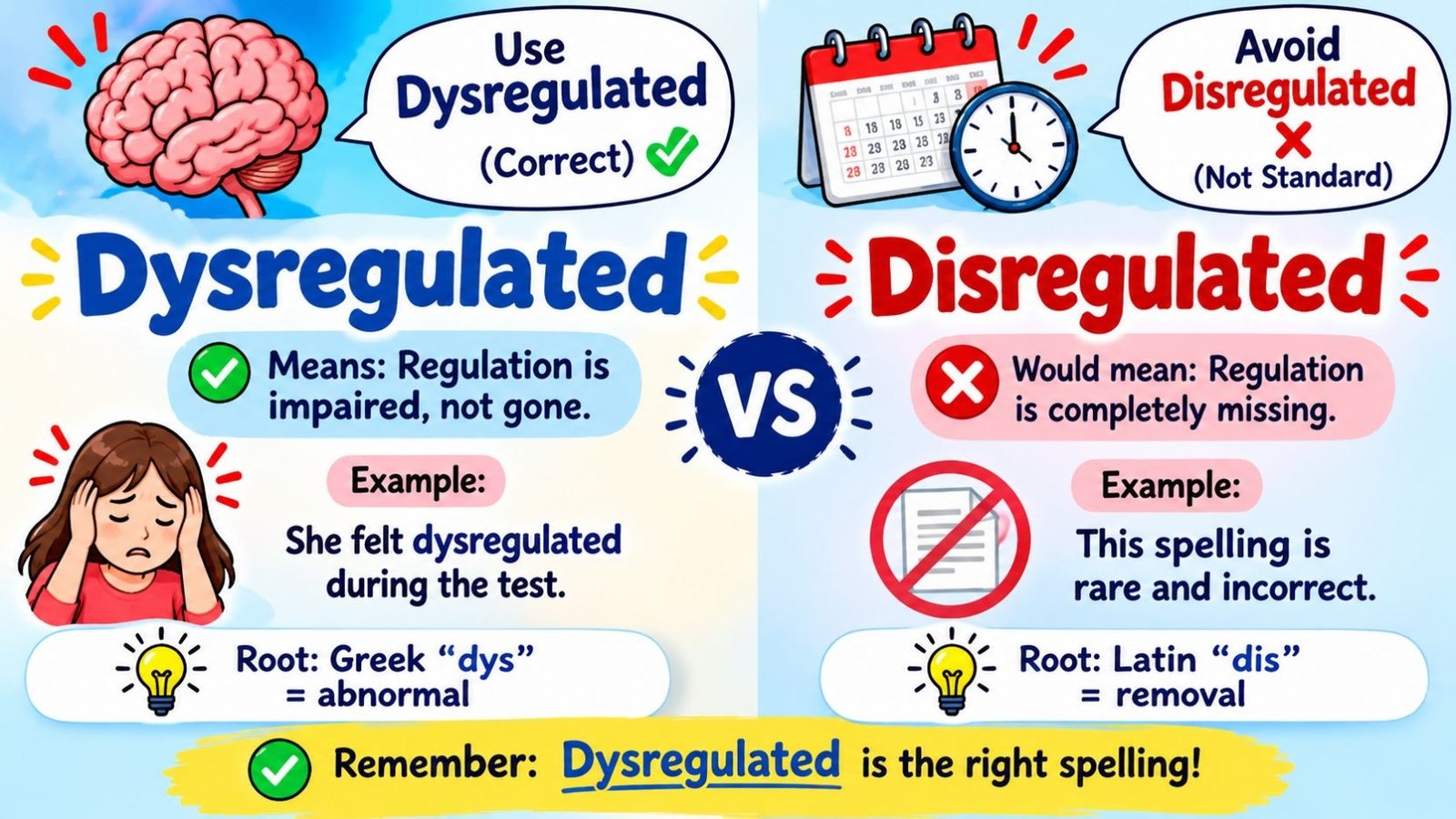
If you have typed this word into a search bar and paused, wondering which spelling looks right, you are not alone. Dysregulated is the correct word in standard English. It describes a system, emotion, or bodily process that has lost its normal balance and is no longer working the way it should.
Disregulated shows up often in casual writing, text messages, and even some articles online. It is not a recognized word in major dictionaries. Understanding why one spelling wins over the other will help you write with confidence, especially when you are talking about emotions, the nervous system, or mental health.
What Does Dysregulated Mean?
Dysregulated means something that is not being controlled or managed properly anymore. The system is still active, but it has stopped working in a stable or balanced way.
This word usually describes:
- Emotions that feel too big, too fast, or hard to control
- A nervous system that overreacts to normal situations
- A body process, like blood sugar or hormone levels, that no longer self corrects
- Behavior that becomes unpredictable under stress
You will hear this word most often in psychology, medicine, parenting conversations, and trauma recovery spaces. A therapist might say a client became dysregulated during a session, meaning their emotional state spiked and they struggled to calm back down.
Read More: It’s Called Vs It Called: Which One Is Correct?
Is It Disregulated Or Dysregulated?
The short answer: dysregulated is correct. Disregulated is not considered standard English.
Here is why the confusion happens. Both words sound almost identical when spoken aloud. Both seem to follow a logical pattern, since English has many words that start with “dis,” such as disconnected, disorganized, and disagree. It feels natural to assume “disregulated” should work the same way.
But the prefix matters here, and it changes the meaning at the root of the word.
| Term | Status | Meaning |
| Dysregulated | Correct, standard word | A system is functioning, but poorly or abnormally |
| Disregulated | Not standard, rarely used | Would suggest regulation has been removed entirely |
Major dictionaries, including Merriam-Webster and Oxford, list dysregulated. They do not treat disregulated as an accepted entry. If you are writing an essay, a clinical note, a blog post, or even a text to a friend about your own emotional state, dysregulated is the word that will read as correct.
Disregulated Or Dysregulated: Why The Prefix Changes Everything
English borrows prefixes from different source languages, and that is the actual root of this confusion.
Dys- comes from Greek. It means bad, difficult, or abnormal. You already know this prefix from other words:
- Dysfunction, meaning something is not working correctly
- Dyslexia, a difficulty with reading and language processing
- Dystrophy, a weakening or wasting of tissue
- Dyspnea, difficult or labored breathing
In every one of these words, the underlying system is still present and active. It is simply not working the way it should. That is exactly the idea behind dysregulated. Your nervous system, your emotions, or your hormones have not disappeared. They have gone off track.
Dis- comes from Latin. It generally means the removal, reversal, or absence of something. You can see this pattern clearly:
- Disconnect, meaning a connection has been broken
- Disengage, meaning involvement has stopped
- Disorganized, meaning organization is missing
If “disregulated” followed this logic consistently, it would suggest regulation has been taken away completely, similar to how a deregulated industry has had its oversight rules removed. That is a different idea from what people usually mean when they talk about a dysregulated nervous system or dysregulated emotions.
So while “disregulated” is not entirely nonsensical in theory, it does not match the meaning that writers, therapists, and researchers actually intend. That mismatch is a big part of why dictionaries have not adopted it as standard vocabulary.
Dysregulated vs Disregulated: A Quick Comparison
| Feature | Dysregulated | Disregulated |
| Dictionary status | Recognized standard word | Not recognized in major dictionaries |
| Prefix origin | Greek “dys,” meaning abnormal | Latin “dis,” meaning absence or removal |
| Common use | Psychology, medicine, education, everyday writing | Rare, mostly informal or accidental |
| Implied meaning | Regulation exists but is impaired | Would imply regulation is missing entirely |
| Recommended usage | Use in all contexts | Avoid in formal or professional writing |
Emotionally Dysregulated: What This Phrase Really Means
“Emotionally dysregulated” is one of the most searched versions of this word, and for good reason. It describes a very specific and common experience.
When someone is emotionally dysregulated, their feelings become intense fast, and they struggle to bring themselves back to a calm state. This can look like:
- Crying suddenly over something small
- Snapping in anger during a minor disagreement
- Feeling panic that seems disconnected from the actual situation
- Shutting down completely and going quiet under stress
This is not the same as simply being upset. Everyone gets upset sometimes and recovers within minutes. Emotional dysregulation describes a pattern where the return to calm takes much longer, or does not happen easily at all.
It is a term used often when discussing ADHD, autism, anxiety disorders, trauma responses, and certain mood conditions, though it can also describe a temporary state that anyone experiences during a hard week.
Disregulated or Dysregulated Nervous System
A dysregulated nervous system is another phrase that shows up constantly in wellness and trauma recovery spaces, and it deserves a clear explanation.
Your nervous system has two main modes. One helps you respond to danger or stress, often called fight, flight, or freeze. The other helps you rest, digest, and recover. In a balanced nervous system, you move between these modes smoothly depending on what is happening around you.
A dysregulated nervous system struggles to make that shift. It might get stuck in a high alert state even when nothing dangerous is happening, or it might shut down and feel numb during moments that call for full presence. Common signs people describe include:
- Feeling on edge or jumpy without a clear reason
- Trouble falling asleep even when exhausted
- A racing heart during ordinary daily tasks
- Feeling foggy, disconnected, or emotionally flat
- Overreacting to small stressors, then feeling drained afterward
This state can develop after prolonged stress, chronic overwhelm, or difficult past experiences. It is not a character flaw. It reflects how the body has learned to respond to its environment over time.
Disregulated HPA Axis
You may also come across the phrase “dysregulated HPA axis” in articles about stress and hormones. The HPA axis stands for the hypothalamic pituitary adrenal axis, a communication pathway between your brain and your adrenal glands. It controls how your body releases cortisol, the main stress hormone.
When this system is working normally, cortisol rises during stress and falls again once the stress passes. A dysregulated HPA axis means that rhythm has broken down. Cortisol might stay elevated too long, drop too low, or spike at the wrong times of day. This is studied in connection with chronic stress, certain mood disorders, and long-term burnout.
Read More: Unkept Or Unkempt: Which Word Is Correct?
How To Pronounce Dysregulated?
Dysregulated is pronounced dis-REG-yoo-lay-ted.
The stress falls on the second syllable, “REG.” Even though the word begins with “dys,” most speakers pronounce that first syllable the same way they would say “dis,” which is part of why the spelling mix-up happens so often. Your ear hears “dis,” but your hand should still type “dys.”
Grammar Of Dysregulated: Part Of Speech And Word Forms
Dysregulated is most commonly used as an adjective. It describes a noun, telling you something about the state of a person, system, or process.
Examples:
- A dysregulated response
- A dysregulated child
- A dysregulated immune system
It can also function as the past participle of the verb “to dysregulate,” used after helping verbs like “has,” “was,” or “became.”
Examples:
- Her mood has dysregulated throughout the week.
- The system became dysregulated after the policy change.
Here are the related word forms you will run into:
| Word Form | Type | Example |
| Dysregulate | Verb (base form) | Chronic stress can dysregulate the nervous system. |
| Dysregulated | Adjective / past participle | He felt completely dysregulated after the meeting. |
| Dysregulation | Noun | Emotional dysregulation is common during adolescence. |
| Dysregulating | Present participle | The noise was dysregulating for the whole classroom. |
Dysregulated In A Sentence: Clear Examples
Seeing the word used naturally makes it easier to remember correctly.
- The toddler became dysregulated after skipping his nap.
- Chronic stress can leave the immune system dysregulated over time.
- She noticed her sleep schedule was dysregulated during finals week.
- His blood sugar stayed dysregulated despite the medication adjustment.
- The therapist helped him recognize when he felt dysregulated so he could pause before reacting.
Notice that in each sentence, something is still functioning. It has simply lost its normal rhythm or balance.
Dysregulated vs Unregulated vs Deregulated
These three words get mixed up often because they look and sound related, but they describe very different situations.
| Word | Meaning | Example |
| Dysregulated | Regulation exists but is impaired or abnormal | A dysregulated nervous system overreacts to stress |
| Unregulated | No regulation has ever existed | An unregulated industry has no official oversight rules |
| Deregulated | Regulation existed before and was intentionally removed | The airline industry became deregulated in the late twentieth century |
Understanding this difference matters because these words are not interchangeable, even though writers sometimes use them as if they were. A dysregulated system is trying to regulate itself and failing. An unregulated system was never being controlled in the first place. A deregulated system had rules that were later taken away on purpose.
Common Mistakes When Using This Word
❌ Incorrect: The child seemed disregulated after the long car ride.
✅ Correct: The child seemed dysregulated after the long car ride.
❌ Incorrect: Her hormones have been disregulated since the surgery.
✅ Correct: Her hormones have been dysregulated since the surgery.
❌ Incorrect: Is dysregulated the same as unregulated?
✅ Correct: No. Dysregulated means impaired control, while unregulated means no control has ever existed.
A simple trick to remember the correct spelling: think of other “dys” words that describe something not working properly, such as dysfunction, dyslexia, and dysphoria. If the word describes a system that still exists but is struggling, “dys” is almost always the right choice.
Is Disregulated A Word At All?
Not in any meaningful, dictionary recognized sense. It occasionally appears in older behavioral science writing and in casual online posts, where it seems to describe behavior that falls outside expected norms rather than a malfunctioning internal system. This is a slightly different and much less common use, and it is not something style guides or major dictionaries currently support.
If you type “disregulated” into a word processor, most spell checkers will flag it. If you say it out loud in a clinical or academic setting, it may come across as a spelling slip rather than intentional word choice. For any writing meant to be taken seriously, whether that is a school paper, a medical note, or a professional article, dysregulated is the safer and more accurate choice.
Disregulated Or Dysregulated In The UK
This is not a regional spelling difference the way “colour” and “color” are different between American and British English. Both American and British English dictionaries agree that dysregulated is the standard spelling. British psychology and medical journals use “dysregulated” and “dysregulation” the same way American sources do. If you searched “disregulated or dysregulated UK” hoping for a regional exception, there is not one. The Greek root “dys” carries the same spelling across both varieties of English.
Origin Of The Word Dysregulated
The word builds on “regulate,” which comes from the Latin word regulare, meaning to control or direct according to a rule. English speakers have used “regulate” and “regulation” for centuries, particularly in law, government, and science.
The prefix “dys” was added later, borrowing from Greek roots already common in medical and scientific terminology. This pattern matches how many clinical terms are formed in English, where a Greek prefix combines with an existing English or Latin based root to describe a specific kind of dysfunction.
“Dysregulation” became especially common in psychology and endocrinology during the twentieth century, as researchers needed precise language to describe systems, like hormone levels or emotional responses, that were active but not properly balanced.
Read More: Tomorrow Vs Tommorrow: Which Spelling Is Correct?
Frequently Asked Questions
Is it disregulated or dysregulated?
Dysregulated is correct. Disregulated is not recognized as a standard word in major dictionaries.
What does dysregulated mean in simple terms?
It means something, often an emotion, behavior, or bodily process, is not working in a stable or balanced way anymore.
Is dysregulated a real word?
Yes. Dysregulated appears in Merriam-Webster, Oxford, and other major dictionaries, and it is used regularly in medical and psychological writing.
What is a dysregulated nervous system?
It describes a nervous system that struggles to move smoothly between alert states and calm, rested states, often staying stuck in one or the other.
What causes a dysregulated nervous system?
Prolonged stress, trauma, chronic overwhelm, and certain health conditions can all contribute to a nervous system losing its normal balance.
What does it mean to be emotionally dysregulated?
It means emotional reactions feel intense and fast, and it takes longer than usual to return to a calm state afterward.
How do you spell dysregulated?
D Y S R E G U L A T E D. The key detail to remember is the “dys,” not “dis,” at the start.
What is the difference between dysregulated and unregulated?
Dysregulated means regulation exists but is not working properly. Unregulated means there was never any regulation to begin with.
How do you calm a dysregulated child?
Common approaches include staying calm yourself, lowering your voice, giving the child space to settle, and offering simple, predictable routines. A pediatrician or child therapist can offer guidance suited to a specific situation.
Can adults be dysregulated too?
Yes. While the word appears often in conversations about children, adults experience emotional and nervous system dysregulation as well, especially during high stress periods.
Final Thoughts
Dysregulated is the word you want, whether you are describing a racing nervous system, an overwhelmed child, or a hormone imbalance that will not settle down. The spelling comes from the Greek prefix “dys,” meaning abnormal or impaired, which fits the idea of a system that still exists but has lost its balance. Disregulated, despite looking like a reasonable option, has not earned a place in standard dictionaries and is best avoided in careful writing.
Next time you sit down to write about emotions, stress, or any system that has gone off track, you can reach for dysregulated with full confidence. It is the accurate, widely recognized term used by psychologists, doctors, and writers across both American and British English, and it says exactly what you mean.

Zunaira Qasim is the author and creator of Gramvixo, dedicated to making English grammar easier for learners and everyday writers. With 4 years of experience researching grammar, confusing words, word choices, and common language mistakes, they create clear and practical content that helps readers understand English and use it with confidence.



One Comment